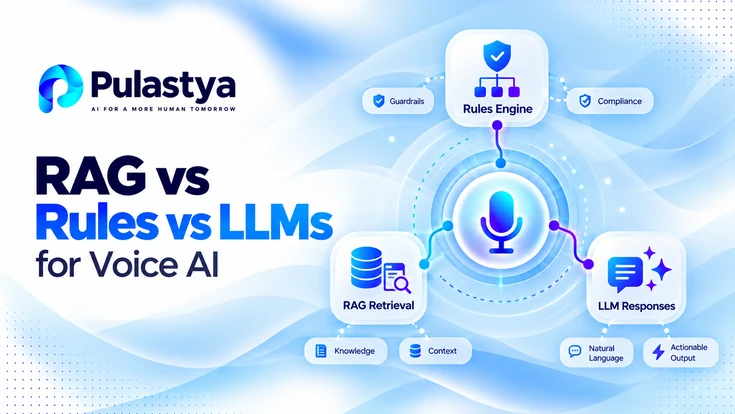
Selecting a voice AI architecture requires a clear separation of responsibilities: which component handles intent detection, which enforces business rules, and which generates conversational text.
Rule engines, large language models, and retrieval augmented generation each suit different voice use cases, and enterprise teams designing production voice agents must weigh them for reliability, compliance, and measurable business outcomes.
- Responsibility separation Keep business rules and compliance enforcement in deterministic components; use LLMs for language understanding and high-variance generation only when bounded.
- Use RAG for knowledge accuracy RAG limits hallucination by grounding generative output in retrieved enterprise documents, transcripts, and policy sections.
- Measure operational tradeoffs Design for latency, cost per call, and observability; favor hybrid approaches where rules mitigate risk and LLMs improve user satisfaction.
Voice AI projects fail when teams conflate control logic with generative output. Rule engines deliver predictable paths and compliance enforcement; LLMs provide open-ended language understanding and generation; RAG blends knowledge retrieval with constrained generation to surface accurate, context-aware responses.
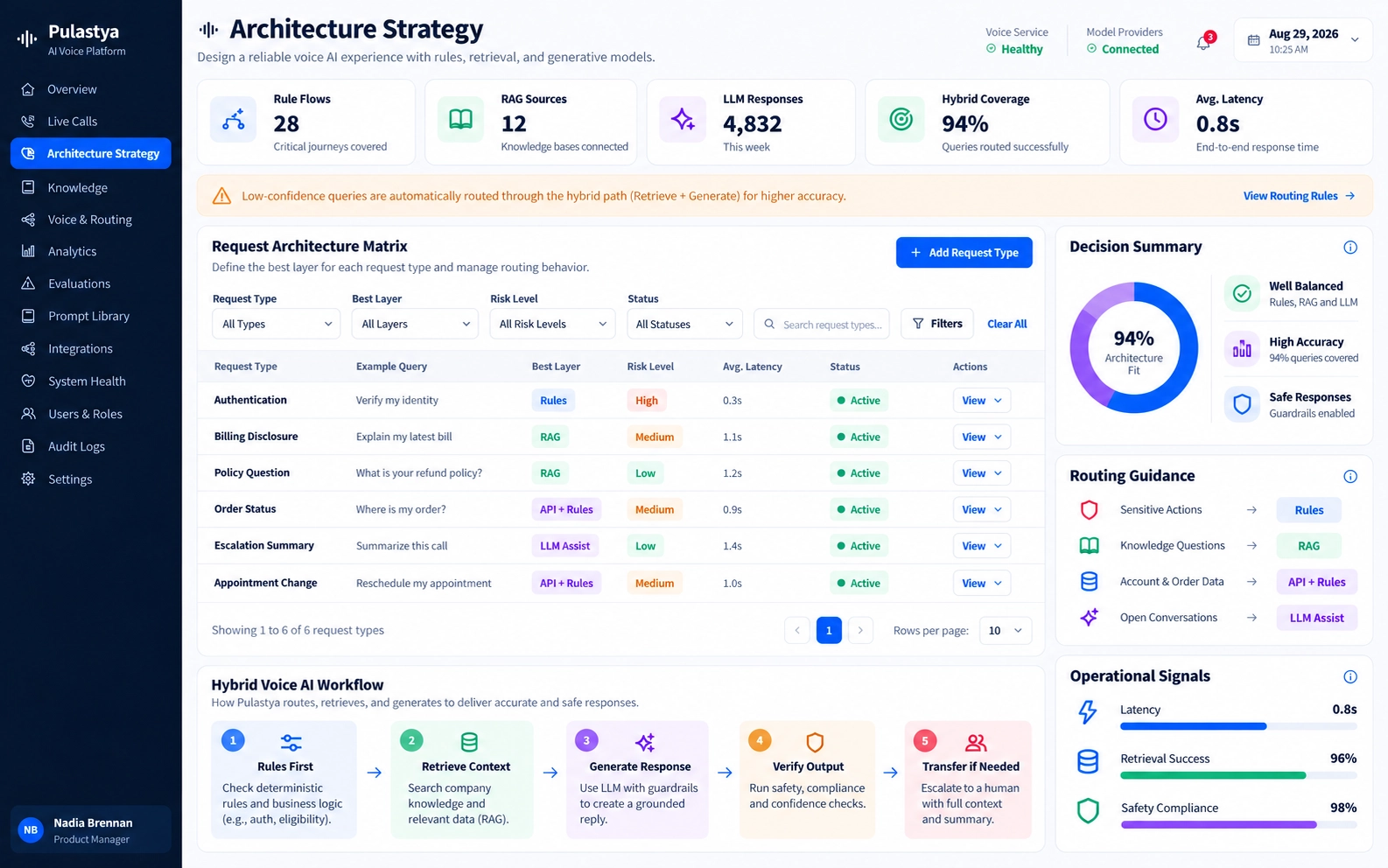
Each has strengths, failure modes, and operational tradeoffs that matter in deployment: latency budgets, data governance, fallback strategies, and monitoring.
These choices assume a production contact center or voice assistant environment with defined intent taxonomies, SLA targets, and regulatory constraints. In that setting, teams need concrete design choices, clean integration with telephony stacks and dialog manager components, and a clear split of responsibilities between rules, retrieval, and LLMs to control risk while improving resolution rates.
Compare Architectures: Rules, LLMs, and RAG
Rule-based systems follow explicit decision trees and slot-filling flows. They excel at enforceable policies, verifiable outcomes, and minimal runtime variability. For enterprise voice, rules implement authentication checks, routing logic, and regulatory disclosures.
Development uses domain specialists who encode pathways, then QA verifies every branch against acceptance criteria. Expect slow iteration on new intents but high predictability for compliance audits.
LLM-driven agents handle open language and unscripted dialogs by mapping utterances to intents, extracting slots, and generating responses. LLMs reduce scripting overhead and can improve customer experience for ambiguous queries.
LLM outputs vary with prompt design and context. Without constraints, LLMs risk producing incorrect or noncompliant language, so enterprises must pair them with guardrails, human-in-the-loop review, and robust monitoring.
RAG combines a retrieval layer that fetches relevant documents or snippets with a generative model that composes answers based on that retrieved context. In voice, RAG is most useful where precise knowledge is required from internal policies, product manuals, or past call transcripts.
Properly built, RAG reduces hallucination compared with unconstrained LLMs by instructing the model to answer only from retrieved content, while still offering flexible natural language answers.
The practical decision is made per request type, not once for the whole agent:
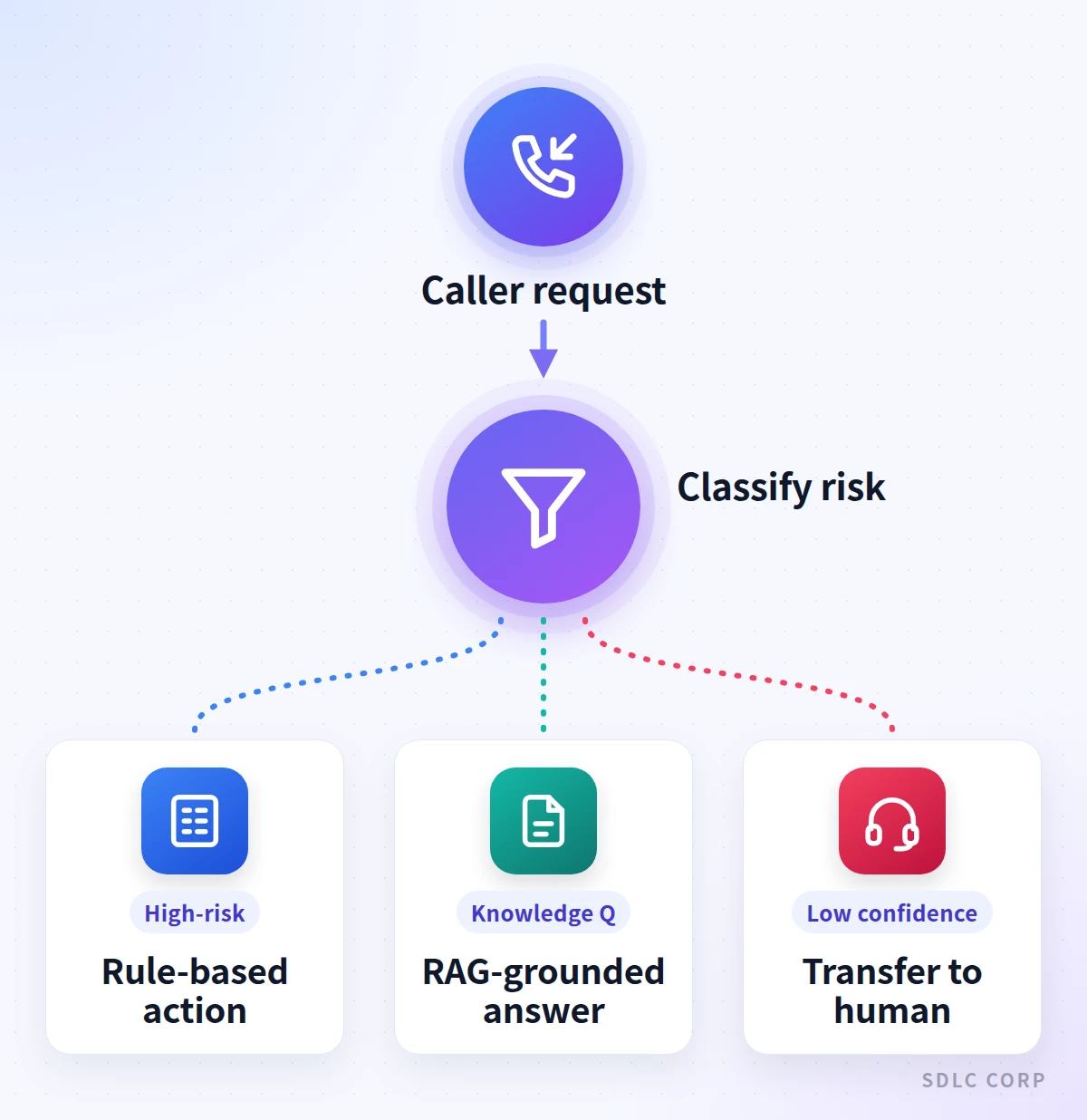
- Actions with legal, financial, or security impact such as authentication, payments, consent capture, and required disclosures: use rules, because every branch must be predictable and auditable.
- Questions answered by approved documents such as policies, product details, and procedures: use RAG, so answers stay tied to a current, citable source.
- Live, caller-specific data such as a balance or order status: call the system of record through an API inside a rules-controlled flow, never from memory or an index.
- Low-risk language work such as clarifying questions, rephrasing, and handoff summaries: an LLM on its own is acceptable when it cannot trigger actions.
For a deeper look at the grounding side, see RAG for AI voice agents; for the deterministic side, see AI vs rules in voice agents.
- Rules: deterministic behavior, easiest to certify for compliance audits, longer dev cycles for new content.
- LLMs: strong natural language handling, fast iteration on conversational scripts, requires strong safety controls.
- RAG: balances accuracy and fluency, depends on retrieval quality and up-to-date knowledge sources.
- Latency: rules are fastest; LLMs add inference time; RAG adds retrieval plus inference cost and complexity.
- Failure modes: rules fail on unanticipated phrasing; LLMs hallucinate; RAG fails when retrieval misses critical documents.
Choose the architecture that isolates risk-bearing functions into deterministic components and reserves generative models for high-value language tasks.
Decide per request
Which Approach Should Handle Each Type of Caller Request
| Request type | Best approach | Why |
|---|---|---|
| Authentication, payments, consent, or required disclosures | Rules | Every branch must be predictable, testable, and auditable |
| Policy, product, or procedure questions | RAG over approved documents | Answers stay tied to a current source that can be cited |
| Balances, order status, or other live caller data | API call inside a rules-controlled flow | Live values must come from the system of record, not an index or the model |
| Clarifying questions, rephrasing, or handoff summaries | LLM with guardrails | Flexible language helps and nothing is committed or executed |
| Any request with conflicting sources or low confidence | Scripted reply or human transfer | A safe fallback is better than letting a model guess |
Notice that most production agents use all three approaches, chosen by the risk and data source of each request.
Designing Rule-Based Voice Agents for Enterprise
Implement rule engines as the system of record for business logic: authentication, consent capture, billing decisions, and escalation triggers. In telephony contexts, integrate rules with dialog managers to enforce call flows and transfer conditions.
Use state machines and versioned rule sets so you can audit decision paths per call. Store rules in a CI pipeline to allow traceable changes and rollback, and maintain a mapping from rule versions to released voice applications.
Define test suites that exercise every rule branch with synthetic and production-captured utterances. Automated testing should include negative tests for policy violations and boundary cases like truncated audio or ambiguous intents.
Attach telemetry to rule decisions so product managers can measure deflection rate, transfer frequency, and time-to-resolution attributable to rule changes. Use these metrics to prioritize rule maintenance over fragile LLM prompts when consistency matters.
Expect tradeoffs: rules give strict control but do not scale to every conversational variation. For new product offerings, use rapid prototyping to identify common failure phrases then encode high-value exceptions into the rule base.
Keep an escape hatch: a supervised fallback to a human agent or a constrained generative response. Document the manual override process and log every override event for compliance and continuous improvement.
- Version rule sets and log which version served each call for auditability.
- Keep rules declarative and separate from presentation so IVR voice prompts can be iterated independently.
- Use automated tests with recorded utterances to validate branches and edge cases.
- Instrument rule outcomes with business KPIs like average handle time and transfers to live agents.
- Define explicit fallback flows for any rule that cannot confidently cover a caller request.
Treat rules as the safety layer: authoritative, auditable, and enforceable, not the full conversational solution.
LLM-Driven Voice Agents: Capabilities and Governance
LLMs offer broad language understanding and can generate natural-sounding responses that reduce friction for callers. They can summarize caller history, rephrase policy language into plain speech, and maintain multi-turn context.
For voice, prompts should include conversation history, intent confidence scores, and slot values to keep responses relevant. Implement response templates where possible to reduce variance and maintain brand tone consistently across channels.
Governance for LLMs must cover training data provenance, allowed content, and post-processing rules. Establish a set of forbidden response categories and apply filters on generated content before playback.
Use confidence thresholds tied to downstream actions: when confidence is low, trigger a rule-based verification or escalate to a human agent. Maintain logs of prompts, retrieved context, and final generated text for incident review and model improvement.
Operationally, plan for cost and latency. Self-hosting models close to the telephony stack can reduce round-trip times for voice interactions but carries infrastructure and model maintenance costs.
Cloud-hosted inference offers operational simplicity but requires careful SLA negotiations for call volume spikes. Implement caching for repeated queries and consider distillation or smaller specialized models for high-throughput intents that do not require full generative capability.
- Include intent confidence and slot values in prompts to reduce extraneous generation.
- Apply post-generation filters for compliance, then map approved text to TTS for playback.
- Set conservative confidence thresholds with rule-based verification for sensitive actions.
- Monitor hallucination indicators and flag sessions for human review when detected.
- Evaluate model hosting tradeoffs: self-hosted inference for latency control; cloud inference for scalability.
Use LLMs to expand conversational coverage, but gate any action that has legal or financial impact.
RAG for Voice: Architecture, Retrieval, and Context
A RAG pipeline combines a retrieval layer that searches indexed documents or transcripts with a generator that composes answers grounded in those results. For voice, retrieval must be optimized for short latency windows and incremental context updates.
Index business documents, knowledge base articles, and compliance snippets; anonymized past-call transcripts can add supporting context but should never outrank approved sources. Ensure retrieval supports metadata filters like product line, customer tier, and effective date to narrow results to the caller context.
Quality of retrieval determines RAG output quality. Use embedding models suited to your domain and re-index whenever a policy or source document changes.
Design retrieval to return top-k snippets with provenance metadata so the generator can cite sources or produce responses that reference the exact policy clause. In voice, include an abbreviated source tag for playback or for agent assist displays during live escalations.
Handle stale or conflicting documents with explicit prioritization rules, and surface ambiguity when retrieval yields contradictory results. If the generator cannot reconcile sources or finds insufficient grounding, fall back to a rule-based scripted response or initiate a transfer. For high-risk content, add a human-in-the-loop approval step before the agent plays the response or performs critical actions.
- Index documents with metadata like effective date, language, and product scope to improve retrieval relevance.
- Use domain-specific embeddings and tune similarity thresholds for short voice query texts.
- Return provenance alongside retrieved snippets so generated answers can cite or reference sources.
- Refresh the index on policy updates and maintain a diff log for auditability.
- Implement a reconcile strategy for conflicting retrieval results and explicit fallbacks for low-confidence cases.
RAG reduces hallucination when retrieval returns high-quality, current documents and metadata filters narrow the search space.
Operational Tradeoffs: Latency, Cost, Monitoring, and SLAs
Latency is critical in live voice applications. Rule engines typically respond within milliseconds, while LLM inference adds model processing time and RAG adds retrieval delay.
Design call flows with tight time budgets: use prefetching of likely retrievals based on earlier contexts, parallelize retrieval and lightweight intent classification, and provide interim prompts or hold music when response generation exceeds a safe threshold. Measure perceived latency as well as technical response time.
Cost modeling must include inference compute, retrieval index storage, and developer effort to maintain rules. Track cost per completed call and cost per escalation. For high-volume, low-complexity intents move logic into rules or smaller models to reduce compute spend.
Reserve large model inference for low-volume, high-value interactions like dispute explanations or complex policy questions grounded by RAG, where natural phrasing improves outcomes.
Monitoring and observability must tie model outputs to business KPIs and risk signals. Capture transcripts, retrieved snippets, prompts, generated text, and rule evaluations in a structured event stream.
Implement automated anomaly detection for rising fallback rates, increased manual overrides, or new failure phrases. Include a feedback loop where human agents tag problematic responses and feed that data into rule updates, retrieval tuning, and prompt or model updates.
- Set latency budgets per intent and design fallbacks for any step that exceeds the budget.
- Model cost should be tracked as cost per call and evaluated against value metrics like resolution rate.
- Instrument each layer: ASR confidence, NLU intent score, retrieval relevance, generation confidence, and rule hits.
- Use synthetic and live A/B tests to measure how changes affect business KPIs and user satisfaction.
- Archive evidence for every call to support compliance, dispute resolution, and model improvement.
Balance latency and cost by assigning low-variance tasks to rules and reserving generative models for high-value interactions.
Hybrid Architectures: Patterns and an Example Scenario
Hybrid patterns combine a rule engine, an intent classifier, a retrieval index, and a generation model. A common pattern routes high-confidence intents to deterministic scripts, uses RAG for policy-based answers, and invokes LLM generation only for empathetic or open-ended dialog.
This layered approach reduces exposure to hallucination and concentrates human review where it matters. Orchestrate these layers in a dialog manager that enforces priority and fallback ordering.
Example scenario: A financial services voice agent must answer account balance queries, dispute transactions, and provide policy explanations. Route balance inquiries to a rules-controlled flow that authenticates the caller, calls the ledger API, and reads the exact amount from a template.
For disputes, fetch the transaction history through the same API path, retrieve the relevant dispute policy via RAG, and let a generator turn both into a plain-language explanation. If the generator cannot reconcile rules and retrieved sources with high confidence, escalate to a live agent with a prepared summary.
Implementation guidance: define clear decision thresholds where control passes between layers. For example, require retrieval relevance above a set similarity score to allow generative phrasing; otherwise, use scripted wording or transfer.
Log the decision rationale for each transfer. Train agents on the hybrid flow so they understand which responses came from rules, which from retrieved knowledge, and which were generated, improving downstream corrections and model supervision.
- Layering pattern: rules first for critical actions, retrieval second for factual grounding, generator third for natural phrasing.
- Define numeric thresholds for intent confidence and retrieval relevance to automate layer transitions.
- Use agent assist UIs that display provenance so human reviewers can validate generated answers quickly.
- Automate summaries for transfers to human agents, compiling rules hit, retrieved snippets, and generated text.
- Create runbooks for when hybrid logic produces conflicting outputs, with clear escalation paths.
Hybrid designs let enterprises capture the speed of rules and the flexibility of generative models without ceding control.
Deployment Checklist and Migration Path
Start with a minimal viable hybrid: codify the most common and risky flows into rules, stand up retrieval for critical knowledge bases, and pilot a scoped LLM use case. Run the pilot on a small fraction of calls with human review.
Use the pilot to collect failure modes, tune retrieval quality, and build prompt templates that reliably map retrieved context to safe responses. Treat pilot data as training material for both rule refinement and retrieval tuning.
Operationalize governance: establish owners for rule changes, a cadence for knowledge index refreshes, and an incident process for generated content errors.
Integrate consent and data retention checks into every pipeline stage so voice transcripts used in RAG respect privacy and legal requirements. Maintain an audit trail linking rule versions, index snapshots, and model versions to each call event for compliance and post-incident analysis.
At scale, budget integration and load testing for the telephony, ASR, and TTS components, because end-to-end latency depends on every one of them.
- Pilot with clear success criteria: reduction in transfers, compliance incidents, and time to resolution.
- Create ownership model: who approves rule changes, who validates index updates, and who signs off model deployments.
- Automate index refreshes and document diff logging to ensure retrieval currency.
- Enforce data privacy at ingestion time for transcripts used in RAG and model fine-tuning.
- Plan phased rollout by intent category, moving lowest-risk intents to generative handling first.
Deploy iteratively: validate each layer under realistic load, and expand generative scope only after governance and monitoring are proven.
Conclusion
Choosing between rules, LLMs, and RAG for enterprise voice AI is not an either-or decision. Rule engines should control authentication, consent, payments, and other auditable actions. RAG should ground policy and product answers in current, approved sources, while LLMs handle clarification, natural conversation, and handoff summaries within clear guardrails. A hybrid architecture assigns each caller request to the right layer without relying on generated text for critical decisions.
Begin with a focused pilot and measure resolution rates, transfer volume, response latency, cost per call, and compliance incidents. Keep rules versioned, retrieval sources current, and model outputs observable, with scripted responses or human escalation when confidence is low. Expand generative capabilities only when testing shows that they improve the caller experience while preserving accuracy, privacy, and operational control.
Frequently Asked Questions
Choose rules when outcomes must be deterministic, auditable, and compliant, such as authentication, billing, or legal disclosures. Rules reduce variance and ease regulatory review. Use LLMs only where natural language flexibility delivers measurable value and you can enforce appropriate guardrails.
RAG reduces hallucination by grounding responses in retrieved documents, but it does not eliminate risk. Retrieval quality, index freshness, and prompt design determine reliability. Add provenance, confidence thresholds, and fallbacks to ensure safety for high-risk responses.
Track KPIs tied to business impact: call resolution rate, transfer volume to live agents, average handle time, and compliance incidents. Instrument model-specific signals like intent confidence and retrieval relevance, then correlate changes with customer satisfaction and operational cost metrics.
Implement content filters, approval workflows for model updates, versioned artifacts, audit logging for prompts and outputs, and a human-in-the-loop path for sensitive actions. Also enforce data retention and consent policies for any voice data used in training or retrieval.
Optimize retrieval and generator parallelism, prefetch likely documents based on session context, and set strict latency budgets with scripted fallbacks if generation exceeds thresholds. Consider smaller distilled models for high-throughput intents and reserve full RAG processing for complex queries.