Choosing between AI and rule-based logic for voice agents is a question of decision-authority: which component should make each decision in a customer interaction.
The answer depends on knowing where rules win, where AI wins, and how to draw clear boundaries so operations, compliance, and product teams can deploy reliable, auditable voice agents at scale.
- Decision-authority first Assign either rules or AI the final authority on every decision point before engineering starts to prevent feature drift and compliance gaps.
- Hybrid for reliability Use rules for regulatory, billing, authentication flows and AI for intent classification, disambiguation, and recovery.
- Measure boundaries Track metrics at the decision boundary to detect model drift, rule sprawl, and cross-component failures.
Voice channels impose constraints most text channels do not: concurrent audio, low tolerance for latency, regulatory recording, and high visibility for errors. Rules deliver predictability and cheap audit trails.
AI offers natural language understanding, dynamic recovery, and reduced script maintenance. The correct production architecture assigns authority to the approach that minimizes user friction while preserving compliance and measurable outcomes.
Decision rules, architecture patterns, testing checklists, and a staged rollout make it possible to combine rules and AI without introducing ambiguous responsibility. Use them to draft a decision-authority matrix tied to metrics such as containment rate, mean time to resolution, false transfer rate, and auditability. The outcome should be a clear ownership model for each dialogue decision point.
When Rules Should Own the Decision
Rules should own decisions when the outcome must be deterministic, auditable, and easily explainable to regulators or internal auditors. Examples include caller authentication, payment authorization prompts, and opt-in consent captures. In these cases a rules engine or hard-coded state machine ensures the same inputs always yield the same outputs, simplifies QA, and reduces legal risk.
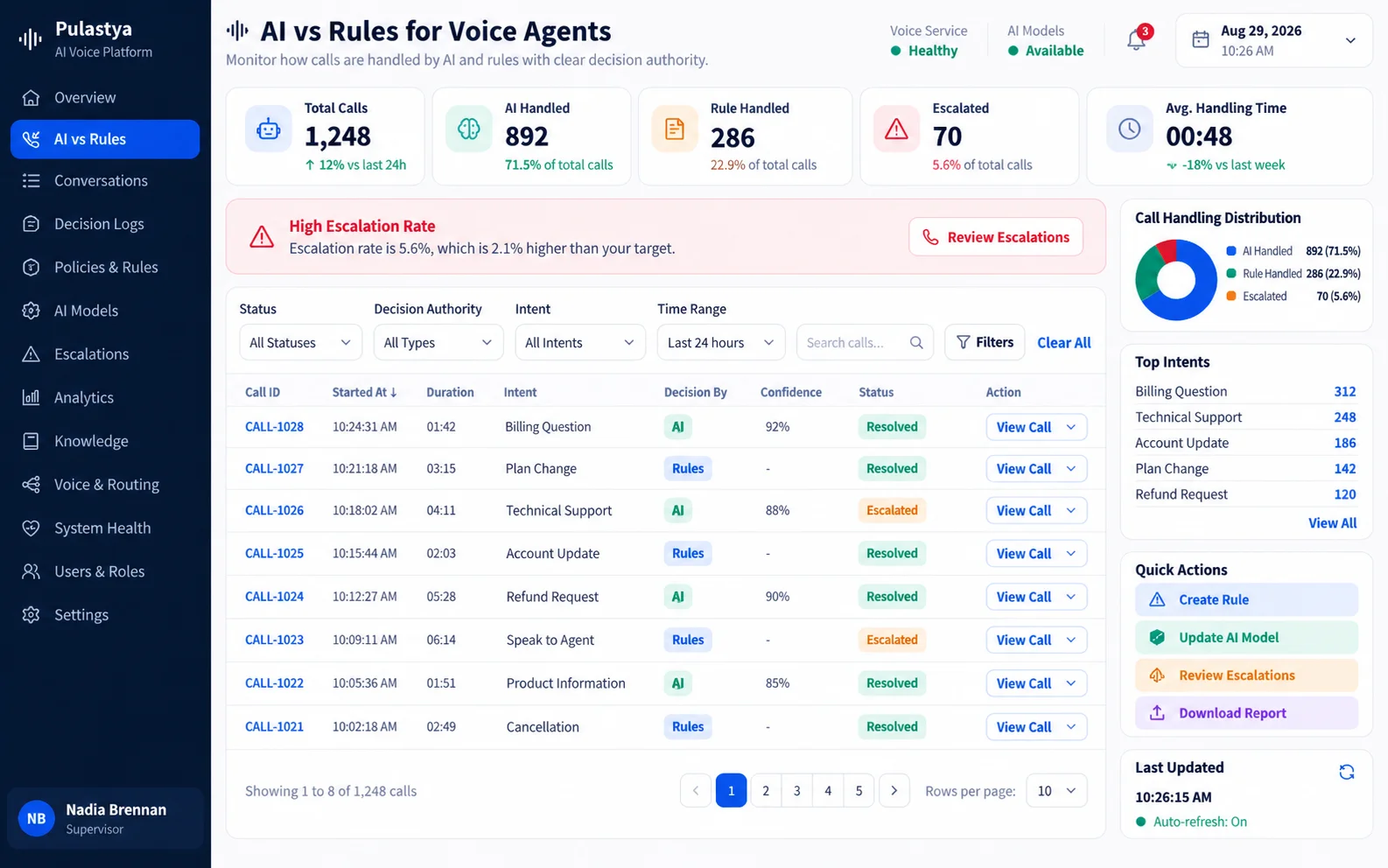
Rules are also preferable for safety-critical blocks where failure modes must be constrained or where specific phrasing is mandated by policy. Implement rules as composable steps with idempotent transitions so retries and out-of-order events do not corrupt state. Maintain a versioned rule repository to support rollbacks and compliance reviews.
Operationally, teams should treat rule-owned decisions as product features with SLAs for change control. Tie each rule to a single business owner and require automated tests that validate boundary cases. Store audit logs with enough context to reconstruct why a rule fired, including timestamped inputs, caller metadata, and rule version identifiers.
- Use rules for authentication sequences and transaction confirmations to ensure repeatability.
- Version all rules in a repository with automated regression tests before deployment.
- Log rule triggers with inputs, outputs, and rule IDs for audit and incident analysis.
- Assign a business owner and a change-control process for each high-impact rule.
Reserve rule authority for deterministic, auditable decisions.
When AI Should Own the Decision
AI should own decisions that benefit from flexible language understanding, complex context aggregation, or probabilistic recovery, such as intent classification, entity extraction, and contextual disambiguation. In practice, AI reduces maintenance when the set of user expressions is open-ended and when small misclassifications are tolerable with safe fallbacks.
Design AI-owned flows with explicit confidence thresholds and defined escape hatches. When the model confidence is high, let AI handle the response. When confidence is below threshold, route to a deterministic rule or transfer to a human. Avoid letting AI own billing or legal confirmations unless paired with a rules-based commit step.
When the AI also generates spoken answers rather than only classifying intent, ground those answers in approved sources and let rules decide what may be said or done; RAG vs rules vs LLMs in voice AI compares the options.
Model governance matters: track input distributions, label drift, and false positive/negative rates by intent. Plan for periodic retraining using post-call labels and ensure you can rollback models quickly. Maintain a human-in-the-loop path for training edge cases uncovered in production.
- Give AI authority for open-ended intent detection and follow-up clarification.
- Implement confidence thresholds that trigger rule-based fallback or agent transfer.
- Continuously label production calls to measure drift and retrain models.
- Keep human review channels for ambiguous or high-impact utterances.
Give AI authority where variability and language breadth justify probabilistic decisions.
Mapping the Decision-Authority Boundary
A decision-authority matrix lists each interaction step, its owner (rule or AI), metrics to measure, and operators responsible for changes. Start with the call entry point: greeting, authentication, intent detection, resolution, confirmation, and post-call actions. For each step declare whether the result is authoritative or advisory and what the escalation path is if the authority fails.
Use a layered approach: keep an inner deterministic core for legal and financial commitments, a mid layer of orchestrated rules for call routing and flow control, often implemented as a policy rule engine, and an outer AI layer for intent and recovery. Each layer should publish a small, stable API surface and standardized status codes to simplify orchestration and observability.
Operationalize the matrix by embedding it into CI pipelines and runbooks. Each matrix entry should map to unit tests, integration tests, and synthetic call scripts that validate both expected and unexpected inputs. Automate alerts tied to matrix entries so ownership is clear when metrics cross thresholds.
- Create a matrix with step, owner, metric, confidence threshold, and escalation path.
- Design a three-layer stack: legal core, rules orchestration, AI outer layer.
- Expose each layer via stable APIs and standardized status codes.
- Automate synthetic tests for each matrix entry to validate both happy and edge paths.
Document the owner, metric, and escalation for every decision point before coding.
Decision authority
Rule-Owned vs AI-Owned Decisions in a Voice Agent
| Aspect | Rules own it | AI owns it |
|---|---|---|
| Best-fit decisions | Authentication, consent capture, payments, legal confirmations | Intent detection, disambiguation, recovery from unclear requests |
| Behavior | The same inputs always give the same output | Probabilistic; acts on a confidence score |
| Typical failure | Breaks on phrasing or cases no rule anticipated | Misclassifies while sounding confident |
| When unsure | Follows a defined default path or transfers | Below threshold, hands off to a rule or a human |
| Audit evidence | Rule ID, rule version, and inputs | Model version, inputs, and confidence score |
| Maintenance cost | Rule count grows with product complexity | Labeling, drift monitoring, and retraining |
Notice that each decision point gets one owner, and AI hands authority back to rules or people when its confidence drops.
Orchestration and Architecture Patterns
Orchestration must keep state, manage latency, and route authority calls deterministically. Implement a central orchestrator that invokes the rules engine and the AI classifier as services. The orchestrator enforces decision contracts: it only accepts final decisions from designated owners and translates advisory AI outputs into actionable commands using rule wrappers.
Choose synchronous versus asynchronous patterns based on latency tolerance. For short authentication checks use synchronous rule calls. For heavy AI processing add async processing with interim prompts and a clearly defined user experience to prevent long hold times. Cache recent decisions to reduce repeated model calls for the same caller context.
Design observability into the architecture: trace every decision across the orchestrator, rules engine, and model runtime. Instrument per-call artifacts such as audio hash, NLU score, rule ID, and final action. Use distributed tracing combined with call metadata to speed root-cause analysis and to attribute customer outcomes to the correct decision owner.
- Put a central orchestrator between telephony and decision services to enforce contract rules.
- Use sync calls for low-latency rule checks and async workflows for heavy AI tasks with user feedback.
- Cache recent context to avoid redundant model invocations and lower cost.
- Instrument traces that record NLU scores, rule IDs, and final actions for each call.
Enforce decision contracts at the orchestrator so only the declared owner can commit an outcome.
Operational Tradeoffs: Cost, Latency, and Compliance
AI reduces manual script maintenance but increases compute and labeling costs. Rules are cheaper to run but can explode in number as product complexity grows. Evaluate cost by measuring cost-per-call for model inference versus engineering time needed to maintain rule trees. For high-volume flows favor rules when they remain stable; for variable language domains favor AI.
Latency directly affects caller experience and determines whether inference can remain inline. Speech recognition and intent classification add latency that teams should measure in their own deployed environment. If subsecond response is mandatory, prefer rules for immediate confirmations and use AI for background tasks or when brief delays are acceptable with appropriate UX cues.
Compliance requires explainability and retention policies. Rules are inherently explainable; provide rule IDs and decision logs. For AI-owned decisions, capture model inputs, confidence scores, and post-hoc explanations where feasible. Build a compliance layer that can replay a call's decision trail, showing which component issued each commit and why.
- Measure cost-per-call for model inference versus long-term maintenance of rule sets.
- Test latency budgets for inline inference; move heavy AI to async if needed.
- Log decision trails with timestamps, component IDs, and confidence scores for audits.
- Plan retention policies that meet legal requirements for audio and decision logs.
Balance cost, latency, and compliance by allocating authority to the component that minimizes overall operational risk.
Rollout Pattern: An Example Mixed-Agent Deployment
Scenario: a mid-size bank wants to add voice-based balance inquiries and card controls. The team assigns rules to authentication, high-value transactions, and legal confirmations, while AI owns intent routing, ambiguous requests, and phrasing recovery. The decision matrix was populated and signed off by product, legal, and ops before any code was written.
The team implemented a staged rollout with synthetic tests and a defined shadow period in which AI suggestions were logged but not acted on.
After acceptable precision and low false positive transfers, they moved AI into advisory mode where the orchestrator presented the AI output but required a rule-based confirmation step for critical actions. This staged approach limited customer impact and provided training data for model improvement.
After two cycles of retraining, the bank put the AI in full operational mode for low-risk queries while retaining rule authority for any billing or card-control commit. The rollout preserved auditability, and the team tracked handle time and transfer rates against the pre-launch baseline to confirm the change was worth keeping.
- Start in shadow mode: log AI recommendations without acting on them to gather labeled data.
- Use advisory mode where AI suggests actions but rules make authoritative commits for risky steps.
- Progress to full AI operation only after defined success criteria and retraining cycles.
- Keep legal confirmations and financial commits as rule-held until compliance approves model explanations.
Use shadow and advisory modes to collect data and validate safety before granting AI full authority.
Conclusion
Choosing AI or rule-based logic for voice agents should not be an all-or-nothing decision. Rules should control authentication, payments, consent, and other actions that require predictable outcomes and clear audit trails. AI is better suited to interpreting varied requests, resolving ambiguity, and recovering from unexpected phrasing. A documented decision-authority matrix keeps ownership explicit and prevents AI suggestions from becoming unapproved commitments.
To make this approach reliable in production, enforce ownership through a central orchestrator, confidence-based fallbacks, versioned rules, and traceable decision logs. Introduce AI gradually through shadow and advisory modes, then expand its authority only when tests and performance metrics support it. Monitor latency, containment, transfers, cost per call, and compliance signals to maintain the right balance between AI flexibility and rule-based control.
Frequently Asked Questions
Set thresholds based on business impact: higher for financial or legal decisions and lower for routing tasks. Use production data to calibrate thresholds, measure false positive and false negative costs per intent, and update thresholds as models retrain.
Yes if the orchestrator enforces a canonical state store and writes state transitions atomically. Use versioned APIs and idempotent operations so retries and concurrent actions do not diverge rule and model views.
Track containment rate, transfer rate, decision latency, NLU confidence distributions, rule trigger frequency, and post-call satisfaction or resolution signals. Correlate anomalies with recent changes to models or rule sets.
Capture inputs, model version, confidence score, and any post-hoc explanation alongside the audio snippet. Store decision logs with rule IDs where a rule wrapped an AI suggestion, ensuring a replayable trail that maps who or what authorized the final action.
Use a three-phase rollout: shadow mode for data collection, advisory mode where AI suggests but rules commit, and limited production with automated monitoring. Only expand scope after meeting predefined accuracy and safety criteria.