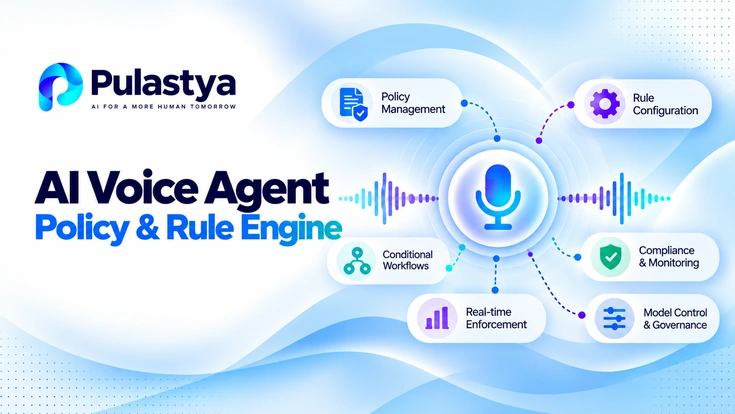
Enterprises deploying voice AI require deterministic policy and rule engines to control call behavior, regulatory responses, and customer experience in real time.
A rule engine binds business policies to audio events, gating what a voice agent can say, ask, or escalate. Technical and compliance teams need clear design patterns, operational controls, and integration points to deliver reliable, auditable voice calls.
- Deterministic outcomes Use explicit rules and thresholded signals to ensure repeatable voice-agent behavior under identical inputs.
- Runtime enforcement Integrate the rule engine inline with the call stack to block or modify utterances before audio playout.
- Auditable controls Log policy evaluations, triggers, and final actions to support compliance and operational review.
Deterministic decision mechanics are central when a voice AI handles sensitive interactions, payment details, opt outs, or scripted disclosures. A policy and rule engine must evaluate inputs from the speech pipeline, context store, and contact profile to produce immediate, deterministic actions.
That means explicit predicates for call flow branching, scoring thresholds that do not rely on opaque model outputs alone, and fast evaluation so live audio latency stays within carrier and CX limits.
The practical work sits in architecture, enforcement, and verification rather than theory. It covers policy primitives, integration with speech-to-text and NLU, runtime enforcement strategies, logging and audit trails, and scaling for concurrent calls, so that rules prevent regulatory exposure while preserving agent autonomy.
Why a Deterministic Policy Engine Matters for Voice AI
Voice calls are synchronous and user expectations demand immediate, predictable responses. Machine learning models can produce probabilistic outputs that vary by run, which is acceptable for backend recommendations but risky for on-the-call statements that carry legal or financial implications.
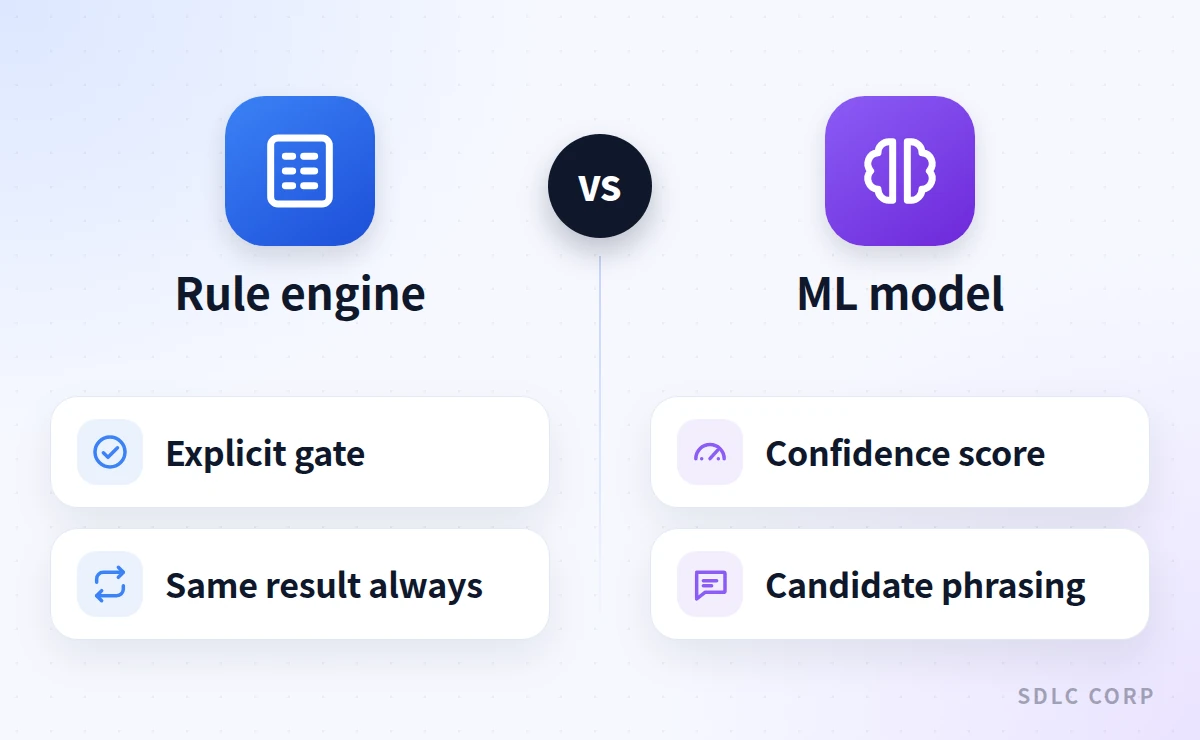
A deterministic policy engine ensures that predefined constraints and fallback behaviors control the agent's spoken output and actions, removing ambiguity where liability or compliance concerns exist.
Regulators and internal auditors require evidence that an enterprise can prevent prohibited disclosures and maintain consistent treatment across calls.
A rules-first approach enables compliance teams to translate legal requirements into predicates and actions, rather than policing model prompts. For operations teams, deterministic rules simplify incident analysis because they reduce the variance introduced by model drift and prompt changes.
Design for decisions, not for predictions. Use the engine to define binary gates, scoring thresholds, and deterministic fallback paths that are enforced inline with speech rendering. That separation keeps ML models responsible for intent detection and candidate phrasing while the rule engine governs whether a candidate is acceptable, needs redaction, or triggers an escalation.
- Eliminate unpredictable outcomes on legally sensitive statements by using explicit gating rules.
- Translate compliance text into executable predicates to reduce ambiguity between legal and engineering teams.
- Maintain consistent user treatment across channels by enforcing the same policy logic in voice and nonvoice flows.
- Keep ML models as intent and candidate generators while the rule engine controls final action selection.
Deterministic rules convert legal and operational requirements into enforceable call-time behavior.
Policy Primitives and Decision Logic to Implement
Start with a concise set of primitives: boolean flags, attribute checks on the contact profile, numeric thresholds, temporal constraints, and redaction or suppression actions for phrases.
These primitives compose into higher-level rules such as 'do not request payment after 8 p.m.' or 'suppress account numbers unless two-factor token verified.' Keep predicates simple and inspectable to facilitate review and unit testing.
Maintain an explicit priority and conflict resolution mechanism. When rules overlap, the engine must resolve deterministically: for example, higher-priority legal rules always override marketing rules, and an explicit deny wins over any allow unless a documented exception applies. Define evaluation order and a deterministic tie-breaker so engineers and auditors can predict the outcome without executing a call.
Support rule parameterization and environments. Policies should accept parameters for region, campaign, or customer tier, and deploy into staged environments for testing. Parameterization avoids rule duplication while enabling targeted enforcement. Provide a clear schema for rule metadata that includes author, approval status, last modified timestamp, and rollback capability.
- Implement simple, testable primitives such as attribute checks, thresholds, and time windows.
- Define priority and deterministic conflict resolution to remove ambiguity in overlapping rules.
- Parameterize rules by region, campaign, and customer tier to reduce duplication and speed rollouts.
- Include metadata for auditability: author, approved status, change log, and rollback id.
Keep primitives small, composable, and parameterized to support fast, auditable changes.
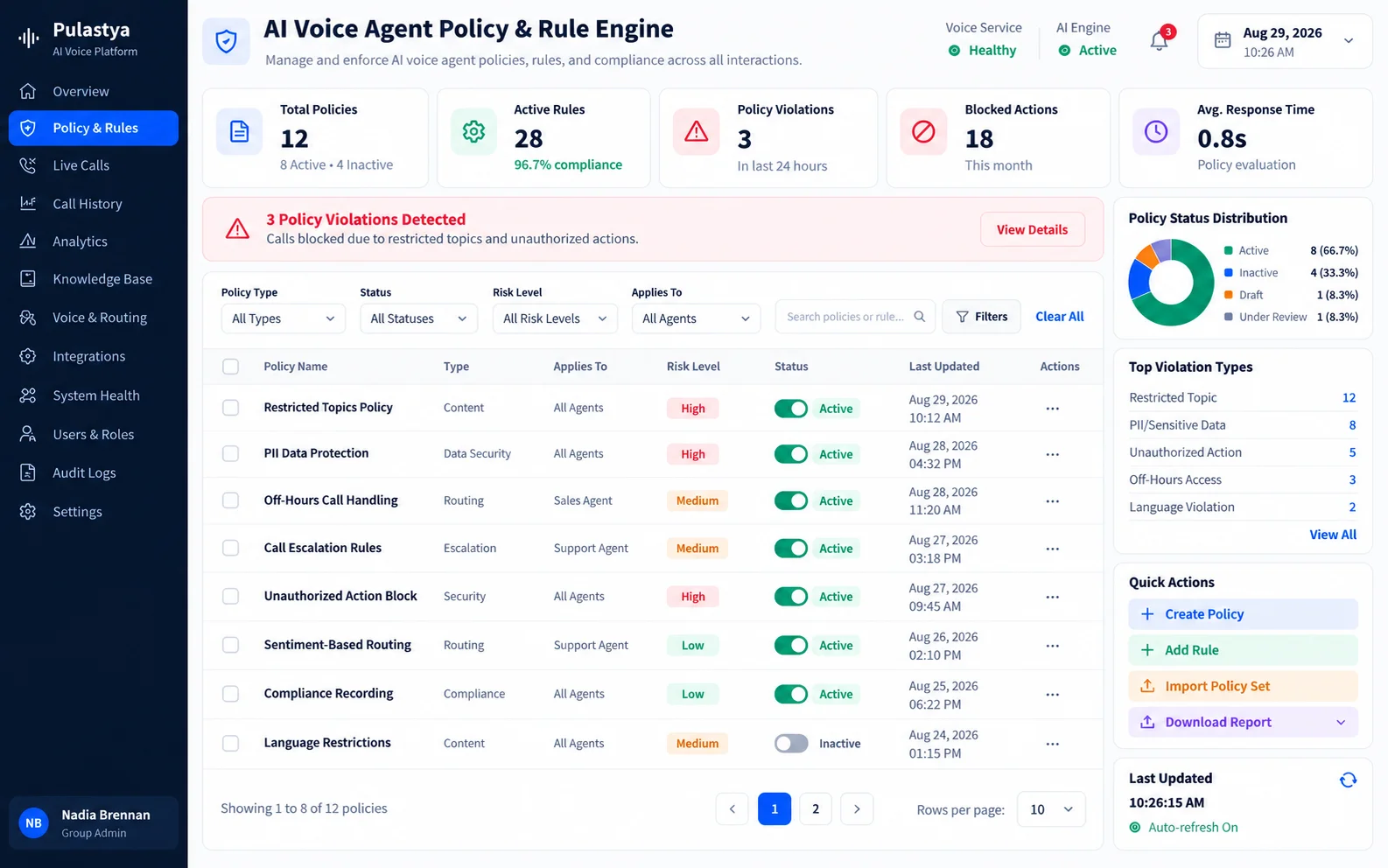
Integration Architecture and Runtime Enforcement
Place the rule engine inline in the speech pipeline so it can block, modify, or annotate candidate outputs before they are converted to audio.
Typical integration points include post-NLU for intent-based rules, pre-TTS for phrase suppression, and before actions such as data lookups, payments, or call transfers. Inline enforcement eliminates race conditions and reduces the risk window where an unapproved utterance reaches the user.
Each evaluation should end in one explicit outcome: allow the candidate, with any required redaction applied; deny it and substitute a scripted response; or escalate the call to a human with the decision context attached.
Design a lightweight evaluation path optimized for low-latency. Use compiled rule sets or precompiled decision DAGs rather than interpreting high-level policy DSLs at call time. Cache customer and session attributes close to the runtime to avoid round-trip latency to centralized stores, and define what happens when an external system is unavailable.
For sensitive actions, fail closed: treat a missing verification or consent attribute as unverified and deny or escalate rather than assume a default that allows the action. Low-risk rules can fall back to cached or default values.
Support a hybrid enforcement model: synchronous inline decisions for blocking or urgent redaction, and asynchronous policy decisions for post-call tagging, analytics, or later remediation. Synchronous paths must be deterministic and fast; asynchronous paths can be richer and feed the governance loop but must not be relied on for immediate legal protections.
- Integrate inline at post-NLU and pre-TTS to block or alter spoken output before audio playout.
- Use compiled decision graphs and local caches to meet subsecond evaluation SLAs for live calls.
- Provide synchronous enforcement for blocking and asynchronous pipelines for tagging and review.
- Fail closed for sensitive actions when external context is unavailable; use safe defaults only for low-risk rules.
Inline, low-latency evaluation is essential for safe and predictable voice interactions.
Inline rule evaluation
How a Policy Engine Decides Before the Agent Speaks or Acts
- Collect inputsIntent and confidence, candidate reply or action, session and profile attributes
- Select applicable rulesFilter by region, campaign, and call type; hot rules run next to the runtime
- Evaluate in priority orderLegal rules first, explicit deny wins, and a fixed tie-breaker settles overlaps
- Fail closed on missing dataAn unavailable verification or consent attribute counts as not verified
- Log the decisionRecord rule IDs, rule version, inputs, and the outcome for audit
Possible outcomes
- AllowSpeak or act, with any required redaction applied
- DenyBlock it and play a scripted alternative
- EscalateTransfer to a human with the decision context
Notice that every evaluation ends in exactly one logged outcome, and missing data never defaults to allowing a sensitive action.
Monitoring, Logging, and Auditability for Compliance
Capture a deterministic audit trail for each evaluated rule including input attributes, rule version id, evaluation result, and final action. Store both the raw inputs (transcripts, NLU scores, context attributes) and the normalized decision outputs so auditors can reconstruct the call-time decision path. Ensure logs are time-synchronized and immutable for legal admissibility where required.
Instrument real-time monitoring that surfaces policy hits as metrics and alerts. Track rule hit rates, false positive indicators, escalation triggers, and latency distributions. Provide dashboards for compliance and operations to review anomalies and to correlate spikes with rule changes, model updates, or campaign launches. Monitoring should enable quick rollback of problematic policies.
Enable sampling and ex post facto review workflows that pair audio segments with the applied policy decisions. Annotate recordings with the rule ids and the evaluation snapshot so reviewers can verify context. Automate regular policy reviews using heuristics that flag high-risk calls or repeated suppressions for human review.
- Log rule id, input attributes, evaluation outcome, and final action for each decision to support audits.
- Track rule hit rates and latency metrics; alert on unusual spikes or rising false positive signals.
- Annotate recordings and transcripts with rule metadata for efficient human review workflows.
- Keep logs immutable and time-synchronized to satisfy regulatory and legal evidence requirements.
Auditable logs and proactive monitoring convert policy enforcement from guesswork into governance.
Operational Patterns, Tradeoffs, and an Example Scenario
Operational patterns balance strictness and customer experience. Conservative rules reduce legal risk but may frustrate users with overblocking. Progressive release strategies work well: deploy new rules to a small percentage of calls, measure customer impact, then widen.
Maintain a kill-switch to instantly disable groups of rules if they cause unacceptable regressions in key metrics such as call completion rate or average handle time.
Consider tradeoffs around model reliance. Relying on model confidence alone can create nondeterministic behavior; combine confidence thresholds with deterministic attribute checks. For example, require both an intent score above a threshold and a verified account attribute before disclosing account balances. This layered approach reduces false disclosures while preserving conversational flexibility.
Example: a financial services agent must not read full account numbers on inbound verification failure. Implement a rule that checks verification_status attribute, call_leg, and region.
If verification fails, suppress numeric sequences, play a scripted verification prompt, and route to a human after two failed attempts. This rule prevents accidental disclosures, creates a clear escalation path, and logs the suppression event for audit.
- Use progressive rollouts and a kill-switch to manage customer experience risks during policy changes.
- Combine model confidence and deterministic checks to reduce nondeterministic disclosures.
- Implement layered escalations that route to human agents after deterministic criteria are met.
- Log suppression events and failed verifications for targeted review and remediation.
Operational controls and gradual rollout reduce the risk of overblocking while protecting sensitive data.
Deployment, Governance, and Scaling for Enterprise Voice
Plan deployments with environment isolation and staged promotion pipelines: dev, test, canary, and production. Use automated policy tests that run representative call traces through the rules engine to validate outcomes before promotion. Keep a versioned policy repository and require approvals from compliance and engineering for production changes to minimize human error.
Scale the rule engine horizontally and split hot vs cold rules. Hot rules are evaluated on every call and must be colocated with the runtime; cold rules run less frequently or during post-call processing and can run in centralized clusters. Use consistent hashing for session affinity when local caches store session attributes needed for deterministic evaluation.
Integrate policy design with the development lifecycle. Maintain a living rulebook and enforcement playbooks, and assign a named owner to each rule group so every production change has a clear approver.
- Use environment isolation and automated policy tests to validate rules before production promotion.
- Categorize hot versus cold rules to optimize runtime placement and scaling economics.
- Employ horizontal scaling and session affinity to keep evaluation latency within voice SLAs.
- Require compliance and engineering approvals for production changes and maintain a versioned policy repository.
Staged deployments, versioning, and clear governance prevent policy regressions as systems scale.
Rule design connects closely to dynamic risk assessment, the boundary between AI and deterministic rules, and the decision about when a call should transfer.
Conclusion
A reliable enterprise voice AI system needs clear limits on what an agent can say and do during live calls. A deterministic policy and rule engine turns compliance requirements into enforceable decisions for verification, sensitive disclosures, redaction, and escalation. By checking proposed responses and actions before execution, it helps keep conversations predictable without removing the flexibility of machine learning.
Effective enforcement also depends on fast evaluation, defined rule priorities, safe handling of missing data, and complete audit records. Teams should test high-risk call scenarios first, deploy policy changes in stages, and monitor outcomes so they can correct issues quickly. With versioned rules and shared ownership across engineering, operations, and compliance, the engine can scale while maintaining consistent controls and a reliable customer experience.
Frequently Asked Questions
Use compiled decision graphs, colocated caches for session data, and precompiled rule sets. Avoid interpreting high-level DSLs inline. Categorize rules as hot or cold and keep hot rules local to the voice runtime. These measures minimize round-trip latency while preserving deterministic evaluation.
Yes. Use ML for candidate generation and confidence scoring, then apply deterministic rules to gate or modify outputs. Combine model confidence with explicit attribute checks to reduce nondeterministic disclosures and ensure repeatable outcomes for sensitive actions.
Store transcripts, raw inputs, normalized decision outputs, rule ids and versions, timestamps, and final actions. Keep these logs immutable and time-synchronized. Annotate recordings with rule metadata to enable efficient human review and legal reconstruction of the decision path.
Deploy rules to canary environments or a small percentage of traffic, monitor key metrics and rule hit patterns, and use synthetic call traces for automated verification. Maintain a kill-switch and rollback procedure so you can immediately disable problematic rules while investigating.