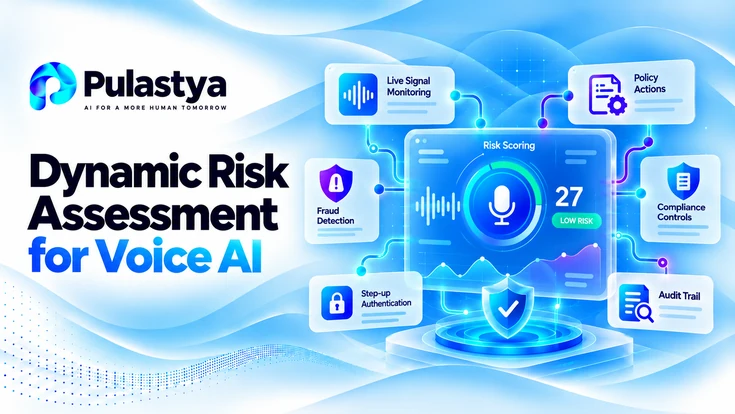
Dynamic risk assessment for voice AI combines live signal analysis, policy-driven decisioning, and automated remediation to reduce fraud, compliance exposure, and operational disruption.
Enterprises need a practical model that balances detection latency, false positives, and customer experience while fitting existing contact-center and security workflows.
- Real-time scoring Continuously evaluate voice sessions using acoustic, behavioral, and contextual signals to make live decisions without blocking legitimate customers.
- Policy-driven actions Translate risk scores into automated responses-step-up authentication, call transfer, or session termination-using configurable policy layers.
- Operational integration Embed risk telemetry into contact-center workflows and compliance audits so SOC, fraud, and CX teams share a single source of truth.
Dynamic risk assessment in voice AI shifts risk decisions from static rules to real-time, contextual evaluations. For contact centers and voice channel owners, that means scoring calls continuously as audio, metadata, and session state evolve.
The result is actionable outcomes such as escalating to human review, applying step-up authentication, or allowing safe completion with tailored prompts. This approach reduces manual review volume and contains exposure during live incidents.
Adopting dynamic risk for voice agents requires engineering for low-latency inference, robust telemetry, and clear governance boundaries. Teams must define risk signals, acceptable false-positive windows, and remediation playbooks tied to regulatory requirements.
With the right operational patterns, system architecture, and signal catalog in place, dynamic voice risk assessment can contain events such as a flash-fraud campaign while calls are still in progress.
What Dynamic Risk Assessment Means for Voice AI Operations
Dynamic risk assessment for voice AI is an operational framework that converts streaming signals into time-sensitive risk decisions during an active call.
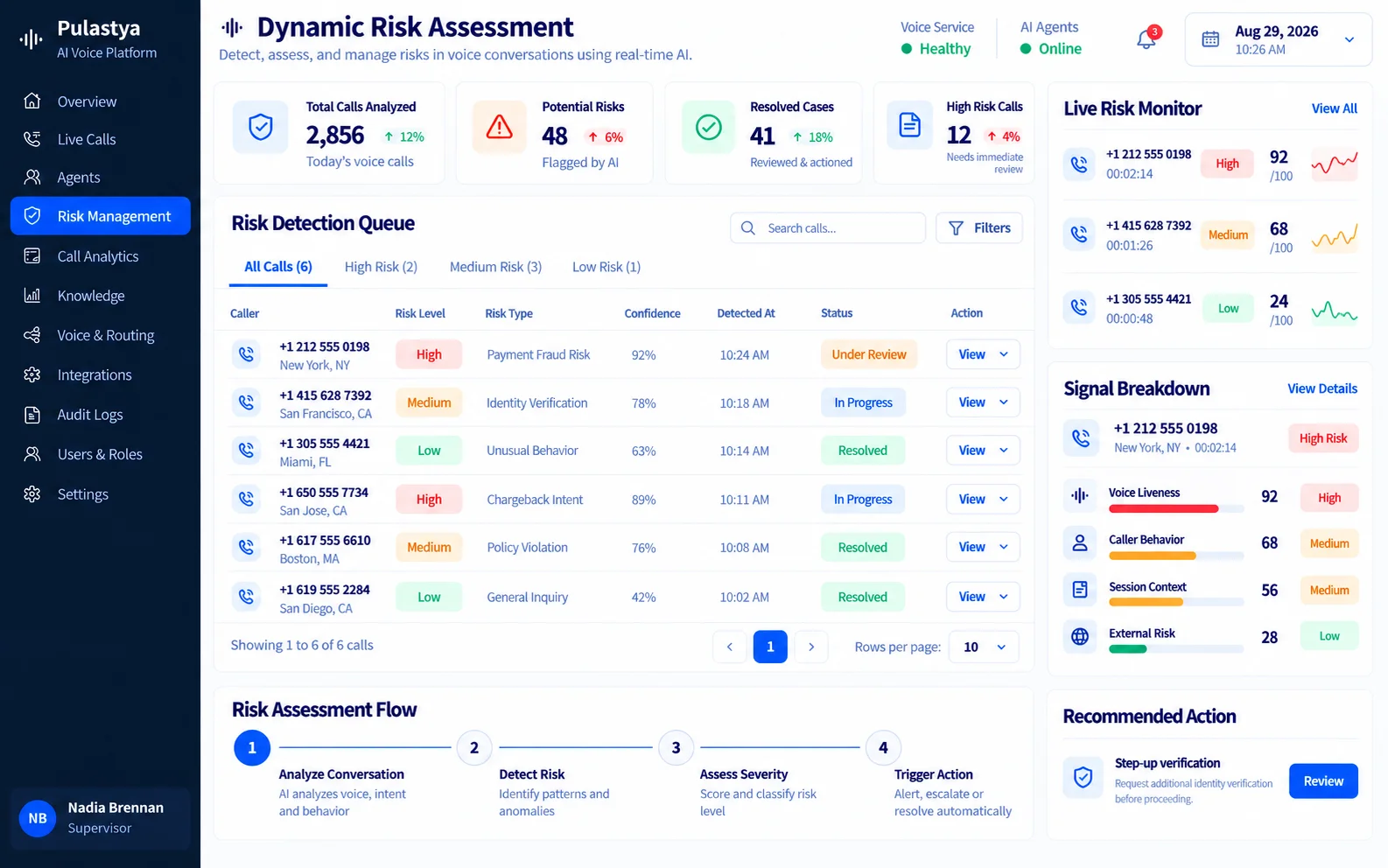
Instead of applying static blocks or post-call reviews, the system evaluates acoustic features, caller behavior, device and network attributes, and transaction context to produce score updates. These updates feed policy engines that trigger actions aligned with customer experience goals and compliance rules.
This approach reduces mean time to detect incidents that unfold inside a call, such as social-engineering attempts, synthetic voice replay, or credential probing. It also supports latency-sensitive controls like adaptive authentication or holding funds while validation continues.
For enterprise teams, dynamic assessment becomes a defensive layer that sits between voice AI flows and downstream systems such as CRMs, payment gateways, and agent desktops.
Operational teams must manage tradeoffs between detection sensitivity and customer friction. High sensitivity catches more risk but increases step-ups and transfers, impacting NPS. Low sensitivity preserves experience but increases exposure. The governance decision should be informed by loss models, regulatory tolerances, and live testing windows that measure end-to-end impact.
- Shift from binary allow/block to continuous scoring that updates during a session.
- Connect score updates to policy actions: hold, escalate, authenticate, or continue.
- Align score thresholds with loss tolerance, compliance scope, and customer segmentation.
- Instrument outcomes for feedback loops that tune models and policies.
Dynamic risk assessment turns passive logs into live controls that protect voice channels without wholesale blocking.
Which Signals to Monitor in Real Time
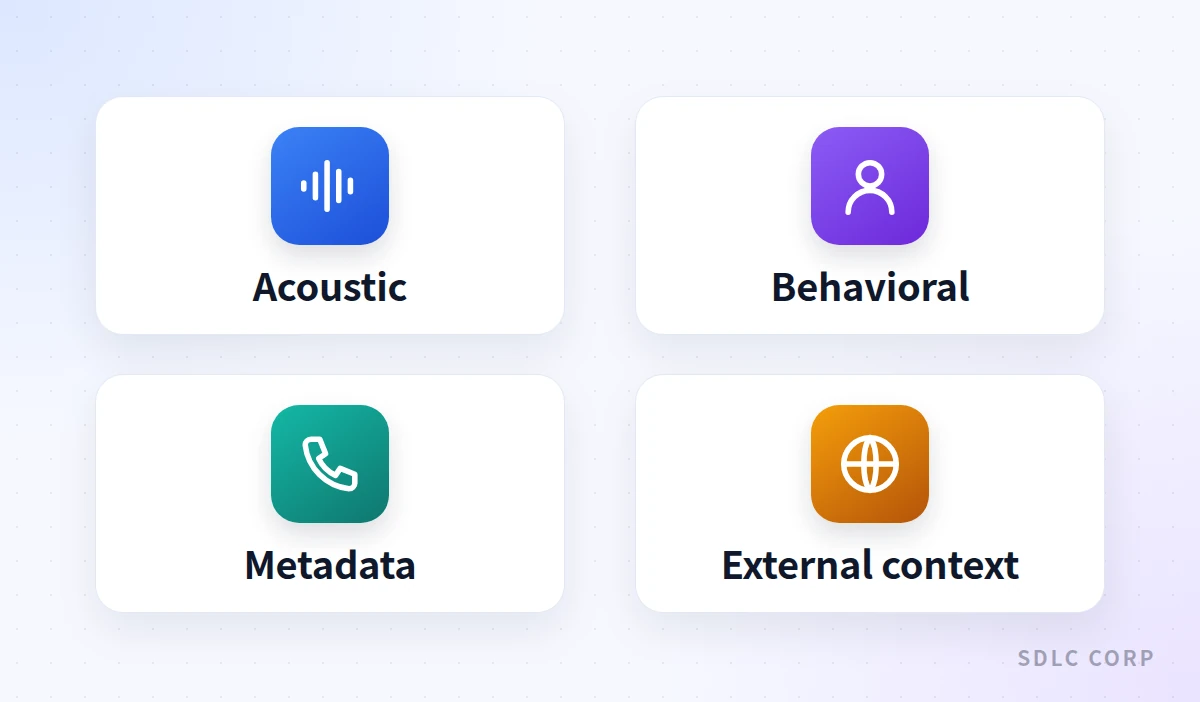
A practical signal catalog includes acoustic features, user behavior, metadata, and external risk indicators. Acoustic features cover spectral properties, voice liveness, and artifact detection that indicate playback or synthesized voices.
Behavioral signals include speech cadence, response latency, phrase complexity, and unexpected script deviations. Metadata covers call path, device identifiers, caller ID reputation, STIR/SHAKEN attestation level where available, and carrier anomalies.
Combine internal transaction context with external threat feeds and historical risk profiles. Transaction context might include payment amounts, account age, recent authentication failures, or unusual request patterns. On a bank’s line that same context is what an agent may not discuss at all, and where the account boundary sits on a banking call draws that line.
External feeds contribute known compromised credentials, device fingerprint blacklists, or country-level fraud spikes. Correlating these signals in real time lets the system detect compound risk conditions that single signals miss.
Prioritize signals by detection lead time and stability. Short-lived indicators like sudden voice artifacts can trigger soft mitigations, while persistent signals such as credential reuse or known compromised numbers justify stronger actions. Capture signal provenance and confidence scores so downstream policy layers can weight them appropriately and auditors can reconstruct why a decision occurred.
- Acoustic liveness and synthesis detection to spot replay or deepfake audio.
- Behavioral markers: response latency, phrase substitution, script deviation percentages.
- Session metadata: SIP headers, carrier anomalies, geo-fence mismatches.
- Contextual factors: transaction risk, account history, external threat intelligence.
Prioritize signals that provide early detection and maintain provenance for auditing.
How to Architect a Dynamic Risk Engine
Architect the risk engine as a streaming pipeline with clear separation of concerns: signal ingestion, normalization, scoring, policy evaluation, and action execution. Use a lightweight real-time bus for low latency signal transport and a state store that maintains session-level context.
Scoring components should be horizontally scalable microservices that accept batched or streaming feature windows and return incrementally updated risk scores.
Place policy evaluation as a separate layer that maps scores and signal provenance to deterministic actions. Policies should be versioned, environment scoped, and support conditional rules based on call stage, regulatory profile, and customer segment. Integrate a side channel for human-in-the-loop decisions where needed, including agent tools that display risk context and recommended scripts.
Keep the risk level visible wherever people watch calls. In Pulastya AI, for example, the live call view shows each call's classification, risk level, and AI confidence, and risk and classification are shown to the person who receives a handed-over call.
Ensure resiliency by designing graceful degradation paths: when scoring services are unavailable, fall back to conservative default policies that let low-risk requests continue but require step-up authentication or human review for high-risk actions such as payments or account changes, and log the gap in scoring.
Maintain audit logs for every score change and action, capture raw signals for later model calibration, and enforce encryption-in-transit and at-rest to satisfy security and privacy controls.
- Use a streaming bus and session state store to keep low-latency context.
- Separate scoring from policy to allow non-ML teams to tune responses.
- Support human review workflows with contextual agent displays and controls.
- Implement graceful degradation and comprehensive audit logging.
Design for incremental scoring and policy-driven actions with clear failover behavior.
Live risk scoring
How Live Call Signals Become a Score and a Policy Action
- Collect signals as the call unfoldsLiveness, caller ID and carrier data, speech behavior, transaction context
- Normalize with provenanceKeep each signal's source and confidence in session state
- Update the session risk scoreRescore incrementally as new audio, metadata and requests arrive
- Compare with policy thresholdsVersioned policy maps score, call stage and request type to one action
Possible outcomes
- Low risk: continueComplete the request with normal prompts
- Medium risk: step upOne-time passcode or extra verification first
- High risk: hold and reviewPause the action and route to fraud review with evidence
Scoring and policy are separate layers, so thresholds can change without retraining the model that produces the score.
Governance, Compliance, and Audit Trails for Voice Risk
Governance must define permissible risk actions per jurisdiction, data retention windows, and consent boundaries. Voice channels intersect privacy rules and financial regulations, so policies should record why an action occurred, which signals contributed, and which policy version authorized the action.
Include data minimization practices to retain only signal derivatives needed for audit and model retraining when allowed by law.
For compliance teams, build an immutable audit trail that ties score changes to raw signal references, policy IDs, and operator overrides. Provide interfaces for periodic review and automated reporting to regulators where required. Maintain role-based access controls so only authorized users can change policies or view sensitive audio content, and log all policy edits with user identifiers and timestamps.
Operationalize model validation by running shadow modes and periodic backtests that compare policy outcomes against labeled incidents. Define acceptance criteria for false positives and negatives, and require retraining or policy rollback when models drift.
Make remediation actions explainable, with clear narratives for why a step-up authentication or transfer was chosen so agents and auditors understand the customer experience impact.
- Record policy ID, signal provenance, and operator overrides for every decision.
- Limit audio retention and use derivatives for long-term model training.
- Provide role-based access and immutable logs for regulator review.
- Run shadow testing and establish formal model validation gates.
Audit trails must tie decisions to signals and policy versions to satisfy regulators and incident response.
Deployment Tradeoffs and Operational Runbooks
Start deployments with pilot segments: low-risk customer groups, non-financial flows, or internal accounts. Use A/B testing to compare existing static controls with dynamic scoring, measure false positive impacts on handle time and conversion, and tune thresholds before broad rollout. Instrument KPIs such as step-up rate, escalation rate, time to contain an attack, and unresolved fraud incidents to evaluate impact.
Operational runbooks should specify detection-to-action timelines, escalation paths, and rollback criteria. For example, define maximum tolerated step-up rate, thresholds that trigger immediate policy rollback, and a communication plan for agents and customers. Include playbooks for incident response when a model or feed causes a systemic spike in false positives or negatives.
When external partners support the rollout, keep vendor scope narrow: signal extraction, model hosting, or policy orchestration as isolated deliverables to preserve future portability.
- Pilot on segmented traffic and measure customer experience before scaling.
- Define rollback criteria and set clear escalation ladders for incident response.
- Track KPIs: step-ups, false positives, time to contain an attack, and fraud escapes.
- Modularize vendor scope to preserve portability and facilitate vendor swaps.
Use pilots and explicit rollback criteria to de-risk rollout and protect customer experience.
Example: Stopping a Flash-Fraud Campaign During a Recall
Imagine a retailer launches a recall that triggers high inbound call volumes. Fraudsters exploit the surge by replaying synthetic confirmations to capture refunds. In early hours, the dynamic risk engine detects an unusual clustering of playback artifacts, repeated caller IDs with short lifespans, and repeated carrier routing anomalies.
A streaming rule that weights acoustic liveness and carrier reputation raises session scores above a containment threshold.
The policy layer enacts an automated step-up: the voice agent sends a one-time passcode to the phone number or email on file and, if the caller cannot complete it, places the call into an agent queue flagged for fraud review. Agents receive contextual evidence: audio snippet hashes, carrier path anomalies, and recent account changes, enabling quick human verification.
The system logs every action with policy version and signal provenance so the security team can trace the event later.
Following containment, the enterprise runs a postmortem that identifies the recall as an enabling event and updates runbooks to temporarily tighten thresholds during similar campaigns. Models are retrained on captured artifacts, and the contact-center is configured to route high-risk recall traffic to a verified agent pool.
This sequence shows how dynamic assessment can minimize loss while preserving service continuity during live incidents.
- Detect spike via correlated acoustic and metadata signals during recall traffic.
- Automatically step up to OTP or human verification to block replay attacks.
- Provide agents with signal context for rapid manual review and resolution.
- Update thresholds and retrain models after the incident to reduce future exposure.
Dynamic scoring plus quick policy actions can contain flash-fraud without shutting down channels.
Risk assessment informs a decision rather than replacing it. Continue with escalation-signal detection, policy and rule engines, and changing call states.
Conclusion
Dynamic risk assessment makes voice AI security more responsive by evaluating risk throughout each live conversation instead of relying only on static rules or post-call reviews. Combining acoustic, behavioral, session, and transaction signals with continuously updated scores helps teams identify suspicious activity early. Clear, versioned policies can then determine when an interaction should continue, require additional verification, or move to human review without unnecessarily interrupting legitimate callers.
To implement this approach effectively, enterprises need low-latency scoring, reliable fallback controls, privacy-conscious data handling, and decision logs that explain every intervention. Start with controlled pilots, monitor false positives, escalation rates, and fraud outcomes, and refine thresholds as real-world conditions change. With the right governance and operational runbooks, dynamic risk assessment can strengthen fraud protection while preserving customer experience and service continuity.
Frequently Asked Questions
Effectiveness depends on control type: for step-up authentication, subsecond to few-second scoring is ideal. For routing decisions, the acceptable assessment window depends on call risk, caller experience, and the latency budget validated for the deployment. Architect for streaming inference with session-level state so score updates can trigger actions within the operational tolerance defined in your runbook.
Cross-functional ownership is required: security and fraud for threat modeling, contact-center ops for CX tradeoffs, ML engineers for models, compliance for data handling, and IT for integration. Establish a steering cadence to align thresholds, reporting, and incident playbooks before production rollout.
Yes. By escalating only high-confidence incidents and applying automated mitigations to medium-risk sessions, teams can cut manual review load. Success depends on tuning thresholds, improving signal quality, and establishing confident policy mappings so automation handles routine cases while humans focus on complex investigations.
Minimize retention by storing derived features instead of raw audio where possible. Voiceprints can count as biometric data under laws such as the Illinois BIPA and the GDPR, which add specific consent and retention duties. Obtain required consents and apply access controls. When raw audio is needed for model validation, use encrypted storage, limited access, and deletion policies aligned with legal requirements.