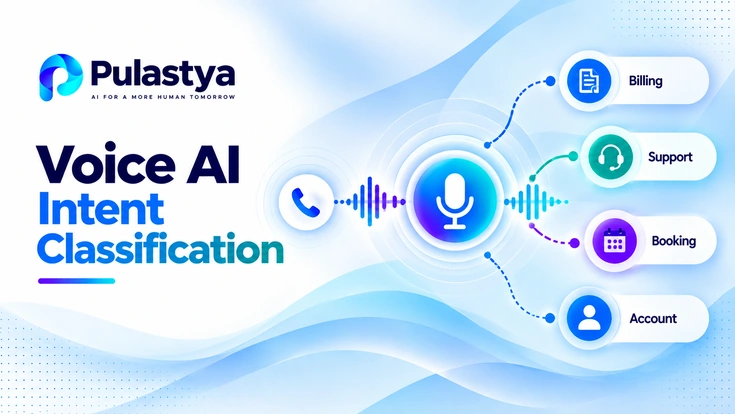
Intent classification in voice AI agents converts spoken language into actionable caller goals. For enterprise contact centers, accurate classification determines routing, automation, and compliance steps.
A production implementation depends on taxonomy design, signal inputs, confidence-driven flows, unknown-intent handling, evaluation metrics, and operational controls, each grounded in concrete voice-call examples and clear policies.
- Taxonomy matters Design intent labels around business actions and routing needs, not linguistic categories. Each label must map to a precise downstream workflow.
- Confidence is an input Expose a numeric confidence score and treat it as a policy input that triggers clarification prompts, reclassification attempts, or human escalation.
- Measure what you act on Evaluate classification quality by outcome metrics such as correct routing, containment rate, and escalation reduction rather than only raw accuracy numbers.
Voice AI intent classification maps a caller utterance to a discrete business goal such as a billing inquiry, outage report, or password reset. In voice channels, the system combines speech recognition output, prosody, and session context before producing an intent label.
Taxonomies and policies should reflect business processes, regulatory boundaries, and escalation rules rather than mirror conversational AI research taxonomies.
The key operational questions are how to build an intent taxonomy, how classifiers should expose confidence and ambiguity, how to handle unknown or changing intents, and how to measure classification quality in production.
Answering them means tying specific caller utterances to the downstream actions they should trigger, and weighing coarse routing labels against fine-grained labels that affect automation rates and containment.
Building an Intent Taxonomy
Start taxonomy design by mapping business goals to caller actions. Identify the end state for each intent: transfer to collections, reset credentials, schedule a technician visit, issue a refund, or provide a status update.
For example, the label 'password_reset' should imply authentication steps, a one-time code flow, and a handoff to verification if biometric checks fail. Labels that do not tie directly to a business endpoint increase implementation ambiguity and automation failure.
Choose granularity based on routing and automation value. A coarse label like 'billing' routes to the billing queue but hides variants that automation can resolve, such as 'check_balance' or 'update_payment_method'.
Teams that want high automation containment should split billing into sub-intents that map to distinct API calls. Teams prioritizing speed and minimal maintenance can keep a smaller label set and use slot extraction after classification to feed the workflow.
Define negative and meta intents explicitly. Labels such as 'greeting', 'hold_request', 'escalation_request', and 'agent_unavailable' let the system manage conversation state without misrouting.
Document edge cases with annotated examples: a caller who says 'I want to dispute a charge and check data usage' should trigger multi-intent handling or routing to a human, depending on configured policy. Maintain a versioned taxonomy aligned with support scripts and IVR flows.
- Link each intent to a single downstream action or clearly documented multi-step workflow.
- Use caller examples when naming labels, e.g., 'report_outage' for 'my internet is down'.
- Balance granularity with maintenance effort; prioritize automatable actions for finer splits.
- Include meta intents for session control like 'repeat', 'hold', and 'agent_request'.
- Version the taxonomy and require change approvals tied to SLA and compliance owners.
Design intent labels to directly map to business actions and routable workflows.
How Voice Signals Map to Intent
Intent classification for voice uses several signal types: ASR transcripts, word-level confidence, speech pace, pause locations, and prior session context. A caller who says 'I need help paying my bill' with a long pause after 'help' may be hesitating, which can justify a clarification prompt.
Where acoustics are poor, preserve ASR alternatives and feed n-best or lattice information into the classifier to reduce errors from single-best transcripts.
Prosodic signals can separate similar utterances. 'I want to cancel' spoken quickly differs from 'I... want to cancel' with a drawn-out pause; the latter often signals frustration and can bias toward immediate agent escalation if policy requires it.
Contact metadata such as account status, recent interactions, and the originating number also shifts intent priors and routing decisions in enterprise workflows.
Keep slot and entity extraction adjacent to intent classification but not merged into a single opaque label. For example, intent 'schedule_technician' should return structured fields like preferred_date, device_type, and outage_severity. That enables downstream APIs to proceed without new user queries. Store uncertain slots with confidence markers so follow-up prompts can target low-confidence fields only.
- Pass ASR n-best alternatives and word-level confidence to the intent classifier.
- Use prosody and pause detection to detect likely escalation or frustration.
- Incorporate account and session context as priors for intent probability.
- Return structured slots with per-field confidence for targeted clarification.
- Log raw signal bundles for post-call analysis and classifier improvement.
Combine ASR, prosody, and context instead of relying on a single transcript to classify intent.
Confidence, Ambiguity, and Clarification
Expose a continuous confidence score for every classification and treat it as actionable input. A documented mapping from score ranges to policy actions keeps behavior predictable: high confidence triggers automated handling, mid confidence prompts clarification, and low confidence prompts escalation.
With a medium-confidence result, the system might ask one narrow confirmation, such as 'Do you want to check your balance or dispute a charge?', rather than repeating the entire question.
Clarification should minimize friction. Anchor yes/no or choice prompts on the classifier's competing labels: if a caller says 'billing' and the classifier is split between 'check_balance' and 'dispute_charge', ask which of the two they mean. A single well-phrased confirmation reduces back-and-forth and improves containment compared with open-ended prompts.
Policies should weigh business risk alongside confidence. High-value transactions or compliance-sensitive intents might require human verification even when confidence is high; for instance, refund requests above a threshold amount always route to a human regardless of classifier confidence.
Track how often clarification changes the predicted intent to tune thresholds and refine prompt templates.
- Publish a confidence-to-action policy: automated, clarify, or escalate.
- Implement narrow confirmation prompts reflecting the classifier's top competing labels.
- Consider business risk when setting thresholds for sensitive intents.
- Track clarification success rates and tune thresholds based on outcomes.
- Log pre- and post-clarification intent labels for continuous improvement.
Treat confidence as a control signal that directs clarification, reclassification, or escalation according to policy.
Confidence to action
How an Utterance, Its Intent Score and Policy Decide the Next Step
| Caller says | Intent + confidence | Policy action |
|---|---|---|
| "My internet is down." | report_outage, high confidence | Handle: start the outage workflow and log the incident on the account |
| "It's about billing." | Split: check_balance vs dispute_charge | Clarify: ask whether they want to check a balance or dispute a charge |
| "I need help with my Zeta device." | Unknown: low confidence on every label | Clarify narrowly, offer routing choices, then escalate if still unclear |
| "I want a refund on a large order." | refund_request, high confidence, over the limit | Escalate: the risk rule sends it to a human regardless of confidence |
Confidence picks between handling and clarifying, but a business risk rule can force escalation even when the classifier is confident.
Unknown Intent and Reclassification
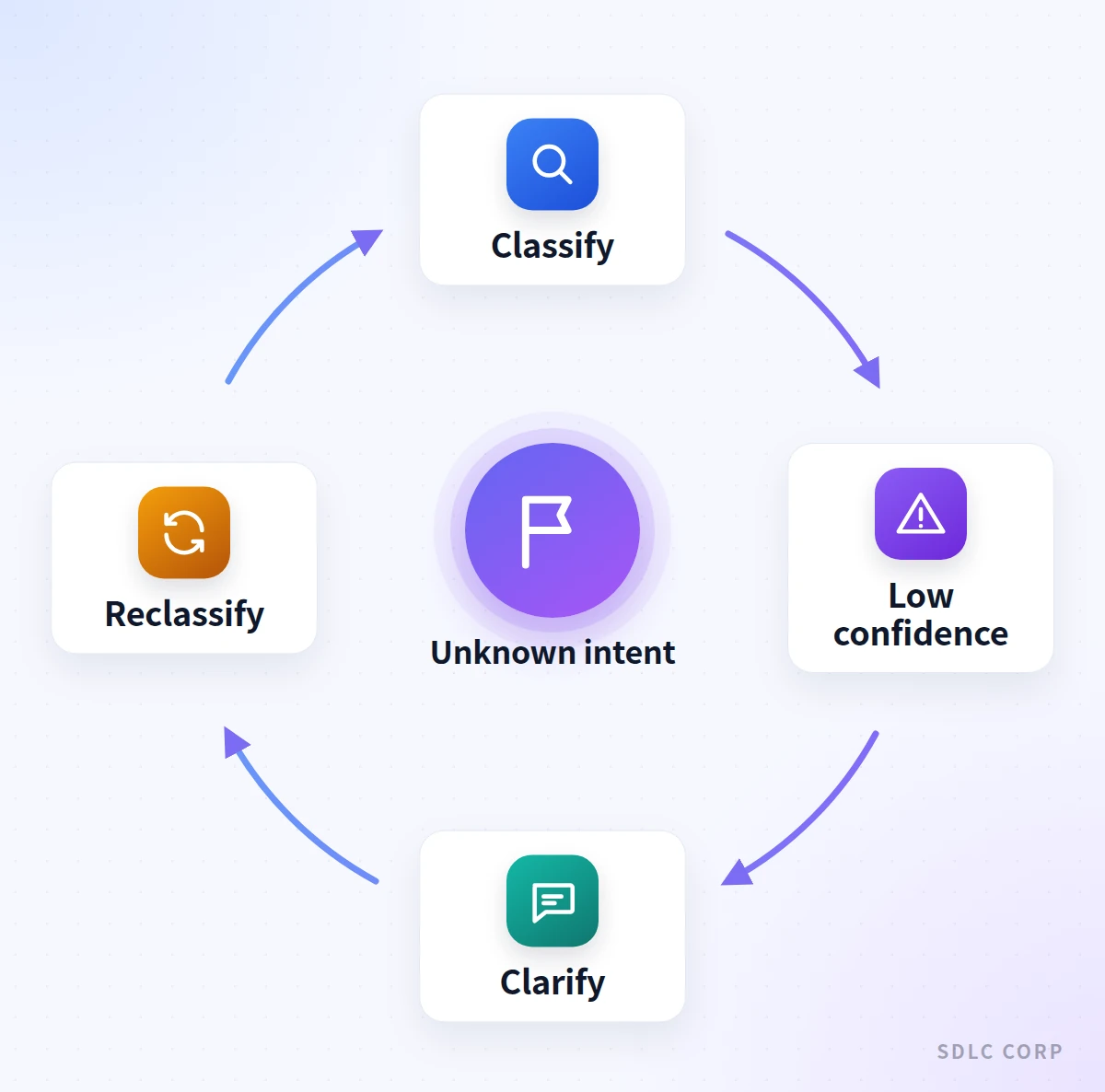
Unknown intent occurs when the classifier assigns no known label or low confidence across all labels. In voice, it can result from ASR errors, new product vocabulary, or multi-intent utterances.
Implement a fallback policy that first attempts safe clarification, then asks the caller a routing question, and finally routes to a human if the intent is still unresolved.
For example, when a caller says 'I need help with my Zeta device' and Zeta is a new product, a fallback prompt like 'Do you mean device setup or device repair?' maps the new vocabulary to existing intents.
Reclassification should be allowed mid-call as new context accumulates. If the conversation starts with 'I have a charge' and later the caller mentions 'subscription cancellation', the agent should re-evaluate intent with the new slot data and switch workflows if appropriate. Build systems that accept incremental updates to the intent hypothesis and can restart downstream processes without losing conversation state.
Maintain an unknown-intent queue with tagging for rapid human review and taxonomy updates. Every unknown utterance should be annotated with raw audio, ASR output, and metadata for the taxonomy team.
Use these examples to decide whether to create new labels, expand existing slot schemas, or improve prompt wording. Track trends in unknown volume as an indicator of product changes or ASR regressions.
- Fallback flow: clarify narrowly, offer routing choices, then escalate to a human.
- Allow hypothesis updates and reclassification as new context is captured.
- Queue unknown cases for human review and taxonomy updates.
- Tag unknowns with account and call metadata for faster root cause analysis.
- Audit unknown volume over time to detect ASR or product-surface changes.
Design fallback and reclassification paths so unknown intent becomes a signal for taxonomy and process adjustments.
Routing and Action Mapping
Map each intent to a routing target and a deterministic action set. The target might be an automation API, a specialized agent skill group, or a compliance review workflow.
For example, 'report_outage' should map to a diagnostics workflow that triggers a network check API, places the caller in a technician scheduling lane, and logs the outage against the account. Avoid one-to-many ambiguity that forces agents to guess next steps.
Define transaction-level constraints per intent. Some intents require authentication before any action; others allow limited self-service.
For instance, 'update_payment_method' should require multi-factor verification before any payment API is invoked, while 'check_balance' might allow a lighter, read-only verification step if policy permits. Encode these constraints in the routing policy so downstream systems enforce them consistently.
Support composite actions for multi-intent conversations. If a caller asks for both a 'refund' and a 'return_label', the system should either run the steps in order or escalate to an agent with a combined checklist.
Add idempotency guards for actions that might be retried after reclassification, and keep audit trails that connect the intent label, confidence score, and exact API calls performed for compliance and dispute resolution.
- Attach one clear routing target and action list to each intent label.
- Document authentication and compliance requirements per intent.
- Support composite intent execution with ordered workflows and manual override points.
- Add idempotency and audit logging to any automated action triggered by intent.
- Test routing logic end-to-end with synthetic calls that reflect business edge cases.
Ensure intents map to deterministic routing and action definitions with constraints and audit trails.
Evaluating Classification Quality
Move evaluation beyond offline accuracy to outcome metrics: containment rate, correct routing percentage, average time to resolution, and escalation frequency attributable to misclassification.
For example, measure whether calls labeled 'password_reset' were completed without agent handoff, and what fraction required human correction. These operational metrics reflect business impact and guide which taxonomy changes to prioritize.
Use stratified sampling for human review across confidence bands, high-value accounts, and intents with recent churn. Annotators should hear the raw audio and see the ASR n-best list and system labels before assigning a gold label.
These annotations produce a confusion matrix that exposes systematic confusions, such as 'cancel_subscription' versus 'pause_subscription', which directly drive policy and prompt changes.
Monitor drift and set automated alerts. Watch for shifts in intent distribution and rising unknown-intent volume after product launches or marketing campaigns, and triage new ambiguous examples quickly into training data or taxonomy edits.
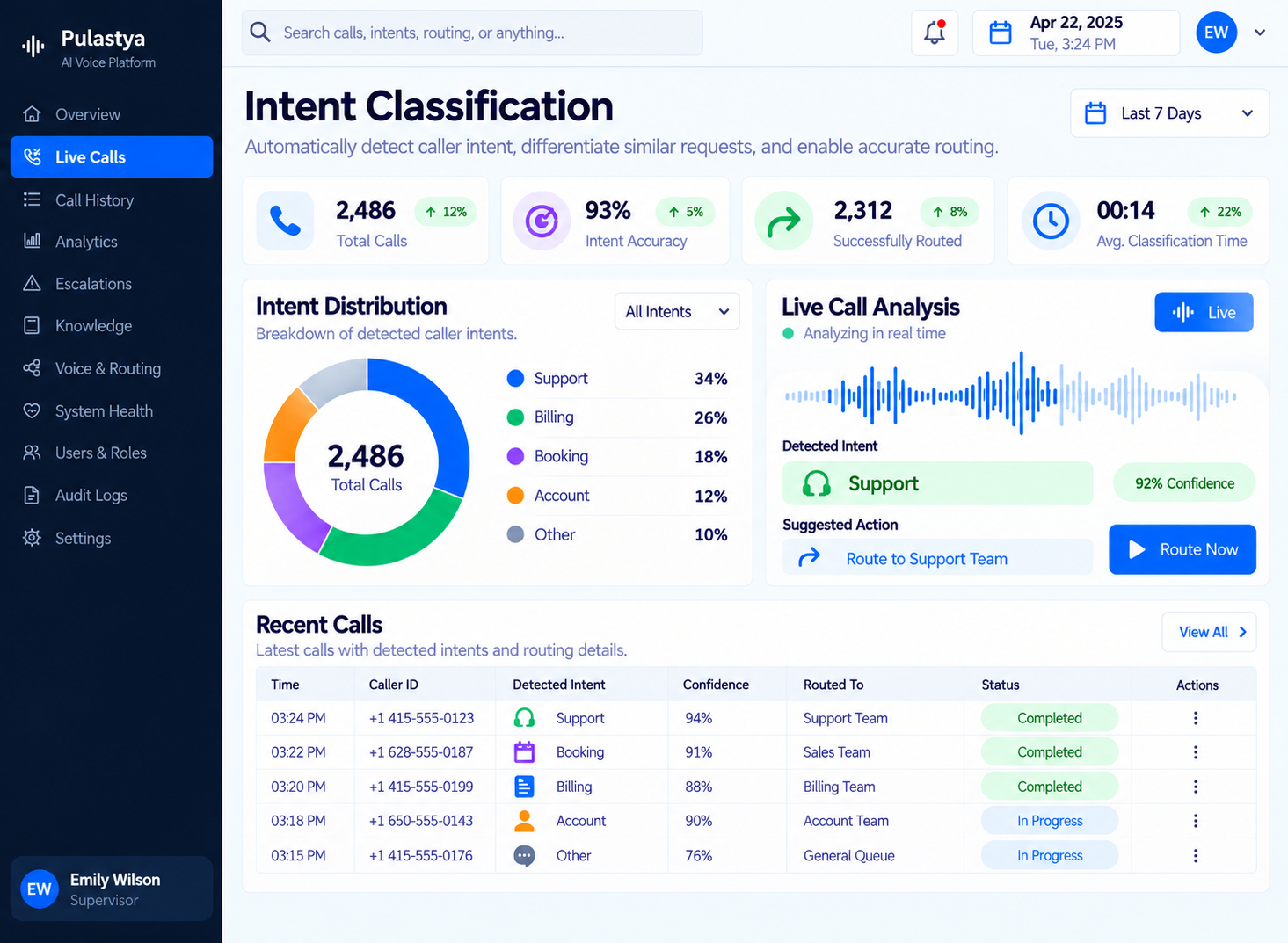
A dashboard showing classifier performance by channel, language, and account segment helps prioritize engineering and operational fixes.
- Measure outcome metrics: containment, correct routing, and escalation rate.
- Perform stratified human review across confidence levels and account types.
- Compute confusion matrices to identify systematic misclassifications.
- Alert on distribution shifts and spikes in unknown intent volume.
- Maintain dashboards by channel, language, and business unit for prioritization.
Evaluate classifiers by downstream outcomes and use stratified human review to find systematic errors.
Operational Policies, Governance, and Continuous Improvement
Run the intent classification lifecycle with clear ownership and change control. Taxonomy stewards approve label changes, prompt text, and confidence thresholds. Any update that changes routing or automation behavior needs impact analysis, a controlled rollout, and rollback gates.
Document who can adjust thresholds for clarification versus escalation, and tie those changes to SLA owners.
Build feedback loops between support agents, taxonomy stewards, and product teams. Simple agent tools to flag misrouted calls and submit corrected labels should feed prioritized work queues for taxonomy or prompt fixes.
A weekly review of unknown clusters and escalation drivers keeps fixes focused on operational pain points rather than theoretical accuracy gains.
Invest in tooling for continuous monitoring and rapid iteration. Dashboards should show per-intent containment, clarification rates, average clarification turns, and the impact of reclassification, while annotated unknown cases surface candidate taxonomy changes for review.
A/B tests of clarification prompts or threshold settings can measure containment lift and handle-time reduction before full deployment.
- Designate taxonomy stewards and require impact analysis for label changes.
- Provide agent tooling to flag misclassifications and submit corrections.
- Prioritize fixes based on business impact and frequency, not only error rate.
- Run controlled rollouts and A/B tests for prompt and threshold changes.
- Automate dashboards that show containment, clarification efficiency, and escalation drivers.
Govern taxonomy and threshold changes with owners, agent feedback, and measurement-driven rollouts.
Intent classification is the first decision on every inbound call. The overview of inbound AI voice agents shows how that decision drives answers, routing and service requests.
Conclusion
Effective voice AI intent classification begins with a business-aligned taxonomy and reliable inputs from speech recognition, conversation context, and extracted details. Confidence scores should determine when an agent can act, when it should ask a focused clarification question, and when it must reclassify or escalate a request. Each intent also needs a defined, secure workflow so that classification produces the right action for the caller.
To keep the system dependable, measure correct routing, containment, clarification success, unknown-intent volume, and avoidable escalations instead of relying on accuracy alone. Review difficult calls with human annotators, monitor changes in intent patterns, and test taxonomy or threshold updates before rollout. Clear ownership, audit trails, and ongoing feedback help enterprise voice AI agents improve automation while protecting sensitive interactions.
Frequently Asked Questions
Set thresholds using a risk-based approach rather than fixed numbers. Define ranges that map to automated handling, a single targeted clarification prompt, or immediate human escalation. Calibrate thresholds with stratified call sampling and tune them based on clarification success rates and business risk for each intent.
Choose granularity based on downstream actionability. Use finer labels where automation can complete the task without human handoff. Keep labels coarse when downstream processes require human judgment. Prioritize splitting labels for high-volume automatable actions to increase containment.
Support multi-intent detection and either run intents sequentially or route to an agent with a combined checklist based on policy. Use slot extraction to identify discrete tasks, ask narrow follow-ups to confirm order of operations, and log both intents for correct downstream processing and audit trails.
Trigger taxonomy reviews when unknowns accumulate for the same surface form or when unknown volume rises after a product change. Prioritize taxonomy updates when unknown cases cause routing failures or increase agent handling time. Use human annotation to decide between taxonomy expansion and prompt improvement.
Track containment rate, reduction in escalations, agent handle time, and successful automation completions tied to intent changes. Tie financial metrics to reduced agent cost or faster resolution for prioritized intents, and run controlled experiments to isolate the impact of classification updates.