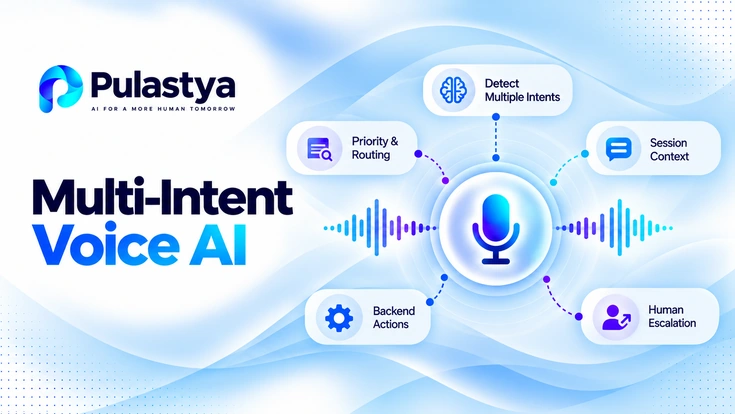
Enterprise contact centers regularly take calls where a single utterance contains billing, technical, and scheduling requests. Multi-intent voice AI detects, prioritizes, and acts on more than one caller goal in the same call while preserving context, applying policy, and minimizing handoffs.
- Detect early, keep context Classify multiple intents in the first 1 to 2 user turns and preserve entity slots across the session to avoid repeating information.
- Confidence drives policy Use model confidence as an input to explicit rules that trigger clarification, reclassification attempts, or immediate escalation to an agent.
- Design for partial resolution Allow the system to complete higher priority tasks while scheduling or queuing remaining intents rather than forcing all-or-nothing resolutions.
Multi-intent calls are common: a caller asks to change an appointment, report a failed payment, and check warranty status in one utterance. A naive single-intent flow treats that as noise and sends the caller through multiple transfers.
A well-designed voice AI system extracts discrete intents, links related entities, and finds the shortest sequence of actions that resolves the prioritized goals while keeping the caller informed.
A production implementation rests on decision points the business can configure: how intents are detected and weighted, how confidence drives clarification or reclassification, how partial resolution works, and when escalation is required.
Each choice shows up in live call scenarios, in integration patterns for CRM and billing systems, and in tradeoffs between throughput, containment, and customer satisfaction.
Detecting Multiple Caller Goals
Detection begins with utterance segmentation and intent tagging across ASR output and session context. In production, run a fast intent classifier on the initial transcription and a second pass that considers dialogue history, extracted entities, and elapsed call time.
For example, a caller saying "I need to reschedule my install and dispute a charge on my bill" should yield two explicit intents, schedule change and billing dispute, plus entities such as account number and preferred dates.
Entities extracted during detection link the intents together. Shared entities such as account number or service address tie both intents to the same account, which enables parallel lookups and reduces verification work.
Slot filling rules should persist entities across intents: once the agent captures account identity, it should not ask again for the second intent unless confidence falls below a configured threshold.
The detection pipeline should output intent candidates with scores and provenance metadata: which model produced the label, whether the classification used prior context, and which slots were satisfied.
Those outputs drive policy decisions such as attempting automated resolution, asking one clarifying question that covers several intents, or escalating directly when evidence is weak or contradictory.
- Run a lightweight classifier on first-turn transcription and a heavier multi-intent parser on full session text.
- Persist shared entity slots to avoid redundant customer verification between intents.
- Emit intent candidates with confidence scores and provenance metadata for policy evaluation.
- Tag utterances that likely contain three or more intents for human review rather than automated branching.
- Use negative intent detection to identify cancellation or confusion language that changes resolution strategy.
Detect multiple goals early and persist shared entities to reduce verification overhead.
Priority and Sequence
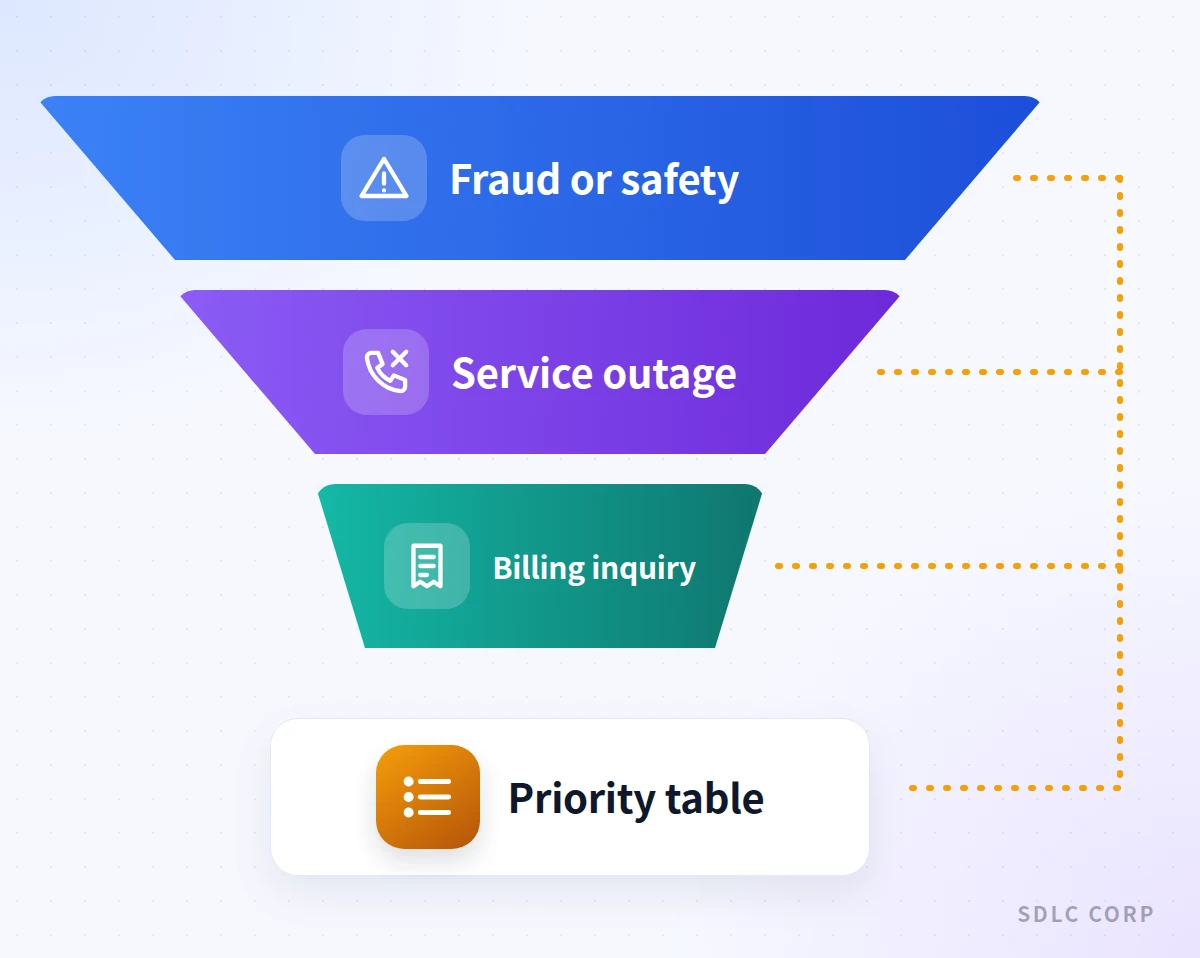
Not all intents are equal; business rules define priority. A safety or fraud report must preempt a routine scheduling change, so keep a configurable priority table that maps intents to tiers.
For example, map a fraud report to tier 1 immediate handling, a service outage to tier 2 urgent, and a billing inquiry to tier 3 standard. The voice agent uses these tiers to decide whether to address intents in sequence, in parallel, or defer some.
Sequence decisions should also consider dependencies and caller experience. If one task places a payment hold that affects a billing dispute, resolve the hold first to avoid conflict.
Likewise, if a caller asks for a refund and service reactivation, and policy requires refund approval before reactivation, the agent should evaluate the refund first and start reactivation only if it succeeds.
When multiple medium-priority intents exist, prefer a shortest-path containment strategy: complete whichever intent can be resolved in one interaction while capturing commitments for the others. That approach reduces agent transfers and caller effort. Implement configurable time or turn budgets per call so the system knows when to ask to continue later or offer call-back options.
- Create an intent priority table with business-owned tiers and example mappings.
- Apply dependency rules to force sequence when one intent affects another.
- Use shortest-path containment to resolve quick intents first and queue longer tasks.
- Set per-call time or turn budgets to determine when to pause and schedule follow-ups.
- Log priority decisions for audit and continuous tuning.
Prioritize safety and transactional dependencies, then use shortest-path resolution to preserve caller time.
State, Dependencies, and Partial Resolution
State management is the backbone of multi-intent handling. The session state should track satisfied slots, unresolved intents, completed actions, and pending background tasks.
For instance, after confirming the account number and completing a scheduling change, the system marks that intent complete while keeping unresolved intents, such as an open service ticket or a billing dispute, for follow-up later in the session or as a scheduled task.
Dependencies require explicit modeling. Some intents wait on external confirmations; a repair appointment, for example, depends on technician availability. Model these as event-driven state transitions: when a backend confirms availability, an event marks the appointment intent complete and triggers notifications.
If a dependency fails, the agent should offer alternative resolutions or queue the intent for a human agent with the dependency status attached.
Partial resolution is an operationally sound pattern: complete what you can now, and document the rest with clear next steps.
If the voice agent resolves the appointment but cannot settle a billing disagreement without an invoice review, it should create a case, assign priority, give an expected callback window, and summarize all of that in a single closing statement. That keeps the caller informed and reduces repeat contacts.
- Persist session state with explicit flags for completed, in-progress, and deferred intents.
- Model external dependencies as event-driven transitions tied to backend confirmations.
- Implement partial resolution flows that complete independent tasks and queue dependent tasks.
- Attach context and history to queued intents to avoid repeating verification at handoff.
- Provide callers with clear expectations when deferral or scheduling is required.
Treat partial resolution as a first-class outcome and attach dependency metadata for smooth follow-up.
Multi-intent handling
How a Voice Agent Works Through Several Goals in One Call
- Detect every caller goalTag each intent with a confidence score and link shared entities such as account number
- Order by urgency and dependencySafety or fraud goes first; a task that another depends on runs before it
- Complete one intent and confirmReuse verified slots, confirm the result with the caller, mark the intent complete
- Move to the next intentCarry session state forward and clarify only the fields that are still uncertain
Possible outcomes
- All goals resolvedClose with one summary of every completed action
- Partial resolutionCreate a case with priority and a callback window for what remains
- Blocked or low confidenceHand off to a human with captured slots, completed steps and the reason
The agent finishes and confirms one goal before starting the next, so completed work is kept and anything blocked becomes a queued case or a handoff.
When to Clarify or Escalate
Configure clarification rules that combine confidence thresholds with business rules. If intent classification confidence falls below a configured threshold, the agent should ask a concise prompt that separates the plausible intents instead of an open-ended question.
For example, ask "Do you want to change the appointment or dispute the charge?" rather than re-running full verification after an ambiguous classification.
Escalation should trigger on low confidence across multiple intents, regulatory needs, or an explicit request to speak with an agent. Typical conditions include confidence below the lower threshold for critical intents, conflicting entity data across intents, or escalation phrases such as "talk to a representative now."
The agent should capture context and prior actions so the human agent can pick up the call quickly.
Confidence should be treated as an input that can cause clarification, reclassification, or escalation according to configured policy. For example, a billing dispute classification at 0.65 confidence might prompt a single targeted question and reclassify on the answer; if confidence remains below the escalation threshold, the flow escalates and attaches captured evidence to the agent ticket.
- Set two confidence thresholds: one for clarification and one for escalation.
- Prefer single-target clarifying prompts that resolve ambiguity across multiple intents.
- Escalate immediately for regulatory or safety intents regardless of confidence.
- Send full context, captured slots, and classifier provenance to human agents on escalation.
- Log clarification attempts and outcomes to refine thresholds over time.
Use confidence thresholds to drive targeted clarification first and escalation only when required.
Intent Classification and Confidence Handling
Intent classifiers in voice agents should output calibrated confidence scores and alternative hypotheses, and operations teams should treat those scores as signals rather than final decisions.
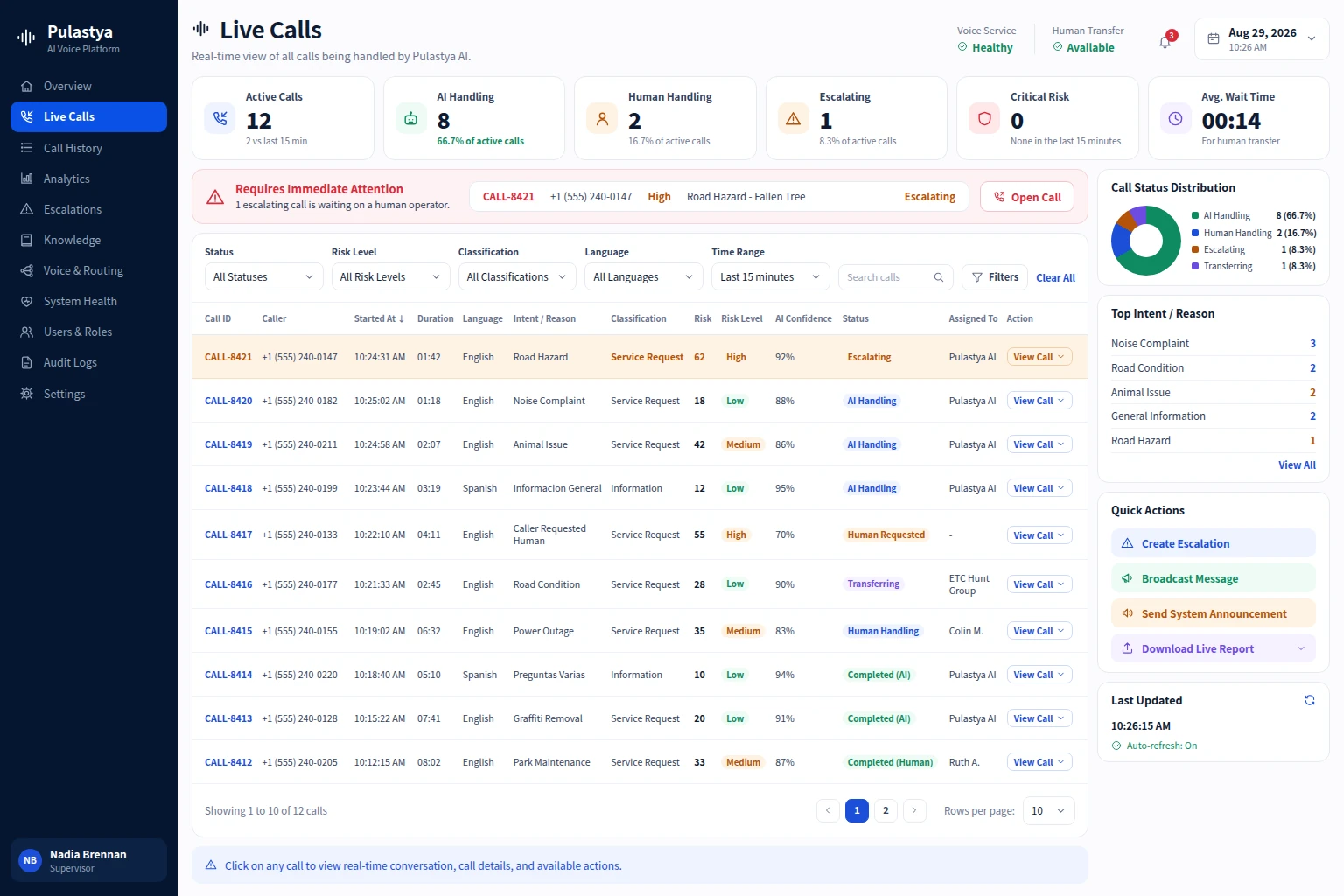
For example, a policy might let confidence above 0.85 proceed to automated resolution, send scores between 0.60 and 0.85 to a short clarification, and hand off sensitive intents below 0.60 to an agent. Validate calibration periodically against call logs and human labels.
Confidence must also feed reclassification. When a clarifying answer yields higher confidence for a different intent, the system should reclassify and restart the intent pipeline for the new primary goal.
This avoids wasted steps: a caller who says "reschedule and refund" and then answers "refund later" should move to a schedule-first flow without losing captured account information.
Operationalize confidence by mapping it to deterministic actions and measuring outcomes such as clarification rate, escalation rate per intent, and post-clarification resolution accuracy. Use those metrics to adjust thresholds, refine clarifying prompts, and find intents that systematically score low and may need new training data or rule-based overrides.
Taxonomy design and threshold governance are covered in more depth in voice AI intent classification.
- Define explicit confidence ranges and associated system actions for each intent class.
- Use clarifying prompts to lift confidence and allow reclassification when needed.
- Send classifier provenance to agents to reduce verification time on handoff.
- Monitor clarification outcomes and recalibrate thresholds based on real call data.
- Apply rule-based overrides for critical intents where confidence is unreliable.
Treat confidence as a policy input that triggers clear, auditable actions.
Session Context and Memory
A voice agent needs session-level memory to support multi-intent resolution across turns and callbacks. Store verified identity, recent intents, pending tasks, and last action timestamps in a session context that lasts for the call and, optionally, across scheduled follow-ups.
If the agent captures a preferred callback time in the first minute, that slot must still be available when it resolves a different intent twenty minutes later in the same call.
Design memory with retention policies and access controls. Keep transient fields for short-lived clarifications and durable fields for business actions such as case numbers, scheduled appointments, and payments.
Role-based access lets agents and analytics systems read the context they need without exposing sensitive data. A ticket for a billing dispute, for example, should include a redacted transcript and the list of completed verifications rather than raw PII. For layered memory and handoff payloads in general, see conversation context in AI voice agents.
Memory should also support branching dialog outcomes. If a scheduled background task updates an appointment, emit an in-session event that updates the state and tells the caller that a previously deferred intent is now resolved.
The same mechanism supports proactive notifications, such as a text or email confirmation when a repair slot is secured, so the caller does not have to contact the business again.
- Persist verified identity and shared slots across the session and follow-ups.
- Separate transient and durable memory with clear retention and redaction rules.
- Emit events to update state when backend processes complete asynchronous tasks.
- Provide redacted context to human agents to expedite handoffs without exposing PII.
- Use memory to enable proactive notifications that close deferred intents.
Session memory must be durable for business actions but ephemeral for sensitive verification data.
Orchestration and Backend Integration
Multi-intent resolution requires orchestration between the voice agent and CRM, billing, scheduling, and case management systems. An orchestration layer accepts intent vectors and slots, translates them into backend API calls, and manages transactionality across systems.
When resolving a refund and a rescheduled appointment together, for example, it should ensure both updates succeed, or perform compensating actions and notify the caller.
Design idempotent operations and clear error handling. Network timeouts and partial failures will occur, so the orchestration layer must interpret backend responses, retry where safe, and mark intents for human review when automatic recovery is unsafe.
Treat operations that change billing as high risk and route them through additional verification steps before automated execution to reduce chargeback risk.
Expose orchestration status to the caller and downstream agents. When an intent triggers asynchronous processing, provide the caller with a reference number and estimated next action. On agent handoff include orchestration logs, attempted actions, and error codes. This reduces duplicate work and enables service teams to prioritize remediation for intents stuck due to integration failures.
- Implement an orchestration layer that maps intent vectors to backend API workflows.
- Ensure operations are idempotent or have safe compensating actions for partial failures.
- Flag high-risk transactions for additional verification before automated execution.
- Attach orchestration logs and error codes to agent tickets to speed remediation.
- Use callback references and estimated timelines to keep callers informed when actions are asynchronous.
Orchestration must ensure transactional integrity and transparent status for callers and agents.
Conclusion
Multi-intent voice AI works best when it treats every caller request as a tracked goal rather than forcing the conversation into a single workflow. Detect intents early, reuse verified account details, and prioritize tasks by urgency and dependencies. With reliable session state and backend orchestration, the agent can complete independent actions without losing sight of requests that still need attention.
For production use, pair confidence-based clarification and escalation rules with safe transaction handling and clear partial-resolution paths. When an intent cannot be completed, the agent should preserve context, create a follow-up case, and explain the next step to the caller. Measure resolution, repeat contacts, and escalation outcomes regularly to improve both automation quality and customer experience.
Frequently Asked Questions
Confidence is compared to configured thresholds. A midrange score triggers a concise clarifying prompt aimed at disambiguating competing intents. A high score proceeds to automated resolution. A low score may escalate directly for sensitive intents or when multiple critical intents conflict.
Yes, when intents are independent and backend systems support parallel operations, the agent can invoke parallel workflows. For dependent intents, sequence rules apply. The orchestration layer enforces transactional constraints and schedules compensating actions on partial failures.
Complete the resolvable intent, create a case or schedule follow-up for the unresolved intent, and communicate both outcomes to the caller. Attach context, captured slots, and expected timelines to the queued task so the next interaction avoids repeating verification.
Persist verified slots in session memory and reuse them across intents. Only re-prompt when confidence drops or when a backend returns conflicting data. Provide human agents with redacted context so they can pick up without full re-verification.
Track clarification rate, containment rate, escalation rate, average time to resolve per intent, and post-call repeat contact for multi-intent calls. Monitor these by intent class to identify problematic flows needing policy or UX changes.