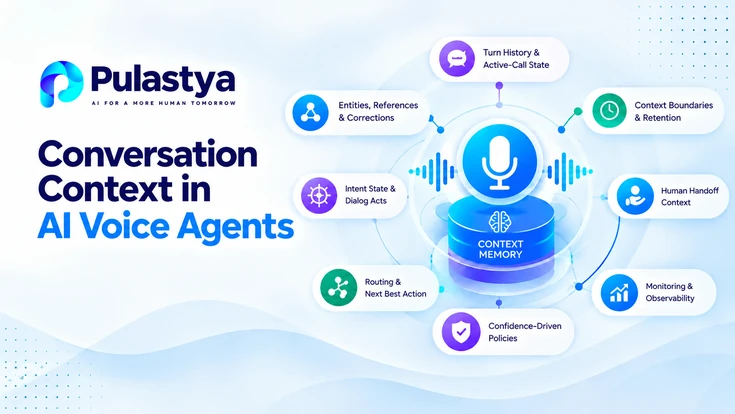
Conversation context defines what an AI voice agent remembers from a call and how that memory drives routing, clarification, and escalation. For enterprise deployments, context design shapes caller experience, error rates, compliance exposure, and agent efficiency.
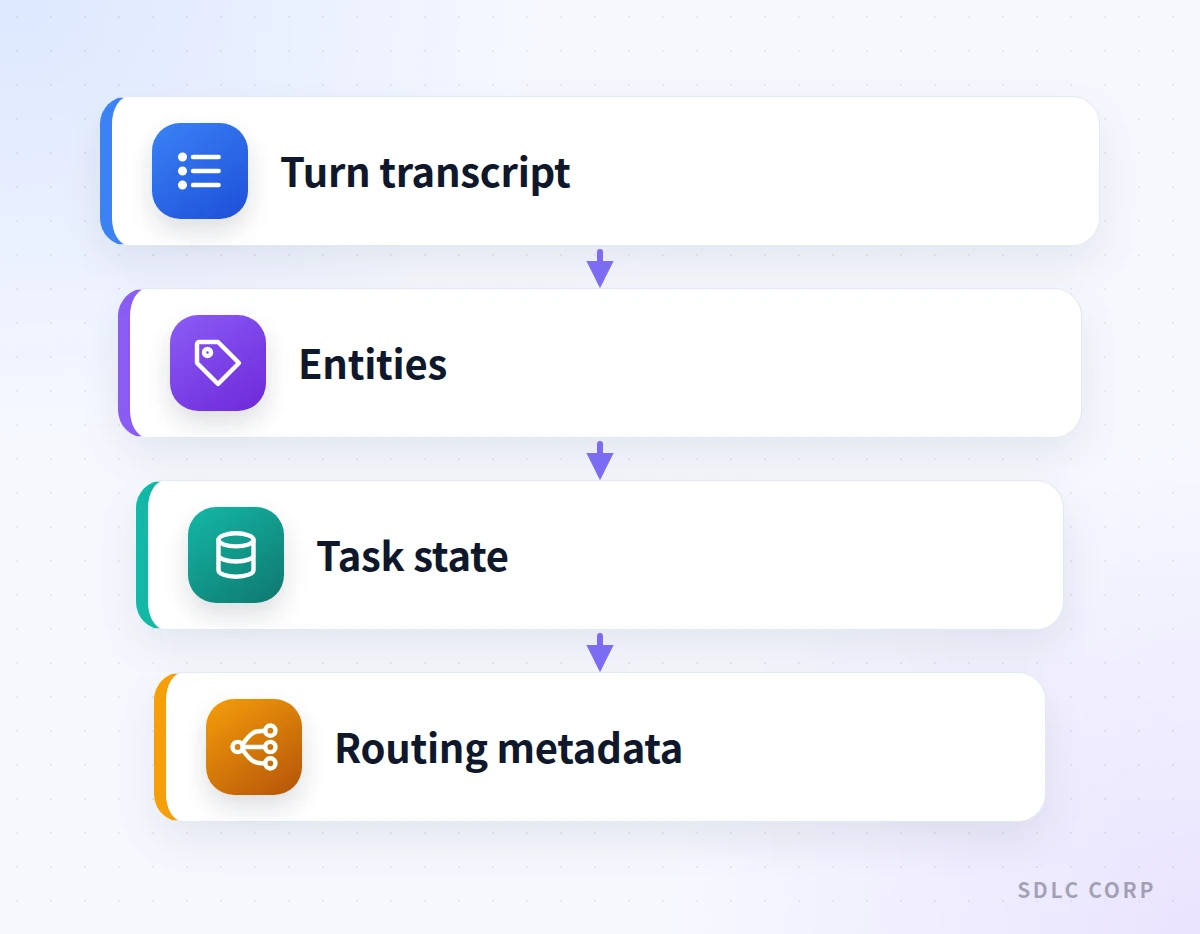
- Layered Context Treat turn-level transcripts, extracted entities, task state, and routing metadata as separate artifacts with independent lifetimes and access controls.
- Confidence as a Control Use model confidence scores as a policy input: low confidence triggers clarification, mid-level confidence triggers reclassification or verification, and very low confidence triggers immediate escalation per policy.
- Handoff Fidelity When passing to a human, provide a compact, structured snapshot: recent turns, validated entities, unresolved tasks, confidence history, and redaction flags to speed resolution and reduce repeats.
The key questions are which runtime artifacts a voice agent preserves, where permanence is appropriate, and how confidence signals change behavior during an active call.
Enterprise voice agents maintain several layers of context during a call: raw turn history, structured entities extracted from utterances, derived task state such as pending authorizations, and operational metadata like confidence scores and routing decisions.
Each layer has its own lifetime and access pattern. Designing those lifetimes explicitly avoids repeated prompts, prevents stale or over-retained data, and supports predictable escalation to human agents with minimal rework.
Real deployments also need operational rules for retention and boundaries: session timeouts, per-item persist flags, redaction rules for sensitive fields, and explicit handoff payload formats. The right defaults reduce false routes, speed resolution, and limit regulatory exposure.
Those defaults should fit common contact center architectures, with tradeoffs made explicit for latency, accuracy, and auditability.
Turn History and Active-Call State
Turn history is the sequential record of what the caller and the system said and did during a session. For voice agents it typically includes time-stamped ASR output, DTMF captures, NLU intent labels, and system prompts.
Keep recent turns in a buffer sized to the task: too small a window loses necessary context, while too large a window adds processing latency and cost. A common pattern keeps the last 6 to 12 turns in active memory for fast back-and-forth clarification.
Active-call state is the structured snapshot derived from turn history: current intent, active task identifier, partially completed form fields, pending authorizations, and last routing decision. Unlike raw turn logs, it is optimized for decisions and often held in a low-latency in-memory store.
Make state changes idempotent and record the triggering turn ID so audits can reconstruct how the agent reached each decision. A clear schema for state keys lets downstream systems consume handoff payloads reliably.
Turn retention trades off latency, searchability, and privacy. Short windows reduce storage and exposure but raise the risk of repeat questions. Longer windows support coherent multi-step flows but require redaction for sensitive fields and stricter access controls.
In practice, use configurable retention tiers: immediate working memory, a session log for the length of the interaction, and a separate audit store with stricter controls for compliance needs.
- Capture both ASR text and confidence at the turn level to support clarification logic and post-call analysis.
- Store a turn id and sequence number to enable idempotent state transitions and replay.
- Limit active turn history size with a configurable circular buffer to balance context and performance.
- Differentiate raw transcripts from cleaned, redacted transcripts for downstream consumption.
- Keep a changelog of state updates with timestamps and triggering utterance identifiers for audits.
Treat turn history as a short-lived working set and export only the structured state for downstream systems unless audit requirements dictate otherwise.
Entities, References, and Corrections
Entities are the structured pieces of information the agent extracts from speech: phone numbers, account IDs, dates, product names, and so on. Coreference resolution ties pronouns to those entities within the session, for example resolving 'it' to the invoice mentioned in the previous turn.
Store each entity with qualifiers: source turn ID, extraction confidence, normalization result, and whether the caller verified it. That metadata tells the agent whether an entity is safe to use without further verification.
Design correction flows intentionally. Callers correct ASR or NLU output with phrases like "no, my account is 12345" or "I meant tomorrow, not today." When that happens, mark the original entity as superseded but keep it in the audit trail.
Accept direct numeric corrections automatically for high-confidence formats such as 10-digit account numbers, but require explicit verification for more ambiguous corrections such as addresses or names.
Normalization involves a similar tradeoff. Aggressive normalization, such as canonical phone formats and address standardization, speeds downstream processing but can mask what the caller meant when it introduces errors. Conservative approaches add verification prompts but reduce misrouted cases.
Standardize normalization pipelines and expose a verification flag so routing and billing systems know whether a value was confirmed by the caller or inferred by the system. The guide to voice AI data extraction covers normalization, validation, and payload design step by step.
- Record entity source, normalized value, extraction confidence, and verification flag for each extracted field.
- Implement correction handling that marks superseded values but preserves original entries for audits.
- Auto-accept corrections for high-precision formats while prompting verification for ambiguous entities.
- Use coreference resolution to link pronouns to last referenced entities within the session window.
- Expose entity verification status to routing logic and human agents to avoid repeated queries.
Treat corrected values as the authoritative source for the active session, but preserve originals for audit and error analysis.
Context Boundaries and Retention
Context boundaries define how long session artifacts live and where they may travel. Typical boundaries are session-scoped (valid only while the call is active), short-term retention (available for post-call diagnostics for a fixed window), and long-term retention (archived logs for compliance).
Set explicit time-to-live (TTL) values by artifact type: raw audio, raw transcripts, structured entities, and audit logs. The governance model should map those TTL values to business needs and regulatory requirements.
Retention policy must also cover context across sessions. Some enterprises want limited continuity between calls for recognized callers to reduce authentication friction; others must treat every call as separate for security reasons.
Implement opt-in, opt-out, and per-caller consent markers, and enforce them in the context access layer. If cross-session memory is enabled, store only validated entities with explicit consent and provide an easy way to revoke it.
Enforcement requires automated redaction, role-based access controls, and retention automation. Redact sensitive PII fields in short-term diagnostic stores and make them available only through secure retrieval for compliance reviewers.
Log who accessed which artifact and why. Auditable deletion routines help meet regulatory demands and data subject requests without disrupting ongoing operations.
- Define TTL by artifact: audio, raw transcript, structured entities, and audit logs.
- Implement consent flags and per-caller memory opt-in for cross-session retention.
- Automate redaction pipelines for defined PII fields before moving data to diagnostic stores.
- Use role-based access control for retrieval and record all access in an audit log.
- Provide reproducible deletion procedures to satisfy data subject access and retention policies.
Explicitly map retention tiers to business and regulatory requirements and enforce them with automation and access controls.
Context Passed at Human Handoff
Human handoff is where context management pays off most. A compact, structured handoff payload should include the last several turns, validated entities and their verification status, the active task ID, recent confidence measurements, and a short narrative of unresolved issues.
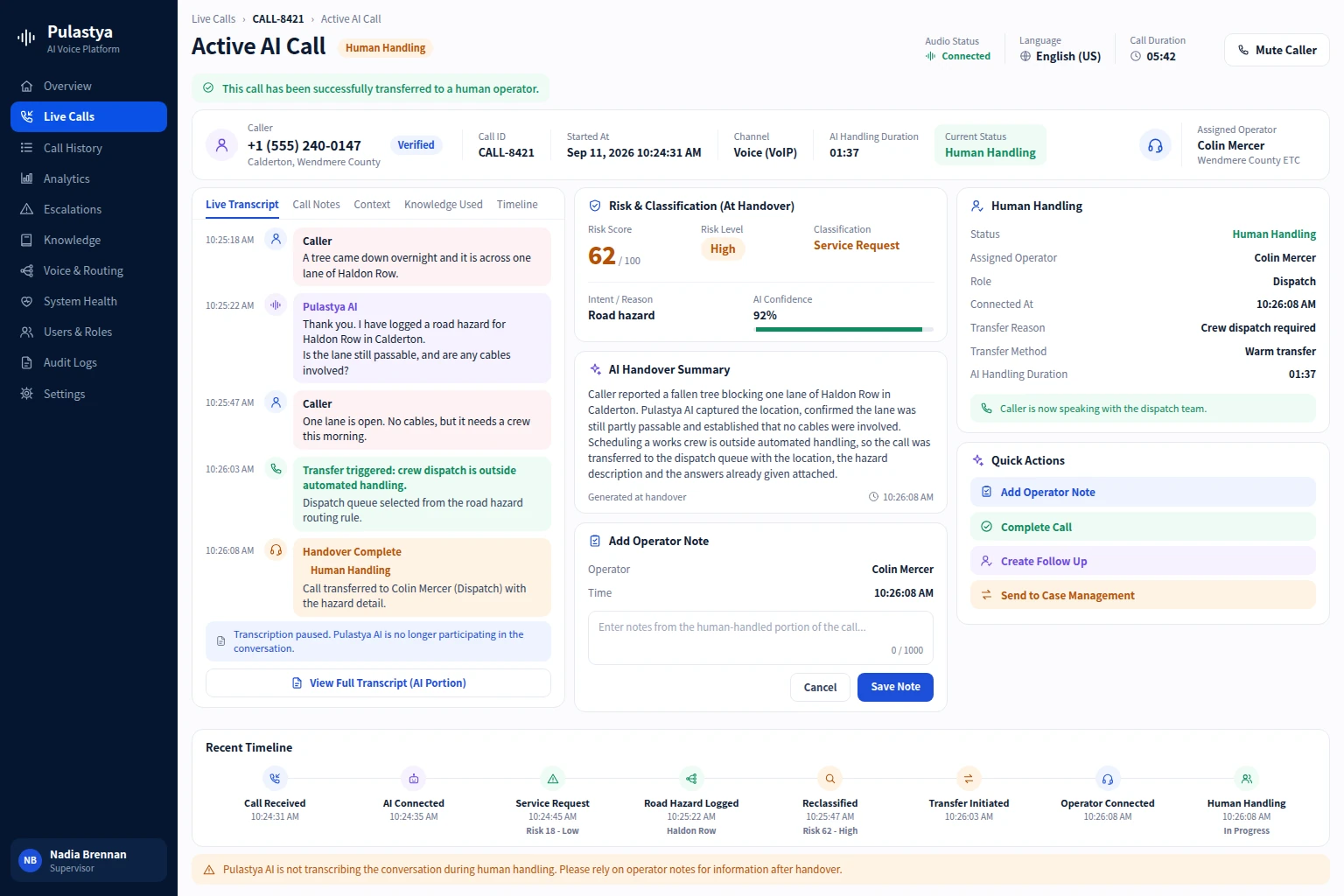
Avoid dumping raw transcripts. A curated snapshot that highlights decision points and completed verification steps reduces repeat questions and helps live agents resolve the call on first contact.
Include the escalation reason and the policy trigger in the handoff. A policy may escalate when confidence has trended down for three consecutive turns, when the caller asks for a human, or when required authorization cannot be completed automatically.
Encoding the trigger lets the human agent see not only what failed but why the handoff happened, which speeds corrective action and improves the caller experience.
Control what reaches human-facing systems to limit exposure. Strip or tokenize sensitive fields unless the receiving role requires them and the agent session is secured.
Use layered delivery: a minimal payload for initial routing, plus a secure retrieval endpoint that supervisors can open when needed. Record the handoff event in the audit trail with the exact payload delivered and the receiving agent's identity.
- Deliver a structured handoff with last N turns, validated entities, task id, and escalation reason.
- Include confidence trend and the policy trigger that initiated escalation to human agents.
- Tokenize or redact sensitive data unless explicitly required and authorized for the receiving role.
- Support a two-stage handoff: minimal routing snapshot plus secure retrieval for full details.
- Log handoff payload and receiving agent identity in the audit system for traceability.
Design the handoff payload to minimize caller repetition while enforcing the least-privilege principle for sensitive data.
Context memory lifecycle
How Call Context Moves From a Single Turn to a Handoff Package
- Turn contextRecent turns in a bounded buffer: ASR text, DTMF, intent labels and confidence
- Extracted and retrieved factsEntities and looked-up values with source turn, confidence and verification flag
- Session stateCurrent intent, task ID, filled fields and pending authorizations for this call
- Persisted business dataOnly validated fields are kept, under TTLs, redaction rules and consent flags
- Handoff packageRecent turns, verified entities, task ID, confidence trend and escalation reason
Raw turns are distilled into verified facts and state, so the human agent gets a curated handoff package rather than a raw transcript dump.
Confidence-Driven Policies and Clarification
Confidence scores are a core control for deciding whether the voice agent should act, ask a clarifying question, reclassify, or escalate. Model outputs typically carry confidence at several layers: ASR, entity extraction, and intent classification.
Use a tiered policy: high confidence allows automated fulfillment, medium confidence triggers verification prompts or rephrasing, and low confidence leads to escalation per configured thresholds. Keep thresholds configurable so teams can tune them to business risk.
Keep clarification prompts short, deterministic, and de-escalating. If intent confidence is medium, ask a closed question such as "Did you mean to pay invoice 9876?" instead of an open-ended prompt that invites new topics. For uncertain entities, repeat the extracted value and ask for confirmation.
Track clarifications per session and escalate when they fail to converge, which avoids endless loops that frustrate callers.
Confidence should also feed reclassification. If later turns raise confidence for a different intent, the system can switch intents through a defined reconciliation step: confirm the new intent, carry over compatible entities, or reset task state if they are incompatible.
Log confidence transitions and reconciliation actions so analysts can tune models and policies from observed failure modes rather than intuition.
- Combine ASR, entity, and intent confidence into a composite decision metric for policies.
- Set configurable thresholds for automated action, verification prompt, and escalation.
- Use short, closed clarification prompts to reduce dialog length and reconfirm extracted values.
- Limit clarification attempts per session and escalate if convergence fails.
- Record confidence trajectories and reconciliation decisions for tuning and audits.
Treat confidence as a governance input, not a single-stop decision: it should trigger verification, reclassification, or escalation according to policy.
Dialog Acts, Intent State, and Routing
Dialog acts are the agent's internal representation of what the caller is doing: asking, confirming, requesting, or rejecting. Maintain an intent state machine that records the active dialog act, the intent stack, and allowed transitions.
For example, a 'payment' intent may permit 'confirm amount' and 'collect authorization' acts. If the caller diverges to 'billing dispute', the machine should push a new intent or trigger reclassification. Explicit state machines reduce ambiguity and make testing deterministic across complex paths.
Routing decisions combine intent state with operational metadata such as caller priority, business hours, and agent skills. Key the routing table by intent ID and priority flags, and include fallbacks for low-confidence intents, such as queueing to a human with minimal routing criteria.
For multi-intent calls, prioritization rules should let critical intents like safety reports or fraud take precedence over routine requests so the caller reaches an appropriately skilled human promptly. The guide to multi-intent voice AI covers sequencing and partial resolution in more depth.
Map intent states to backend actions carefully. Some intents need synchronous backend calls during the call for real-time validation; others can create asynchronous tasks for post-call processing.
Synchronous validation improves accuracy but can add hold time. Set timeouts and circuit breakers on backend calls so the agent can switch to an alternate flow instead of leaving the caller waiting indefinitely.
- Model dialog acts and intents as a state machine with explicit transitions and push-pop semantics for multi-topic calls.
- Use intent-priority rules to route critical issues faster than lower priority tasks.
- Bind intent states to routing table entries that include skill requirements and fallback queues.
- Decide per intent whether backend calls should be synchronous or asynchronous based on latency tolerance.
- Implement circuit breakers and timeouts to preserve caller experience when backend systems are slow.
Make dialog act state machine rules explicit so routing and backend integration behave predictably under multi-intent calls.
Monitoring, Observability, and Operational Controls
Context management needs observability to expose failures and tune policies. Track average clarifications per call, the rate of low-confidence escalations, entity extraction accuracy for critical fields, and handoff repeat rates, where callers must repeat information to a human agent.
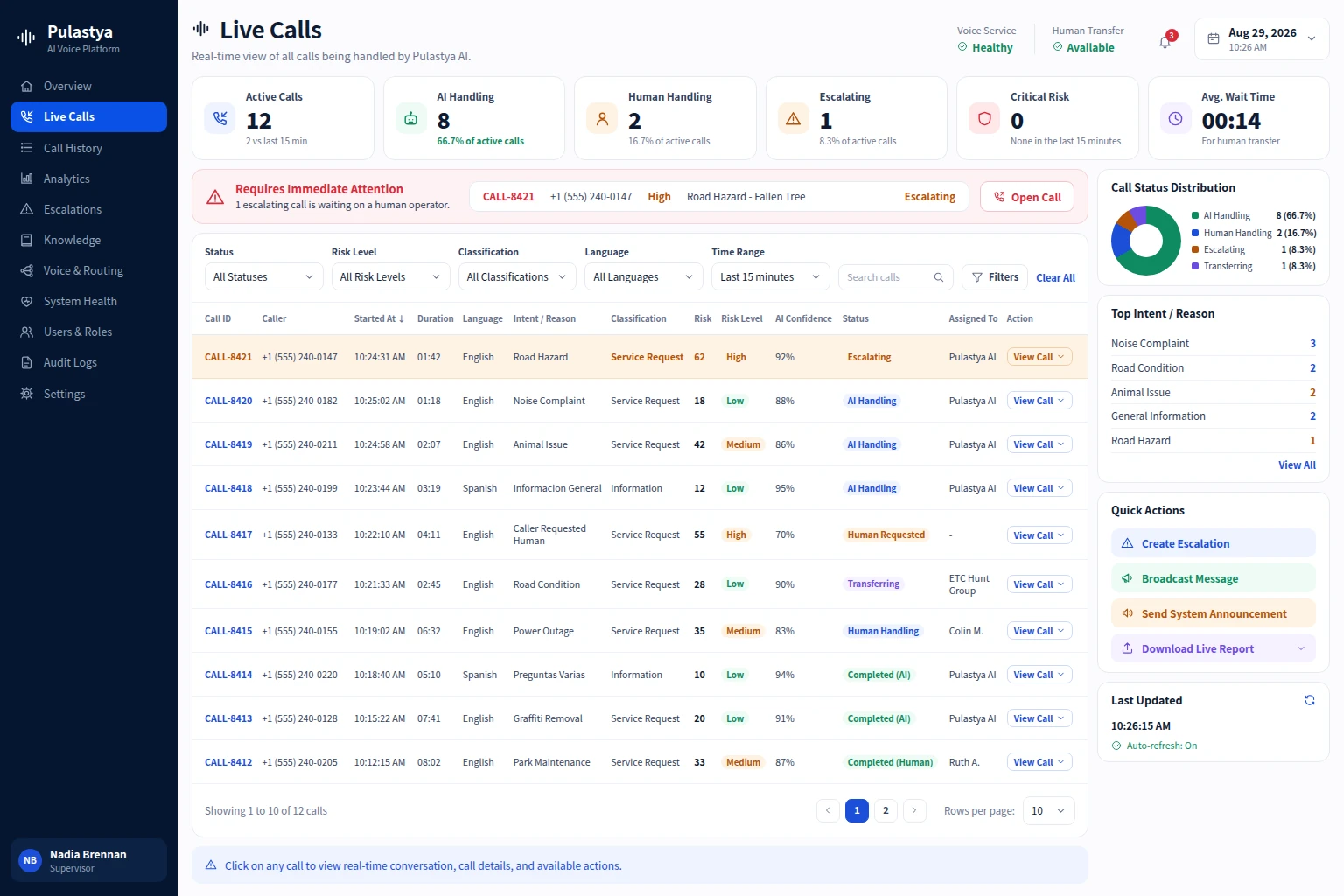
Alert on sudden regressions, for example when clarification counts spike after a model change or a new normalization pipeline introduces errors.
Support targeted troubleshooting with context-level tracing and safe replay. Give support engineers a view of the structured session snapshot used at decision time without exposing raw PII, with redacted views and time-limited access tokens for deeper analysis.
A replay mode that steps through state transitions and policy decisions speeds root cause analysis and shows whether thresholds or model outputs caused a handoff.
Operational controls should include feature flags for context behaviors, canary rollouts, and a feedback loop from human agents into context policy design. Let business owners change clarification thresholds, retention TTLs, and handoff payload contents through a controlled interface, and audit those changes.
Exportable reports that correlate policy settings with handle time, resolution rate, and compliance incidents help leadership make informed adjustments.
- Monitor clarification count, escalation rate, entity accuracy for critical fields, and handoff repeat rates.
- Provide redacted, role-based session views and time-limited access for troubleshooting.
- Implement replayable state transition logs to diagnose policy and model interactions.
- Use feature flags and canary rollouts for changes to context and clarification policies.
- Correlate policy settings with business KPIs such as handle time and first-contact resolution.
Make context behaviors observable and controllable so operators can tune policies based on measurable business outcomes.
Conclusion
Effective conversational context is not about preserving every spoken word. It means keeping the right turn history, verified entities, active task state, and routing signals available for the right amount of time. Clear retention boundaries, consent controls, redaction, and traceable state changes help AI voice agents respond consistently while protecting caller information.
For reliable enterprise deployment, turn these principles into configurable policies and measure clarification rates, entity accuracy, escalation quality, and repeated questions after human handoff. Combine confidence-driven decisions with concise handoff summaries and auditable state logs. This allows contact center teams to refine conversations, improve resolution, and understand why an agent acted or escalated.
Frequently Asked Questions
The agent keeps layered artifacts: short-lived turn transcripts, structured entities with verification flags, derived task state such as pending authorizations, routing metadata, and confidence scores. Each artifact has an independent lifetime and access control to balance usability and privacy.
Treat confidence as a policy input with configurable thresholds: high confidence allows automation, medium confidence triggers concise verification prompts, and low confidence triggers escalation. Log confidence trajectories so thresholds can be tuned against business risk and customer experience metrics.
A compact payload should include the last several turns, validated entities and verification status, active task id, the escalation reason, and recent confidence trend. Tokenize or redact sensitive fields unless the receiving role requires them and access controls allow it.
Yes, but only with explicit consent and strict controls. Store only validated, consented entities for cross-session use and provide opt-out and revocation mechanisms. Map cross-call memory to use cases like authenticated preferences while minimizing PII exposure.
Implement structured changelogs and replayable state transitions, keep role-based redacted views for support, and capture the precise handoff payload and receiving agent identity. Correlate these traces with metrics like clarification counts and escalation rates to identify root causes.