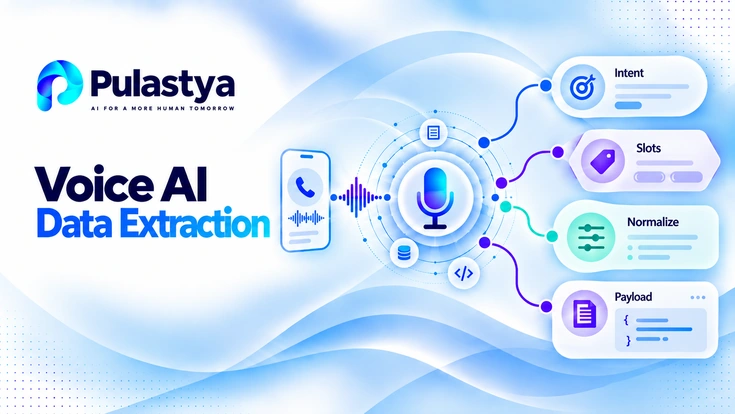
Voice AI data extraction turns spoken requests into operational inputs that feed routing, workflow, reporting, and human review.
A practical workflow runs from raw audio to validated structured fields, showing how intent, slots, normalization, confidence, and payloads work together in production voice systems for enterprises.
- Deterministic field mapping Design canonical slots and mapping rules so every common utterance maps predictably to a target field, reducing downstream exceptions and simplifying validation logic.
- Confidence-driven flows Treat model confidence scores as control signals: low confidence can trigger clarification prompts, alternate classification, or escalation to a human, according to configurable thresholds.
- Audit-rich payloads Produce structured payloads that include raw transcript, intent id, slot origins, confidence scores, and rule evaluations to support debug, compliance, and analytics.
Enterprises deploy voice AI to accept spoken instructions across contact centers, field service, and in-vehicle systems. The core problem is consistent: capture freeform speech, map meaning to discrete fields, validate values against business rules, and emit a reliable structured payload.
Solving it takes attention to real call behavior, operational tradeoffs, and policies that use confidence to trigger clarification, reclassification, or escalation.
A production voice data pipeline spans components: ASR, intent classification, slot filling, normalization, rule-based validation, and payload emission with audit metadata. Each stage affects latency, error patterns, and downstream automation rates. Practical controls include configuration options, sample utterances that expose edge cases, and clear policies for human-in-the-loop review and compliance logging.
From Spoken Language to Structured Fields
The first stage is capturing an utterance and converting it into an annotated representation. A typical enterprise call begins with a request such as "I need to reschedule my delivery to next Tuesday" or "Yes, move the appointment to 3 p.m."
The pipeline must isolate intent, extract time, date, and identifier slots, and retain the raw transcript so reviewers can reconstruct decisions. Include channel metadata such as caller ID and ASR engine version.
ASR output is seldom perfect, so add punctuation normalization and a noise-tolerant preprocessor to reduce downstream parsing errors. For example, "3 p.m." may render as "three pm" or "3pm"; normalization rules should produce a consistent token.
Domain-specific pronunciation lexicons for proper nouns, product codes, and street names common to your customer base reduce the substitution errors that break field mapping.
Capture annotations at the time of extraction: token-level confidences, alignment timestamps, and ASR alternatives. These artifacts let downstream logic prefer a higher-confidence alternative when a slot conflicts with business rules. For multimodal flows, attach screen context or form state to the utterance to disambiguate pronouns and short answers such as "yes" or "that one."
- Store the full ASR n-best list with scores when legal policy permits for forensic analysis.
- Keep alignment timestamps to allow precise audition during QA and to reconcile agent edits.
- Attach channel metadata including device type and network quality to identify recurring error sources.
- Prefer domain lexicons for product SKUs, locations, and proper names to lower substitution errors.
- Log ASR engine and model id to associate regressions with model updates.
Start by capturing rich ASR output and context to make later mapping and audits reliable.
Extraction pipeline
How a Spoken Request Becomes a Structured Payload
- TranscriptASR text with word confidence, n-best alternatives, timestamps and caller metadata
- Intent and entity extractionClassify the action and fill slots such as date, order number or address
- Normalization and field mapping"Next Friday" becomes an ISO date; phone numbers use E.164; tokens map to fields
- Validation and confirmationBusiness rules check values; uncertain or high-risk slots are read back or escalated
- Structured payload to target systemTyped fields plus confidence, rule versions and a transaction ID for safe retries
Values are normalized before they are validated and read back, so the caller confirms the exact date or number the target system will receive.
Normalization and Field Mapping
Normalization turns diverse surface forms into canonical values. Dates, times, units, phone numbers, and monetary amounts need deterministic rules. For example, "next Friday", "the 14th", and "Friday week" must resolve to concrete ISO dates relative to a reference time.
Apply a deterministic precedence: explicit calendar dates take priority over relative references, and ambiguous two-digit years map with configurable cutoff logic.
Field mapping links normalized tokens to enterprise fields. For example, utterances that mention an order or order number map to the purchase_order_id slot, and phrases with delivery, ship, or drop off map to the delivery_address slot.
Use pattern-based matchers for structured tokens like invoice numbers and flexible NER models for names. Keep the mapping table versioned and environment specific to enable safe rollouts.
Handle ambiguous tokens with explicit policies. If a spoken phrase could be either a product name or a location, use contextual signals such as recent screen focus or prior conversation history.
Provide a fallback route: if mapping confidence is low and no context resolves ambiguity, prompt a clarified question or flag for human review based on the configured SLA for the flow.
- Define canonical field formats such as ISO 8601 for dates and E.164 for phone numbers to standardize downstream consumption.
- Version mapping tables and include release notes for each change to facilitate rollback after regressions.
- Use regex and grammar rules for rigid patterns, and reserve ML NER for soft categories like names.
- Use session context to resolve short answers and pronouns before invoking clarification flows.
- Implement a deterministic precedence order for conflicting normalizations to avoid oscillation.
Canonicalize values early and keep mapping rules versioned to control production behavior.
Intent Classification and Slot Filling
Intent classification assigns the business action, while slot filling extracts the parameters needed to execute it. In a billing call, the intent might be dispute_charge, with slots for amount, transaction_id, and reason.
For short utterances like "I want a refund", the classifier must tolerate missing slots and trigger a follow-up sequence that collects the required data before routing to automation. For how the intent labels themselves are designed, see voice AI intent classification.
Design intent schemas that reflect operation-level actions rather than marketing terms. Keep intents granular enough to allow different downstream automations but not so granular that classification accuracy degrades. For example, use intent reschedule_appointment instead of a generic update_request, enabling a targeted slot collection script and SLA mapping for rescheduling flows.
Slot confidence must be surfaced alongside intent confidence. When an intent is high-confidence but a critical slot has low confidence, policy should prefer slot-level clarification rather than rerouting the entire request. Example runtime policy: if intent_confidence > 0.85 but slot_confidence < 0.6 for a required slot, ask a precise confirmation question limited to that slot.
- Model intents around executable business outcomes to simplify routing and SLA assignment.
- Treat slots as typed fields with expected formats, required flags, and validation rules.
- Expose both intent and slot confidence to policy engines to drive clarifications.
- Support multi-intent sessions and maintain intent history for session-scoped disambiguation.
- Use deterministic slot coercion for minor format variations, and escalate when coercion would risk action failure.
Model intents for actionable outcomes and use slot-level confidence to guide minimal clarifications.
Validation and Confirmation
Validation enforces business rules before automation. Examples include checking that a requested delivery date falls within serviceable zones or that a refund amount does not exceed the original charge. Implement rule engines with prioritized checks: syntactic validation first, then business logic that may require external system lookups such as order status or inventory availability.
Confirmation strategies should be proportional to risk and SLA. Low-risk confirmations can be implicit via a single clarifying prompt, for example "Did you mean Tuesday the 14th at 3 p.m.?" High-risk actions such as changing billing instructions or authorizing refunds above a threshold require explicit spoken consent or handoff to an agent. Capture explicit confirmations as structured boolean fields with timestamps.
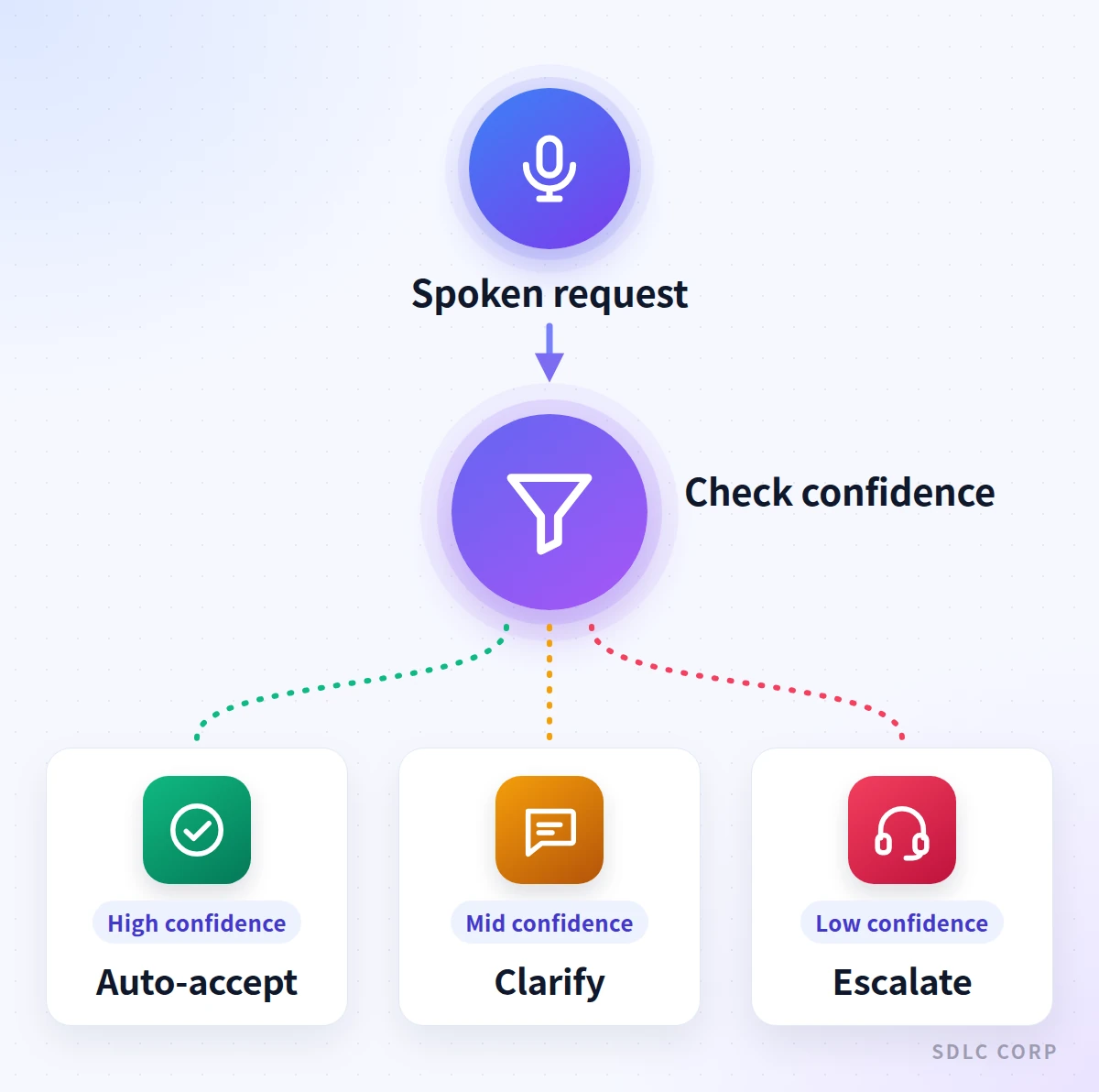
Use confidence to choose confirmation mode. If ASR and slot confidences are high, proceed with low-friction confirmations or silent automation. If any required slot has low confidence, trigger a targeted confirmation dialog. If repeated attempts fail or confidence remains low, escalate to human review and record the reason code in the audit payload.
- Prioritize syntactic checks first, then call external services for contextual validation to minimize latency.
- Classify actions by risk to determine whether implicit confirmation is acceptable or explicit consent is required.
- Record confirmation text and timestamp as part of the structured record for compliance.
- Configure tiered confirmation: quick rephrase, full repeat, and human escalation based on confidence thresholds.
- Add reason codes when escalating to enable downstream analytics on common failure modes.
Tie validation depth to business risk and let confidence scores select the least disruptive confirmation path.
Structured Payloads and Audit Context
A production payload contains canonical fields ready for downstream systems plus rich provenance metadata. Essential elements are intent ID, normalized slots, slot and intent confidence scores, raw transcript, n-best alternatives, timestamps, ASR engine ID, mapping rule version, and any external validation results.
Include environment and correlation IDs to link the record to a session and the enterprise event stream.
Design payload schemas for both machine and human consumers. Machine-oriented fields must be typed and consistent. Human-oriented audit fields should be verbose enough to reconstruct the conversation: include the confirmation prompts issued, user responses, and reason codes for any clarifications or escalations. This dual-focus payload supports automated processing while preserving compliance and QA needs.
Plan retention and access controls for payloads. Sensitive fields like payment tokens or personal identifiers must be redacted or stored in encrypted vaults and referenced by token. Implement role-based access so that only authorized reviewers can retrieve full transcripts. Store a pared down machine-readable record for long-term analytics while maintaining detailed logs in a regulated retention tier.
- Emit intent id and normalized slots with explicit types to support downstream automation.
- Include provenance fields such as mapping table version and ASR model id to simplify debugging.
- Store confirmation transcripts and timestamps for auditability and dispute resolution.
- Redact or vault sensitive data and use pointers in the main payload to control access.
- Provide a compact analytics record and a separate detailed audit record for compliance retention.
Produce payloads that balance immediate automation needs with long-term auditability and access controls.
Confidence-Driven Clarification and Escalation
Confidence scores are operational controls, not mere diagnostics. Map confidence ranges to actions: automatic accept, targeted clarification, reclassification attempt, or escalate to a human. For example, set intent acceptance above 0.9 as automatic, between 0.7 and 0.9 as require slot confirmation, and below 0.7 as route to an agent. These thresholds should be empirical and revisited during monitoring cycles.
Clarification prompts should be minimal and explicit. For a low-confidence address slot, ask "Where should we deliver? Please confirm the street number and city" instead of asking for the entire request again. Short confirmation grammars constrain ASR error during clarification.
When repeated clarifications still yield low confidence, run a reclassification pass using additional context, or escalate based on SLA and risk.
Escalation policies must include queue routing, handoff context, and expected response SLAs. When escalating, pass the full payload and a concise summary of ambiguity reasons to the agent interface, for example low confidence on delivery_zip and conflicting validation against system records. Record the escalation trigger and final resolution in the audit log for continuous improvement.
- Define confidence bands and map each band to a deterministic action to avoid ad hoc behavior.
- Use narrowly scoped clarification prompts to limit ASR error during follow ups.
- Attempt reclassification with expanded context before escalation when appropriate.
- When escalating, attach concise ambiguity diagnostics and the full transcript to reduce agent triage time.
- Continuously tune thresholds using post-call resolution data to balance automation and agent load.
Operationalize confidence into deterministic actions and tune thresholds with real resolution data.
Integration and Routing Best Practices
Integrate the structured payload into downstream systems using idempotent APIs and correlation ids to prevent duplicate actions when retries occur. For example, include a client_transaction_id that the fulfillment system can use to detect and ignore duplicate reschedule requests. Standardize HTTP response codes and error payloads so the calling service can take deterministic recovery steps.
Design routing logic that uses both intent and business context, so high-value customer requests can be routed differently from low-risk queries.
For instance, a high-value account requesting appointment changes might default to human-assisted automation with a short confirmation, while simple address updates for low-value orders can be fully automated. Include SLA tags in the payload so routing policies can honor priority and compliance constraints.
Monitor end-to-end observability metrics including automation success rate, time to confirmation, escalation rate, and false positive confirmations. Correlate these metrics with mapping table versions, ASR model updates, and lexicon changes to identify regressions. Build dashboards for stakeholders and schedule regular reviews to adjust normalization and confidence thresholds based on empirical outcomes.
- Use idempotent transaction ids in payloads to avoid duplicate downstream side effects.
- Include SLA and priority tags to drive routing rules and agent allocation.
- Expose consistent error semantics in integration contracts for automated retries.
- Segment routing by risk and customer value to optimize agent capacity.
- Instrument correlation between model and mapping changes and automation KPIs to detect regressions.
Use idempotent payloads and context-aware routing to make automation safe and auditable.
Structured capture becomes critical on claims calls, where every loss report needs consistent fields. The guide to AI voice agents for insurance policy and claims calls applies these patterns to first notice of loss intake.
Conclusion
Reliable voice AI data extraction requires more than converting speech into text. Enterprise systems need accurate intent classification, typed slot extraction, consistent normalization, and business-rule validation before any request becomes an automated action. Versioned field mappings, structured payloads, and idempotent integrations help keep this process predictable, traceable, and safe.
Confidence-driven confirmations and human escalation provide safeguards when spoken details are unclear or actions carry greater risk. By protecting sensitive data, preserving appropriate audit context, and reviewing extraction errors, automation success rates, and escalation patterns, teams can steadily improve voice workflows without sacrificing accuracy or accountability.
Frequently Asked Questions
Treat confidence scores as control signals. Define confidence bands that map to actions such as automatic acceptance, targeted clarification, reclassification attempts, or escalation. Use empirical thresholds tuned with post-call resolution data rather than fixed theoretical values.
The machine payload should contain typed normalized fields required for automation. The audit payload should include the raw transcript, n-best ASR alternatives, mapping versions, confidence scores, confirmation dialog transcripts, and reason codes for clarifications or escalations to support QA and compliance.
Escalate when required slot confidence remains low after targeted clarifications, when business risk exceeds configured thresholds, or when external validation fails and the action has high potential impact. Ensure escalations include concise diagnostics to minimize agent triage time.
Redact or vault sensitive data fields and reference them with secure tokens in the main payload. Apply role-based access controls for detailed transcripts and maintain encryption in transit and at rest. Retain sensitive audit logs only within regulated retention tiers.
Reduce errors by using domain lexicons for proper nouns and SKUs, enforcing typed slot formats, applying deterministic normalization rules, and constraining confirmation grammars. Monitor error patterns and update lexicons and mapping rules based on real production failures.