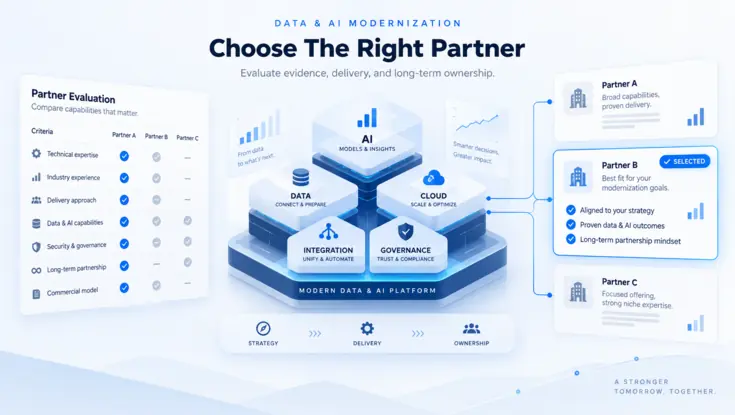
Choose a data and AI modernization partner by the evidence they can show, the way they will deliver, and how well they will transfer ownership to your team.
Start by defining the business outcome, architecture constraints, control requirements, delivery model, and handover expectations.
Then ask each partner to prove that they can work inside those conditions with real artefacts such as plans, test evidence, monitoring examples, release records, and knowledge transfer material.
Use the scorecard as a directional comparison tool, not as a universal procurement formula. Adjust weights to reflect the risks and capabilities that matter most to your programme.
The Right Partner Reduces Decision And Delivery Risk
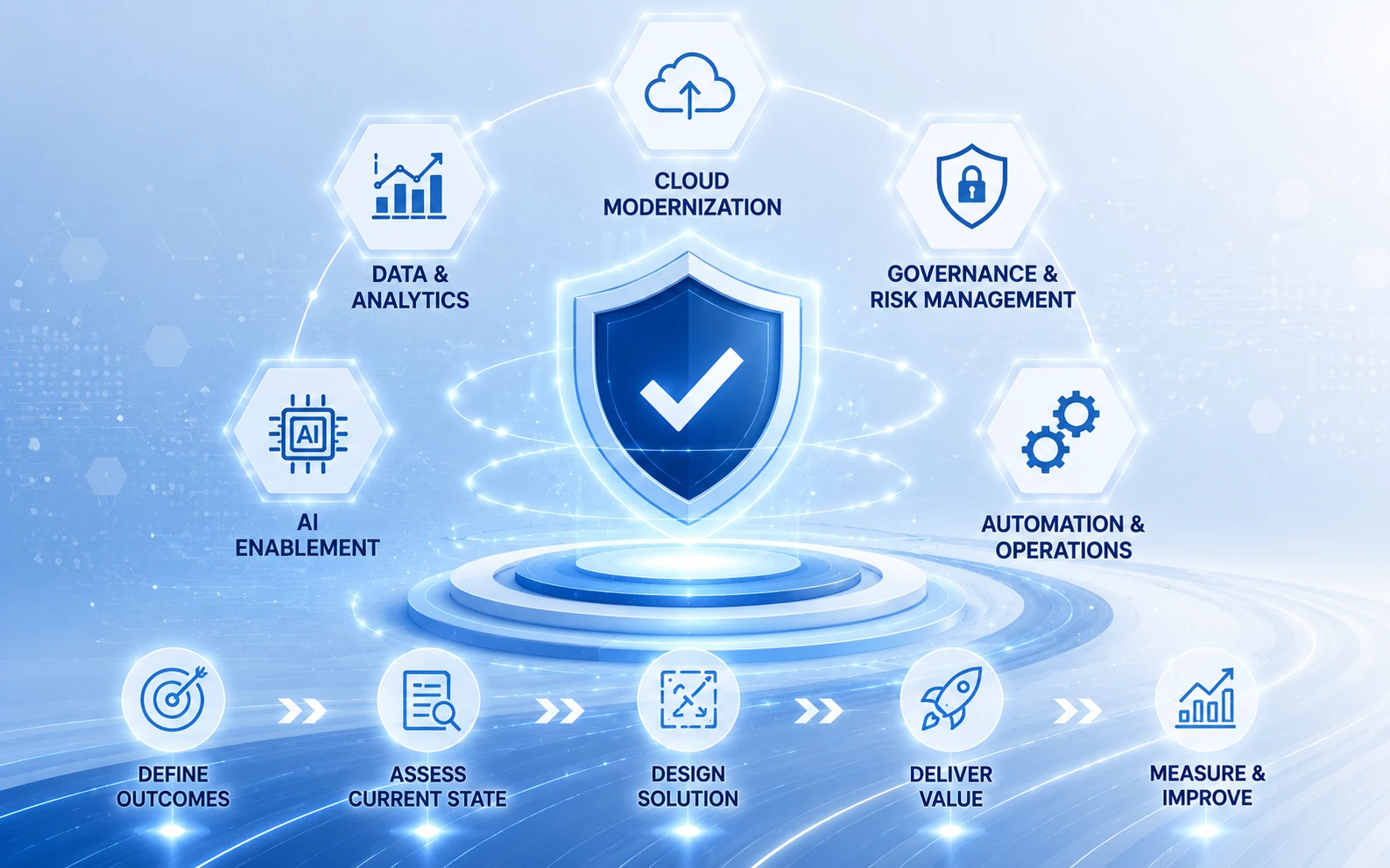
The procurement objective is predictable delivery with a clear handoff plan. Look for milestone evidence, pragmatic architecture, and usable governance controls. Assess partners on accountability, not on headline capability lists.
Partner choice matters because large programs rarely fail quietly. A McKinsey analysis of more than 500 large capital projects found cost overruns averaging at least 79% of initial budgets and delays averaging 52% of planned timelines.
Software delivery shows the same pattern. Standish Group CHAOS research for 2020 reported that about 31% of IT projects succeeded, 50% were challenged on time, budget, or scope, and 19% failed outright.
In both cases the recurring causes sit in scope, ownership, and execution discipline rather than in the technology itself. Those are exactly the conditions a partner evaluation should test.
Define risk tolerance by outcome and by domain. A finance reporting program can accept less experimentation, but it needs stronger lineage and auditability. An ML pilot may allow more early model instability, but it still needs reproducible pipelines before production.
Match partner case studies to those real risk profiles.
Use short evaluation cycles and contract gates to avoid long blind investments. Tie acceptance to operational metrics such as data freshness, model reproducibility, recovery time, and knowledge transfer milestones. Those gates convert promises into verifiable progress.
- Prioritize accountable outcomes over feature lists
- Map partner experience to your risk profile
- Require acceptance criteria tied to operational metrics
- Prefer partners who commit to measurable handoff milestones
Select for measurable accountability, not only tool expertise.
When the next question is how to sequence the work after this decision, review enterprise data and AI modernization roadmap.
Start By Defining The Outcomes And Scope
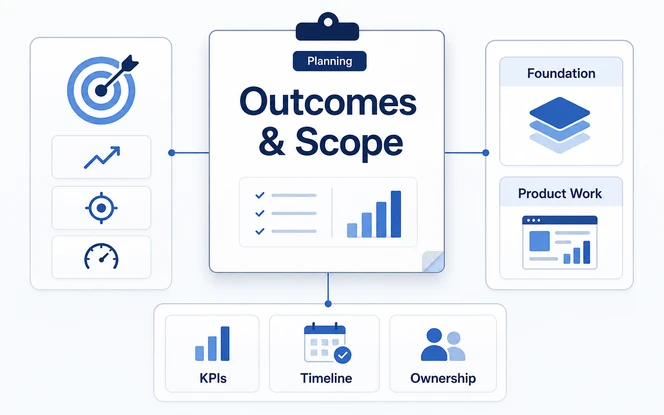
Begin with a one page outcomes statement. List the business objectives, target metrics, and delivery horizon. Also state what stays in house, such as data access, domain modeling, or regulatory oversight. That clarity reduces ambiguity when you compare partner plans.
Scope must separate foundation work from product work. Foundation items include cloud landing zones, identity integration, data cataloging and core ingestion. Product work includes BI dashboards, ML models and automation.
A vendor can deliver both, but contracts and scoring should differ since foundation work is durable infrastructure while product work often iterates rapidly.
If the foundation scope includes moving warehouses, lakes, or pipelines to the cloud, align it first with your cloud data modernization strategy for enterprises so partners price against the same target platform.
Create success metrics that are verifiable and operational, for example a 24 hour reduction in reporting cycle time, reproducible model training and an SLA for data pipeline recovery.
Attach responsibility: which KPIs the partner is contractually accountable for, which KPIs your teams own, and which outcomes require shared accountability. This clarity prevents post delivery disputes over ownership.
- Produce a one page outcomes and scope statement
- Separate durable foundation from iterative product work
- Define verifiable success metrics and ownership
- Require timeline and acceptance criteria for each outcome
Outcomes and clear ownership boundaries focus evaluation and pricing.
For the security and privacy controls that support this delivery plan, review data security and privacy in enterprise AI.
Evaluate Strategy And Architecture Capability
Evaluate a data and AI modernization partner by asking for a concise target state diagram and rationale for major design choices, including tradeoffs and constraints.
Valid rationales show that the partner can adapt architecture to your existing stack rather than forcing a single platform. Look for documented tradeoffs on cost, latency, governance, and operational complexity.
Demand an architecture decision record for at least three past engagements that are similar in scale to yours. Each record should include initial constraints, chosen patterns, alternatives considered and post deployment operational consequences.
These records show whether the partner learns from past projects or repeats patterns regardless of context.
Use the capability evaluation framework to score strategy capability across five dimensions: neutrality to vendor lock, operational simplicity, data governance integration, scalability and migration risk.
Ask for evidence mapped to each dimension and weight them according to your business priorities during shortlisting.
- Require target state diagrams with tradeoff rationale
- Ask for architecture decision records from similar projects
- Score vendor neutrality, governance, scalability, simplicity
- Insist on documented migration and rollback plans
Architecture evidence reveals whether designs are pragmatic or theoretical.
Check Data Engineering, AI And Integration Depth
Probe the team composition and depth across data engineering, feature engineering, MLOps and integrations. A partner who claims AI capability must demonstrate repeatable pipelines, reproducible data or feature pipelines where appropriate, and CI pipelines for models.
Superficial ML proof of concepts without operational pipelines create unmanageable technical debt.
Ask for demonstrations of full lifecycle delivery: data ingestion, transformations, feature pipelines, model training, model deployment and monitoring. Request code samples, CI configurations and observability dashboards with anonymized metrics.
The presence of these artifacts shows engineering discipline and reduces the likelihood of throwaway prototypes.
Evaluate integration experience with your stack, including identity providers, ERP systems, event streams and legacy databases. Integration depth matters more than preferred tools.
Confirm the partner can map integration patterns to your security posture and can operate connectors in production without persistent vendor support.
- Confirm full lifecycle ML and data engineering artifacts
- Request CI, deployment and observability examples
- Validate integration experience with your legacy systems
- Prefer engineers with production data, ML, and integration operations experience that matches your use case
Depth across engineering and integration predicts sustainable production operations.
Assess Governance, Security And Production Operations
Governance must be explicit: data classification, lineage, access controls and approval workflows. Ask for a mapped governance plan showing how policy enforcement occurs in pipelines and on model outputs.
Proof should include examples of data catalogs, lineage graphs and policy enforcement automation applied in a production environment.
Security evidence should include secure onboarding processes, encryption practices, key management patterns and incident response playbooks. Request third party audit reports or red team summaries when available.
Do not accept abstract statements about security; require artifacts that show how controls operate in a live pipeline.
Evaluate production operations by reviewing runbooks, SRE style SLAs, monitoring thresholds and escalation paths. Ask how the partner handles incident retrospectives and continuous improvement. A partner that hands over systems without operational workflows increases long term risk and support costs.
- Require a tangible governance plan with examples
- Ask for security artifacts and incident response playbooks
- Review runbooks, SLAs and escalation procedures
- Confirm how lineage and access are enforced in pipelines
Operational and security artifacts are non negotiable evidence items.
Review Delivery Model And Domain Collaboration
Delivery model determines how knowledge travels and how quickly value appears. Prefer a blended team model where vendor engineers pair with your domain SMEs rather than a pure build and handoff model.
Blended teams create domain context, enable faster iteration and make knowledge transfer measurable during delivery.
Evaluate governance cadence and artifact ownership: who owns data models, who reviews model accuracy, how are requirements captured and prioritized. Check whether the partner operates with product management practices that put domain owners in control of scope and backlog.
Partners that treat data work as an external project create bottlenecks after launch.
Assess the partner's collaboration tools, sprint cadences and demo practices. Look for evidence of domain workshops, data mesh pilots or domain centered data modeling when relevant.
Delivery style is often a stronger predictor of long term success than specific tooling choices.
- Prefer blended teams over isolated delivery teams
- Require product management practices with domain ownership
- Check sprint, demo and domain workshop evidence
- Confirm how the partner scales collaboration across domains
Discovery checklist, prioritized questions
- Do you use blended teams that pair vendor engineers with our domain SMEs throughout delivery?
- Who will own data models and who is accountable for reviewing model accuracy?
- How are requirements captured, prioritized and assigned to backlog owners?
- What product management practices ensure domain owners control scope and the backlog?
- How do you measure and report knowledge transfer during delivery?
- Describe your sprint cadence, demo practices and acceptance criteria.
- Provide examples of domain workshops, data mesh pilots or domain centered data modeling you have run.
- How do you scale collaboration across domains and avoid isolated delivery teams?
- What governance cadence and artifact ownership processes do you enforce?
- How do you handle handoffs versus continuous collaboration after launch?
- Can you provide references where your delivery model led to operational adoption?
Ask For Evidence, Not Only Capability Claims
Use a simple scorecard to compare partners on evidence rather than polished marketing. Score one partner at a time against the same criteria and prioritise evidence for governance, production operations, and knowledge transfer.
Interactive scorecard
Partner Evaluation Scorecard
Weight partner fit across strategy, engineering depth, governance, delivery, knowledge transfer, and commercial alignment before shortlisting.
About this assessment
This scorecard supports structured partner discussions. It is not a commercial quote, guarantee, or substitute for formal procurement, legal, finance, or risk review.
- Score one partner at a time against the same evaluation standard.
- Evidence quality matters more than polished claims, especially for governance, production operations, and knowledge transfer.
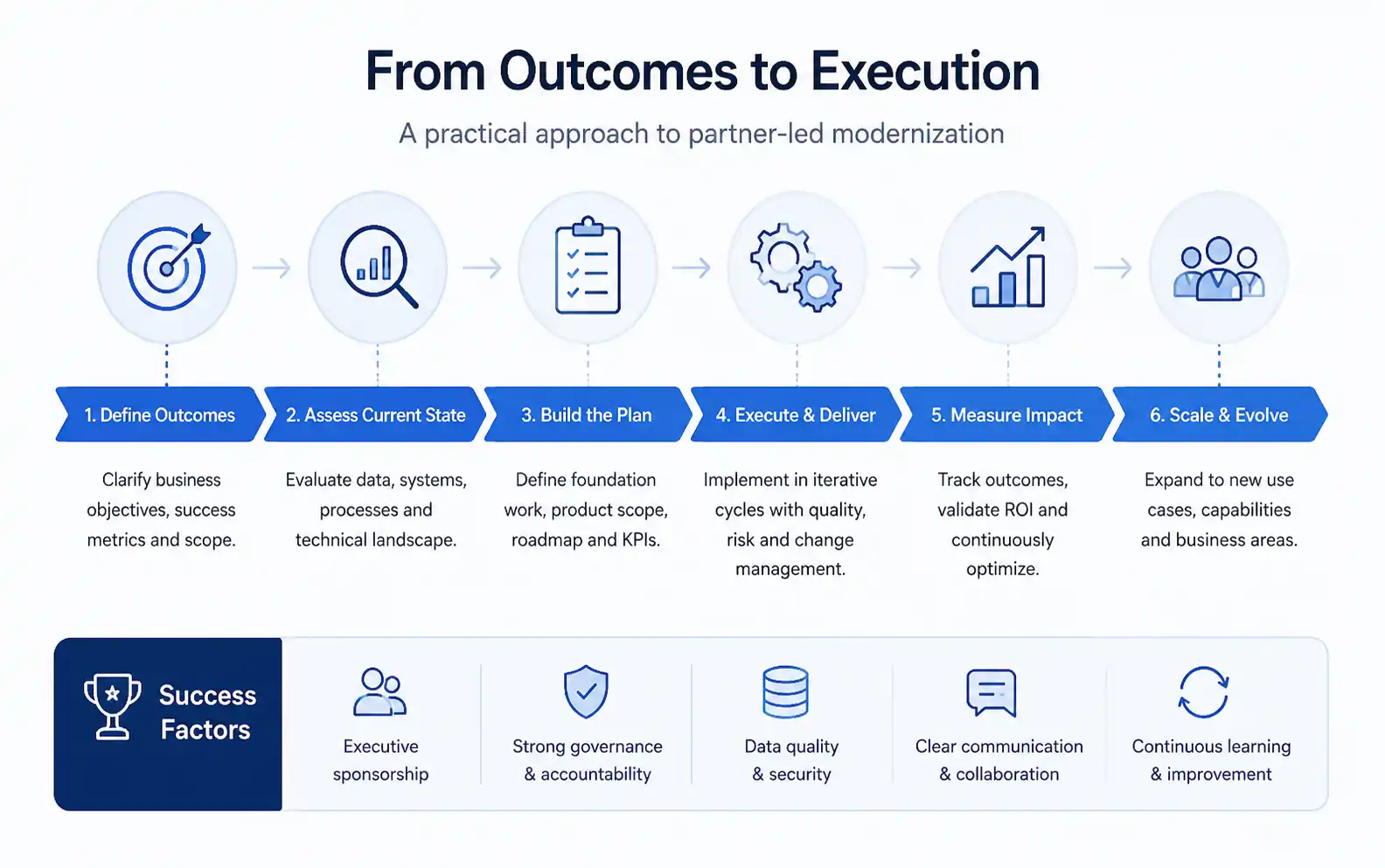
Partner Evidence Table
Use this table to turn each partner claim into a procurement test. Request decision grade artifacts, then verify that the evidence comes from comparable production work rather than a generic demonstration.
| Claim | Evidence To Demand | How To Verify |
|---|---|---|
| We understand your outcomes and scope | A workplan that maps business outcomes to deliverables, scope boundaries, acceptance gates, owners, and target metrics. | Trace every major outcome to a named deliverable and measurable acceptance criterion. Challenge any objective that has no owner, baseline, or completion test. |
| We can design the right target architecture | Target state diagrams, architecture decision records, migration waves, rollback plans, and documented tradeoffs covering cost, latency, governance, and operational complexity. | Ask the proposed architect to explain rejected options and operational consequences. Compare the records with references from projects of similar scale and constraints. |
| We have deep data, AI, and integration capability | Named specialists, representative code samples, pipeline tests, CI configurations, deployment scripts, integration patterns, and anonymized observability dashboards. | Run a scoped paid technical spike using one realistic source, transformation, model or automation step, and production style monitoring requirement. |
| We can meet governance and security requirements | Data classification and lineage examples, access control mappings, approval workflows, security testing summaries, incident response playbooks, and audit evidence. | Walk one sensitive data flow from source to output. Confirm how access, policy enforcement, lineage, incidents, and exceptions are recorded in the operating environment. |
| We can operate the solution reliably in production | Runbooks, service objectives, alert thresholds, release records, recovery procedures, rollback evidence, incident retrospectives, and post launch support commitments. | Review anonymized incidents and ask who detected, escalated, resolved, and documented them. Test one recovery or rollback scenario during due diligence. |
| We collaborate effectively with domain teams | A staffing plan, responsibility map, sprint and demo cadence, workshop outputs, backlog ownership model, and escalation paths. | Interview the proposed delivery lead and specialists together. Confirm how decisions move from domain owners into designs, backlog items, acceptance, and production support. |
| We will transfer knowledge and ownership | A staged transition plan with training agendas, shadowing periods, accessible documentation, competency assessments, handover milestones, and vendor exit criteria. | Tie milestone acceptance to demonstrated tasks completed by your team. Confirm with references whether internal staff could operate and change the solution after handover. |
| Our commercial model aligns with delivery | Transparent assumptions, rate or price breakdowns, responsibility boundaries, change control terms, milestone payments, and acceptance linked invoicing. | Reconcile every cost with scope and ownership. Model likely change scenarios and confirm who carries the cost, schedule, quality, and dependency risk. |
Compact scoring rubric (example)
| Score | What to expect |
|---|---|
| Weak | Mostly claims with little supporting evidence or references. |
| Adequate | Some relevant artifacts or experience, but gaps remain for confident decisions. |
| Strong | Credible delivery detail, architecture thinking, and relevant case evidence. |
| Excellent | Decision grade evidence and a clear operating model with handover commitments. |
How to run the scorecard in procurement
Require partners to map concrete evidence to each scored dimension. Ask vendors to submit artifacts such as architecture records, runbooks, anonymized telemetry, code samples, and case studies with contactable references.
Insist on at least two contactable references that match your outcomes; reference conversations should confirm the partner's role, what was delivered, how knowledge was transferred, and how the solution performed in production over time.
Pay particular attention to post handover operating experience.
Use short paid procurement tests (discovery sprints or scoped technical spikes with acceptance criteria) as practical evidence generators.
These reveal how the partner works with your teams; if a partner refuses a small paid spike, treat that as a negative signal.
- Use a partner scorecard tied to evidence artifacts
- Require two contactable references for similar outcomes
- Insist on code samples, anonymized telemetry, and runbooks
- Use paid discovery sprints as procurement tests
Evidence mapped to a scorecard beats product marketing.
Ask partners to show concrete delivery artifacts such as pipeline tests, release controls, monitoring, and rollback paths. Useful reference baselines include Google Cloud's MLOps guidance and the NIST AI Risk Management Framework.
Evaluate Knowledge Transfer And Long Term Ownership
Knowledge transfer should be contractually defined with measurable milestones. Require training hours, shadowing windows, documentation deliverables and post handover support plans. Avoid vague promises about training: insist on session agendas, attendee lists and competency assessments to verify learning outcomes.
Examine how the partner codifies institutional knowledge. Look for playbooks, runbooks, architecture decision records and code level documentation stored in repositories accessible to your teams.
The presence of executable examples and automated tests reduces risk during team turnover or when scaling the platform.
Review the transition plan for long term ownership. Ask who will own platform maintenance, who will support model retraining and how escalations will occur.
A gradual reduction of vendor involvement with clear competency milestones is preferable to abrupt transfer or open ended managed services with unclear exit terms.
- Contractually define training, shadowing and competency checks
- Require executable playbooks and accessible documentation
- Demand a staged vendor exit with competency milestones
- Verify who will own maintenance and model retraining
Make knowledge transfer measurable and time boxed.
Reference Criteria For Partner Evaluation
Use current framework guidance to anchor evaluation criteria instead of relying only on a scorecard. Microsoft's Cloud Adoption Framework shows how business outcomes, readiness, and landing zone decisions shape a modernization plan.
The FinOps Foundation's Automation, Tools, & Services capability is also useful when partner selection includes managed tooling or outsourced operations because it emphasizes requirements gathering, interoperability, and the risk of overdependence on professional services.
From Partner Evaluation To Delivery
If the next step is turning shortlist criteria into a delivery plan, a controlled implementation program matters more than a polished proposal.
See enterprise data and AI modernization services for support with architecture validation, migration planning, governance controls, and knowledge transfer.
Frequently Asked Questions
Require a target state diagram, architecture decision records from similar projects, migration and rollback plans, anonymized telemetry and examples of enforced governance.
These artifacts show whether a partner reasons about tradeoffs, learns from prior work and can operate the architecture in production.
Ask for full lifecycle artifacts: feature engineering code, CI pipelines, model deployment scripts, monitoring dashboards and incident retrospectives. Request a short paid spike that exercises their MLOps flow.
Refusal to provide these artifacts or to run a spike is a strong negative signal.
There is no single best model. Fixed price offers cost certainty but less flexibility. Time and materials supports iteration but requires tight governance. Outcome based pricing aligns incentives but demands precise, measurable acceptance criteria.
Match the model to project clarity and your willingness to own delivery risk.
Common red flags include no contactable references, evasive security or governance answers, lack of architecture records or CI artifacts, refusal to run a paid technical spike, and unclear knowledge transfer plans. Treat these as high risk indicators during shortlisting.
Structure transfer as staged milestones with measurable deliverables: training sessions with agendas, shadowing windows, competency assessments, documented runbooks and a tapering support schedule. Tie payments or final acceptance to completion of these milestones to ensure accountability.