
Data security and privacy in enterprise AI modernization should be treated as design requirements across every data movement, processing step, retrieval path, and model call.
Modernization moves data into new stores, processors, and external services. Controls must therefore be built into the architecture before deployment, rather than added as a final checklist.
Decision makers should prioritize a control-by-design approach when they modernize data platforms and enable AI use cases.
That means classifying data, setting minimization rules, enforcing identity and least privilege, and preserving permissions across search and retrieval pipelines.
This guidance focuses on concrete controls, trade-offs, and operating patterns that reduce exposure without blocking AI innovation.
Practical governance ties these controls to engineering and delivery practices: policy-aligned metadata, automated masking and retention, observable access telemetry, and clear vendor requirements for model providers.
When teams move from policy design into build work with AI development services, these controls must be carried into retrieval, inference, and deployment pipelines.
The sections below also map each control to AI-specific exposure points, such as prompt leakage and retrieval augmented generation.
Key Takeaways
- Best fit: sensitive or regulated data that must support AI, analytics, or RAG workloads without weakening existing controls.
- Protect first: classification, minimization, permission-aware access, and third-party handling rules, before use case scope expands.
- Reader outcome: a control sequence for access, processing, provider review, and monitoring that can be embedded in delivery plans.
Classify Data Before Modernizing Or Using It For AI
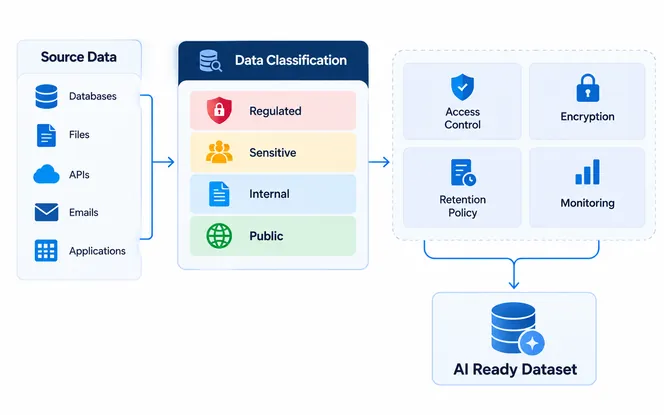
Start with a pragmatic classification program that maps business-critical and regulated data classes to required controls.
Let use cases drive the classification: which AI models will read or index the data, where it moves during training or inference, and which services might expose it.
Combine automated scanning, rule sets for structured schemas, and short-cycle human review for edge cases.
Apply classification as metadata at the source, and maintain it through ETL and replication. Store the tags in a central catalog and propagate them downstream, so pipeline logic and access controls can consume them.
Connect classification to your governance model, so policy owners can change definitions and exceptions without code changes.
Classification labels and retention periods
Each label below maps to minimum controls and a retention tier. The tiers follow a 3, 5, and 7-year retention model for raw data.
| Label | Typical data | Minimum controls | Retention period |
|---|---|---|---|
| Public | Published content, product documentation, approved marketing material | Integrity checks and change control; no masking needed | Tier 1: 3 years, or until the content is withdrawn |
| Internal | Process documents, internal metrics, operational reports | SSO, role-based access, encryption at rest | Tier 1: 3 years |
| Sensitive | Customer contact data, HR records, contracts, pricing | Masking before indexing, attribute-based access, access logging | Tier 2: 5 years |
| Regulated | Financial reporting data, payment data, special category personal data | Tokenization, customer-managed keys, isolated processing, approved unmasking only | Tier 3: 7 years, unless a specific law sets another period |
Treat these periods as maximums for raw data, not targets. Where the GDPR applies, personal data must still be deleted once its purpose ends, even if the tier allows longer.
Balance protection and access
A conservative classification model reduces exposure, but it increases operational friction. Over-classification can block analysts and AI model builders, so balance protection against access needs.
Use progressive enforcement. First surface classification in catalogs and logs. Then enforce automated policy gates for high-risk classes, while lower-risk classes stay under advisory controls.
- Define a minimal set of classification labels that map to concrete controls, for example regulated, sensitive, internal, and public.
- Automate detection for common sensitive patterns, but require human validation for ambiguous or context-dependent cases.
- Propagate labels in metadata stores, and embed them in data contracts and ETL manifests to preserve intent across pipelines.
- Keep an exceptions register tied to governance owners, and review exception durations quarterly.
- Measure classification coverage with periodic sampling and false positive metrics to refine rules.
Standards and ownership for classification
For an auditable baseline, ISO/IEC 27001 lists classification of information as an Annex A control (5.12), alongside data masking (8.11) and information deletion (8.10).
Use the enterprise data governance framework to define stewardship rules, approval paths, and control ownership before these protections scale across teams and platforms.
Apply Minimization, Masking And Retention Controls
Data minimization reduces the attack surface and lowers compliance costs. For AI use cases, apply it both at collection and at the point where data merges into training or retrieval stores.
Decide which fields are essential for model performance, then drop or aggregate the rest. For user-level data, prefer hashed identifiers or irreversible tokenization where linkage is not required.
These principles are also legal duties. Under data protection under the GDPR, Article 5 requires personal data to be limited to what is necessary and kept no longer than its purpose requires.
Mask or redact sensitive fields before they are indexed or fed into models.
Use deterministic tokenization when downstream joins are required, but document the equality and frequency patterns it can expose. Use one-way hashing where re-identification is unnecessary.
Implement masking as a pipeline stage with immutable audit logs that record who requested unmasked access and why.
Retention tiers for AI data and evidence
Retention rules should be policy-driven and versioned. Enforce residency and retention limits at the storage layer and in lifecycle automation, using the tiers below.
| Tier | Retention period | Data and artifacts | Action at expiry |
|---|---|---|---|
| Tier 1 | 3 years | Internal operational data, masked training extracts, de-identified prompt and response logs | Automated deletion, including caches, index replicas, and backups |
| Tier 2 | 5 years | Sensitive business records, data access and retrieval audit logs, training dataset manifests, lineage evidence | Move to restricted, encrypted archive during the period, then delete with a deletion record |
| Tier 3 | 7 years | Regulated financial and contractual records, unmasking and privilege elevation approvals, deletion records | Check for legal holds, then delete and log the deletion |
Embeddings, indexes, and caches inherit the tier of their source content, and must never outlive it. When source records are deleted, derived artifacts are rebuilt or purged.
EU AI Act record-keeping
Where the EU AI Act applies to a high-risk AI system, its record-keeping rules sit on top of these tiers.
Providers must keep technical documentation for 10 years after the system is placed on the market, and automatically generated logs for at least six months.
Article 10 of the Act also requires data governance practices for training, validation, and testing data. Classification and minimization records help provide that evidence.
For the lineage records that back this evidence, see data lineage for AI governance and regulatory compliance.
Test the impact on model quality
Removing fields can reduce model accuracy. Test model performance before and after minimization, and use privacy-preserving techniques such as synthetic augmentation where appropriate.
Quality thresholds for the fields you keep are set out in AI data quality controls.
- Embed minimization decisions into data contracts and CI tests for pipelines that feed models.
- Use reversible encryption only when necessary, and restrict unmasking to audited, approved workflows.
- Automate retention actions with lifecycle policies, and keep deletion records immutable.
- Apply field-level masking before data enters search indexes or retrieval stores used by RAG.
- Profile model sensitivity to specific features to guide which attributes can be removed safely.
Minimize before you move data, and mask it before you index or model it.
For the catalog design that supports this work, review metadata management for enterprise AI.
Design Identity And Least Privilege Access
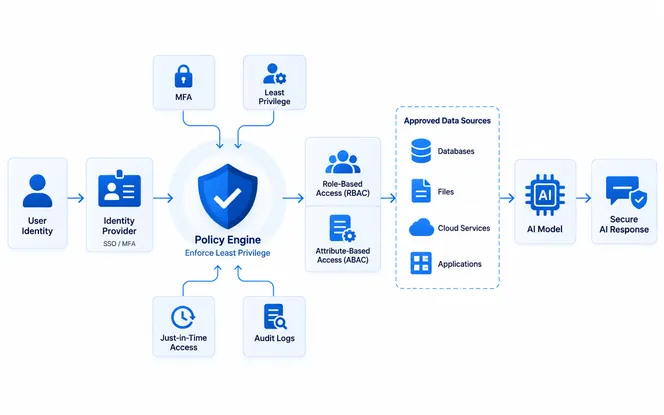
Identity is the primary control plane for data access. Use strong identity providers, centralized access policy engines, and short-lived credentials for services.
Map identities to roles and enforce least privilege through role-based access control. Pair it with attribute-based checks for environment, project, and data classification. Avoid universal service accounts with broad permissions.
NIST SP 800-53 is a useful control reference here. Its access control family covers account management (AC-2) and least privilege (AC-6), which map directly to this section.
Scope service identities and elevation
Model pipeline service identities need careful scoping. Create narrow identities for ingestion, transformation, model inference, and indexing, each holding only the permissions its stage needs.
Use short-lived tokens and workload identity federation for cloud services to avoid long-lived secrets. Rotate any required secrets automatically through a secrets manager.
Enforce privilege escalation controls and emergency access workflows. Any temporary elevation should require justification, approval, and session recording.
Balance productivity and protection with self-service access: automated approval for low-risk data, and manual approval for sensitive sets. Document the trade-offs, and tie access reviews to role ownership.
- Adopt attribute-based access controls that combine role, project, and data classification attributes.
- Use separate service identities for indexing, retrieval, and training to limit lateral exposure.
- Integrate secrets management with CI/CD, so credentials never appear in code or config repos.
- Run automated periodic access reviews, and certify high-risk roles more frequently.
- Log and audit all privilege elevation requests, and correlate them with data access events.
Treat identities and service accounts as first-class assets, subject to the same lifecycle controls as data.
Protect Data In Movement, Storage And Processing
Data security and privacy in enterprise AI modernization needs layered protection across transport, storage, processing environments, and transient data paths.
Use strong TLS for service traffic and network segmentation to limit lateral movement. Encrypt stored data, and add field-level protection for the most sensitive attributes.
ISO/IEC 27001 also treats the use of cryptography as an Annex A control (8.24). Document key management and rotation, rather than relying on platform defaults.
Secure processing environments and caches
Control the environments where models run. For on-premises or cloud VMs, use hardened images and limit inbound network access.
For serverless or managed model services, understand the data handling guarantees, transient storage behavior, and tenant isolation options. Process sensitive data in dedicated, isolated environments where possible.
Protect data in pipeline intermediaries and caches. Transient stores, message brokers, and search indexes can all retain copies of data.
Inventory these stores, apply the same classification and retention rules, and apply masking or encryption consistently. Plan secure deletion that also clears caches and backups.
- Enable end-to-end TLS, and use mutual TLS for service-to-service calls where possible.
- Use customer-managed encryption keys for high-risk data, and record key rotation events.
- Isolate model training environments when training on sensitive or regulated data.
- Scan and remediate transient caches, message brokers, and logs for sensitive content.
- Document data flow maps that include intermediate stores and processing nodes.
Protect data across every transient store and processing environment, not only in primary databases.
Preserve Permissions In Search, RAG And AI Workflows
Search indexes and retrieval pipelines are common sources of permission leakage. Carry authorization metadata with each searchable fragment, so document-level and field-level permissions survive indexing.
Query-time enforcement must check the caller identity against stored ACLs before results are returned. Filtering results afterwards is not enough.
Enforce permissions at query time
Retrieval augmented generation needs strict retrieval permissions. An ingestion identity can index content and maintain the corpus, but permissions must be enforced against the caller at query time.
Retrieval services should use the same access policy evaluations as application APIs. They should pass caller context into each request and apply per-request attribute checks, so users see only authorized content.
Fine-grained, query-time permissions add complexity and latency. Use tiered strategies: cache non-sensitive results with broad access, and enforce strict checks on sensitive subsets.
Document the permission model in your metadata catalog, so model builders understand the constraints when they train or fine-tune.
- Attach ACL metadata to indexed fragments, and require authorization checks at retrieval time.
- Avoid exposing raw index content to model training; use curated, permissioned extracts instead.
- Authenticate and propagate caller context into retrieval requests for accurate enforcement.
- Measure permission check latency, and optimize policy engines for common query patterns.
- Log retrievals with caller identity and returned fragment IDs for later audit.
Preserve and enforce permissions at the point of retrieval, not only at storage.
For permission-aware retrieval, see Microsoft's guidance on document level access in Azure AI Search and its retrieval augmented generation overview.
Treat embeddings as sensitive data
Research such as the ACL embedding inversion study shows that embedding vectors can sometimes be inverted to recover or approximate the original text.
Embeddings can therefore leak sensitive content. Protect them with the same care as the raw data they came from.
- Apply raw-data controls to embeddings: limit retention, restrict access, encrypt in transit and at rest, and log access.
- Avoid sharing raw embeddings externally, and enforce strict API rate limits and authentication.
- Consider differential privacy, calibrated noise, or dimensionality reduction before any external use.
- Run inversion and membership tests regularly, and monitor for anomalous queries.
- For third-party embedding services, enable privacy features and review data use terms, as covered in the model provider section below.
Evaluate Model Provider And Third-Party Data Handling
Model providers and third-party services add contractual and technical risk. Start by documenting data flows to and from each provider.
Identify what data will be sent, stored, or used to improve third-party models. Review each provider's policies on retention, training use, and cross-tenant isolation.
A provider that processes personal data on your behalf acts as a processor under the GDPR. Article 28 then requires a contract that limits processing to your documented instructions.
Minimize outbound data by design, and send only the representation the task requires.
Treat embeddings as derived sensitive data when they encode sensitive source content. Apply classification, encryption, access control, retention limits, and provider review to both raw content and embeddings.
Contract and deployment controls
Negotiate technical controls into contracts: data separation guarantees, dedicated instance options, explicit non-use clauses, and audit rights.
If a provider cannot meet residency, control, or audit requirements, choose a deployment model that keeps the safeguards, such as a private, customer-controlled, or internally operated environment.
For managed services that accept prompts, remove sensitive identifiers before calling the API. A gateway can inspect and redact content before any outbound call.
Provider inventory and review
Some providers offer strong enterprise controls, such as private deployments and customer-owned keys, while others do not. Keep an inventory of approved providers mapped to acceptable use cases.
Reassess providers when product features change, or when new data classes are integrated.
- Document the exact data elements sent to providers, and avoid sending raw PII or regulated content.
- Require contractual non-use of data for training, and specify retention and deletion timelines.
- Prefer private instances or bring-your-own-key options for high-risk workloads.
- Use an API gateway to sanitize prompts and block sensitive content before outbound calls.
- Audit providers periodically, and reassess them when capabilities or terms change.
Treat model providers as a critical control: contract, configure, and continuously verify.
Monitor Access, Leakage And Policy Violations
Observability is essential for detecting misuse and tracing incidents. Collect structured telemetry for every data access: who, what, when, where, and why.
Correlate access logs with classification metadata and model interactions. This surfaces anomalies such as bulk indexing, unusual retrieval volumes, or repeated unmasking requests.
Detection, containment and log retention
Combine rule-based detection with behavioral analytics. Rules catch known bad patterns, such as exfiltration through large exports. Behavioral models detect deviations from normal user or service activity.
Prioritize alerts tied to sensitive classifications. For clear high-risk signals, enable automated containment, such as suspending a service identity pending review.
Log retention must balance forensic needs against cost and privacy. Keep access and retrieval logs for the Tier 2 period of 5 years, and summarize older telemetry.
Protect log storage, and make access to logs auditable, to prevent tampering or leakage.
- Correlate access events with data classification and downstream model queries for full context.
- Build detection rules for spikes in exports, mass unmasking, or cross-project retrievals.
- Use automated containment for high-confidence events, with clear manual review paths.
- Protect and audit access to logs and alerts to prevent tampering or insider misuse.
- Test detection with red team exercises that simulate prompt leakage and RAG abuse.
Monitoring is only effective when it closes the loop with enforcement and incident workflows.
Embed Privacy And Security Gates Into Delivery
Make privacy and security gates a standard step in development pipelines. Add CI/CD checks for classification tags, masking coverage, secrets exposure, and provider contract status.
Require automated policy validation for any artifact that will feed a model or index, and block deployments that fail critical checks. This shifts reviews left and reduces late-stage rework.
Policy as code and staged approvals
Use configuration as code to make controls reproducible. Express policies, retention rules, and masking transforms in machine-readable form, so pull requests can validate them automatically.
Give engineers clear remediation guidance, and use non-blocking advisories for low-risk failures, so delivery is not slowed unnecessarily.
Create staged approvals for sensitive workloads. For example, require security and privacy sign-off for training datasets with regulated data, and a manual review for externally exposed models.
Keep a lightweight exceptions process with expiry dates. This keeps innovation moving while preventing permanent bypasses of controls.
- Automate CI policy checks for masking, classification propagation, and secret scanning.
- Express data policies as code, and include them in pipeline validation steps.
- Require security review gates for training runs that use sensitive classes.
- Give developers sandbox environments that enforce production-like protections.
- Log gate failures, and track remediation metrics to measure policy effectiveness.
Shift controls left with automated gates and policy as code to reduce delivery friction.
Frequently Asked Questions
Start with classification and metadata. Knowing which data is sensitive, and why, lets you apply targeted minimization, masking, and access rules.
Classification also feeds automated policy enforcement and monitoring, so you get immediate risk visibility without blocking low-risk workloads.
Sanitize prompts before outbound calls, remove or tokenize identifiers, and send only the minimum context the task requires.
Do not treat embeddings as automatically privacy safe. Text can sometimes be inferred from them, so protect them according to the sensitivity of the source content.
Use provider non-use terms, isolation controls, retention limits, and a documented threat model for any sensitive data that leaves your environment.
Attach authorization metadata to indexed fragments, and enforce authorization at retrieval time using the caller context.
Do not serve results from privileged indexing identities directly to users. Run per-request policy checks, and log retrievals with fragment IDs for audit and traceback.
Look for spikes in exports or downloads, repeated large retrieval requests, unusual training runs that access many sources, and patterns of unmasking or privilege elevation.
Correlate these signals with sensitive classification tags, and trigger containment for high-confidence events.
Possibly, but only after a risk assessment. Require contractual non-use terms, dedicated tenancy or private instances, and technical controls such as customer-managed keys.
If providers cannot meet those guarantees, prefer on-premises or private deployments, and limit provider use to non-sensitive data sets.