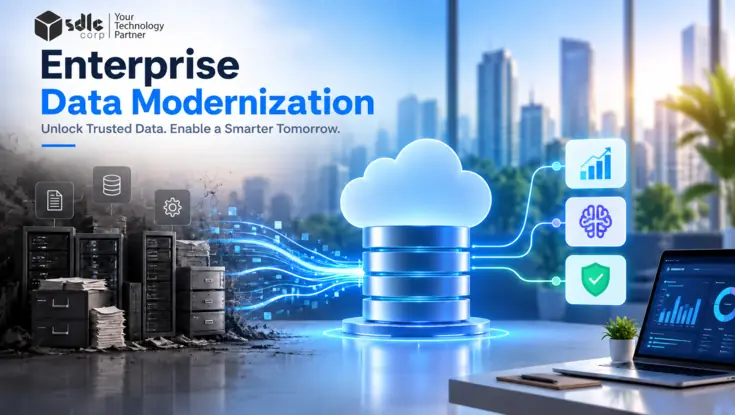
Enterprise data modernization is the process of improving how an organization collects, connects, stores, manages, protects, and uses data across its systems.
It can involve replacing outdated data platforms, modernizing legacy pipelines, connecting disconnected applications, improving data quality, and introducing stronger governance. It can also prepare enterprise data for modern analytics, automation, and artificial intelligence.
The objective is not simply to move databases to the cloud or install a new reporting tool. The objective is to create a reliable data foundation that supports current operations and future business requirements.
For an independent industry perspective, IBM provides a useful overview of data modernization and its role in improving data accessibility, usability, and value.
- What it is: A coordinated improvement of how enterprise data is integrated, governed, stored, and used
- What it is not: Only a cloud migration or a database replacement project
- Common starting point: A current-state assessment of systems, data quality, and reporting
- Main outcome: A trusted, governed data foundation for reporting, automation, and AI
- Relationship with AI: A separate but connected workstream that gives AI systems reliable data
Explore the modernization cluster:
- Cloud Data Modernization Strategy for Enterprises explains how cloud architecture, migration sequencing, governance, and workload priorities fit together.
- How Data Modernization Enables Enterprise AI connects trusted data, lineage, security, and reusable access layers to production AI.
- Enterprise Data and AI Modernization Cost breaks down the main budget drivers, delivery stages, and planning variables.
- How to Choose a Data and AI Modernization Partner provides practical criteria for assessing delivery capability, evidence, governance, and long-term support.
- How to Modernize Legacy Applications for AI covers integration, refactoring, replatforming, and replacement decisions for older systems.
Enterprise Data Modernization in Simple Terms
Many organizations operate with data spread across:
- Enterprise resource planning systems
- Customer relationship management platforms
- Finance applications
- Human resources systems
- Operational software
- Cloud applications
- Legacy databases
- Documents and spreadsheets
- Department-specific tools
These systems may use different formats, identifiers, definitions, and update schedules.
As a result, teams often spend significant time collecting and reconciling information before it can be used. Reports may provide different answers to the same question, and new analytics or AI initiatives may struggle because the underlying data is incomplete or unreliable.
Enterprise data modernization connects these sources through shared architecture, integration controls, and consistent governance.
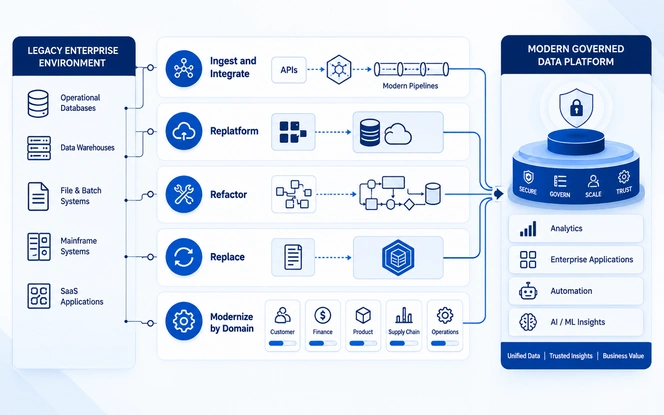
Modernization does not always require every existing system to be replaced. In many cases, organizations retain important applications while modernizing the way data moves between them and how it is governed and consumed.
Why Do Enterprises Need Data Modernization?
Data environments often grow gradually.
A company may begin with a small number of applications and later add new systems through expansion, acquisitions, regional operations, or department-specific requirements. Each system solves an immediate business problem, but the overall technology environment becomes fragmented over time.
Common signs that an organization needs data modernization include:
Information Is Fragmented Across Systems
Critical data may exist in multiple applications without a consistent integration layer.
Customer information may be stored differently in the CRM, finance platform, and service system. Product or supplier records may use different identifiers across procurement, inventory, and reporting tools.
This fragmentation makes it difficult to create a complete view of operations.
Reporting Requires Manual Work
Teams may export data into spreadsheets, correct it manually, and combine multiple files before preparing a report.
This process is slow and difficult to repeat consistently. It also creates a risk that reports depend on individual knowledge rather than controlled enterprise processes.
Different Reports Show Different Results
Departments may calculate revenue, active customers, order status, or other metrics differently.
Without common definitions and governed data models, two reports can appear accurate while producing different answers.
Legacy Platforms Are Difficult to Integrate
Older databases and applications may remain operationally important but may not support modern APIs, real-time integration, or cloud analytics.
Replacing them immediately may be expensive and disruptive. However, leaving them isolated limits the organization's ability to modernize.
Data Quality Problems Continue to Grow
Duplicate records, missing values, incorrect mappings, and inconsistent formats can spread across connected systems.
Without clear ownership and validation rules, data quality becomes an ongoing operational problem rather than a one-time cleanup exercise.
Analytics and AI Projects Cannot Scale
A dashboard or AI pilot may work with a small prepared dataset but fail when connected to live enterprise systems.
The difficulty is often not the dashboard or model itself. The real issue is that the organization lacks reliable pipelines, consistent definitions, access controls, and monitoring.
What Does Enterprise Data Modernization Include?
Enterprise data modernization is broader than database migration. It normally includes several connected areas.
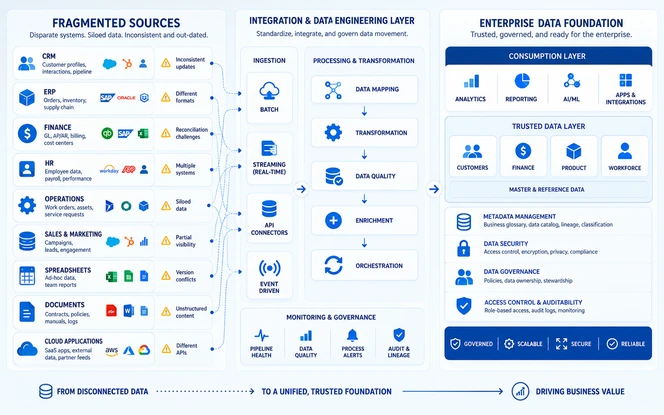
1. Data Strategy
An enterprise data modernization strategy defines how enterprise data will support business priorities.
A strong strategy covers:
- Important business outcomes
- Priority data domains
- Current limitations
- Data ownership
- Modernization investments
- Governance requirements
- Analytics and AI priorities
- Implementation sequence
The strategy helps prevent modernization from becoming a collection of disconnected technical projects.
2. Enterprise Data Architecture
Data architecture defines how information moves from source systems to enterprise users, reports, applications, and AI services.
A modern data architecture may include:
- Operational databases
- Application programming interfaces
- Batch and real-time pipelines
- Data warehouses
- Data lakes
- Lakehouse platforms
- Master data services
- Metadata repositories
- Analytics layers
- Data access layers for AI systems
- Access and security controls
The right architecture depends on the organization's systems, scale, security requirements, and operating model.
3. Data Engineering and Integration
Data engineering creates the pipelines and integration services required to move and transform information.
This can involve:
- ETL and ELT pipelines
- API integration
- Event-based data exchange
- Batch processing
- Real-time data processing
- Schema mapping
- Data transformation
- Historical data migration
- Error handling
- Pipeline monitoring
- Reconciliation
Reliable engineering ensures that data arrives in the right format, at the expected time, and with enough context to be used correctly.
4. Data Quality
Data quality work identifies and controls problems such as:
- Duplicate records
- Missing fields
- Invalid formats
- Conflicting values
- Incorrect relationships
- Outdated records
- Inconsistent identifiers
Modernization should not only clean existing data. It should introduce rules and monitoring that prevent the same problems from returning.
5. Data Governance
Data governance defines how data is owned, classified, accessed, documented, and managed.
A governance framework can include:
- Data owners
- Data stewards
- Business definitions
- Data catalogs
- Metadata
- Data lineage
- Quality standards
- Access policies
- Retention requirements
- Issue resolution processes
- Audit records
Governance helps users understand where information came from, what it means, and whether it can be trusted.
Google Cloud’s data governance overview further explains how governance connects policies, responsibilities, controls, and trusted data use.
6. Data Platform Modernization
Organizations may modernize an existing warehouse, move workloads to the cloud, or introduce a new enterprise data platform.
This can include:
- Database modernization
- Data warehouse migration
- Cloud data platforms
- Data lake or lakehouse adoption
- Storage optimization
- Workload separation
- Performance improvement
- Backup and recovery modernization
The platform should support present requirements without making future integrations unnecessarily difficult.
7. Analytics Modernization
Data modernization also improves how information is delivered to business users.
Analytics modernization can involve:
- Consolidating duplicated reports
- Creating common KPI definitions
- Building reusable semantic models
- Introducing self-service analytics
- Improving dashboard performance
- Providing role-based access
- Embedding analytics into applications
- Supporting predictive analytics
More dashboards are not the goal. The goal is reliable, understandable information for the people who need it.
8. Security and Access Management
Modern data environments must protect sensitive information while still making approved data available.
Security considerations include:
- Role-based access that grants each user only the data permissions required for their business responsibilities
- Identity management that connects users and service accounts to centralized authentication, approval, and access-lifecycle controls
- Data classification
- Encryption
- Audit logging
- Environment separation
- Data masking
- Privacy controls
- Retention and deletion policies
Access should be based on business responsibility rather than unrestricted availability.
Enterprise Data Modernization vs Cloud Migration
Cloud migration and data modernization are related, but they are not the same. Cloud migration moves data systems or workloads from one infrastructure environment to another, while data modernization improves how data is integrated, governed, stored, secured, and used. An organization can move an outdated database to the cloud without improving its architecture, data quality, or reporting processes, so migration alone may reduce infrastructure work without solving fragmentation or governance problems.
A proper modernization program may include cloud migration, but it also evaluates data models, pipeline design, access controls, quality monitoring, reporting standards, system integration, and support for analytics and AI. The cloud is an infrastructure choice, while modernization is a broader transformation of the data environment. Cloud data modernization combines both by using cloud infrastructure alongside improvements to architecture, quality, governance, security, and data consumption.
When planning cloud-related changes, Microsoft’s cloud modernization planning guidance provides a structured reference for matching modernization strategies to workload needs and business goals.
| Comparison Area | Cloud Migration | Enterprise Data Modernization |
|---|---|---|
| Primary Objective | Move data systems, databases, or workloads to cloud infrastructure. | Improve the complete way enterprise data is integrated, governed, stored, protected, and used. |
| Scope | Primarily focuses on infrastructure, hosting, deployment, and workload movement. | Covers strategy, architecture, engineering, quality, governance, security, integration, and analytics. |
| Architecture | May retain existing data models, pipelines, and application dependencies. | Reviews and redesigns architecture, pipelines, models, and access layers where required. |
| Data Quality | Moving data to the cloud does not automatically correct duplicates, missing values, or inconsistent records. | Introduces validation rules, monitoring, ownership, reconciliation, and ongoing quality controls. |
| Governance | Cloud security controls may improve, but business definitions and data ownership may remain unchanged. | Establishes ownership, stewardship, metadata, lineage, policies, access controls, and auditability. |
| Integration and Reporting | Existing integration gaps and conflicting reports may continue after migration. | Standardizes definitions, modernizes APIs and pipelines, and creates governed reporting models. |
| Analytics and AI Readiness | Cloud capacity alone does not guarantee reliable analytics or AI outcomes. | Creates trusted, documented, secure, and reusable data for analytics, automation, and AI. See how data modernization enables enterprise AI. |
| Expected Outcome | Modern hosting, improved scalability, and reduced infrastructure-management effort. | A reliable and governed enterprise data foundation that supports current operations and future use cases. |
Common Enterprise Data Modernization Approaches
Organizations can modernize data in different ways depending on risk, budget, and technical condition.
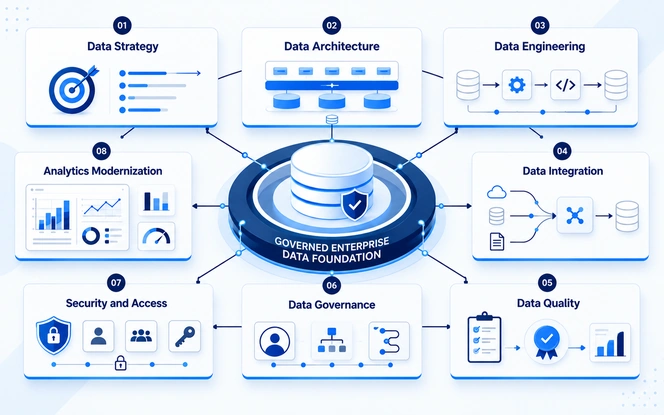
Retain and Integrate
An existing system remains in place while APIs, pipelines, or integration services make its data available to modern platforms.
This form of legacy data modernization is useful when the application remains valuable but its data is isolated. Our real-time storefront and ERP integration case study shows this approach in practice.
Replatform
The existing workload is moved to a modern platform with limited changes to its core logic.
Replatforming can improve performance, scalability, and infrastructure management without requiring a complete rebuild.
Refactor
Pipelines, data models, or applications are redesigned to improve maintainability and support modern requirements.
This requires more effort but can remove structural limitations that would remain after a simple migration.
Replace
An outdated platform is replaced with a modern product or custom system.
Replacement may be appropriate when the existing technology is unsupported, expensive to maintain, or unable to meet future requirements.
Build a Modern Data Layer Around Legacy Systems
Organizations can retain important operational systems while creating a unified data layer for reporting, analytics, and AI.
This is often a practical approach when immediate system replacement would create too much disruption.
Modernize by Data Domain
Instead of changing the entire enterprise environment at once, modernization can begin with one domain such as:
- Customer data
- Finance data
- Product data
- Supplier data
- Operations data
- Workforce data
This allows the organization to prove the approach before expanding it.
A Typical Enterprise Data Modernization Process
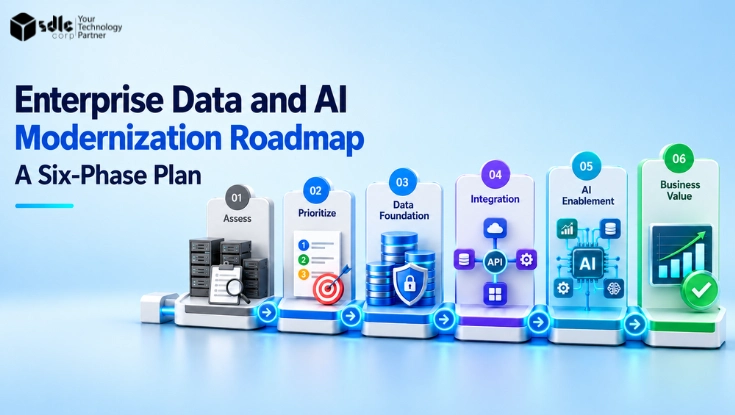
A data modernization framework should follow a controlled sequence. Each phase builds on the one before it, so decisions about architecture, integration, and governance are based on a clear understanding of the current environment rather than assumptions.
A five-phase process also reduces risk. Teams can validate results at every stage, keep critical operations running during the transition, and adjust priorities as new business requirements emerge.
| Phase | Inputs | Activities | Output |
|---|---|---|---|
| 1. Assess and Prioritize | Source-system inventory, data flows, pipelines, reports, quality issues, governance gaps, security requirements, dependencies, and business priorities. | Document the current state, interview business and technical owners, establish baseline measures, assess risk and value, and rank systems and data domains by impact and complexity. | A validated current-state assessment, prioritized use cases, agreed scope, baseline metrics, and a sequenced modernization roadmap. |
| 2. Design the Target Foundation | Approved priorities, business requirements, compliance obligations, workload needs, legacy constraints, scalability goals, and budget boundaries. | Define the target architecture, platform pattern, integration approach, security model, governance roles, transition states, data models, and how retained legacy systems will participate. | An approved target architecture, delivery plan, governance design, security controls, migration waves, ownership model, and acceptance criteria. |
| 3. Build and Govern | Target designs, priority data sources, mappings, quality rules, business definitions, access policies, metadata requirements, and delivery standards. | Build pipelines and APIs; transform and reconcile data; implement validation, error handling, monitoring, common models, metadata, lineage, ownership, and role-based access controls. | A tested, governed data foundation that supplies trusted and reusable information to approved reports, applications, analytics, and AI services. |
| 4. Validate and Deploy | Governed datasets, modernized reports, migration packages, test cases, recovery procedures, training materials, and measurable acceptance thresholds. | Test completeness, accuracy, reliability, performance, security, recovery, and user acceptance; run legacy and modern outputs in parallel; reconcile differences; train users; and deploy in controlled waves. | Approved production workloads, reconciled reports, trained users, documented controls, operational handover, and retirement plans for superseded assets. |
| 5. Operate and Improve | Production telemetry, data-quality results, incidents, platform costs, adoption data, user feedback, audit findings, and new business requirements. | Monitor service levels, quality, lineage, security, cost, adoption, and governance compliance; resolve issues; optimize workloads; update documentation; and expand successful patterns to new domains. | A continuously improved data environment with measurable outcomes, controlled costs, sustained adoption, and a governed backlog for the next modernization wave. |
The phases are sequential for governance and approval, but delivery can overlap in practice. For example, architecture for a second data domain can begin while the first domain is being validated, provided shared controls and ownership remain consistent.
Key Benefits of Enterprise Data Modernization
Common data models and definitions reduce differences between reports and departments.
Automated pipelines reduce the time spent exporting, cleaning, and combining data manually.
Validation, monitoring, and ownership improve the accuracy and completeness of critical information.
A modern integration layer makes it easier to connect new applications, partners, and data sources.
Catalogs, lineage, access controls, and ownership improve accountability and trust.
Modern platforms can support increasing data volumes, users, and workloads more effectively.
Teams can spend less time fixing data and more time using it.
Modernized data provides a stronger foundation for predictive models, knowledge systems, intelligent workflows, and decision support.
How Enterprise Data Modernization Supports AI
Artificial intelligence depends on data, but access to more data does not automatically produce better AI.
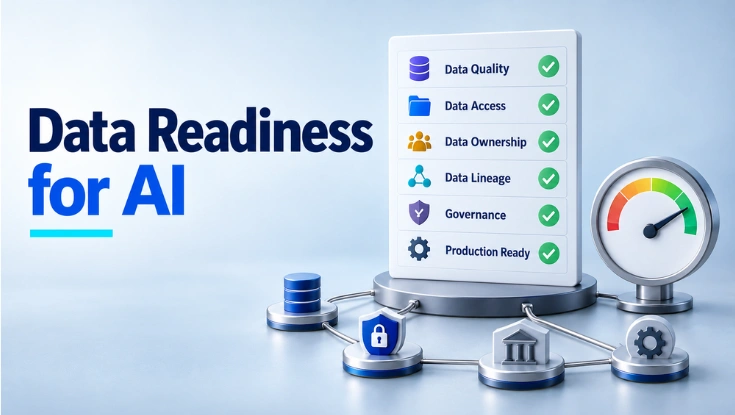
Enterprise AI systems need data that is:
- Relevant
- Accessible
- Consistent
- Documented
- Secure
- Timely
- Governed
- Suitable for the intended use case
A model connected to poor-quality or poorly understood data can produce unreliable results at a larger scale.
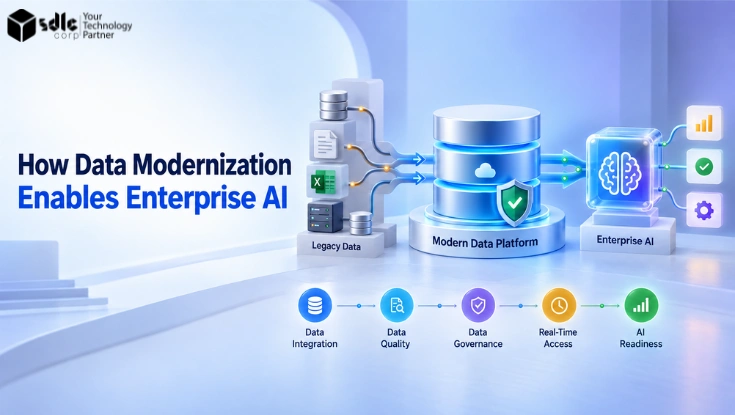
Data modernization helps by providing controlled access to trusted enterprise information. It also creates the lineage, quality monitoring, and security controls needed to understand how AI systems use data.
For AI governance, the NIST AI Risk Management Framework offers a voluntary structure for managing trustworthiness and risk across AI systems.
However, an organization does not need to complete every data modernization initiative before beginning AI work.
A practical approach is to modernize the specific data foundation required for a priority AI use case, validate the result, and then expand the architecture.
Enterprise data modernization and enterprise AI modernization should therefore be treated as separate but connected workstreams.
For organizations planning both, our Enterprise Data and AI Modernization Services page explains how the two workstreams can be coordinated within one program.
Common Enterprise Data Modernization Challenges
Trying to Modernize Everything at Once
Large transformation programs become difficult to control when too many systems and departments are included in the first phase.
A phased approach usually provides faster learning and lower risk.
Focusing Only on Technology
A new platform cannot solve unclear ownership, inconsistent definitions, or poor operating processes on its own.
Modernization must include governance, users, and responsibilities.
Moving Poor Quality Data Without Improving It
Migrating inconsistent data to a modern platform only transfers the problem.
Quality rules and ownership should be introduced during the transition.
Underestimating Legacy Dependencies
Older systems may support important reports, integrations, or operational processes that are not fully documented.
These dependencies should be mapped before migration begins.
Rebuilding Every Existing Report
Some reports may duplicate others or no longer support a real business need.
Modernization is an opportunity to simplify the reporting environment.
Ignoring Adoption
Users may continue using spreadsheets and old systems when the modern environment is difficult to understand or does not fit their workflows.
Training, documentation, and user involvement are essential.
Treating Governance as a Final Phase
Governance introduced after implementation often becomes a separate corrective project.
Ownership, access, and quality controls should be designed from the beginning.
How to Know Whether Your Organization Is Ready
An enterprise may be ready for data modernization when several of the following conditions exist:
- Important data is spread across disconnected systems
- Reports require repeated manual preparation
- Departments use conflicting business definitions
- Legacy technology limits integration
- Data quality issues affect operations
- Cloud or AI initiatives require better access to data
- Reporting costs continue to increase
- Users do not know which source to trust
- New applications are difficult to connect
- Regulatory or audit requirements require better traceability
The first step should normally be a current-state assessment rather than an immediate platform purchase.
The assessment should identify which problems require architectural change and which can be resolved through governance, process improvement, or targeted integration.
How to Measure the Success of Data Modernization
Success should be measured through business and technical outcomes.
Targets should be adjusted to the organization's baseline, risk level, and service commitments. The following starting targets make each measure specific enough to track and govern:
- Reduction in manual reconciliation: reduce recurring reconciliation effort by 50% to 70% within the first 12 months.
- Improvement in data completeness: achieve at least 98% completeness across mandatory fields in priority data domains.
- Reduction in duplicated records: keep duplicate rates below 1% for mastered customer, product, supplier, or employee records.
- Faster report preparation: reduce preparation time for priority recurring reports by 60% to 80%.
- Fewer conflicting reports: eliminate conflicting results for tier-one KPIs and reduce other report disputes by at least 90%.
- Increased use of approved, reusable data products: serve at least 70% of recurring analytical demand through governed datasets, semantic models, or data products.
- Improved pipeline reliability: maintain at least 99.5% successful scheduled runs and restore failed critical pipelines within four hours.
- Better visibility into data lineage: document end-to-end lineage for at least 95% of critical data elements and regulated reports.
- Faster integration of new systems: reduce the average time required to onboard a standard data source by 30% to 50%.
- Reduction in legacy platform costs: reduce eligible licensing, infrastructure, and support costs by 20% to 30% after planned decommissioning.
- Increased user adoption: reach at least 80% monthly active use among target users within six months of rollout.
- Readiness of priority data for analytics and AI: ensure at least 95% of required data meets defined quality, ownership, lineage, security, and freshness thresholds before production use.
Metrics should be defined before implementation, measured against a documented baseline, assigned to an owner, and reviewed on an agreed schedule. Where a target is not appropriate for a specific domain, the team should replace it with an approved service level rather than leaving the measure open-ended.
Conclusion
Enterprise data modernization improves how information moves across systems and how it is prepared, governed, and delivered to users. It is not limited to cloud migration or database replacement; it brings together data strategy, architecture, engineering, quality, governance, security, and analytics within a coordinated program. The most effective approach is usually phased, allowing organizations to begin with priority systems or data domains, establish reusable architecture and governance, and expand the modernized environment over time.
A reliable enterprise data foundation also makes it easier to introduce analytics, automation, and AI without creating more isolated technology projects. For organizations planning a broader transformation, explore our Enterprise Data and AI Modernization Services to understand how data modernization and AI modernization can be delivered as connected but distinct workstreams.
Frequently Asked Questions
Is Enterprise Data Modernization The Same As Digital Transformation?
No. Digital transformation is a broader change involving business models, customer experiences, applications, workflows, and operating processes. Data modernization is one part of digital transformation focused specifically on how enterprise data is managed and used.
Does Data Modernization Require Moving To The Cloud?
No. An organization can modernize data in cloud, on-premises, or hybrid environments. The right deployment model depends on security, cost, performance, and operational requirements.
Do All Legacy Systems Need To Be Replaced?
No. Legacy systems can sometimes be retained and connected through APIs, integration platforms, or modern data pipelines.
What Is The Difference Between Data Migration And Data Modernization?
Data migration moves information from one environment to another. Data modernization also improves architecture, quality, governance, integration, and how data is delivered and used.
How Long Does Enterprise Data Modernization Take?
The timeline depends on the number of systems, data quality, architecture, governance maturity, and scope. A focused workstream may take a few months, while larger programs continue through multiple phases as scope expands.
What Should Be Modernized First?
Organizations should begin with data domains and systems that create the most business value or operational risk. Common starting points include reporting consolidation, data quality, system integration, and priority analytics requirements.
How Does Data Governance Support Modernization?
Governance defines ownership, business meaning, quality expectations, access, and accountability. Without governance, the modern platform can become another uncontrolled data environment.
Can Data Modernization Begin With One Department?
Yes. A department or data domain can be used as the first modernization workstream, provided the architecture can expand later.