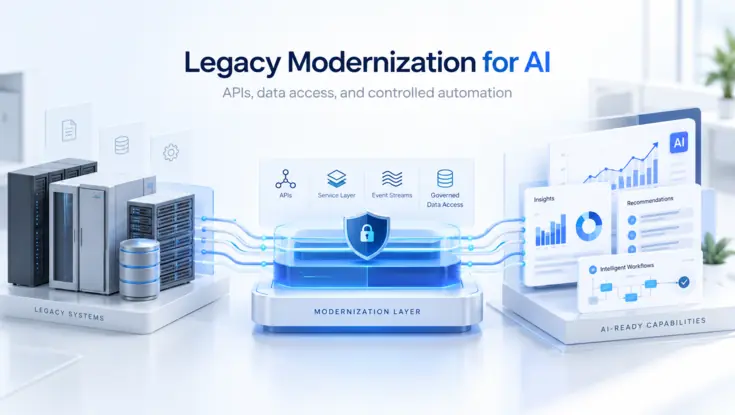
Legacy application modernization for AI does not require enterprises to rewrite mission critical systems. Modernize interfaces, workflow boundaries, and controlled actions first, so AI can read data, recommend outcomes, and later act in measured stages.
Key takeaways
- Legacy applications can expose data and workflows to AI without a full rip and replace program.
- Modernize interface boundaries, workflow decoupling, and safe read and write patterns before choosing a modernization path.
- Use a clear comparison of encapsulation, replatforming, refactoring, and replacement to match depth to risk.
- Promote AI from recommend to act only when precision, acceptance rate, and time saved thresholds hold.
Decision makers face three competing pressures. They must maintain uptime and regulatory compliance, reduce technical debt, and still enable the AI driven capabilities that the business is asking for today.
A pragmatic path separates data and capability access from wholesale replacement. APIs, event patterns, change data capture, and a service layer make legacy data and workflows available to AI models.
That approach preserves existing business logic and keeps rollback options open. The core application keeps running while the AI layer grows around it in small, observable increments.
This guide sets out a practical pattern for enterprise teams. Assess criticality and risk, expose read and recommend interfaces first, decouple workflows, and choose the right modernization depth for each system.
It then covers human review before any automated write back, promotion thresholds for AI pilots, security controls, testing, observability, rollback, and a phased roadmap that ties every step together.
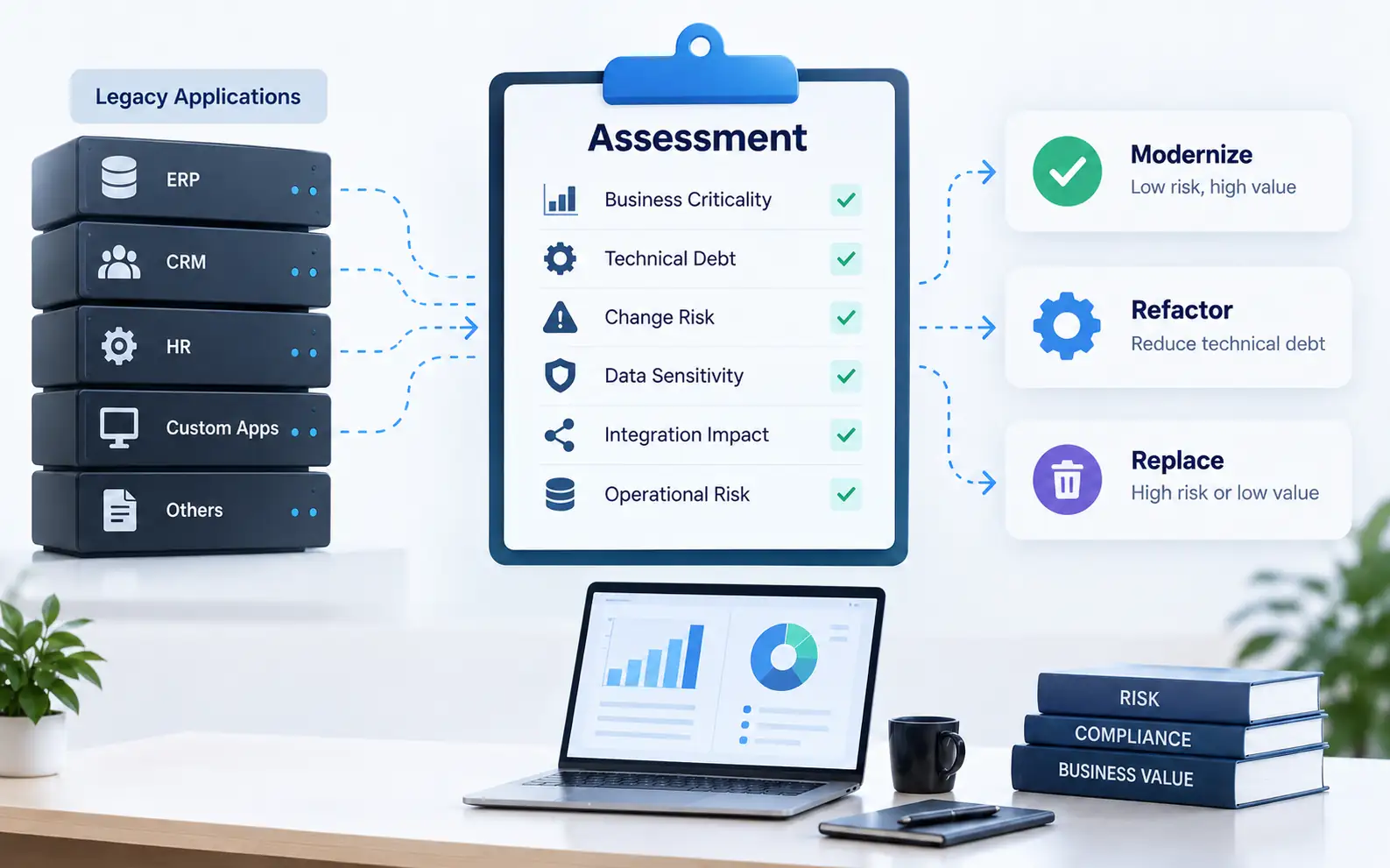
Assess business criticality, technical debt and change risk
Build an application inventory
Begin with a prioritized inventory that maps legacy applications to business functions, uptime SLAs, compliance boundaries, and data sensitivity. This inventory becomes the shared reference for every modernization decision that follows.
For each system, capture transaction volumes, peak window constraints, downstream consumers, and known failure modes. Note who owns the application, who supports it after hours, and which vendor contracts still apply.
This operational context decides the first move. It tells you whether to expose read only views, add an API facade, or schedule a phased replatform before any AI traffic reaches the system.
Score technical debt and change risk
Quantify technical debt as discrete risks rather than a general feeling. Typical items include unsupported libraries, single vendor hardware, undocumented integrations, hard coded business rules, and manual workarounds that staff perform every week.
Assign each system a change risk score that combines business impact with the likelihood of regression. A simple scale from one to five for each factor is usually enough to rank the estate.
Use those scores to decide the prerequisite work. A high score may call for a read only surrogate, a service layer, or a deeper refactor before any AI integration is attempted.
Set stakeholder gates early
Include stakeholder gating in the assessment itself. Legal reviews regulated data, security reviews credential flow changes, and operations reviews rollback steps and incident playbooks before any build work starts.
Document acceptance criteria for each modernization increment. Teams can then validate AI outputs against business rules without disrupting existing SLAs or reopening decisions that were already agreed.
- Create a matrix of system criticality, data sensitivity and change window constraints to prioritize work.
- Record integrations and data consumers to avoid breaking downstream processes when adding APIs or event streams.
- Score technical debt items by remediation cost and operational risk to guide effort versus value tradeoffs.
- Obtain legal and security sign off early for any route that exposes regulated data outside current controls.
- Define rollback criteria and incident playbooks before deploying any AI connected interface.
Prioritize by business impact and operational risk, not by code age alone. An old system that is stable and well understood can be a safer AI candidate than a newer, fragile one.
Use the enterprise data integration strategy guide to compare API, event, and batch integration patterns before wiring legacy workflows into live AI experiences.
When the next step is delivery, SDLC Corp AI development services keep the same architecture boundaries in place, so rollout and rollback stay controlled from the first release.
Separate data access from application replacement
Build canonical read views
Treat data access as an independent deliverable. Many AI use cases need curated, consistent views of the business rather than the full transactional model that the legacy application uses internally.
Implement read optimized stores or materialized views that reflect canonical business entities such as customer, order, asset, or claim. This reduces coupling to legacy schemas and their historical quirks.
Canonical views also enable cached, auditable queries for AI inference. Every question a model asks can be traced to a known view version, which simplifies both debugging and compliance reviews.
Use change data capture for a neutral data plane
Where direct queries are unsafe, use change data capture (CDC) to stream canonical events into a neutral data plane. CDC reads committed changes without forcing synchronous changes to the legacy stack.
CDC also supports event driven workflows. It gives AI systems a reliable, replayable stream for model training and inference, and it removes risky analytical queries from production databases during business hours.
Keep replacement on its own timeline
Keep the application replacement decision separate from the data access plan. You can give AI robust read and recommend capabilities years before any replatforming work begins.
That separation reduces pressure on operations teams. It enables incremental modernization while the business sees measurable outcomes early, which in turn builds the case for deeper investment later.
- Build canonical entity views to shield AI from legacy schema volatility and denormalization.
- Use CDC to populate an intermediating data plane for streaming and batch AI use cases.
- Provide read only APIs or materialized views rather than direct database access to protect integrity.
- Version data views so AI models can reference stable schemas during retraining cycles.
- Log and retain query provenance for audit and model input validation.
Deliver reliable read access first, and let replacement follow a proven data strategy. The data plane you build now will still serve the new application after cutover.
Use the cloud data modernization strategy guide to decide which legacy workloads should stay put, move, or be replatformed as AI demand grows.
If the harder problem is the pipeline estate behind the application boundary, read how to modernize legacy data pipelines for cutover, reconciliation, and rollback design.
Expose capabilities through APIs, events and service layers
Use the service layer as a policy point
Combine REST or GraphQL APIs, event topics, and a service layer to make legacy capabilities consumable by AI. None of these options requires changes to core application logic.
The service layer acts as a policy enforcement point. It translates model recommendations into validated commands and enforces authorization, rate limiting, and data masking before anything reaches the legacy system.
The same layer isolates AI clients from legacy data models. The Anti-corruption Layer pattern describes this translation role, keeping new services clean while the old system keeps its own semantics.
Publish domain events
Events keep operations loosely coupled. Publish domain events for state changes, then subscribe from the AI plane to trigger inference, enrichment, or retraining without polling the legacy system.
Events also enable replay and after the fact analysis. That supports compliance reviews and model debugging, because teams can reproduce exactly what the model saw when it made a recommendation.
Design APIs for machine clients
Design APIs explicitly for machine consumption. Aim for predictable payloads, stable schemas, clear versioning, and machine friendly pagination and filtering that will not break when a model client changes.
Include metadata fields for provenance, confidence scores, and human review status. Downstream systems can then make deterministic routing decisions instead of guessing how much to trust each response.
- Implement a service layer that mediates all AI interactions, enforcing policies and validation.
- Expose read and command APIs with stable schemas and versioning for machine clients.
- Publish domain events for state changes and subscribe to them for model triggers and observability.
- Add provenance, confidence and review metadata to API responses for downstream governance.
- Use API gateways to centralize authentication, quotas and telemetry for AI traffic.
APIs and events let AI use legacy functionality without embedding new logic in legacy code. That keeps the change surface small and the core system easier to support.
Decouple workflows before introducing AI actions
Map and tag every workflow step
Map full workflows end to end. Identify which steps are human decisions, which are automated actions, and which create irreversible effects such as payments, shipments, or regulatory filings.
Decoupling means isolating reversible, compensating steps from terminal operations. AI can then enter at low risk points first, while terminal steps stay under existing controls until evidence supports a change.
Use an orchestration layer or workflow engine to make these boundaries explicit. External orchestration also lets operators pause, inspect, or redirect a workflow while it is still in flight.
Start in advisory mode
Where possible, inject AI as an advisory service that annotates the workflow with recommendations rather than commands. This keeps risk low while teams evaluate AI behavior against business rules.
Track recommendation acceptance rates and business impact from day one. These numbers identify safe automation candidates and feed directly into the promotion thresholds described later in this guide.
Plan compensation and duplicate controls
Define clear escalation and audit trails for every workflow change. If an AI driven recommendation causes an error, the system must be able to return to a known good state.
A compensating transaction can reverse the business effect after execution. It does not make the original action idempotent, so duplicate execution needs its own separate controls.
Use idempotency keys, deduplication, or inbox and outbox patterns to prevent the same command from running twice. Retries, timeouts, and replayed events are the usual causes of duplicates.
- Create workflow maps and tag decision points as read only, recommend, or execute.
- Use a workflow engine to externalize orchestration and enable intervention while a workflow is in flight.
- Start AI in advisory mode to collect metrics on accuracy and operator acceptance.
- Design rollback paths for any action that cannot be immediately reversed, and pair them with idempotency keys or deduplication.
- Instrument each step for observability and audit to support incident analysis.
Introduce AI in advisory mode until workflows and compensations are proven. Promotion to action should be a measured decision, not a side effect of a successful demo.
Choose encapsulation, replatforming, refactoring or replacement
Legacy application modernization for AI should match modernization depth to risk appetite, regulatory constraints, and long term strategy. The four common options differ sharply in risk, cost, and fit.
The table below compares them side by side. Most enterprises use more than one option across their estate, and sometimes more than one on the same system over time.
| Option | What it does | Risk | Cost | Best when |
|---|---|---|---|---|
| Encapsulate | Wraps legacy functions with APIs, adapters, or a facade while core code stays unchanged | Low | Low upfront, with maintenance effort that grows over time | Legacy logic is stable and accurate, and AI mainly needs read and recommend access |
| Replatform | Moves the application to a new runtime, database, or cloud host while preserving behavior | Medium | Medium | The current runtime limits scalability, security controls, or connectivity that AI traffic requires |
| Refactor | Restructures code into cleaner modules without changing business logic | Medium | Medium to high | Tangled code blocks testing, integration, or safe write back from AI services |
| Replace | Retires the system and rebuilds or buys a new one, ideally in Strangler Fig increments | High | Highest near term cost | The system cannot meet future operational, regulatory, or AI needs through the other options |
Encapsulation keeps operational familiarity but raises long term maintenance effort. Replacement removes technical debt at a higher near term cost, so reserve it for systems that cannot meet future needs.
Apply the Strangler Fig pattern
Martin Fowler's Strangler Fig Application describes incremental replacement, where new components gradually take over functions from the old system until it can be retired safely.
Route one endpoint or process at a time to the new component, and keep the original system available as a fallback. Each increment gives a clear checkpoint for AI integration.
A routing facade in front of both systems makes this practical. Microsoft's Strangler Fig pattern guidance covers the facade, the migration sequence, and when the pattern is not a good fit.
Compare total cost of ownership
Document total cost of ownership scenarios for each option over three to five years. Include licenses, infrastructure, support effort, skills, and the cost of running two systems during migration.
Add ongoing model governance costs to every scenario. Monitoring, evaluation, retraining, and review staffing continue long after launch, and they often change which option looks cheapest.
- Choose encapsulation to minimize risk when legacy logic is stable and accurate.
- Use the Strangler Fig pattern to incrementally replace components with minimal disruption.
- Refactor modules where code clarity and testability materially reduce integration risk.
- Replatform when the runtime limits scalability or security controls required for AI.
- Include model governance and monitoring costs in TCO estimates for each option.
Match modernization depth to business value and operational constraints. The right answer for a billing core may be the wrong answer for a reporting tool on the same platform.
Start with read and recommend use cases
Pick the right pilot
Prioritize read and recommend scenarios with clear business value and low operational risk. Good examples include document summarization, anomaly detection, case routing suggestions, and search across policy or product knowledge.
These use cases typically need only read access to canonical views and a lightweight service layer that presents recommendations to operators inside the tools they already use.
Set promotion thresholds
Define measurable success criteria before the pilot starts. Precision, operator acceptance rate, and time saved are the core signals, and each needs a pilot target and a stricter automation gate.
Use the thresholds below as starting targets. Tune them to your risk tier, and hold each gate for a sustained period rather than a single good week.
| Metric | What it measures | Advisory pilot target | Automation gate | How to measure |
|---|---|---|---|---|
| Recommendation precision | Share of AI recommendations that reviewers confirm as correct | 80% or higher | 95% or higher for the automated category | Reviewer labels on a weekly sample |
| Operator acceptance rate | Share of recommendations operators accept without edits | 60% or higher | 85% or higher for four consecutive weeks | Accept, edit, and reject events logged in the service layer |
| Time saved | Reduction in handling time per task versus the control cohort | 20% or more | 30% or more with no rise in rework | A/B comparison of task timings |
| Error and rework rate | Corrections needed after an AI assisted decision | No increase versus control | Below the manual baseline | Rework tickets and reversal logs |
Treat recall as a supporting metric where missed cases are costly, such as fraud or safety alerts. A model can look precise while quietly skipping the hardest cases.
Run A/B tests with control cohorts
Use A/B testing in live operations with a control cohort that works without AI. This isolates the real effect of recommendations from seasonal volume changes or unrelated process improvements.
Track both model performance and business KPIs. Progress to partial automation only when both sets of numbers clear their gates together and stay there.
Staff pilots with mixed teams
Organize pilot teams with application owners, data engineers, and operations staff. Keep pilots short, instrumented, and connected to incident response so issues surface safely and teams can iterate before scaling.
- Select pilots with clear data availability and predictable operator workflows.
- Measure operator acceptance and downstream business effects, not only model metrics.
- Run live A/B tests with control cohorts to validate real world impact.
- Keep pilots timeboxed and instrumented for fast iteration and rollback.
- Use pilot results to build the business case for further automation or replacement.
Read and recommend pilots deliver value with minimal disruption and clear metrics. Their results become the evidence base for any later automation or replacement decision.
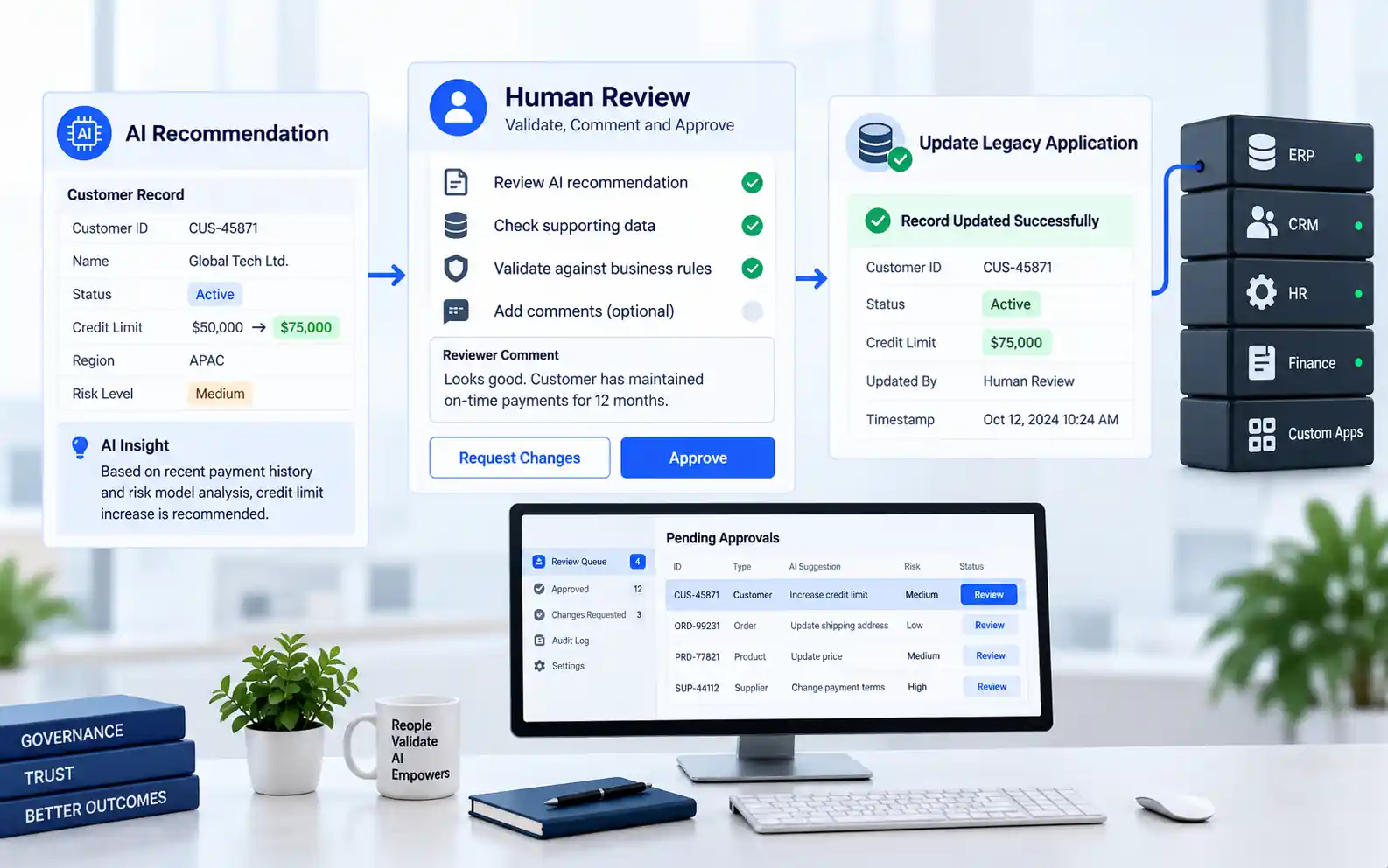
Add human review before write back
Gate every system of record change
Treat automated write back as the highest gate. Introduce a staged approval process where AI outputs need human sign off before any change reaches a system of record.
Implement role based signing flows and soft quotas. Reviewers can then batch approvals without losing context, and no single person carries an unmanageable queue.
Show reviewers the evidence
Design the review screen and API payloads to show provenance, confidence scores, and the rationale behind each recommendation. Give quick access to the source data and relevant business rules.
That transparency reduces reviewer cognitive load and improves acceptance rates. It also produces better feedback, because reviewers can explain why they rejected an item instead of simply declining it.
Graduate trust by impact tier
Move toward automation with a graduated trust model. Low impact changes can be automated at high confidence once the promotion gates hold, while higher impact items stay in review.
For example, a low impact tier might allow automatic execution at 0.95 confidence or above. A medium tier keeps single reviewer approval, and a high tier requires dual approval.
Maintain a safety margin for critical updates. Delayed execution windows let a second person or a monitoring rule stop an action before it commits to the system of record.
- Implement mandatory human review gates for any write back into systems of record.
- Surface provenance, confidence and rationale so reviewers can make informed decisions.
- Use role based approvals and staged automation thresholds to control escalation.
- Batch approvals for operational efficiency while preserving per item audit trails.
- Employ delayed execution or kill switches for automated actions on critical entities.
Human gates protect data integrity while teams build confidence in AI decisions. They should narrow gradually as evidence grows, not disappear after one successful quarter.
Govern security, data and compliance for AI access
Modernization for AI changes who and what can reach legacy data. That makes security and compliance design part of the architecture, not a review step added at the end.
Control identity and credentials
Give every AI client its own service identity with scoped permissions. Avoid shared accounts and long lived passwords, and route all AI traffic through the gateway so access stays visible and revocable.
Separate read scopes from command scopes. A model that only recommends should never hold credentials that allow it to write, even if the service layer would block the call.
Minimize and mask sensitive data
Send models only the fields a use case needs. Mask or tokenize personal and regulated data in the service layer, and respect residency rules when inference runs outside your region.
Review prompts, context windows, and logs for leakage risk. Logs that capture model inputs can quietly become a second copy of sensitive data if retention is not controlled.
Keep audit evidence ready
Record who approved each action, which model version produced it, and which data view it used. Auditors and incident teams need that chain to reconstruct any decision later.
Align retention periods for logs, events, and snapshots with regulatory requirements. Keeping evidence too briefly weakens audits, while keeping it too long increases exposure.
- Issue a dedicated, scoped service identity for every AI client and rotate its credentials regularly.
- Keep read scopes and command scopes in separate roles.
- Mask or tokenize regulated fields before they leave the service layer.
- Log the approver, model version, and data view for every AI assisted action.
- Set retention rules for prompts, logs, and event streams with legal and security teams.
Strong identity, data minimization, and audit evidence let AI reach legacy systems without widening the attack surface. These controls also shorten approval cycles for later use cases.
Test, observe and roll back safely
Release with canaries and feature flags
Testing must span unit, integration, and production like environments. Include edge cases drawn from historical incidents and known failure modes, not only clean sample data.
Use canary deployments and feature flags to expose AI outputs to a small share of traffic first. Martin Fowler's article on feature toggles explains how release, experiment, and ops toggles differ.
Observe models and business effects
Build observability into both the model pipeline and the service layer. Log inputs, model versions, confidence, decision latency, and end to end business effects for every request.
Set alert thresholds on business KPIs, not only on system errors. Teams can then react to declining model quality before it grows into visible business impact.
Rehearse rollback
Plan rollback as part of every release. Keep immutable model artifacts and reversible deployment paths so any version can be restored quickly and with confidence.
Playbooks should cover revoking automated write access, reverting feature flags, and replaying event streams to restore state. Rehearse them before launch, not during the first incident.
Where a completed action must be undone, Microsoft's Compensating Transaction pattern describes how to design reversal steps for work that spans several systems.
- Use canary releases and feature flags to limit the blast radius of AI changes.
- Instrument model inputs and outputs with versioned logs for reproducibility.
- Alert on business KPI degradation, not only system exceptions.
- Keep immutable model artifacts and clear rollback playbooks for each deployment.
- Retain event streams and snapshots to support state reconstruction if needed.
Design observability and rollback into every AI integration step. A release that cannot be reversed quickly is not ready for production traffic.
Build a phased modernization roadmap
The patterns above work best as a sequence. Each phase has an exit gate, so the program moves forward on evidence rather than on calendar pressure alone.
- Assess the estate. Build the inventory, score change risk, and agree stakeholder gates. This phase usually takes four to six weeks for a focused portfolio.
- Expose read access. Deliver canonical views, CDC feeds, and the service layer for the first priority systems, with versioned schemas and audit logging in place.
- Run advisory pilots. Launch timeboxed read and recommend pilots with control cohorts, and measure precision, acceptance rate, and time saved against the agreed targets.
- Add gated write back. Introduce review flows, impact tiers, delayed execution, and compensation for pilots that cleared their promotion gates.
- Deepen modernization. Use pilot evidence and TCO scenarios to choose encapsulation, replatforming, refactoring, or Strangler Fig replacement for each system.
Phases can overlap across systems. One application may be running advisory pilots while another is still in assessment, which is normal for a large portfolio.
Review the roadmap each quarter. Update risk scores, close finished work, and move the next systems forward when their prerequisites are ready.
Frequently asked questions
No. Many AI use cases can be delivered by exposing read only views, APIs and event streams. Full replacement is necessary only when encapsulation, refactoring or replatforming cannot meet operational or business requirements.
Gate write back with human review, role based approvals and conservative confidence thresholds. Add compensating transactions, delayed execution windows and kill switches, and increase automation only after agreed performance gates hold.
CDC streams committed changes from legacy systems into a neutral data plane. It provides replayable data for model training, supports event driven workflows and reduces risky synchronous queries against production databases.
Track recommendation precision, operator acceptance rate, time saved and rework rate against a control cohort. Measure end to end business impact through A/B tests, not inference accuracy alone.
A common starting gate is 95% precision for the automated category, 85% operator acceptance for four consecutive weeks, and at least 30% time saved with no rise in rework. Tune these to each risk tier.
Use the Strangler Fig pattern when specific endpoints or processes can move to new components one at a time while the legacy system remains a fallback. It suits programs that need low risk, observable checkpoints.
Assessment often takes four to six weeks, and read access plus advisory pilots can follow within a few months. Gated write back and deeper modernization depend on pilot evidence, system complexity and regulatory review.