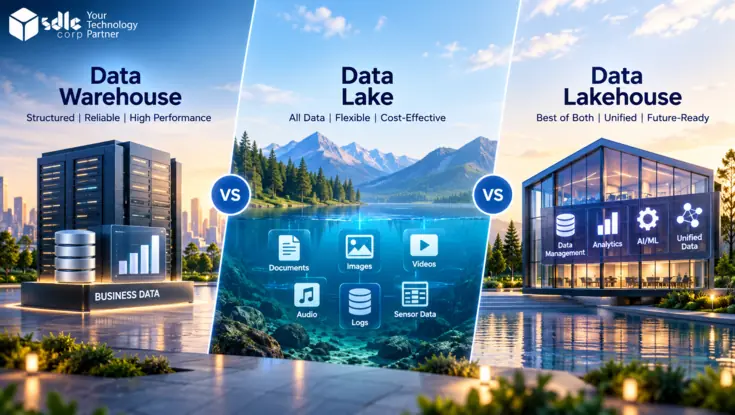
Data warehouse vs data lake vs lakehouse is a workload and governance decision, not a simple platform ranking. Compare the three patterns by data shape, query pattern, latency, governance model, operational effort, and ecosystem fit.
Many enterprises use more than one pattern. The objective is to assign each workload to the option that gives the best balance of control, performance, flexibility, and cost.
How enterprise data modernization shapes architecture choices
Enterprise data modernization frames the trade offs that decide the fit: agility, cost, governance, and analytics capability. Those goals determine whether a data warehouse, data lake, or data lakehouse suits your organization.
Understanding these goals helps you prioritize schema enforcement, query performance and freshness, cost control, and support for machine learning workflows. For a concise overview, see what is enterprise data modernization.
Workload Decision Matrix
The matrix maps four representative enterprise workloads to a recommended storage pattern. Every row uses the same six columns: workload, data shape, latency tolerance, concurrency, governance needs, and recommended pattern.
Swipe sideways to see every column.
| Workload | Data shape | Latency tolerance | Concurrency | Governance needs | Recommended pattern |
|---|---|---|---|---|---|
| Month end finance reporting (certified reporting) | Structured, curated schemas | Scheduled refresh (minutes to hours) | High | Strict (ACID, lineage, RBAC) | Data warehouse |
| Exploratory model training over large multimodal data | Unstructured plus structured, large files | High tolerance (batch) | Low to moderate | Flexible; metadata and provenance important | Data lake |
| Self service analytics across subject area teams | Curated open tables (Parquet, Delta) | Medium (minutes) | Medium to high | Moderate to high (governed tables) | Lakehouse |
| Hybrid enterprise estate (mixed workloads) | Mixed | Mixed | Mixed | Layered governance | Combined pattern |
Read each row from left to right. The first five columns describe the workload profile, and the last column names the pattern that fits it best. The reasoning behind each recommendation is listed below.
- Month end finance reporting suits a warehouse because trusted KPIs and predictable SQL performance matter for many simultaneous users.
- Exploratory model training suits a lake because format flexibility and low cost storage matter most for raw, large datasets.
- Self service analytics suits a lakehouse because lake scale data gains warehouse like governance for shared analytics and AI.
- A hybrid estate suits a combined pattern because segmenting workloads by layer lets each pattern serve its best use case.
Simple scoring example (how to apply)
Assign weights that sum to 100: latency 30, concurrency 25, governance 25, and data shape fit 20. Score each candidate from 0 to 5 on every criterion.
Multiply each score by its weight and add the results. Divide the total by 5 to get a normalized score out of 100. The highest score is the recommended pattern.
Sample results, shown as weighted total and normalized score:
- Month end finance reporting: warehouse (5 × 30 + 5 × 25 + 5 × 25 + 4 × 20) = 480, or 96/100; lakehouse 440, or 88/100; lake 250, or 50/100. Decision: data warehouse.
- Exploratory model training: lake 470, or 94/100; lakehouse 360, or 72/100; warehouse 200, or 40/100. Decision: data lake.
- Self service analytics: lakehouse 455, or 91/100; warehouse 420, or 84/100; lake 300, or 60/100. Decision: lakehouse.
The scoring keeps the best fit mappings from the matrix while giving you a repeatable, numeric decision rule to test against your own workloads.
The Platform Choice Depends On The Workload
The data warehouse vs data lake vs lakehouse decision should start with workload requirements. Evaluate data shape, latency, concurrency, retention, governance depth, and how users or applications will consume the data.
A warehouse is strongest when certified metrics and predictable SQL concurrency dominate. A lake is strongest when flexible raw capture and economical retention dominate.
A lakehouse is strongest when governed open tables can reduce duplication across analytics and AI workloads. Most estates contain all three workload types, which is why a single platform answer rarely holds.
Use the decision matrix to compare candidates against representative workloads, then validate the leading option with a short proof of concept.
The result of this comparison is a storage pattern decision. Platform layering, control planes, and migration sequencing are separate architecture decisions that follow it.
What Is A Data Warehouse?
A data warehouse is strongest when teams need certified business metrics, predictable SQL performance, and high concurrency reporting on well defined structures.
That makes it a strong choice for finance, executive reporting, and governed decision support, where semantic consistency matters more than format flexibility.
Its limitation is not weakness. It is focus. Warehouses are less natural for raw multimodal data, low cost long term landing, or exploratory workflows that change shape constantly.
Use them where governed, repeatable business consumption is the primary goal.
- Best fit: governed reporting, stable metrics, and high concurrency business use.
- Strength: clear schema, certified outputs, and mature access controls.
- Trade off: less natural for raw, fast changing, or highly heterogeneous data.
- Decision rule: choose it when trusted business consumption is the dominant requirement.
Warehouses win when consistency and reporting performance matter more than raw data flexibility.
What Is A Data Lake?
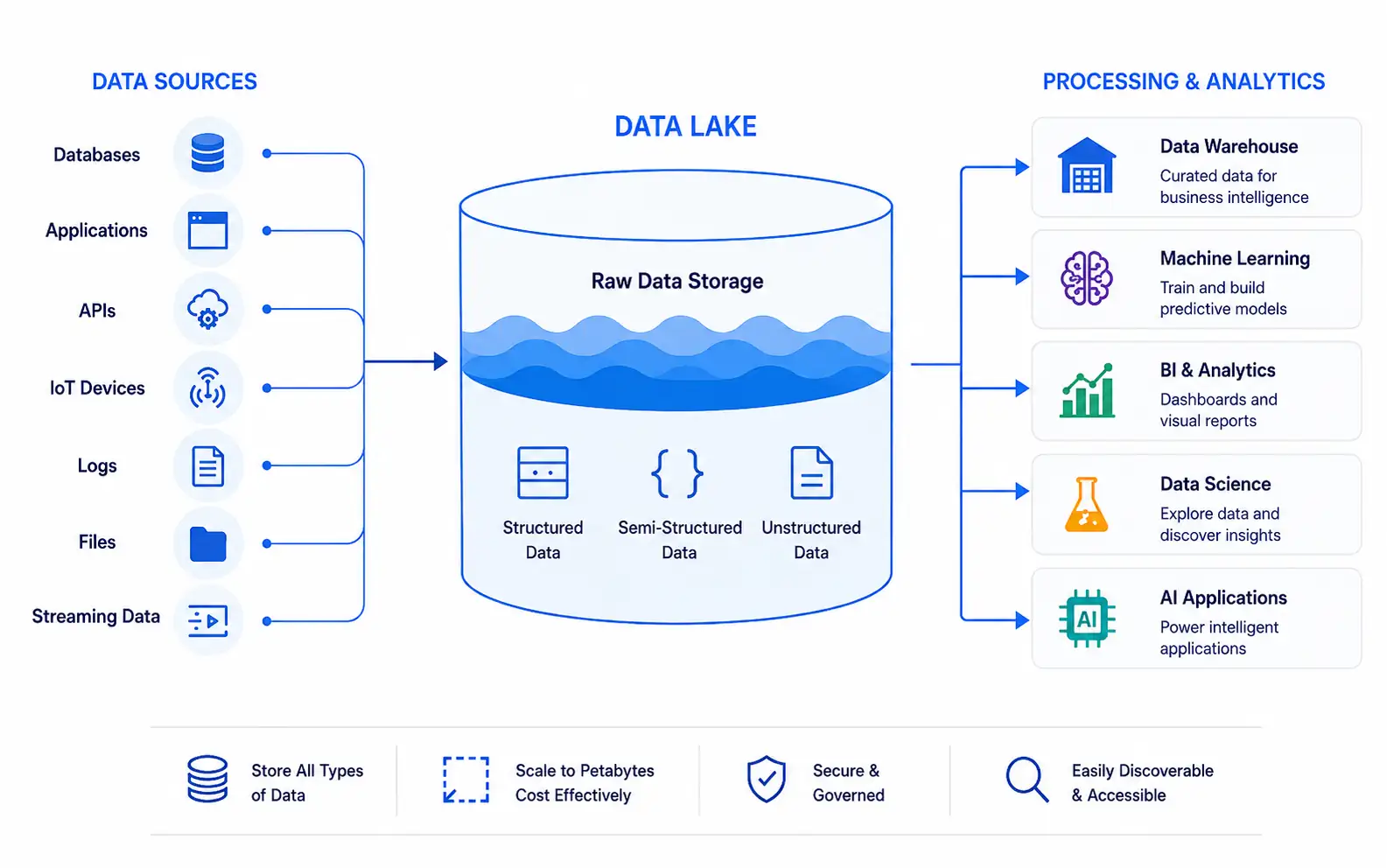
A data lake is strongest when teams need broad raw data capture, many file formats, and economical retention for exploration, training, or downstream processing.
That makes it useful as a landing zone and as a foundation for workloads that do not need warehouse like interaction on day one.
Its trade off is operational discipline. A lake needs metadata, access policy, lineage, and quality controls to stay usable.
Without those controls it becomes hard to discover, trust, or govern the data that teams were trying to preserve.
- Best fit: raw capture, format variety, and low cost historical retention.
- Strength: flexibility and storage economics.
- Trade off: governance and discoverability must be built intentionally.
- Decision rule: choose it when raw data flexibility matters more than curated interactive access.
Lakes are powerful because they are flexible. They are risky when teams mistake flexibility for governability.
What Is A Data Lakehouse?
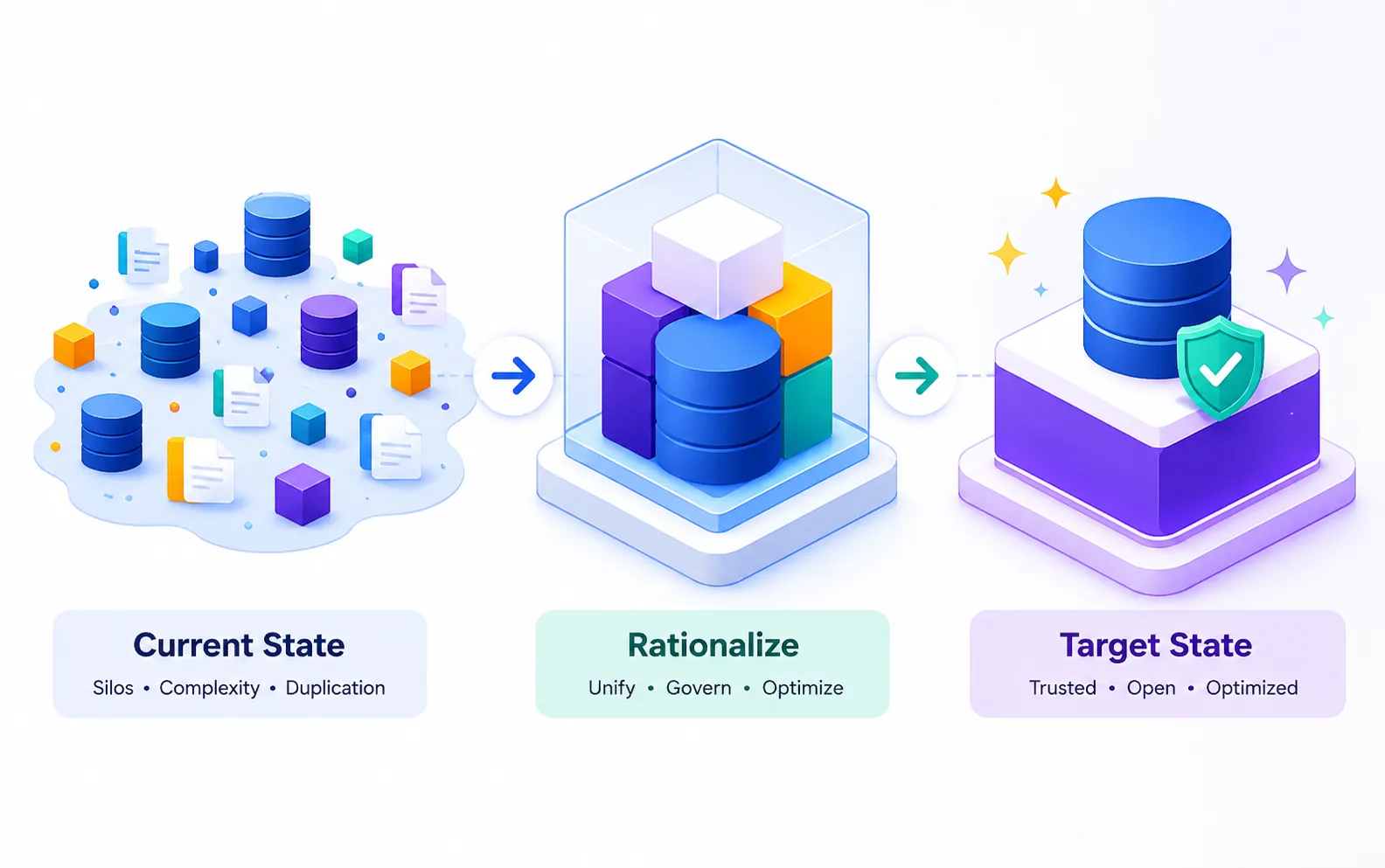
A lakehouse is useful when teams want open storage economics with stronger table semantics, versioning, and governance than a raw lake usually provides.
It can reduce duplication between raw and curated layers when the organization is prepared to operate the metadata and performance controls it depends on.
The trade off is operational complexity. A lakehouse is not a free simplification. It still needs metadata discipline, performance tuning, lineage, and access controls to deliver consistent enterprise behavior.
- Best fit: shared analytics and AI over governed open tables.
- Strength: unified storage pattern with stronger table behavior.
- Trade off: metadata and operations become critical infrastructure.
- Decision rule: choose it when open storage plus governed table semantics solves a real duplication problem.
Lakehouses are valuable when they reduce real duplication, not when they are adopted as a generic compromise.
For the open table format documentation behind these claims, see the reference formats section later in this article.
Core Differences Across Data, Performance And Governance
Compare the three patterns across four dimensions: data shape, interaction pattern, governance model, and operating effort. The table shows how each pattern behaves on each dimension.
Swipe sideways to see every column.
| Dimension | Data warehouse | Data lake | Data lakehouse |
|---|---|---|---|
| Data shape | Structured, modeled schemas enforced on write; semi structured support varies by platform. | Any format, including files, logs, images, audio, JSON, and Parquet, with schema applied on read. | Open columnar tables with Iceberg, Delta, or Hudi metadata, plus schema enforcement and controlled evolution. |
| Interaction pattern | SQL first BI, dashboards, and certified marts with high concurrency and predictable latency. | Batch processing, Spark and notebook exploration, and ad hoc engines scanning files. | SQL, Spark, and ML engines reading the same tables; BI concurrency depends on engine and tuning. |
| Governance model | Mature RBAC, row and column security, ACID transactions, and built in auditing in most platforms. | Object level IAM and bucket policies by default; catalog, lineage, and quality checks must be added. | Table level ACID, time travel, and catalog based access control, provided the catalog is run well. |
| Operating effort | Lowest for managed services; effort goes to modeling, cost control, and workload management. | Moderate to high; teams own file layout, partitioning, catalog, and quality tooling. | Moderate to high; compaction, snapshot expiry, catalog operations, and engine tuning become routine work. |
Data shape and schema discipline
Warehouses enforce schema when data is written. That keeps downstream metrics stable but slows onboarding of new sources, because every source change usually means a model change.
Lakes accept data first and interpret it later. That speeds ingestion, but it moves the cost of understanding the data to every consumer who reads it.
Lakehouses sit between the two. Open table formats record schema in metadata and support controlled evolution, so new columns can be added without rewriting history.
Query and interaction patterns
Warehouse engines are tuned for many short SQL queries at once. Result caching, workload isolation, and automatic scaling make dashboard traffic predictable.
Lake engines are tuned for large scans and transformations. They perform well for batch jobs but can struggle when many analysts run small interactive queries against raw files.
Lakehouse engines narrow that gap with statistics, file skipping, and caching. Interactive performance still depends on file sizing, clustering, and how well the tables are maintained.
Governance model
In a warehouse, access control, auditing, and transactions usually ship with the platform. Governance work concentrates on definitions, ownership, and certification of shared metrics.
In a lake, governance is assembled from parts: identity policies, a catalog, lineage capture, and quality checks. Each part must be configured and kept consistent as the lake grows.
In a lakehouse, the catalog becomes the control point. If the catalog is weak, table level guarantees do not translate into consistent enterprise access policy.
Operating effort and skills
Managed warehouses shift infrastructure work to the provider. Teams still need modeling, cost monitoring, and workload management skills, but storage layout is rarely their concern.
Lakes and lakehouses give teams more control over layout and engines. That control pays off only when the team has capacity to run compaction, catalogs, and access tooling.
Storage cost per TB by tier
Storage prices differ by more than twenty times across tiers. The figures below are indicative US region list prices in mid 2026. They exclude compute, requests, retrieval, and egress.
Swipe sideways to see every column.
| Storage tier | Typical pattern use | Indicative price per TB per month | Notes |
|---|---|---|---|
| Object storage, hot (Amazon S3 Standard) | Lake and lakehouse active data | About $23 for the first 50 TB, falling to about $21 above 500 TB | Request and egress fees are billed separately. |
| Object storage, infrequent access (S3 Standard IA) | Older lake zones read about monthly | About $12.50 | 30 day minimum storage and a per GB retrieval fee. |
| Archive, instant access (S3 Glacier Instant Retrieval) | History read a few times a year | About $4 | 90 day minimum; retrieval costs about $0.03 per GB. |
| Archive, deep (S3 Glacier Deep Archive) | Compliance and legal retention | About $1 | 180 day minimum; standard restores take up to 12 hours. |
| Warehouse storage, active (BigQuery active logical) | Warehouse tables changed in the last 90 days | About $20 per TiB | Physical billing charges compressed bytes at a higher unit rate. |
| Warehouse storage, long term (BigQuery long term logical) | Tables unmodified for 90 days | About $10 per TiB | Rate drops automatically with no performance change. |
| Warehouse managed storage (Snowflake, Redshift RA3) | Warehouse tables | Roughly $23 to $40 | Varies by contract type, region, and time travel or fail safe retention. |
The headline gap is smaller than it looks. Warehouse storage is often billed on compressed or logical bytes. Lake storage bills every file you keep, including duplicates and old table versions.
Treat these numbers as planning inputs only, and confirm current rate cards for your region and contract before building a budget.
Concurrency ranges
Concurrency is where the patterns separate most clearly. The ranges below are planning figures, not guarantees, because engine choice, query shape, and scaling settings all change them.
Swipe sideways to see every column.
| Pattern | Typical engine setup | Indicative concurrent queries | Scaling behavior |
|---|---|---|---|
| Data warehouse | Managed MPP engine with multi cluster or serverless scaling | Around 8 to 20 per compute cluster (Snowflake defaults to 8 per warehouse cluster); hundreds with automatic scaling | Adds clusters or slots automatically and queues work beyond the limit. |
| Data lake | Spark, Hive, or serverless SQL over raw files | Single digits to low tens of interactive queries per cluster or account quota | Scales well for batch throughput; interactive concurrency is capped by quotas and file scans. |
| Data lakehouse | SQL warehouse engines over open tables | About 10 per cluster as a common sizing guide (Databricks SQL); hundreds with multi cluster scaling | Scales out by cluster; speed depends on compaction, statistics, and caching. |
For finance or executive dashboards with hundreds of simultaneous users, warehouse style scaling is the lowest risk choice. For a few dozen analysts, a well maintained lakehouse is usually enough.
Metadata operation overhead
Lakes and lakehouses pay a metadata tax that warehouses mostly hide. Every file is an object to list, read, and track, and every table commit adds metadata that must be maintained.
Swipe sideways to see every column.
| Operation | What drives the overhead | Indicative figures | Mitigation |
|---|---|---|---|
| Object requests | Listing and reading many small files | S3 PUT requests about $0.005 per 1,000; GET requests about $0.0004 per 1,000 | Write fewer, larger files and avoid directory listing at query time. |
| Small file compaction | Streaming and frequent small writes | Default target file sizes: Delta Lake OPTIMIZE about 1 GB, Iceberg 512 MB, Hudi 120 MB | Schedule compaction jobs and tune writer file sizes. |
| Transaction log growth | Each commit adds a log or snapshot entry | Delta Lake writes a checkpoint every 10 commits by default | Keep checkpointing on and monitor log size on busy tables. |
| Snapshot and version cleanup | Time travel keeps old files alive | Delta VACUUM retains 7 days by default; Iceberg snapshot expiry defaults to 5 days when it runs | Run expiry and vacuum on a schedule aligned to recovery needs. |
| Catalog operations | Schema changes, grants, and table discovery | Grows with table and user count rather than data volume | Centralize the catalog and automate policy assignment. |
None of these costs appear on a storage quote. They show up as engineering hours, compute for maintenance jobs, and slower queries when maintenance falls behind.
Total cost beyond storage
Do not score storage cost in isolation. Include query compute, concurrency scaling, metadata operations, data duplication, recovery, access control, and the skills needed to run the platform.
A lower storage price can be offset by higher engineering or governance effort. A higher warehouse storage price can be offset by less duplication and less maintenance work.
Which Pattern Supports Enterprise AI Best?
No single pattern is universally best for enterprise AI. Warehouses, lakes, and lakehouses can all support ML and GenAI when contracts, lineage, access controls, and reproducibility are strong enough.
The better question is which pattern fits the data shape, latency, governance, and tooling needs of each use case.
Training data
Raw training data usually lives most naturally in a lake. Images, audio, documents, and event logs are cheap to keep there, and training frameworks read files directly.
The risk is reproducibility. Without versioned tables or dataset snapshots, a model cannot be retrained on exactly the same data it was built with.
Feature serving
Low latency feature serving often relies on curated tables or dedicated serving layers. Some teams add a feature store, but only when reusable structured features and serving consistency justify the extra operating model.
Retrieval workflows
Retrieval augmented generation depends on governed content stores and permission aware indexing. The storage pattern matters less than whether document permissions follow the content into the index.
- Use lakes when raw scale capture and training flexibility dominate.
- Use curated warehouse or table serving layers when low latency governed access dominates.
- Use lakehouses when unified governed open tables reduce duplication materially.
- Judge AI fit by reproducibility, governance, latency, and tooling, not by one storage label.
Enterprise AI depends on governed, reproducible data access more than on any one storage category.
Before committing to a storage pattern, check the control and pipeline requirements around it in data readiness for AI.
Those practices help create an AI ready data foundation that supports reproducibility, governance, and permission aware access for ML and retrieval workflows.
When A Combined Architecture Is More Practical
Hybrid is usually the practical answer for large enterprises, because different workloads really do need different storage and interaction patterns.
The goal is not to avoid hybrid. The goal is to make it intentional by defining where each pattern starts, where it hands off, and how metadata and policy stay consistent across the boundary.
Common hybrid layouts
The most common layout lands raw data in a lake, refines it into governed lakehouse tables, and publishes certified marts to a warehouse for high concurrency reporting.
A second layout keeps the warehouse as the system of record for finance. A lake holds only logs, media, and training data that the warehouse cannot store economically.
A third layout, now increasingly common, lets the warehouse query open tables directly. That avoids copying data while keeping warehouse concurrency for the reports that need it.
Where hybrid designs fail
Hybrid estates fail when the same metric is computed differently in two layers. Define each certified metric once and publish it from one place.
They also fail when access policies drift. A user who is blocked in the warehouse should not be able to read the same records as files in the lake.
Finally, watch for silent duplication. Every copy between layers adds storage, pipeline runs, and reconciliation work, so each copy needs a named consumer and an owner.
- Use hybrid when workloads differ materially in latency, structure, or governance needs.
- Keep metadata, lineage, and access policy consistent across boundaries.
- Avoid duplicating data without a clear consumption reason.
- Treat hybrid architecture as an operating model choice, not a failure to standardize.
Hybrid patterns succeed when governance and metadata are unified, even when storage patterns are not.
Use modern enterprise data architecture for the full layering model.
Decision Criteria For Platform Selection
Use a scored decision matrix to keep the comparison disciplined. Weight the factors that matter for each workload, then test the top choices against representative workloads instead of platform claims.
Suggested criteria and weights
Swipe sideways to see every column.
| Criterion | What to measure | Suggested weight |
|---|---|---|
| Latency | p95 query time for representative dashboards and jobs | 15 to 30 |
| Concurrency | Peak simultaneous users and queued queries | 10 to 25 |
| Data variety | Share of semi structured and unstructured sources | 5 to 20 |
| Governance depth | Regulatory scope, row and column security, and audit needs | 15 to 25 |
| Retention economics | Years of history and access frequency by data age | 5 to 15 |
| AI tooling | Engines and frameworks that must read the data | 5 to 15 |
| Operating burden | Engineering hours for compaction, catalog, and tuning | 10 to 20 |
Adjust the weights per workload, but keep them summing to 100 so scores stay comparable across teams.
Running the proof of concept
- Pick two or three representative workloads, including the hardest reporting query and the largest training job.
- Load a realistic data volume, with at least a few months of history, into each candidate.
- Measure p95 latency, peak concurrency, maintenance effort, and cost per query over at least one business cycle.
- Test access policies end to end, including a user who should be blocked.
- Score the results with the same weights and share the trade offs with stakeholders before committing.
- Score workload needs before debating products or vendor messaging.
- Include operating effort and governance maturity in the decision.
- Validate the top option with representative workloads and controls.
- Move to architecture and strategy pages after the comparison decision is made.
Selection works best when the comparison ends with a testable decision rule.
Use cloud data modernization strategy when migration sequencing is the main concern.
Use enterprise data products for AI and analytics when ownership of reusable outputs is the sticking point, and modern enterprise data architecture for the broader platform boundary.
Reference Formats Behind Lakehouse Claims
To keep the comparison vendor neutral, use open table format references alongside platform guidance.
Apache Iceberg documents multi engine table behavior and metadata management. Apache Hudi documents incremental table behavior and lakehouse trade offs.
The Delta Lake documentation describes transaction log, batch, and streaming behavior. These sources help qualify where a lakehouse pattern is useful instead of relying on one vendor definition.
Frequently Asked Questions
Yes. Hybrid architectures are common: a data lake for raw capture and bulk training, a warehouse for high concurrency reporting, and optionally a lakehouse layer to centralize metadata and reduce duplication.
The key is coordinating metadata, governance, and data contracts between layers.
Data lakes are often a strong fit for large scale model training when teams need raw, diverse formats and large batch processing, but they are not the universal best option.
Warehouses, lakes, and lakehouses can all support ML depending on data formats, performance needs, governance controls, and the tooling for reproducibility and serving.
Not necessarily. A lakehouse can reduce duplication, but warehouse grade SLAs for low latency, high concurrency queries often require additional engineering.
Many enterprises still maintain a warehouse for certified marts while using the lakehouse for unified storage and metadata.
Essential capabilities include a central metadata catalog, dataset level access controls, automated lineage, data quality checks, and dataset versioning.
These features make data discoverable, auditable, and safe for analytics and AI workflows regardless of the underlying storage.
Hot object storage for lakes and lakehouses costs about $23 per TB per month on Amazon S3 Standard and about $1 in deep archive. Managed warehouse storage typically runs about $20 to $40 per TB.
Compute, requests, and maintenance usually cost more than storage itself.
Run short POCs using representative datasets and workloads. Measure query latency, concurrency, pipeline reliability, metadata integration, and operating effort.
Use a scored decision matrix to compare results and surface trade offs for stakeholders before scaling the migration.