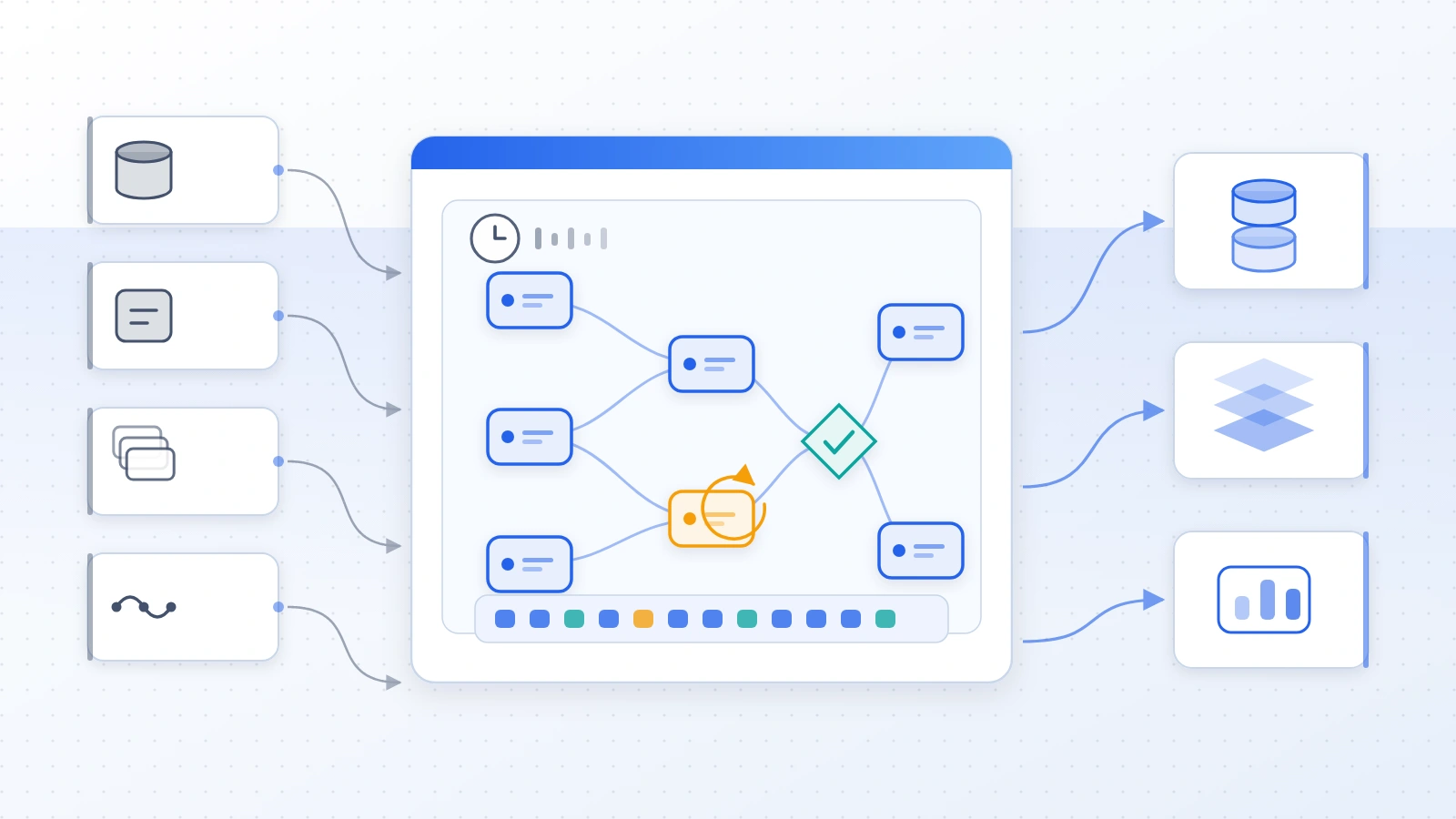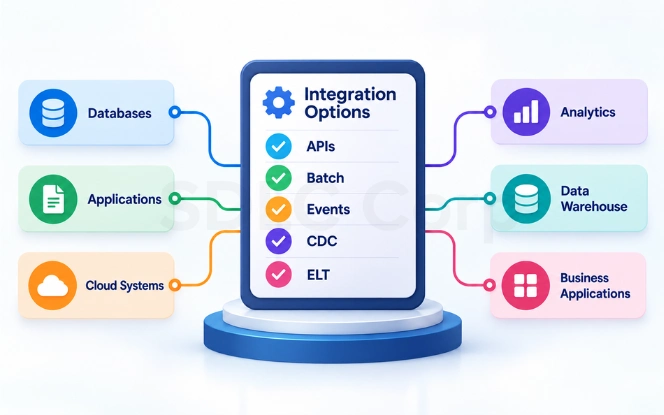

An enterprise data product is a governed, reusable data offering built for a defined consumer need. A durable data product is defined by its consumer contract, ownership, lifecycle, and usage rather than by a generic platform description.
The value of a data product comes from reliability and clarity. Consumers should know what the product is for, who owns it, which quality and freshness expectations apply, how access works, and when it will change or retire.
- Start from a consumer decision or workflow, not from a dataset waiting for a label.
- Define a product contract that includes semantics, quality, freshness, and access rules.
- Assign an owner with service responsibilities, not only a steward name.
- Measure adoption and usefulness after publication, not only whether the product exists.
Worked Example: Customer Eligibility Data Product
Use one concrete product to make the contract and operating model testable. A customer eligibility product can serve a lending workflow, a support agent, and a decision support model without making each consumer rediscover definitions or build private copies.
| Contract field | Example value | Operating implication |
|---|---|---|
| Purpose and consumers | Eligibility decisioning for assisted service and risk review workflows. | New consumers require an approved use case and access review. |
| Identifier and semantics | customer_id, eligibility_status, reason_code, effective_at. | A stable identifier and documented reason codes prevent ambiguous joins and explanations. |
| Freshness and quality | Refresh within the agreed decision window; block publication when source reconciliation fails. | Consumers can distinguish a usable result from a stale or incomplete result. |
| Access and lineage | Role based access, source system references, transformation version, and approval status. | An owner can reconstruct how a decision input was produced. |
| Change and retirement | Versioned schema, 60 day deprecation notice, and named migration owner. | Consumers receive a predictable transition rather than a silent breaking change. |
Measure product value and service health
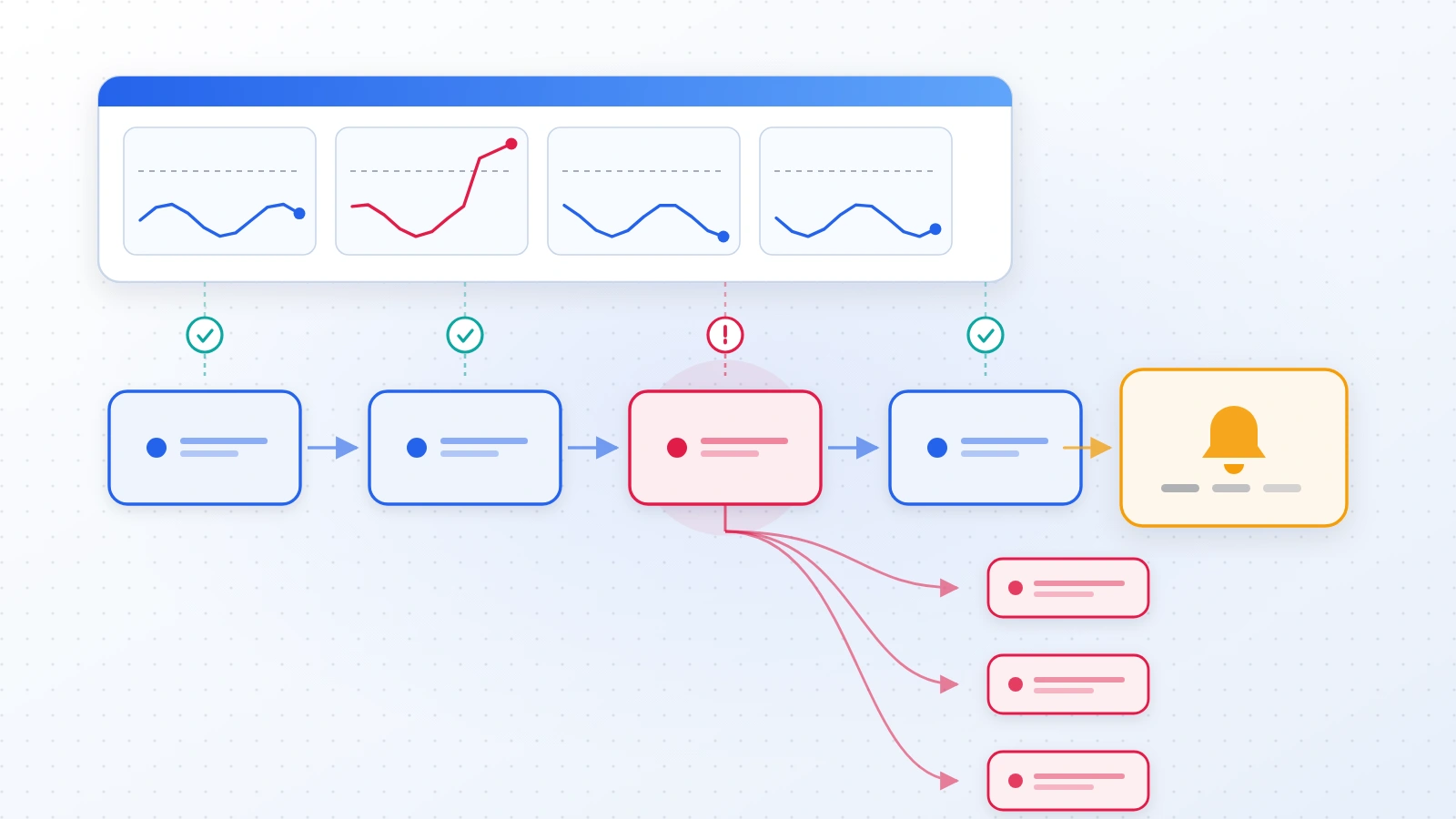
Track whether intended consumers can find, request, and use the product, then pair adoption evidence with service health. A practical dashboard can show approved consumers, first successful use, freshness SLA attainment, failed quality checks, incident recovery time, and deprecation progress. Review a metric when it changes a product decision: improve the contract, address a dependency, reduce access friction, or retire an unused product.
- Assign one accountable product owner and separate platform support from domain decision rights.
- Publish a short consumer onboarding path with expected access and validation steps.
- Use usage and reliability evidence together so a technically healthy but unused product is not treated as successful.
What Qualifies As An Enterprise Data Product?
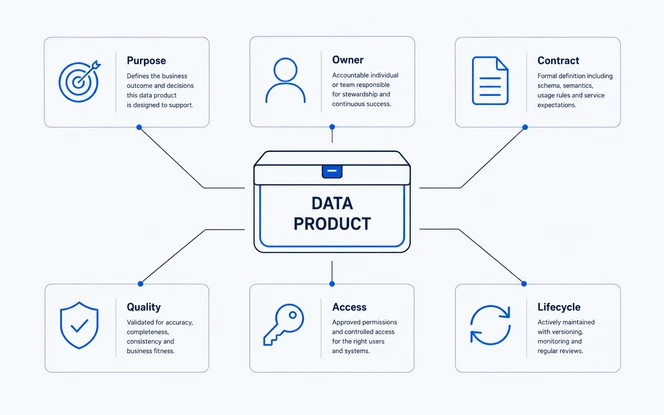
A dataset becomes a product when it has a defined purpose, an accountable owner, documented semantics, service expectations, and a path for change. Without those elements, it may still be useful data, but it is not yet a durable product.
That distinction matters because a product creates obligations. Consumers expect the publisher to explain the meaning, quality, freshness, and lifecycle of what they are consuming.
- Defined consumer need and business purpose.
- Named owner with support and change responsibilities.
- Documented contract for fields, quality, freshness, and access.
- Lifecycle rules for versioning, change, and retirement.
For an external framing of product style ownership and federated governance around shared data, see Martin Fowler's data mesh principles. For the ownership and platform trade offs behind domain oriented data products, see Data Mesh vs Data Fabric for Enterprise AI. For enterprise data governance frameworks, see enterprise data governance frameworks.
Start With A Decision Or User Need
Start with a decision or user need because products exist to reduce friction for a consumer. A good product is designed around the question a team needs answered, the workflow it enables, and the service level the consumer actually requires.
This prevents teams from publishing raw extracts as if every table deserves product status.
- Define the primary consumer, decision, and consumption pattern first.
- Design fields, freshness, and granularity from that need.
- Publish one product for a real use case before trying to serve every possible audience.
- Reject products that exist only because the source table already exists.
Define The Product Contract
The product contract is the core artifact. It should define business meaning, schema, quality expectations, freshness target, access rules, lineage references, and deprecation policy. If the product serves AI use cases, also state any limits on feature reuse, retrieval context, or sensitive fields.
A concrete consumer SLO example helps. For instance, a product may promise hourly refresh, named completeness checks, a documented key, and a target access response time for approved consumers.
- Document semantics, keys, and intended use clearly.
- Set freshness, completeness, and availability expectations per consumer need.
- Publish access, retention, and change management rules.
- Use the contract to make review and onboarding faster for consumers.
Assign Ownership And Service Responsibilities
Ownership and service responsibility should be explicit enough that consumers know who to contact when quality changes, access is delayed, or the contract needs revision. Product ownership is more than stewardship; it includes service expectations and adoption responsibility.
Platform or governance teams can support the product, but they should not become the hidden owner of every domain product.
- Name a product owner with decision authority and operating responsibility.
- Separate domain ownership from shared platform support roles.
- Define support channels and escalation rules for consumers.
- Review ownership when products cross domain or regulatory boundaries.
Build Quality, Lineage And Security Into The Product
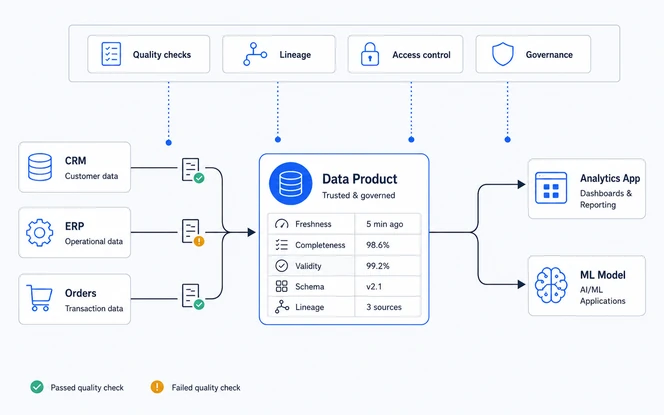
Quality, lineage, and security should be built into the product contract and the delivery path. Consumers need to know what the quality checks are, where the data comes from, what permissions apply, and which fields carry special restrictions.
Describe those controls at the product level and link to the dedicated governance, quality, and architecture articles only when the reader needs implementation depth. For source to decision traceability, impact analysis, audit evidence, and AI specific provenance, see Data Lineage for AI Governance.
- Expose the key quality checks and failure thresholds to consumers.
- Link lineage and dependency information to the product record.
- Publish access and handling rules for sensitive data clearly.
- Treat controls as product features, not hidden implementation detail.
Publish, Discover And Measure Product Usage
Publishing and discovery should make the product easy to find, understand, request, and adopt. That means searchable metadata, clear ownership, example use cases, and a simple path for access or feedback. A product that technically exists but cannot be discovered or accessed without tribal knowledge still creates friction for the consumer.
Usage metrics matter after launch. Track whether consumers adopt the product, whether they keep using it, and whether workarounds suggest the contract still misses real demand. Measurement should connect product health with consumer behavior so teams can distinguish a reliable product from a useful product.
Make discovery part of the product experience
Discovery starts with metadata that answers practical consumer questions. A catalog entry should explain the product purpose, supported use cases, owner, refresh pattern, important fields, quality expectations, access method, and lifecycle status. Search terms should reflect business language rather than only source system terminology. This helps analysts, application teams, AI engineers, and operational users find the same governed product instead of creating parallel extracts.
Measure adoption, reliability and consumer outcomes together
A useful measurement model separates adoption, service health, and business usefulness. Adoption metrics can include unique approved consumers, active consumers over time, repeat usage, downstream applications or models, and time from access approval to first successful use. These measures show whether the product is being incorporated into real workflows.
Service health metrics should reflect the product contract. Track freshness SLO attainment, quality check pass rates, failed refreshes, incident frequency, mean time to recovery, access request turnaround, and breaking change events. Review these measures from the consumer perspective. Infrastructure may be healthy while a product is late, incomplete, or difficult to access, so platform uptime alone is not sufficient evidence of product reliability.
Consumer outcome measures answer whether the product is reducing work or improving a decision. Depending on the use case, evidence can include fewer duplicate pipelines, shorter analysis preparation time, reduced reconciliation effort, faster model feature delivery, fewer manual corrections, or increased reuse across approved teams. Not every product needs a financial KPI, but each product should have a clear reason for continuing to receive operational support.
Use measurement to make lifecycle decisions
Metrics are most useful when they trigger a decision. Rising adoption may justify stronger support or tighter SLOs. Repeated onboarding failures may indicate unclear metadata or access friction. Frequent quality incidents may require upstream remediation. Low sustained usage may show that a product should be merged, redesigned, or retired.
Review trends rather than isolated counts and combine quantitative measures with consumer feedback. A new product may have low usage while teams are onboarding, whereas a mature product with steadily declining usage may need a retirement discussion.
- Publish searchable metadata and clear access request paths.
- Show example consumers and common use cases where possible.
- Track adoption, reuse, failed onboarding, and support demand.
- Pair usage metrics with freshness, quality, incident, and recovery measures.
- Measure whether the product reduces duplicate work or improves a consumer workflow.
- Use usage evidence to improve the product contract and retirement decisions.
Scale From One Product To A Portfolio
Scaling from one product to a portfolio requires consistent contracts, ownership rules, and lifecycle governance. The goal is not to publish as many products as possible. The goal is to create a portfolio that consumers can actually trust and navigate. As the number of products grows, weak naming, overlapping purpose, inconsistent service levels, and unclear ownership create more cost than value.
A portfolio operating model should make it easy to decide when a new product is justified, how it relates to existing products, what level of service it deserves, and when it should be merged or retired. Lightweight standards are usually more effective than a central team trying to approve every implementation detail.
Create a portfolio structure consumers can understand
Start with a taxonomy that reflects business capabilities, domains, or major consumer journeys. Group products in a way that helps a user answer, “Where should I look for trusted data for this decision?” The taxonomy should be stable enough for discovery but flexible enough to accommodate new products without creating overlapping categories.
Use a standard product template across the portfolio. Every product should expose the same core information: purpose, owner, intended consumers, contract, access path, service expectations, dependencies, lifecycle state, and support route. Consistency lowers the learning cost because consumers do not need to interpret a different documentation model for every domain.
Review overlap before adding another product
Portfolio growth should be demand led. Before approving a new product, check whether an existing product can meet the need through a documented extension, serving view, or new access pattern. This does not mean forcing unrelated consumers into one oversized product. It means avoiding multiple products that represent the same business concept with slightly different names, keys, or refresh rules.
A lightweight review can ask five questions: Is there a repeatable consumer need? Does a similar product already exist? Is the proposed owner prepared to operate it? Are the required service expectations supportable? Is there a clear reason the product should exist beyond one temporary project? These questions keep the catalog from becoming a renamed inventory of datasets.
Use service tiers to match investment with importance
Not every product needs the same operating level. A product supporting real time operational decisions may need tighter freshness targets, active monitoring, incident response, and stronger change controls. A product used for monthly planning may tolerate a slower refresh and simpler support model. Service tiers help teams allocate engineering effort according to consumer impact instead of applying the highest standard everywhere.
Tiering should remain transparent. Consumers need to understand what each tier promises, and owners need to understand the cost of maintaining it. Higher service levels should be justified by business criticality, usage, regulatory exposure, or dependency impact.
Manage ownership and dependencies at portfolio level
Individual owners remain accountable for their products, but portfolio governance should make cross product dependencies visible. A widely reused customer or product master may support many downstream products, so changes to that shared dependency require broader impact analysis than changes to a narrowly used analytical product.
Portfolio reviews should expose heavy support demand, duplicate transformation logic, ownership gaps, and rising infrastructure cost so leaders can decide where consolidation or shared platform investment will create more value.
Retire products deliberately
A healthy portfolio removes products as well as adding them. Retirement may follow sustained low demand, replacement by a better governed product, unacceptable support cost, obsolete business logic, or a change in operational need. Publish the retirement state, identify affected consumers, provide a migration path, and keep the old product available only for the agreed deprecation window.
Track active products, planned retirements, duplicate candidates, and products without accountable owners. These signals help governance teams keep the portfolio navigable and prevent inactive products from weakening consumer trust.
- Use standard templates so consumers see familiar contract patterns.
- Organize products with a business oriented taxonomy that supports discovery.
- Review overlap and duplication before publishing new products.
- Apply service tiers based on consumer impact and operating requirements.
- Review cross product dependencies, support cost, and ownership gaps regularly.
- Retire or merge products that no longer justify ongoing support.
- Treat portfolio quality as discoverability plus reliability, not only count of products.
Common Mistakes To Avoid
Common mistakes include publishing raw datasets as products, assigning owners without service accountability, confusing infrastructure uptime with consumer SLOs, and measuring success only by catalog count.
A good product strategy stays close to consumer value and makes the service expectations visible enough that teams can rely on them.
- Do not label everything a product just to improve appearances.
- Do not use infrastructure SLAs as a substitute for product SLOs.
- Do not publish without a clear lifecycle and retirement path.
- Do not ignore adoption signals after launch.
Example Product Contract
A useful first data product contract is short and testable. For example, a customer retention product can define the serving entity, the update cadence, the freshness target, the accepted null rate for critical fields, the owner for schema change approval, and the escalation path when an upstream source misses the refresh window. That contract gives analytics, AI, and operations teams one place to validate whether the product is trustworthy enough for a decision.
Illustrative Values: a customer retention product might require critical fields such as customer_id and retention_risk_band to stay below a 0.5% null rate, with data refreshed within a 24 hour freshness window. These values are illustrative only; the actual tolerance and freshness target should be set according to the consumer decision, source behavior, regulatory requirements, and the operational impact of stale or incomplete data.
Keep the contract visible to consumers, not only to platform teams. A product page or catalog entry should show the required fields, join keys, retention period, version policy, and support contacts. If a product change breaks a feature pipeline or dashboard, the consumer should be able to tell quickly whether the issue is a contract breach, a planned version change, or a local misuse of the data.
- Define the consumer, decision, and acceptable failure mode.
- Publish freshness, completeness, and support expectations with measurable thresholds.
- Version breaking changes and expose a deprecation path.
- Record the owner who accepts residual product risk.
Eligibility Vs Retention Data Product Examples
Comparing two products side by side shows how the same product discipline adapts to different consumer needs. The eligibility product supports time sensitive operational decisions, while the retention product supports ongoing analysis and intervention planning. Both still need a clear purpose, contract, owner, service expectations, and lifecycle.
| Product dimension | Customer eligibility example | Customer retention example |
|---|---|---|
| Primary purpose | Support assisted service and risk review decisions about whether a customer currently meets defined eligibility rules. | Identify customers showing retention risk and support prioritization of outreach, offers, or service interventions. |
| Primary consumers | Service agents, risk review teams, operational applications, and approved decision support models. | Customer success teams, marketing analysts, retention operations, and churn prediction workflows. |
| Core fields | customer_id, eligibility_status, reason_code, effective_at, decision_version. | customer_id, retention_risk_band, risk_reason, engagement_score, last_activity_at, model_or_rule_version. |
| Freshness expectation | Refresh within the operational decision window so consumers do not act on outdated eligibility status. | Refresh on a cadence aligned with the intervention cycle, such as daily or near daily for active retention programs. |
| Quality controls | Block or flag publication when source reconciliation fails, required identifiers are missing, or rule inputs are incomplete. | Validate critical behavioral inputs, accepted null rates, score coverage, and consistency between customer activity and risk outputs. |
| Access and handling | Role based access with approved use cases, lineage references, and controls for sensitive decision attributes. | Role based access with restrictions on sensitive customer attributes and clear rules for campaign or model reuse. |
| Change management | Version rule logic and schema changes, publish deprecation notices, and identify affected operational consumers before cutover. | Version scoring logic, feature definitions, and threshold changes so campaigns and models can be tested before migration. |
| Useful success measures | Decision freshness, quality check pass rate, incident recovery time, approved consumer adoption, and reduction in manual eligibility checks. | Active consumer reuse, time saved in audience preparation, intervention adoption, score reliability, and reduction in duplicate retention pipelines. |
| Retirement trigger | Replace or retire when policy logic moves to a new governed product or the supporting decision workflow is decommissioned. | Merge or retire when a newer customer risk product replaces the same use case or sustained usage no longer justifies support. |
The comparison highlights why one enterprise wide template can support different data products without forcing identical service levels. The contract structure stays consistent, while freshness, controls, support intensity, and success measures change according to the consumer decision.
Reference Standards For Contracts And Lineage
For external standards that support product contracts, use the Open Data Contract Standard, which describes structure, semantics, quality, ownership, and serving details in one contract artifact. For lineage across jobs and datasets, use OpenLineage. Together they reinforce the article's point that a data product needs both a consumer facing contract and an observable delivery path.
Frequently Asked Questions
A data product is a supported service with a documented contract, a named owner, measurable quality standards, access controls and a lifecycle. A dataset or dashboard can be an output of work but lacks operating discipline unless it has those product features.
Avoid productizing datasets with low or unclear demand, highly experimental data, or one off analysis outputs. Productization is justified when there are repeatable consumers, measurable business value, and a willingness to fund ongoing ownership and support.
At minimum: schema with field semantics, canonical keys, freshness SLA, access methods, change policy with deprecation windows, and an ownership table with escalation contacts.
Require impact analysis, notify downstream consumers, provide a compatibility mode or dual write period, and enforce a deprecation window. Maintain versioned snapshots for model training when strict consistency is required.
Key metrics include unique consumers, query frequency, SLA attainment for freshness and uptime, incident rate and mean time to recovery, downstream dependency counts, and consumer satisfaction scores.