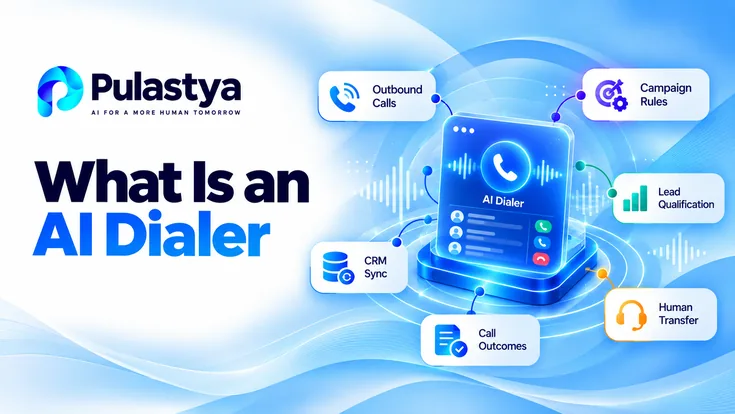
An AI dialer is software that automates outbound voice outreach by combining programmable calling, speech AI, and campaign logic to move contacts toward measurable outcomes like qualification, appointment, or transaction.
Enterprises use AI dialers to scale repetitive outreach, route prospects to humans when needed, and capture structured outcomes for CRM and reporting.
- Definition An AI dialer pairs automated call placement with speech AI to run outbound campaigns and record structured call outcomes.
- Outcome focus Design the dialer around specific, measurable outcomes such as verified interest, scheduled appointment, or handoff to a human agent.
- Integration first Real value requires CRM and contact system integration, consent and call-recording controls, and a transparent human transfer path.
At core, an AI dialer controls call pacing, dialing channels, and the initial conversational layer. It reduces manual dialing overhead while applying voice models to detect intents, play dynamic scripts, and capture responses that map to business outcomes and CRM fields.
Adoption focuses on predictable lead-to-outcome flows, integration points, and safe human handoff. Decision makers should evaluate architecture, voice model behavior, and campaign observability rather than vendor marketing claims about autonomy or accuracy.
What an AI Dialer Is
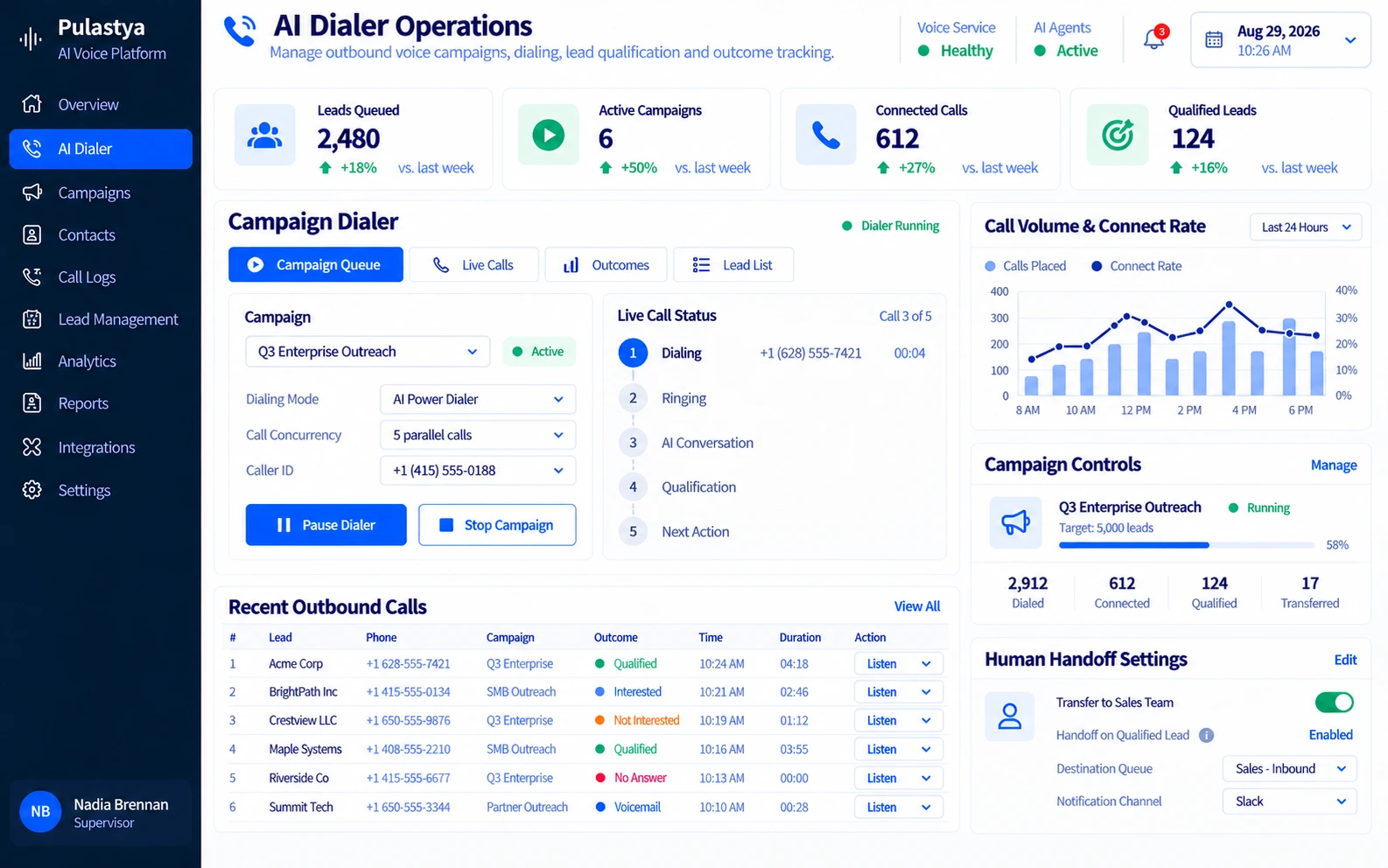
An AI dialer combines a call control layer with speech recognition, natural language understanding, and decision logic to run outbound voice interactions at scale. It orchestrates who to call, when to call, what audio assets to play, and how outcomes are recorded in operational systems.
The dialer covers synchronous items like call setup, DTMF and speech capture, plus asynchronous features such as contact scheduling and campaign reporting. Core components include telephony adapters, an AI conversation engine, campaign manager, and integration connectors to CRM and data stores.
Vendors describe different feature sets, so translate marketing into architecture: session control, audio I/O, STT/NLU, an outcome model, transfer and escalation paths, and secure data handling. Treat claims about accuracy or autonomy as conditional on model, callers, and call context.
- Telephony adapter: SIP trunks or cloud telephony that initiates and receives calls reliably across carriers.
- Conversation engine: ASR plus NLU components that convert speech to structured intents and slots.
- Campaign manager: scheduling, pacing, and contact segmentation tied to campaign outcomes and SLA.
- Integration connectors: two-way sync with CRM, contact lists, and outcome fields for downstream workflows.
- Security and consent controls: recording toggles, storage rules, and data encryption for call artifacts.
Map vendor features to architecture before procurement.
Key Components of an AI Dialer
Break the dialer into four domain layers: connectivity, conversation, orchestration, and outcomes. Connectivity handles carriers and call routing, conversation handles voice models, orchestration runs campaign rules, and outcomes persist results to downstream systems.
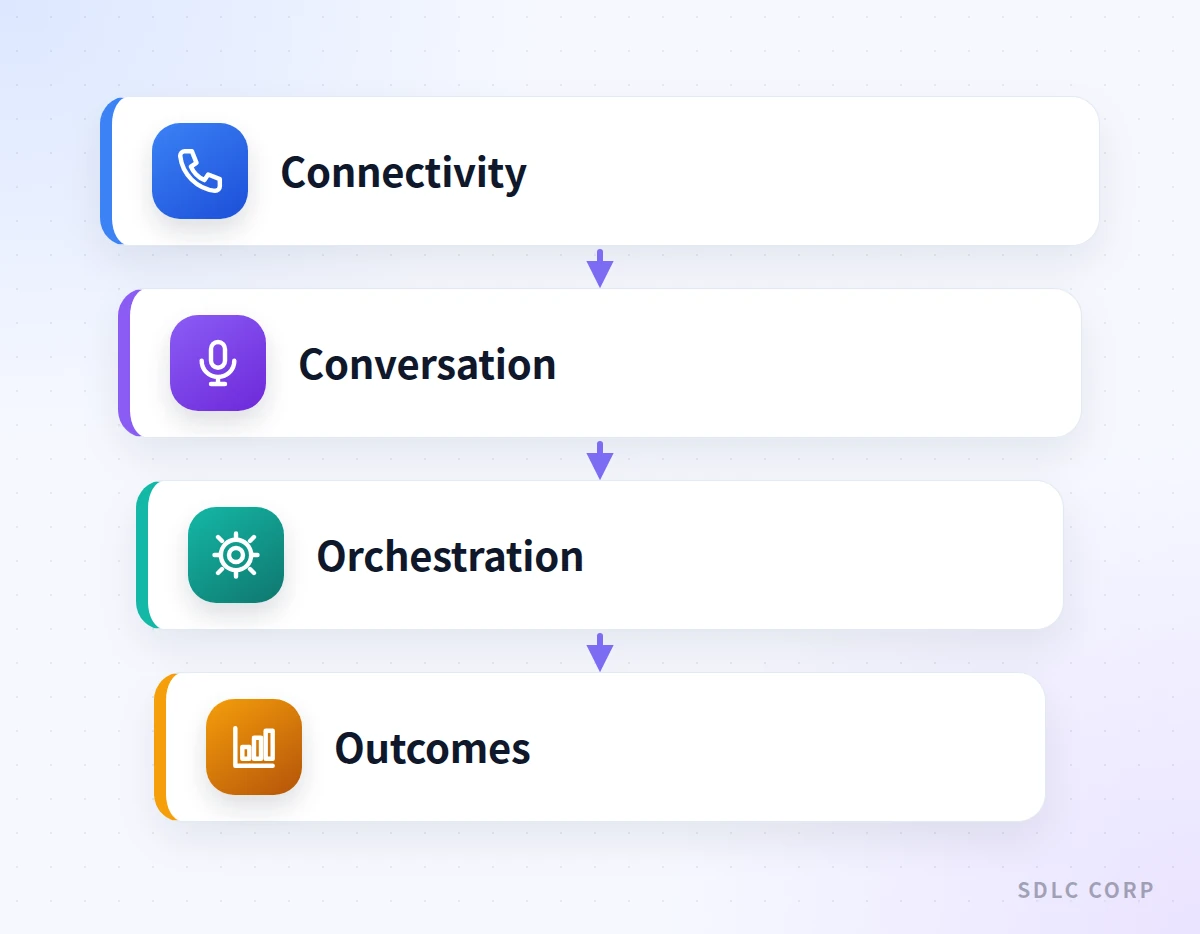
Design considerations per layer influence scalability and observability. For example, connectivity choices determine latency and call success rates, while orchestration logic affects campaign throughput and compliance with calling windows and consent.
Define nonfunctional constraints for each layer: concurrency targets for connectivity, model latency and confidence thresholds for conversation, transactional guarantees for orchestration state, and retention policies for outcome artifacts.
- Connectivity scale: concurrent call targets and carrier failover patterns for peak periods.
- ASR and NLU selection: language coverage, domain adaptation, latency, and confidence scoring.
- Orchestration rules: pacing, retry windows, quiet hours, and priority routing for high-value contacts.
- Outcome schema: canonical fields for disposition, intent, next steps, and CRM mapping.
- Operational telemetry: call traces, error rates, model confidence trends, and human handoff metrics.
Layered design reduces scope creep and clarifies responsibilities.
How Outbound AI Calling Moves From Lead to Outcome
A deterministic lead-to-outcome flow keeps campaigns auditable and reproducible. The sequence typically starts with data enrichment, proceeds to call eligibility checks, then outbound session initiation, live or automated conversation, outcome capture, and CRM update for downstream actions.
Operational decision points use signals such as answer type detection, speech intent confidence, and business rules. These signals determine whether to replay content, ask clarification, mark a disposition, or escalate to a human agent for complex scenarios.
Captured outcomes should be structured and actionable: discrete disposition codes, captured slot values, and recommended next steps. Standardize the outcome schema so campaign managers and downstream systems can consume results without manual translation.
- Enrich and deduplicate: validate contact data and consent status before queuing for dialing.
- Eligibility gating: filter by do-not-call lists, local calling hours, and campaign rules.
- Call setup and answer detection: classify live answer, voicemail, or network failure immediately.
- Conversational layer: play dynamic prompts, interpret responses, and collect required fields.
- Outcome persistence: write disposition, captured data, and call recordings to CRM and archive.
Standardize dispositions to close the lead-to-outcome loop.
Lead to outcome
How an AI Dialer Moves a Lead From List to Recorded Outcome
- Enrich and deduplicate the leadValidate contact data and consent status before the lead is queued
- Gate eligibilityFilter by do-not-call lists, the contact's local calling hours and campaign rules
- Place the call and detect the answerClassify live answer, voicemail or network failure as soon as the call connects
- Run the conversationPlay prompts, interpret replies and collect required fields with confidence scores
- Persist the outcomeWrite disposition, captured fields and recording references to the CRM and archive
Possible outcomes
- Automated outcome recordedConfident result, such as a qualified lead, triggers the CRM follow-up
- Transfer to a human agentLow confidence or a request for a person: agent gets summary and captured data
- No conversationVoicemail or failure is logged so retry and follow-up rules decide what happens next
Eligibility is checked before any call is placed, and every call ends in a structured outcome that downstream systems can act on without manual translation.
Practical Scenario: Lead-To-Sale Call Flow
Scenario: a B2B sales team wants to qualify inbound leads and schedule demos. The campaign pulls qualified leads, checks consent and time zone, places an outbound call, and runs a short qualification script driven by NLU slots for interest and budget.
During the call, the AI asks confirmation questions, validates key fields, and assigns a confidence score to qualification. If the model detects an intent to schedule, it queries the calendar API and offers available demo slots. Low-confidence cases trigger a human agent transfer.
After call completion, the system writes a structured outcome: qualification status, captured attributes, scheduled appointment ID, and an audit trail of prompts and timestamps. A follow-up workflow in CRM assigns a rep and triggers email confirmation.
- Initial check: consent, time zone, and prior interaction history to avoid redundant outreach.
- Qualification prompts: use short, targeted questions to capture intent, purchase timeframe, and decision authority.
- Confidence thresholding: set defined bands that determine automatic scheduling versus human handoff.
- Calendar integration: query availability and confirm appointments within the same session when possible.
- Post-call workflow: update CRM, assign owner, and trigger confirmation messages and analytics tags.
Automate scheduling when confidence and availability align.
Where Human Transfer and Workflows Fit
Human transfer is a core safety valve for edge cases, compliance checks, and high-value conversions. In a warm transfer, the AI or a coordinator first reaches and briefs the receiving agent, then connects the contact.
In a cold (blind) transfer, the live call goes straight to the destination without that consult; a summary can still accompany it if the systems support it.
The chosen method affects agent readiness and conversion rates. The trade-offs are compared in warm vs cold transfer.
Design transfer triggers around confidence scores, detected intents such as 'talk to sales', and manual agent request signals. Ensure the system collects context, audio snippets, and a synthesized summary for the receiving agent to minimize context-switch costs.
Workflows should define SLA for transfer answer time, fallback routing, and what to do on transfer failure. Log handoff events and outcomes to connect AI-driven steps with human-led resolution for downstream reporting and improvement loops.
- Warm transfer data: pass disposition, captured slots, confidence score, and key audio highlights to the agent.
- Trigger conditions: low NLU confidence, request for pricing or escalation, or regulatory consent confirmation.
- Agent readiness: agent UI must surface context and suggested next actions within seconds of transfer.
- Fallback paths: voicemail to agent inbox, callback scheduling, or retry with modified pitch.
- Audit trail: persist transfer timestamps, agent IDs, and final disposition for compliance and coaching.
Make human transfers fast, contextual, and auditable.
Testing, Monitoring, and Quality Measures
Empirical testing is essential. Run A/B tests on prompts, track model confidence against outcomes, and measure end-to-end conversion rather than isolated speech metrics. Use controlled experiments before scaling new prompts to production campaigns.
Monitoring should combine real-time alerts for call anomalies with periodic reviews of model drift, false positives, and customer complaint rates. Keep a sampling strategy for recorded calls to support quality reviews and compliance checks.
Quality frameworks must include human-in-the-loop review for edge cases, calibration of confidence thresholds, and continuous improvement cycles. Build feedback loops from agent corrections and downstream conversion signals into model retraining pipelines.
- A/B test prompts and response flows to measure impact on outcome conversion.
- Set alerts for spikes in ASR errors, call failures, or unusual disposition distributions.
- Use sampled call reviews to validate NLU slot accuracy and customer experience quality.
- Track human handoff success rates and agent conversion against automated outcomes.
- Integrate agent corrections into a labeled dataset for iterative model improvement.
Measure outcome impact, not just speech accuracy.
Enterprise Design Considerations
Enterprise deployments require attention to scale, security, and integration. Plan capacity for peak dialing, isolate sensitive data, and enforce role-based access. Ensure two-way CRM synchronization and idempotent writes for outcome records to avoid state conflicts.
Risk management includes consent management, call recording governance, and vendor model transparency. Avoid deep vendor lock-in by standardizing outcome schemas and using middleware to decouple conversation logic from carrier and CRM endpoints.
Procurement should include performance SLAs, privacy and data processing terms, and clear remediation paths for model-related errors. Treat features still on a vendor roadmap as options rather than commitments, and validate them with proof-of-concept pilots before enterprise-wide rollout.
- Scalability: define concurrent call targets and test carrier failover under load.
- Data protection: encrypt recordings, control access, and purge per retention policy.
- Integration resilience: implement retries and reconciliation for CRM sync without overwriting authoritative fields.
- Vendor governance: require model explainability, data usage disclosures, and change-notice commitments.
- Pilot and scale: validate assumptions with a pilot that exercises transfer, calendar, and CRM updates.
Standardize schemas to reduce vendor coupling and simplify audits.
Conclusion
AI dialers are operational systems that combine telephony, speech AI, and orchestration to convert contacts into business outcomes at scale. Successful programs emphasize integration, clear outcome schemas, and fast human handoff for exceptions.
Decision makers should require architecture reviews, realistic testing, and pilots that validate outcome accuracy and workflow integration. Treat advanced automation as an incremental capability that augments human teams rather than replacing them outright.
Adopt a measurement plan focused on end-to-end conversion, transfer efficacy, and model confidence trends. Use those signals to govern where automated interactions are safe and where human agents must remain in the loop.
- Define outcome schemas and CRM mappings before building campaigns.
- Pilot with tight controls on consent, recording, and transfer behavior.
- Measure outcome conversion and adjust confidence thresholds iteratively.
- Document integration contracts to avoid operational coupling to a single vendor.
- Plan human handoff as a first-class feature, not an afterthought.
Start small, measure outcomes, and scale with governance.
To see how these components run a full campaign, from lead intake to follow-up workflows, read about outbound campaign automation.
Calling windows, retry budgets, live-agent destinations and campaign states are covered in AI calling campaign setup.
For a buyer-level view of outbound programs, including campaign controls, call types, compliance and evaluation criteria, see the guide to AI outbound calling software.
Frequently Asked Questions
A predictive dialer focuses on call pacing to maximize agent talk time, typically routing answered calls to humans. An AI dialer adds a conversational AI layer that handles initial interactions, interprets speech, captures structured data, and can transfer to humans when automation reaches its limits.
Track measurable, operational outcomes such as verified lead status, scheduled appointment IDs, completed transactions, and successful human transfers. Standardize disposition codes and captured fields so downstream systems can automate follow-ups without manual interpretation.
Transfer when model confidence falls below an agreed threshold, when the customer explicitly requests a human, or when the conversation requires negotiation, compliance checks, or complex decision-making. Design transfer triggers and SLA expectations before running live campaigns.
Essential integrations include CRM for contact and outcome sync, calendar or scheduling APIs for appointment booking, and telephony carriers. Also integrate consent and suppression lists and a logging store for recordings and audit trails.
Yes. Manage consent, recording notices, and data retention according to applicable laws and corporate policy. Limit data exposure, encrypt stored artifacts, and ensure voice data usage is covered in vendor agreements and customer consent flows.