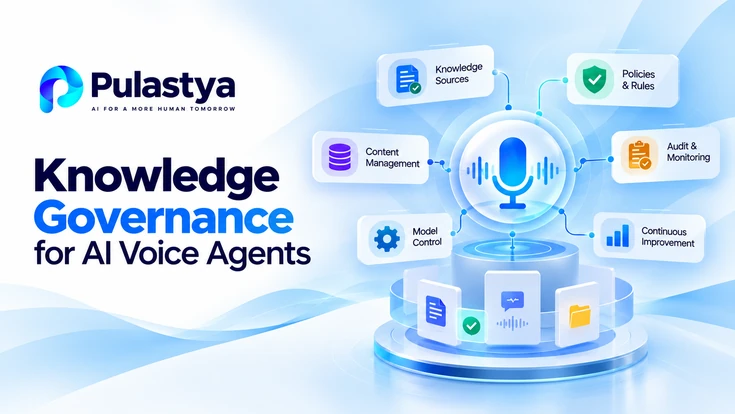
Knowledge governance for AI voice agents defines who owns conversational content, who can access it, and how approval and audit trails enforce correctness and compliance.
Enterprises must treat voice interactions as first-class knowledge assets with policies that cover real-time call decisions, offline training data, and regulatory retention.
Governance controls must map directly into the design and operation of production voice agents.
- Ownership mapped to artifacts Assign ownership for knowledge artifacts by source and use case: transcripts, KB articles, utterance-to-intent mappings, and response templates.
- Access tied to runtime Control access both at the API level and in the voice runtime: which agents, prompts, or decision trees may surface which knowledge.
- Approval and audit are continuous Approval is not a one-time gate; implement staged approvals, live A/B monitoring, and immutable logs for post-call review and compliance.
Effective governance for AI voice agents combines identity, data classification, approval workflows, and run-time controls that operate across telephony, speech recognition, and language models.
Start by inventorying sources: CRM records used to personalize replies, internal KB articles surfaced during calls, audio recordings, and transcripts used for model retraining. Each source requires distinct ownership, retention rules, and masking rules when surfaced in live voice responses. Education offices meet the same problem against a fixed calendar, as keeping term dates and admissions material current shows.
Operational teams must align governance with call flow behavior: thresholding ASR confidence before committing a reply, designating fallback IVR prompts for low-confidence segments, enforcing policy on PII revealed during a call, and tracking who authorized new knowledge snippets entering the agent.
The governance stack should support approvals, immutable audit logs, and continuous monitoring so voice agents scale without increasing legal or operational risk.
Define Ownership for Every Knowledge Artifact
Start governance by cataloging every artifact the voice agent can use: raw audio, intermediate ASR output, NLU intent/slot definitions, canonical answers, templated speech outputs, and reinforcement signals from feedback.
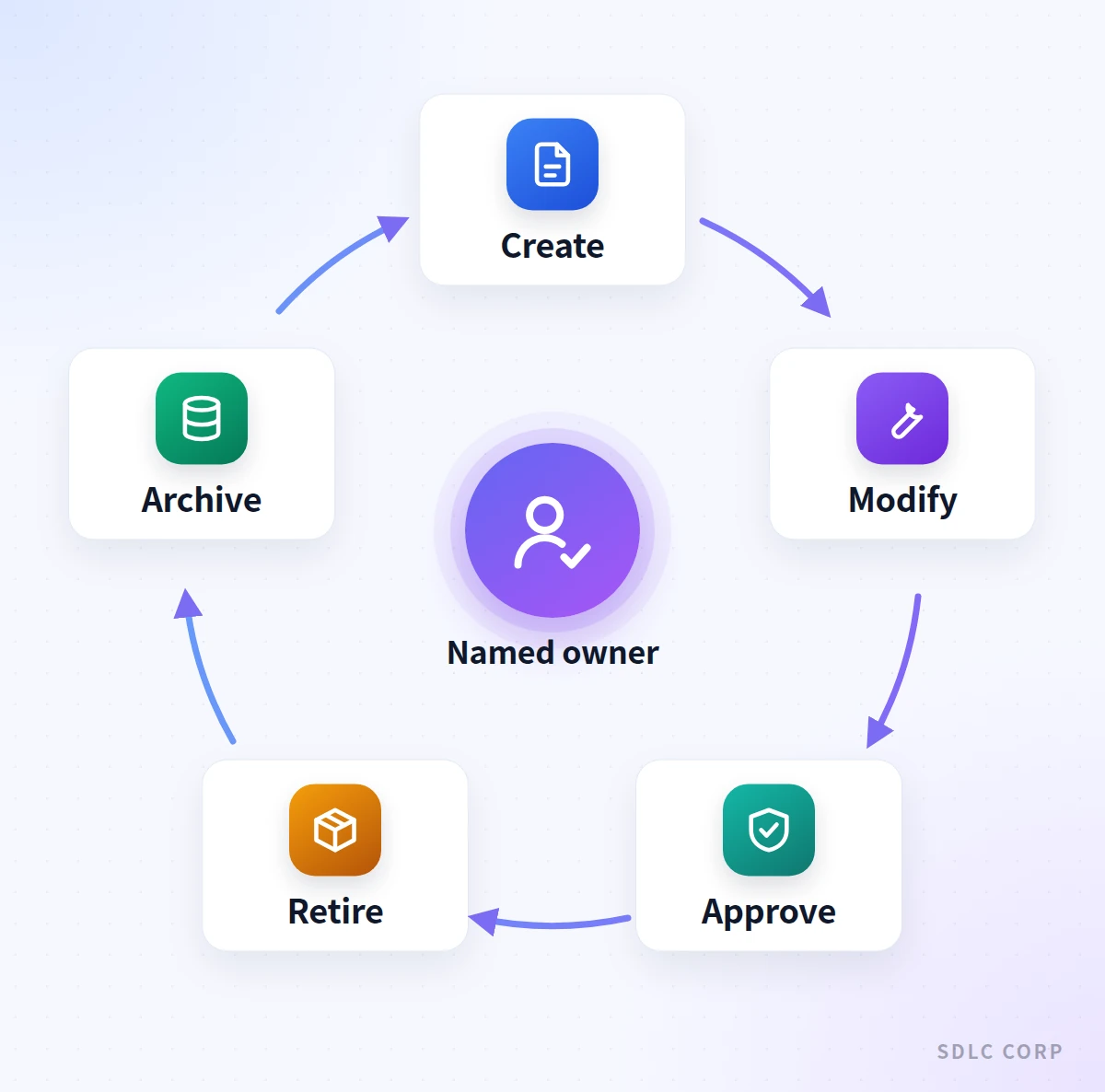
For each artifact, specify a domain owner responsible for accuracy, retention policy, and approval authority. Owners should be business-side subject matter experts for content and engineering leads for technical mappings.
Map ownership to lifecycle actions: create, modify, approve, retire, and archive. For example, a product FAQ article owner approves content changes that can affect spoken responses, while a data engineering owner controls how audio recordings are stored and redacted.
Record these mappings in a governance registry that the voice platform consults at runtime to prevent unauthorized content changes from reaching callers.
Make ownership operable by integrating owners into CI/CD pipelines for knowledge. Use pull-request style workflows for content updates, require sign-off from the assigned owner before publishing to production voice flows, and ensure owners receive alerts for usage spikes or error rates tied to their artifacts.
- Catalog artifacts by type and intersection with live call flows.
- Assign explicit owner, steward, and emergency contact for each artifact.
- Register ownership in the knowledge registry used by the voice platform.
- Enforce owner sign-off in the publishing pipeline for production call flows.
- Alert owners on anomalous runtime behavior attributed to their artifacts.
Ownership must be explicit, operational, and enforced through the publishing pipeline.
Classify Data and Enforce Access Controls
Implement a data classification scheme aligned to voice contexts: public prompts, internal knowledge, restricted customer PII, and regulated content (billing, health, or financial). Attach classification metadata to transcripts, knowledge snippets, and template responses.
Use those tags to drive both human access permissions and run-time masking rules so the agent never transmits restricted content without appropriate authorization.
Enforce least privilege using role-based and attribute-based access controls. For example, QA reviewers may access de-identified transcripts, whereas compliance officers can access full transcripts for audit with multi-factor approval. At the voice runtime, map session attributes (caller identity, account level, consent flags) to authorization checks before surfacing knowledge that is not public.
Integrate access controls into the voice platform's APIs and admin console. Rate-limit and log administrative queries, require just-in-time elevation for sensitive content changes, and use short-lived credentials for components that pull knowledge into runtime to reduce exposure from credential leakage.
- Define classification levels specific to spoken interactions.
- Attach metadata to every knowledge item and transcript.
- Apply role-based and attribute-based access controls to knowledge stores.
- Require multi-factor or manager approval for access to PII or regulated content.
- Use short-lived credentials and audit all admin access to knowledge.
Guard access at both the admin and runtime layers, using classification metadata as enforcement hooks.
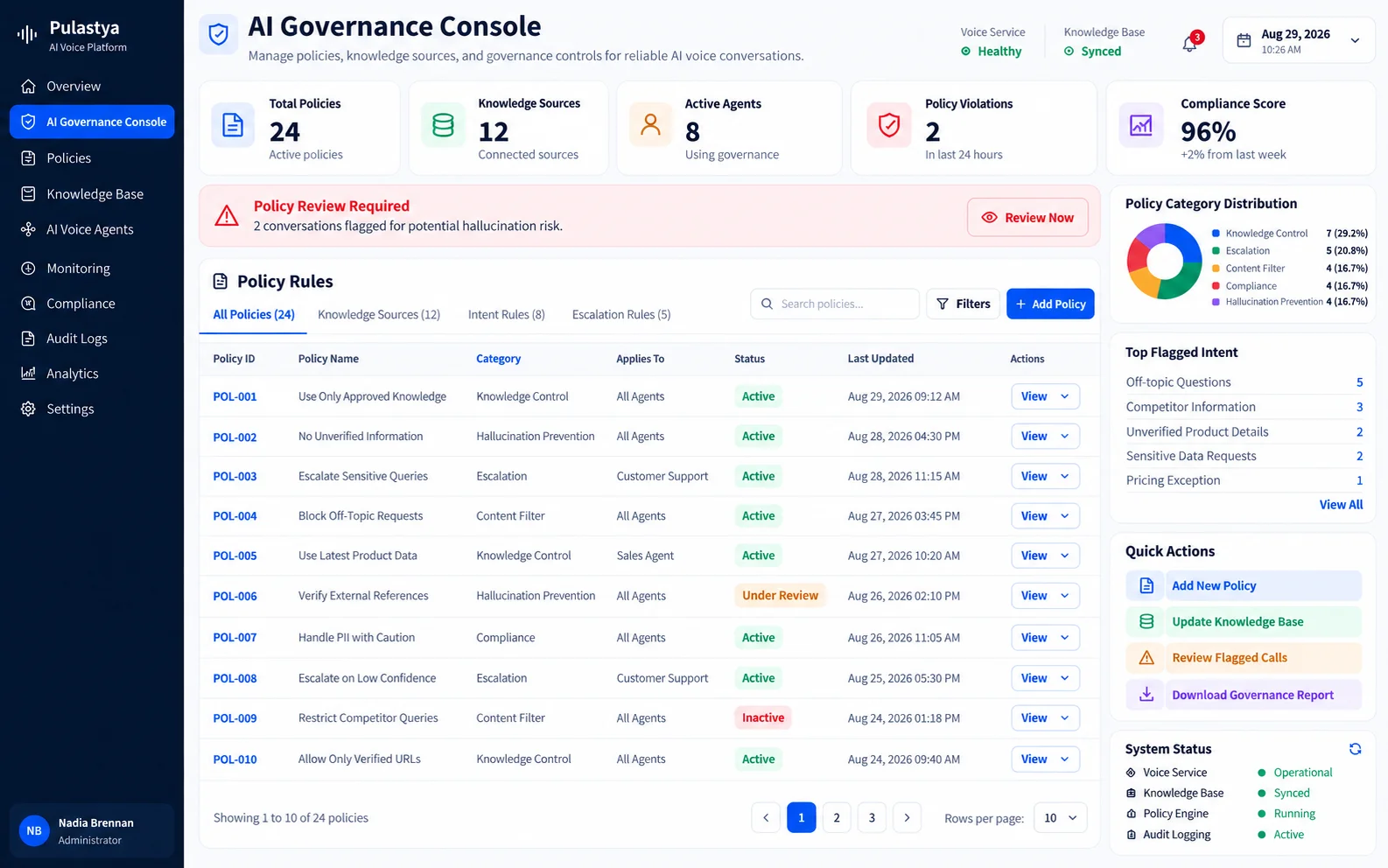
Approval Workflows and Change Controls for Voice Content
Design approval workflows that mirror operational risk. Low-risk phrasing changes can use an expedited flow, while any content that affects liabilities, legal language, or pricing statements must trigger a full review including legal and product owners. Enforce approvals through automation: block publish actions until required stakeholders sign off and record signatures and timestamps for compliance evidence.
Use staged deployments for content changes: dev and staging voice agents validate phrasing and speech synthesis, then controlled canary releases expose the update to a small percentage of live calls while monitoring key metrics such as intent match rate, customer confusion incidents, and escalation rate to human agents. If metrics degrade, rollback should be automatic and documented.
Retire content through the same workflow. When a policy, price, or offer ends, the owner withdraws the snippet from the live knowledge set and archives its version, so the agent stops using it while audit logs can still resolve what was said on past calls.
Keep a change history tied to production voice versions. Each voice agent release should include a manifest of knowledge changes, the approvers, and test results. This manifest supports incident response and post-incident root cause analysis when a spoken answer causes confusion or regulatory attention.
- Classify changes by risk and define approval gates per risk tier.
- Automate approval enforcement in the publishing pipeline.
- Deploy changes via staged canaries with monitoring thresholds.
- Maintain immutable change manifests for each production release.
- Automate rollback when canary metrics exceed predefined limits.
- Retire expired content from the live set and archive its version.
Approval gates must be automated and tied to staged deployments with clear rollback criteria.
Content lifecycle
The Governed Path From Draft to Retirement for Voice Knowledge
- DraftThe artifact owner proposes a change with classification and risk tier attached
- ReviewReviewers match the risk tier; legal and product join for pricing or legal language
- ApproveThe pipeline blocks publishing until required owners sign off and logs each signature
- PublishRelease to a small canary share of calls with a manifest of changes and approvers
- MonitorWatch escalations, confusion, and complaints; roll back automatically on breach
- RetireWithdraw expired content from the live set and archive its version for audits
Notice that approval is enforced by the pipeline and that retirement follows the same governed path as publishing.
Design Run-Time Safety: Confidence, Fallbacks, and Redaction
Operationalize run-time safety by defining thresholds and fallback behaviors. Set ASR and NLU confidence thresholds that trigger safer response paths: confirmation prompts, transfer to a live agent, or neutral fallback messages. Establish a tiered response design: high-confidence direct answers, medium-confidence confirm-then-proceed flows, and low-confidence escalation to human agents or IVR menus.
Implement PII detection and redaction at multiple points: on ASR output, before transcripts and logs are stored, before extracted fields are passed to downstream components that do not need them, and before TTS output. Use named-entity detection to mask account numbers or government identifiers in stored transcripts and to stop masked fields from being spoken.
For cases where sensitive content is required, require caller authentication and an explicit consent token validated at runtime before surfacing the content.
Monitor run-time policies continuously. Track how often confidence thresholds trigger fallback, how often redaction alters responses, and the rate of incorrectly redacted or leaked data. Feed these signals back into both model tuning and policy thresholds to reduce unnecessary escalations while preserving safety.
- Set ASR and NLU confidence thresholds that map to specific call actions.
- Design multi-path fallbacks: confirmation, neutral reply, or agent transfer.
- Detect and redact PII in transcripts and in TTS outputs at runtime.
- Require authentication and consent for revealing sensitive information.
- Continuously monitor fallback and redaction metrics and tune thresholds.
Run-time safety combines confidence thresholds, deterministic redaction, and monitored fallbacks to limit risk in live conversations.
Auditability and Monitoring for Continuous Compliance
Establish audit logging that captures immutable evidence: session IDs, full call transcripts, the version of knowledge and models used, decision points where the agent selected a particular snippet, and the approver chain for that snippet.
Ensure logs are tamper-evident and retained per compliance needs. Index logs to support fast search by caller, artifact, timestamp, or approver.
Implement real-time monitoring dashboards that surface operational KPIs relevant to governance: instances of unauthorized knowledge access, rollback events, increases in transfers to human agents, and spikes in customer complaints tied to a response change. Alert the right stakeholders automatically and attach relevant artifacts for faster triage.
Build a periodic review cadence: sample calls for manual quality checks, compliance audits on how regulated content is handled, and model drift analysis. Use audit findings to update ownership, update approval rules, and refine training data selection to prevent recurrence of governance lapses.
- Log session metadata, transcripts, decision points, and artifact versions immutably.
- Retain logs per regulatory and business retention policies.
- Provide searchable indices for rapid incident investigation.
- Monitor governance KPIs in real time and route alerts to owners.
- Schedule periodic manual reviews and compliance audits tied to artifacts.
Audits must connect runtime activity to governance artifacts and approvals for actionable compliance evidence.
Design Voice-Call Mechanics Consistent With Governance
Translate governance policies into concrete voice-call mechanics. For example, use session-level flags that indicate caller authentication, consent, and role; pass those flags to the NLU layer to alter intent routing; and use turn-taking timers and silence detection to avoid misinterpreting background speech as commands.
These mechanics should be standard components of call templates so every flow enforces the same rules.
Incorporate dual-path handling for transactions: if the agent initiates a sensitive action, require an explicit confirmation step that echoes the action in clear, unambiguous language and logs the confirmation as an approval event. For card-not-present scenarios, prefer tokenized identifiers and avoid reading sensitive numbers aloud, even to authenticated callers, unless policy explicitly allows it.
Make the call mechanics auditable: include a call manifest that records the ASR hypothesis, confirmed slots, any suppressed or redacted fields, and the exact phrasing returned to the caller. Use this manifest for dispute resolution and to train models that reduce mis-confirmations over time.
- Pass session flags (auth, consent, account tier) to runtime decision logic.
- Use silence detection and turn timers to reduce ASR errors and overlaps.
- Require explicit confirmations for sensitive actions with logged approvals.
- Prefer tokenization over reading sensitive numbers; avoid TTS of PII.
- Emit a call manifest capturing hypotheses, confirmations, and redactions.
Governance must be implemented as explicit call mechanics, not just policy documents.
Operationalize Governance: Roles, Training, and Tools
Operational governance requires defined roles (knowledge owners, approvers, compliance reviewers, incident responders) and training aligned to voice specifics. Train owners on how spoken phrasing differs from written content, on how ASR errors can change meaning, and on how to craft responses that are unambiguous when synthesized. Provide playbooks for escalation when the agent returns incorrect or harmful responses.
Provide tooling that makes governance actions low-friction: a knowledge management UI with versioning and approval workflows, a real-time policy engine that evaluates session flags, and a searchable audit console. Integrate these tools with change management and ticketing systems so content updates follow existing enterprise process controls and traceability.
For the initial rollout, teams without in-house platform engineers can bring in AI development services to codify governance policies into platform controls and call templates, map compliance requirements into the publish pipeline, and automate approval gates.
- Define governance roles and provide voice-specific owner training.
- Deliver low-friction tools: versioned knowledge UI, policy engine, audit console.
- Integrate governance actions with change management and ticketing systems.
- Publish playbooks for incident response and content remediation.
- Use managed support for initial rollout to codify policies into platform controls.
Operational governance depends on roles, repeatable processes, and tooling that integrates with enterprise systems.
Governance decides who approves and owns content. The scope of that content is covered in what goes into an AI voice agent knowledge base, and review cadence and stale-answer detection in keeping an AI voice knowledge base accurate.
Conclusion
Effective knowledge governance for AI voice agents starts with clear ownership of every content artifact and enforceable controls over what the agent can use. Classify sensitive data, apply role-based access, and require risk-based approvals before updates reach live calls. At runtime, combine caller authorization with speech-recognition confidence checks, PII redaction, and safe fallback paths to keep spoken answers reliable and compliant with enterprise policies.
Governance must also continue after deployment. Record approved knowledge versions and call decisions in tamper-evident audit trails, monitor escalations and disclosure risks, and regularly review transcripts and customer feedback under appropriate access and retention rules. Use those findings to refine content, approval workflows, and voice-call safeguards. This creates a repeatable process for scaling AI voice agents while maintaining accountability, knowledge accuracy, and trust.
Frequently Asked Questions
Assign ownership by artifact type and business domain. Business SMEs own factual content and response phrasing; engineering owns transcripts, model versions, and integration points. Record owners in a governance registry and require owner sign-off in the publishing pipeline before production deployment.
Use multi-point redaction: detect PII in ASR output, mask it in stored transcripts and logs, pass only the fields each task needs to downstream components, and prevent TTS from speaking masked fields. Add session-based authorization checks and require explicit consent before revealing sensitive account details.
Define an expedited flow limited to low-risk changes and require post-deploy audit for emergency fixes. For high-risk content, maintain multi-stakeholder approval even under urgency, and use canary releases with tight monitoring to limit blast radius.
Provide immutable logs that link session IDs to transcripts, the knowledge version used, decision points, approver identities and timestamps, and any redaction or suppression actions. Retain logs per regulatory retention rules and make them searchable for efficient audits.
Track metrics such as the frequency of fallbacks and escalations, rates of corrections after owner updates, instances of unauthorized access, and complaints tied to spoken content. Combine automated alerting with periodic manual review samples to detect gaps and iterate on policies.