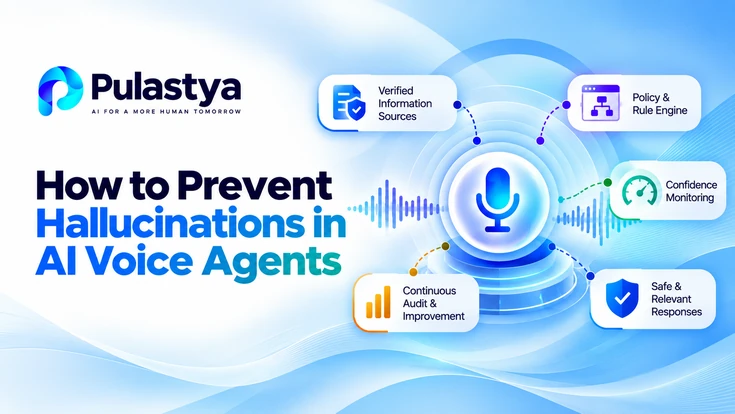
Voice agents that invent facts or provide incorrect action steps create regulatory, legal, and operational risk for enterprise deployments. Preventing hallucinations requires a combined approach across model grounding, real-time signal handling, explicit refusal behavior, and continuous measurement.
Technical teams need a practical playbook for reducing hallucinations in production voice AI systems while preserving user experience and response speed.
- Ground before you generate Attach a retrieval or rules-based evidence step for any factual or transactional response to reduce unsupported model invention.
- Measure and route on confidence Use calibrated ASR and intent confidence to trigger fallbacks, clarifying questions, or human transfer before the agent asserts risky facts.
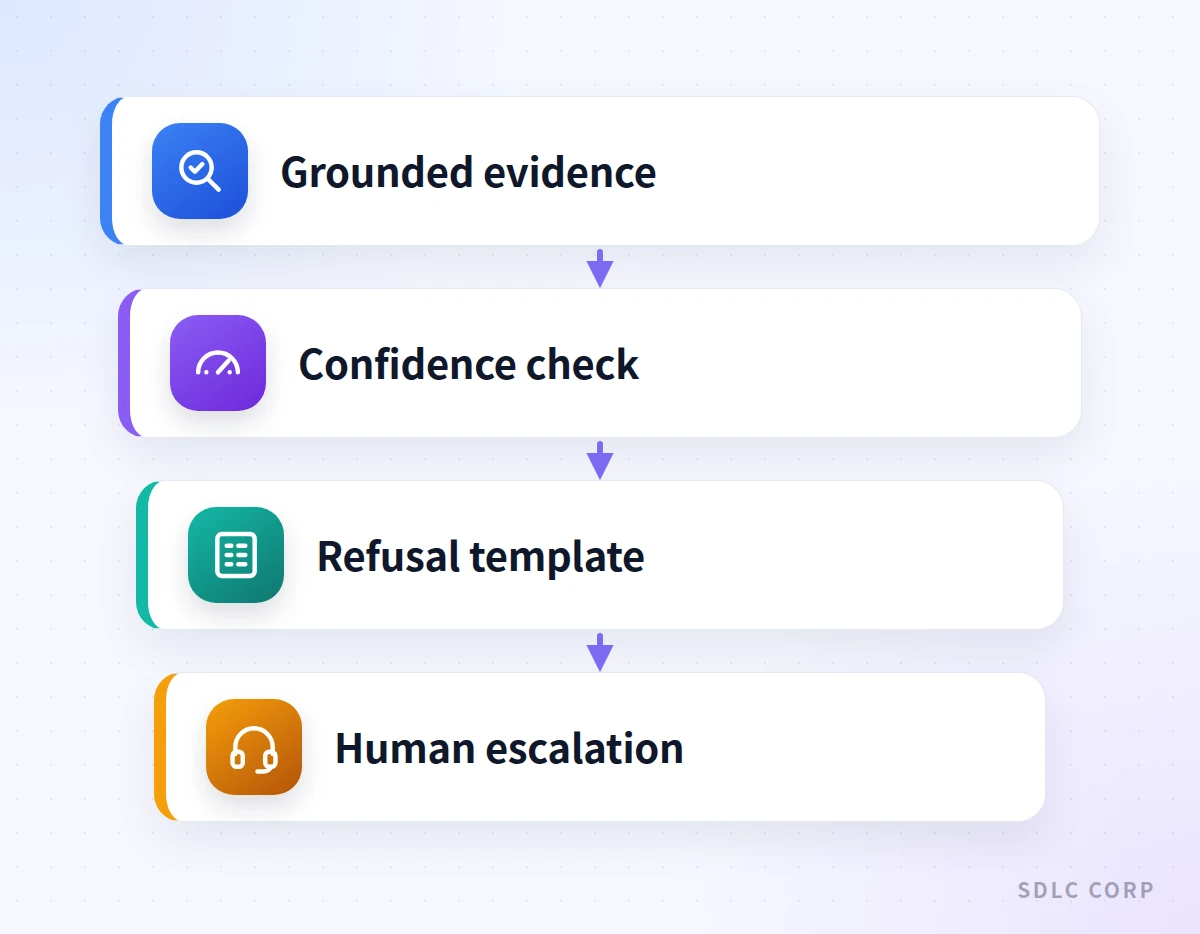
- Design safe refusal behavior Create concise, auditable refusal templates and escalation paths so agents decline or defer when the upstream evidence is insufficient.
Start by treating hallucination as a system-level failure, not just a model problem. Causes include mismatched retrieval, noisy speech recognition, unclear prompts, and unconstrained generation.
Engineering controls must span data pipelines, runtime orchestration, model prompts, and human escalation. Each control has tradeoffs between latency, coverage, and developer effort; document those tradeoffs so product and risk teams can make informed decisions.
These controls matter most in enterprise voice-call contexts: customer service lines, payment verification flows, and technical support. Focus on determinism for transactional prompts, graceful degradation for ambiguous queries, and auditable provenance for statements used to make decisions.
Practical mitigations fall into grounding, generation constraints, signal handling, operational guardrails, testing, and a runnable incident playbook that teams can adopt and adapt.
Why Voice-Agent Hallucinations Occur
Hallucinations usually surface when a generative model produces fluent text that lacks adequate grounding in authoritative data. In voice agents, the problem compounds because acoustic variability, misrecognitions, and partial utterances inject uncertainty before the model generates a reply. Enterprise teams must instrument the entire pipeline from ASR hypotheses to NLU intent to retrieved evidence to generation.
Architecturally, three failure modes repeat: missing facts in the retrieval layer, overconfident model completion when prompts are ambiguous, and unhandled ASR errors that change intent.
Each mode requires a different control: deterministic rules or KB hits for missing facts, constrained output templates for unsafe completions, and robust confidence thresholds for ASR-driven ambiguity. Treat these as separable controls you can enable incrementally.
Tradeoffs matter. Heavy-handed grounding reduces hallucinations but increases latency and engineering cost. Strict refusal behavior reduces risk but degrades agent utility for borderline queries. Document acceptable risk levels per interaction type, for example stricter thresholds for payment instructions than for general product questions, and align those with compliance and CX stakeholders.
- Separate evidence retrieval from generation so you can validate provenance before speaking.
- Instrument ASR alternative hypotheses and confidence scores into downstream decisions.
- Classify queries into high-stakes versus low-stakes and apply stricter controls to high-stakes flows.
- Log complete request, retrieved passages, prompt used, and model response for post-incident audit.
- Maintain a list of banned assertions and hard-fail rules for regulated content and transactional actions.
Treat hallucination as a pipeline defect spanning ASR, retrieval, and generation rather than a single model bug.
Designing Grounding and Retrieval
Implement retrieval-augmented generation (RAG) with explicit provenance: attach source identifiers and confidence scores to every retrieved chunk. Prefer exact-match rules or database queries for transactional facts like balances, payment limits, or fee amounts. Use vector retrieval for loose matching but add a reranking layer that enforces minimum lexical overlap or metadata filters for critical answers.
Data freshness is essential for voice agents that discuss accounts, pricing, or status. Establish maximum staleness for each data domain and invalidate or re-index documents automatically when source systems change. Where the authoritative system is an internal database, call that API directly rather than relying on stale document stores.
Design retrieval timeouts and fallbacks to preserve responsiveness. If retrieval returns no high-confidence evidence within an allotted window, the agent should ask a clarifying question, offer to escalate to a human, or use a short refusal template. Document the latency budget and route slow retrievals to concise, transactional fallbacks to avoid speculative answers.
- Tag each retrieved passage with source, timestamp, and a retrieval-score and surface that metadata for audits.
- Use exact database lookups for account-specific answers and reserve RAG for contextual explanations.
- Enforce explicit retrieval thresholds before allowing generative text to reference a fact.
- Implement soft timeouts for retrieval with defined fallback dialogs for missing evidence.
- Periodically validate vector store neighbors against fresh canonical sources to detect drift.
Only let the model assert a fact when the retrieval layer provides verifiable provenance within policy thresholds.
Prompting, Response Templates, and Constrained Generation
Control generation via system prompts and output schemas. For transactional utterances, use template-driven outputs (slot-value responses) that map directly to backend operations. For example, require the model to return JSON fields for 'intent', 'confidence', and 'evidence_id' when an action is requested. Enforce parsers and validators so downstream systems only act on well-formed responses.
For open responses, design refusal-first prompts that bias the model toward deferring when evidence is weak. Example guidance: instruct the model not to state a fact that lacks a retrieved source, and instead say it cannot confirm that detail and offer a human handoff. Keep refusal templates concise to reduce escalation friction while ensuring compliance with audit requirements.
Balance naturalness and safety by applying post-generation filters: named-entity matchers, factuality checks, and deterministic rewrite rules. These filters can remove or mask clinically or legally sensitive claims before vocalization. Document false-positive tradeoffs so product owners understand when content may be suppressed to protect the enterprise.
- Use strict output schemas for actions; only allow backend effects when keys and types validate.
- Embed refusal policies in system prompts to bias the model toward safe deferral when evidence is absent.
- Apply deterministic post-filters for personal data and regulated claims before TTS.
- Limit generation length for high-stakes dialogs to reduce scope for hallucination.
- Version control prompts and schemas to enable rollback and audit trails.
Combine prompt-level guidance with schema validation to prevent model text from triggering unauthorized actions.
Real-Time Signals: ASR, NLU, and Confidence Scoring
ASR errors frequently trigger hallucinations by altering key nouns or numbers. Surface the top N ASR hypotheses and associated confidences to the NLU and retrieval layers so downstream logic can detect instability. For numeric or named entities, require an additional verification step when ASR confidence falls below a predefined threshold.
Calibrate intent and slot confidences with production data. Uncalibrated confidences lead to either excessive handoffs or excessive hallucinations. Use reliability diagrams and periodic calibration tasks to map raw model scores to actionable thresholds that determine whether to ask a confirmation question or proceed.
Design routing logic that uses combined signals: ASR confidence, intent confidence, and retrieval quality. For example, route to a human if ASR confidence is low and retrieved evidence is absent, but allow automated handling if ASR has medium confidence and the retrieval layer returns a high-quality exact-match record. Encoding these rules reduces risky automated assertions.
- Expose and log top ASR alternatives for critical entity slots to enable downstream disambiguation.
- Require numeric confirmation (read-back) for amounts or account numbers below ASR confidence thresholds.
- Implement confidence calibration for both NLU and retrieval scoring based on labeled calls.
- Combine multiple signals into a weighted routing decision rather than relying on a single threshold.
- Use short clarifying prompts when signals conflict instead of speculative answers.
Combine ASR, NLU, and retrieval confidences into a single routing policy to decide when to speak, ask, or escalate.
Layered controls
The Checks a Voice Agent Runs Before It States a Fact
- Check what was heardUse ASR alternatives and entity confidence; read back numbers when confidence is low
- Apply the safety policyLook up the intent's allowed assertions, required confirmations, and escalation rule
- Ground the factExact API or database lookup for account facts; RAG with provenance for explanations
- Enforce evidence thresholdsNo fact is spoken unless evidence clears the threshold within the time budget
- Constrain and filter outputValidate action schemas and run post-filters before text reaches TTS
Possible outcomes
- Speak the grounded answerSignals agree and evidence is verified
- Ask a narrow clarifying questionSpeech or intent is ambiguous
- Decline and transferEvidence is missing or the stakes are high
Notice that no single control is enough; each layer catches a different failure before the caller hears it.
Operational Guardrails and Failure Modes
Establish explicit guardrails for each call type including allowed assertions, banned topics, and required confirmations. Maintain a safety policy table that maps intents to enforcement actions: soft clarification, hard refusal, or immediate human transfer. Make this table a living artifact updated after incidents and postmortems.
Prepare a minimal safe-mode voice script that the system can fall back to when instrumentation detects model drift or an unknown failure. Safe mode should use short statements, limit the scope of actions, and prioritize escalation. Test safe-mode transitions regularly in prescheduled maintenance windows to validate behavior without customer impact.
Design an incident response playbook for hallucination events that includes immediate mitigation (disable releases, route to humans), data capture (recordings, prompts, retrievals), and a reproducible test case.
Feed the annotated incident data back into test sets, prompt updates, retrieval filters, and, where a model is fine-tuned, training data. Ensure legal and compliance teams are integrated into the post-incident review for regulated domains.
- Maintain a safety policy table mapping intents to allowed assertion levels and escalation actions.
- Implement a tested safe-mode with limited functionality and clear human-transfer messaging.
- Capture full context for any hallucination: ASR output, retrieved documents, prompt, and model response.
- Run weekly health checks for retrieval freshness and ASR/NLU calibration drift.
- Define SLA and RTO for turning off risky features when incidents are detected.
Operationalize guardrails with a safety table, a tested safe-mode, and an incident playbook that integrates legal and product owners.
Testing, Monitoring, and Continuous Improvement
Create a test corpus of in-domain call transcripts including edge cases and adversarial prompts. Use both logged real calls (sanitized) and synthetic variants that stress entity recognition and rare queries. Automate regression tests that run against every model or retrieval change to detect increases in unsupported assertions.
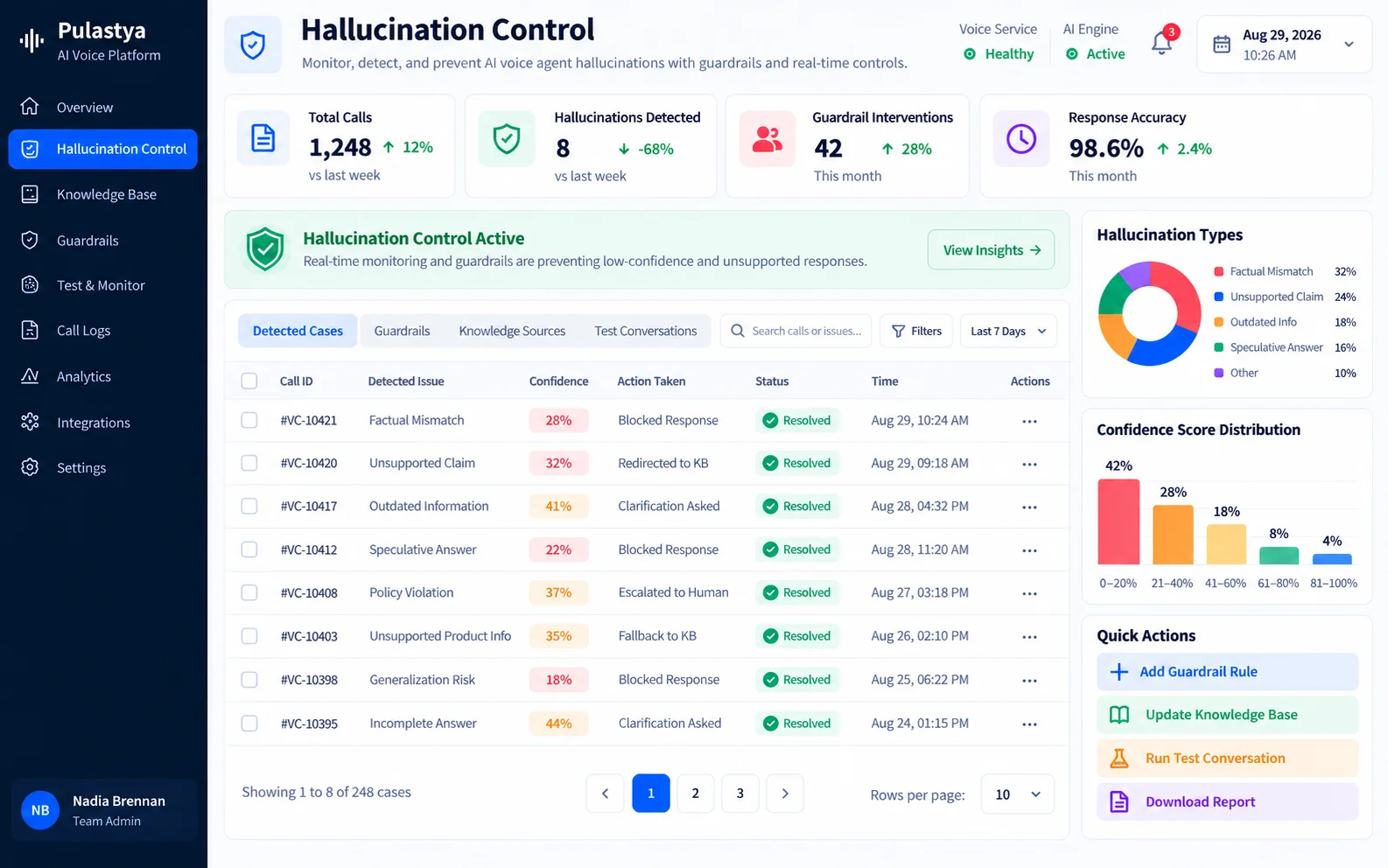
Instrument runtime monitoring that looks for hallucination signals: increased refusal rates, sudden spikes in manual transfers, and mismatches between retrieved evidence and agent statements. Build dashboards that correlate model changes with call-level business metrics so stakeholders can weigh accuracy versus customer experience.
Establish a feedback loop that converts annotated incidents into prioritized engineering tasks: route high-impact failures to immediate hotfixes, plan medium-priority prompt or retrieval adjustments, and schedule low-priority data collection jobs.
- Maintain a labeled test set reflecting real call distributions and edge-case adversarial inputs.
- Automate regression checks for factual consistency and schema validation on every CI build.
- Monitor business KPIs tied to hallucination such as transfer rates and dispute tickets.
- Use annotation workflows to convert incidents into reproducible test cases quickly.
- Prioritize fixes based on risk, frequency, and business impact rather than only technical severity.
Continuous testing and correlated monitoring turn hallucination from an emergent risk into a manageable operational metric.
Example Scenario and Operational Runbook
Scenario: A bank voice agent receives a call where the customer asks, 'How much is the incoming wire fee to expedite an international transfer?' ASR returns a low-confidence transcript that could mean an incoming or outgoing wire, and the retrieval layer fails to return a clear fee schedule.
Without grounding, the model invents a fee and instructs the customer to proceed, creating compliance and reputational risk.
Runbook step 1: Detection. The system flags low retrieval match and ASR confidence. Trigger a confirmation question: 'Do you mean an incoming or outgoing wire?' If the caller clarifies, perform an exact database lookup for fee and require the model to reference the fee_id before speaking. If clarification fails, route to a specialist.
Runbook step 2: Post-incident. Capture the audio, ASR N-best list, retrieved results, and final response. Annotate the event and add the example to the test corpus. Implement a short-term mitigation: strengthen the ASR confirmation for wire-related intents and add a hard rule that disallows asserting a fee without fee_id provenance; long-term, improve retrieval reranking and prompt refusal wording.
- Detect: combine low retrieval score with ASR ambiguity to trigger clarification.
- Confirm: ask a narrow, slot-focused question to resolve entity ambiguity before proceeding.
- Block: refuse to provide fee numbers without a canonical fee_id or direct API lookup.
- Escalate: route to a human if entity confirmation fails twice or if the call is high value.
- Remediate: add the case to regression tests and implement prompt and retrieval fixes.
Concrete detection, confirmed lookups, and a documented post-incident flow prevent similar hallucinations from recurring.
Teams can strengthen this control model by reviewing RAG grounding for voice agents, knowledge-base content design, and knowledge governance.
Conclusion
Preventing hallucinations in AI voice agents requires more than stricter prompts. Reliable systems verify facts against authoritative sources, account for uncertainty in speech recognition and intent detection, and block unsupported claims before they reach the caller. Retrieval with clear provenance, validated action schemas, and well-defined refusal or handoff rules work together to reduce risk while keeping conversations useful and responsive.
Begin with the highest-risk call intents, establish evidence and confidence thresholds, and test ambiguous requests using representative call transcripts. Monitor unsupported assertions, escalation patterns, and knowledge freshness as models and source systems change. When an incident occurs, preserve its full trace, activate the appropriate safe fallback, and add the case to regression tests. This makes hallucination prevention a measurable, repeatable part of voice-agent operations.
Frequently Asked Questions
Add an explicit grounding layer that returns verifiable evidence before the model speaks. For transactional answers, call the authoritative API or require a specific document ID; for explanatory answers, attach source identifiers and enforce minimum retrieval quality before vocalization.
Combine ASR confidence with NLU and retrieval scores and implement a policy: ask a clarifying question for medium confidence, request explicit read-back for critical numeric slots, and transfer to a human for repeated low-confidence inputs or high-value transactions.
No. Post-filters help but cannot catch hallucinations that are coherent and match surface patterns. The strongest defense is prevention via retrieval, schema constraints, and refusal-first prompts. Use filters as an additional safeguard, not the primary control.
Define metrics such as unsupported-assertion rate (manual or automated annotation), user-initiated dispute rate, and unexpected human takeover rate. Correlate these with model, retrieval, and ASR versions to detect regressions and prioritize fixes.
Contain it as soon as the incident is confirmed: switch the affected intent to human handling or safe mode through a pre-approved control rather than waiting for a new release. Then preserve the evidence, create a reproducible test, and complete the required review before restoring automated handling.