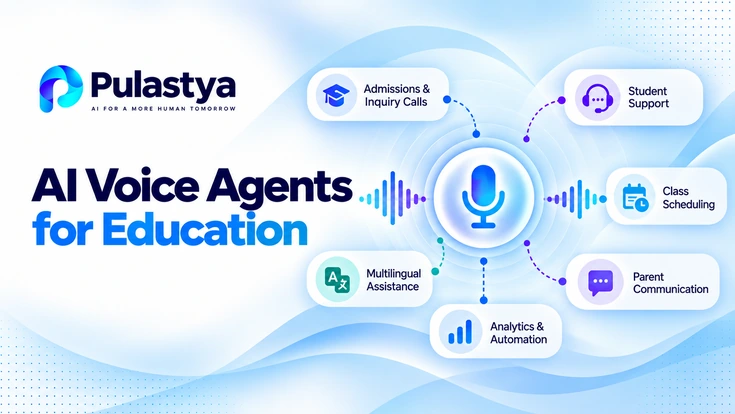
An education office phone has a predictable day, and the institution decides its shape.
A school office takes a burst of absence calls before nine, admissions questions either side of a deadline, term date enquiries all year, and among them a small number of calls that must reach a named person within minutes. A college or university front line has no morning spike of that kind, but it has clearing, enrolment week and a fee deadline, each of which arrives as the same question several hundred times over.
Both lines are built on the same two decisions: which calls repeat often enough to be worth automating, and which must never be answered by software at all. Only the second answer changes between a primary school and a university.
- Demand arrives in spikes Absence reporting in schools, clearing and enrolment in higher education: each spike is one short question asked many times over.
- Taking a report is not discussing a record An agent can accept information about a student and pass it on. It must not read anything back about that student to an unverified caller.
- Welfare concerns are not assessed Anything that sounds like a safeguarding or welfare matter goes to a named person immediately, without the agent weighing it first.
The volume is concentrated. Much of a school's inbound call traffic arrives in a window of about forty minutes, into an office that is simultaneously handling arriving pupils, deliveries and the first problems of the day.
In a school the subjects are children, and that changes what an agent may say rather than only what it may do. A caller who knows a child's name, class and date of birth is not thereby a person entitled to hear anything at all about them.
In higher education the student is usually an adult holding their own rights over their record, and is usually the caller. That moves the limiting factor from safeguarding to identity: the question stops being whether anyone may be told and becomes whether this caller has been verified, which is a process the institution owns rather than one the agent improvises.
Who Rings an Education Office, and When
The callers are more varied than the building suggests, and they arrive in patterns that repeat term after term. Sorting them by what they need is easy. Sorting them by what may safely be said back is the real problem.
| Caller | Typical call | Shape of the demand |
|---|---|---|
| A parent or carer | My child is not in today | Concentrated before the register closes |
| A prospective family | How do I apply, and by when | Seasonal, around deadlines and open events |
| A current family | A question about a form, a trip or a payment | Steady, spread across the day |
| A visiting teacher or contractor | Who do I report to, and where | Early morning and time-critical |
| An outside agency or another school | A request about a named student | Rare, and never an agent's to answer |
| A student in higher education | A question about their own enrolment, fees or timetable | Steady, with walls of it at enrolment and fee deadlines |
| Somebody with a welfare concern | Something that needs a person now | Unpredictable, and why the line is staffed |
Five of those seven rows are routine and highly repetitive. The other two are why an education office cannot simply be handed to software, so the useful framing is not which calls an agent may take. It is which calls it must recognize instantly and hand over untouched.
Absence Reporting Is the Call That Repeats Every Morning
An absence report is a short, structured call with the same shape every time: who is calling, which student, which day, and why. It is also the call most likely to be sitting eleven-deep in a queue at ten to nine.
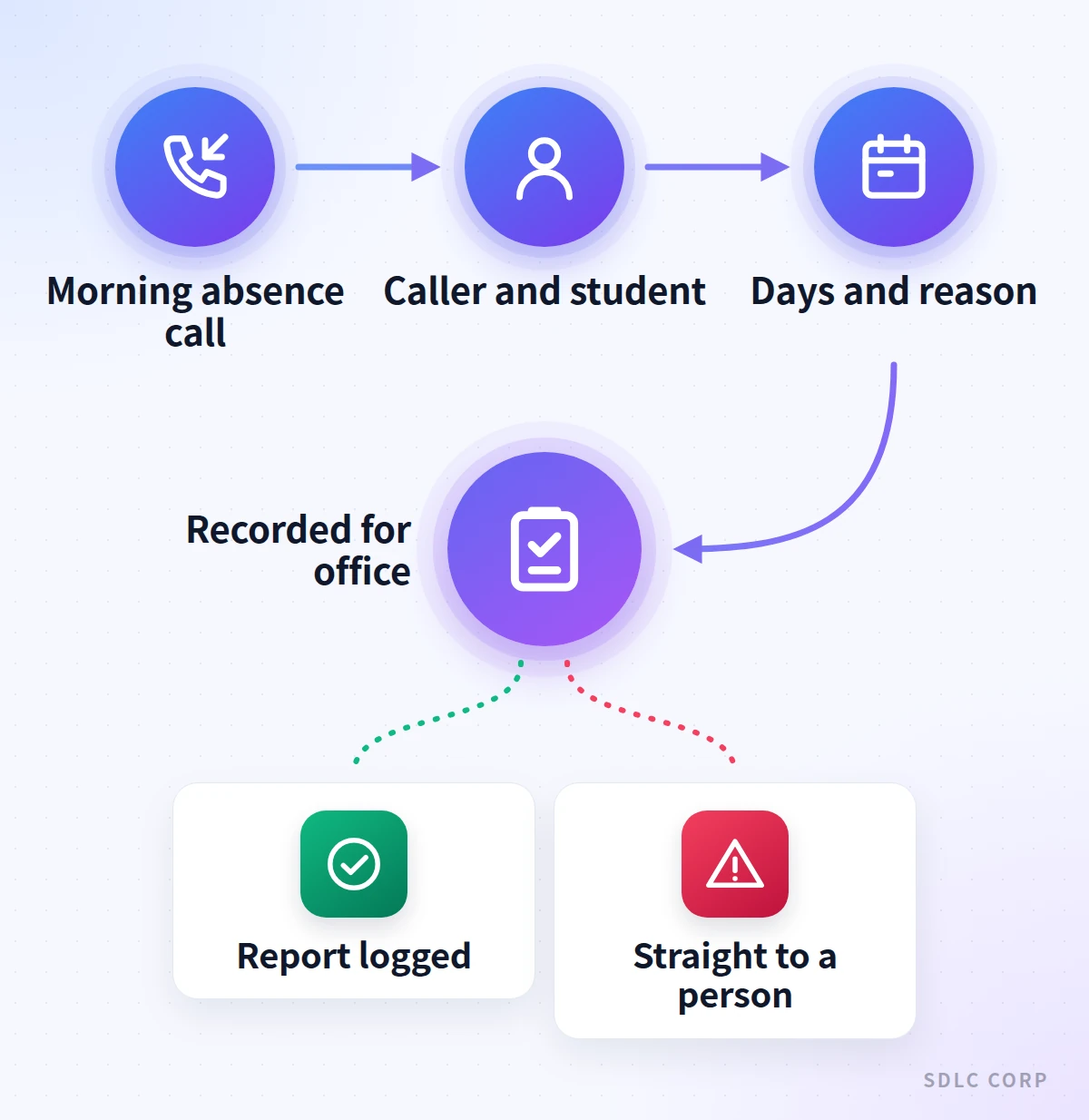
An agent can take that report end to end, and the reason is worth stating precisely. Taking a report is a one-way transaction. The caller supplies information and the agent records it. Nothing about the student is read back, which is what makes it safe at volume.
- The caller's name and their relationship to the student, as they state it.
- The student's name and class or year group, confirmed by reading it back to the caller.
- Which day or days the absence covers, and whether a return date is known.
- The reason, recorded in the caller's own words rather than sorted into a category by the agent.
That last restraint matters. Schools record absence reasons against rules they must apply consistently, and a system that quietly maps a rambling explanation into a tidy code has made an administrative decision that belongs to the office.
One thing an absence line must never become is a way of finding out whether a student is present. A caller asking the agent to confirm that a child arrived is asking about that child's attendance record, which sits on the other side of the boundary.
Turning what the call captured into a record in another system is general intake work rather than anything specific to schools, and it is described in turning a captured call into a structured record.
The Boundary: A Named Student Is Never the Subject
State this one plainly, because everything else depends on it. An AI voice agent must never discuss a specific student's records, welfare, behavior or attendance history with a caller whose identity the school has not verified.
That holds regardless of how much the caller appears to know already. A name, a class, a date of birth and a form tutor's name are all details a person with no right to the information may perfectly well have.
- No confirmation of whether a student is in school, was in school, or has been absent before.
- No discussion of behavior, sanctions, incidents or anything recorded about conduct.
- No academic information: grades, reports, sets, predictions or assessment outcomes.
- No welfare, medical or support information, including whether any exists at all.
- No confirmation that a named student attends the school in the first place.
The last of those surprises people and matters most. Confirming that a named child attends a particular school is itself information about that child, and there are families for whom that single fact carries real risk.
The agent's entire role with respect to an individual student is therefore to accept information and pass it on. Anything requiring a record to be read back belongs to a member of staff who can establish who they are speaking to.
Whether a caller is who they claim to be is a question the school answers through a process it owns and can evidence, not through questions an agent improvises mid-call. The wider design considerations are set out in designing calls that carry identity and sensitivity risk.
Safeguarding and Welfare Go Straight to a Person
Some calls must reach a named person immediately, and the agent's only job is to recognize them quickly and get out of the way. It does not assess them, grade them, or ask what happened.
That is a deliberate design choice rather than a shortcoming. Assessment is a professional judgment made by people with training and a defined role. An agent that asks one clarifying question has both delayed that judgment and begun taking a disclosure.
- Any caller raising a concern about a child's safety or welfare, however tentatively it is phrased.
- A student calling about themselves in any way that suggests distress.
- Anything about a child's whereabouts when they are expected to be in school.
- A call from an agency, a health professional or the police about a named student.
- Any caller who asks for the safeguarding lead or an equivalent named role.
Routing for these has to be tested rather than configured and forgotten. The question worth asking of any deployment is what happens when the named person does not pick up, and the only acceptable answer is another person rather than a voicemail box.
When a call should leave an agent at all, and how that trigger is designed so it fires early rather than late, is covered in deciding the moments a call should leave the agent.
Admissions and Enrolment Enquiries
Admissions most resembles a commercial enquiry, and it is where an agent earns back most of its time: the questions repeat, the answers are published already, and the volume arrives in predictable seasonal bursts.
What an agent can do is explain a process. How to apply, what the stages are, which documents an application needs, when the deadlines fall, and what happens after a form is submitted.
What it cannot do is apply that process to a person. Whether a particular family will be offered a place, whether a late application will be considered, and what an appeal might achieve are judgments with consequences, and a confident wrong answer is remembered for years.
- Answer: the published process, the dates, the documents and how to attend an open event.
- Capture: contact details, the year group or course, and the question, so the team calls back with the right file open.
- Refuse: any prediction about an individual application, appeal or waiting list position.
Where families do not share a first language with the office, the wording and the voice carry more weight than usual, and what that requires is covered in handling multiple languages and accents on calls.
Booking a place on an open event, a campus tour or an interview slot is an ordinary scheduling task with the usual constraints, described in booking an appointment during a call.
Colleges and Universities: Student Services and the Enrolment Calendar
Higher education runs the same capabilities against a different caller. The student is usually an adult, usually calling about their own record, and usually calling in a week when several thousand people want the same answer.
That inverts the school pattern. A school agent is mostly taking information about someone else; a university agent is mostly being asked for information about the caller. So the limiting factor stops being safeguarding and becomes identity, and identity is established by the institution's own process rather than by questions the agent invents mid-call.
The calendar does the rest of the work. Clearing and late application windows, enrolment week, fee deadlines and results days each arrive as one short question asked at volume, which is precisely the shape a knowledge-grounded agent absorbs without adding risk.
- Answer from published material: course content and entry requirements, application stages and deadlines, what enrolment requires and which documents to bring, fee amounts and payment methods, term dates, and how to reach a department.
- Capture rather than answer: the progress of a named application, an individual fee balance or payment arrangement, a personal timetable, results, and accommodation allocations.
- Hand over without assessing: wellbeing and mental health, disability and support services, and any caller in evident distress.
- Book rather than advise: an adviser appointment, a campus tour or an open day slot, using the institution's own calendar.
The where-is-my-application call is the highest-volume item in that middle row, and it behaves like any other status enquiry: the answer lives in a live system behind a verified caller, so the agent's job is to confirm the request and route it, as automating status and order enquiries sets out.
Clearing is the week to design for rather than the week to launch in. Volume peaks, callers are making a decision in a single conversation, and a confidently wrong answer about entry requirements is acted on immediately.
Term Dates and the General Administrative Line
The remaining volume is the published answer, given repeatedly: term dates, staff training days, uniform, the shape of the school day, how to pay for a trip, where to find a form, which entrance a visitor should use.
These are the calls a knowledge-grounded agent handles well, provided the source is the institution's own current material rather than whatever a model recalls about schools in general. A term date from last year is a wrong answer delivered with complete confidence.
Pulastya answers from documents the organization provides, and states when it lacks the context to answer, offering a transfer rather than guessing. On a school line the second behavior matters more than the first, because the alternative to a transfer is a family acting on something invented.
Currency is the whole game with this material. Calendars change, a training day moves, and a document updated in July and never looked at again will still be answering questions the following March.
Name an owner for each source and a trigger that forces a review, using the routines set out in keeping the source content a voice agent reads from accurate.
Data Protection and Scoping a Deployment
Information about students is regulated, and how depends on where the institution operates, the sector it sits in, the ages of the students and the legal basis it relies on. Nothing written in general terms can tell a school which duties attach to its phone line.
- Whether a call may be recorded, who must be told, and in what words.
- How long recordings, transcripts and call summaries may be kept, and where they may be held.
- What counts as a student record once an absence reason has been captured and written down.
- What a parent or a student is entitled to receive if they later ask for everything held about them.
- Whether the automated nature of the call must be disclosed to callers.
Establish each of those with your own counsel and data protection adviser before launch, then write the agreed answers into the agent's opening and its retention settings rather than leaving them as assumptions made during setup.
- Write the handover list firstSafeguarding, welfare, and any call about a named student. Have the people who own those duties sign it before anything is configured.
- Start with absence reportingOne call type, the highest volume, nothing read back. Success or failure is obvious inside a week.
- Prepare the published materialTerm dates, the admissions process and the school day, each with a named owner and a review date.
- Rehearse the difficult callersThe one asking whether a child arrived, the one who says something worrying mid-report, and the one who is neither.
- Test against your own contentPlace the calls yourself, against your real material and your real handover list, not a demonstration script.
A browser test call before launch supports exactly that rehearsal, and Pulastya provides one alongside transcripts and call summaries, which give a school something concrete to review after the first week.
Other sectors run the same capabilities and draw their boundaries in completely different places, which the wider map of voice AI use cases by industry sets out sector by sector.
Conclusion
AI voice agents for education are most useful when they handle repeatable calls without treating a student record as an open source of answers. Schools can automate one-way absence reporting, published term dates and admissions guidance; colleges and universities can cover enrolment information and routine student-service questions. Individual records, welfare concerns and safeguarding calls still need the institution's own verification and human handover processes.
For a safe rollout, begin with a narrowly defined call type, maintain approved and current source documents, and test transfers to named staff, including a backup if the first person cannot answer. Agree on data protection, recording and retention rules before launch, then review real calls and summaries for mistakes. Success means less pressure on the front desk without compromising accuracy, privacy or timely support.
Frequently Asked Questions
Yes, and it is usually the best first call type to automate. An absence report is a one-way transaction: the caller supplies the student, the days and the reason, and the agent records them. Nothing about the student is read back, which is what makes it safe at the volume the morning brings.
No. That is information from the student's attendance record, and giving it out depends on the school knowing who is calling through a process it owns. A name, a class and a date of birth are not proof of entitlement. The request should reach a member of staff who can check properly.
It goes to a named person immediately, and the agent does not assess it, grade it or ask what happened. Assessment is a professional judgment, and a clarifying question both delays it and starts taking a disclosure. Test what happens when that person does not answer; the fallback must be another person.
The published process: how to apply, the stages, the documents required, the deadlines and how to attend an open event. What it must refuse is applying that process to an individual, meaning any prediction about whether a place will be offered or what an appeal might achieve.
They vary by jurisdiction, sector, student age and the legal basis the institution relies on, so they cannot be assumed from general practice. Recording, disclosure, retention of transcripts and what counts as a student record all need establishing with your own counsel and data protection adviser before launch.
Yes, and the boundary moves. In a school the subject is a child and safeguarding sets the limit. In higher education the student is usually an adult calling about their own record, so the limit is identity verification through the institution’s own process. Published material — courses, entry requirements, enrolment steps, fee amounts and deadlines — is answerable in both.