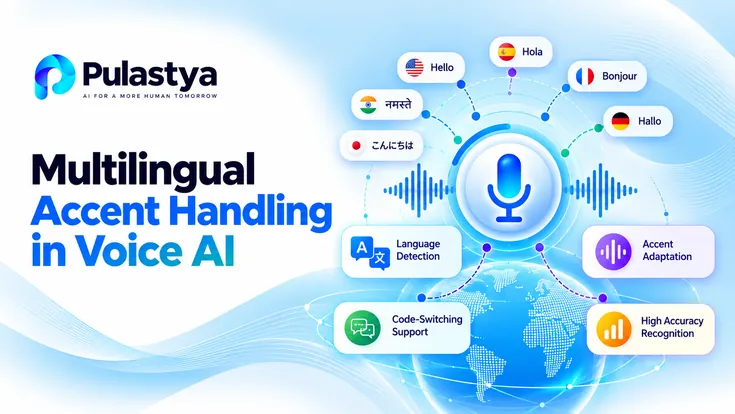
Multilingual accent handling in voice AI requires combining language identification, accent-aware acoustic modeling, and runtime routing to deliver reliable call-level performance across markets.
Enterprise teams must settle practical engineering patterns, data strategies, and operational tradeoffs when deploying voice AI for multilingual contact centers, IVR replacement, or global voice agents.
- Language ID plus accent modeling Treat language detection and accent variability as separate but integrated layers to reduce error propagation and allow targeted adaptation.
- Operational metrics drive choices Optimize for business metrics like containment rate and escalation, and use those KPIs to choose model size, latency budget, and fallback logic.
- Runtime routing matters Design call flows that combine confidence thresholds, fast lightweight models for routing, and heavier adaptive models for contested audio segments.
Enterprises deploying voice AI face two linked problems: recognizing the correct language and decoding highly variable accents without breaking latency or increasing error rates.
Solutions mix model-level techniques, data curation, and call-architecture choices. Decisions should prioritize metrics tied to call outcome, such as intent recognition lift, transfer-to-agent rates, and average handle time, rather than raw word error rate alone.
Engineering, product, and operations teams need concrete implementation detail and decision criteria. The key choices are single-model versus pipeline approaches, data collection and annotation practices, evaluation rigs for real calls, and runtime routing and fallback strategies. These design tradeoffs are sharpest in a multilingual contact center handling heavy accent diversity.
How Do Voice AI Systems Detect Language and Accent in Live Calls?
Language detection in real-time calls usually starts with a fast language identification model that operates on short audio frames. For enterprise voice, choose models that accept noisy channel inputs and provide a calibrated confidence score every few hundred milliseconds.
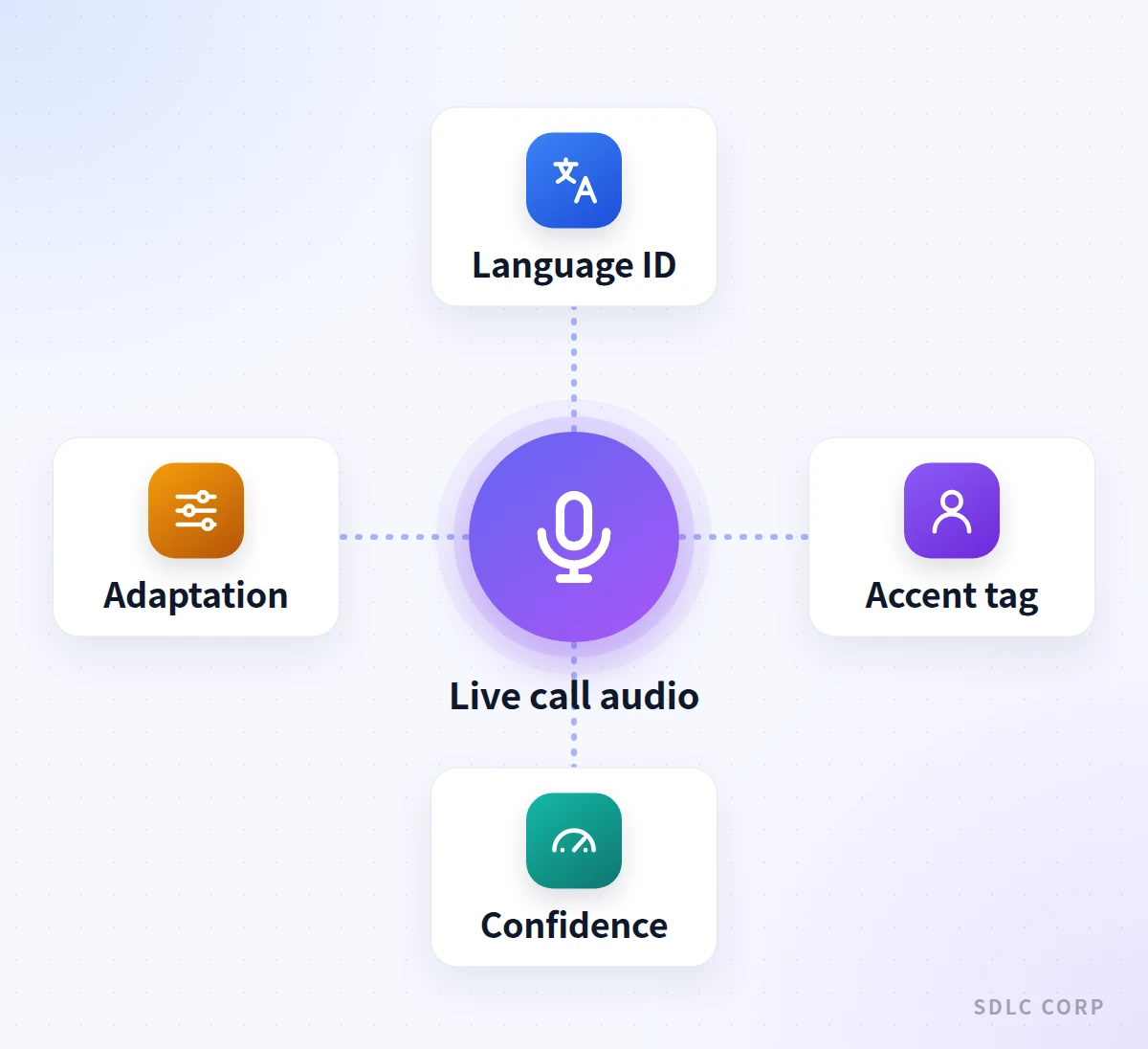
Low-latency LID enables early routing to language-specific ASR or multilingual decoders and reduces the risk of cross-language recognition errors that cascade into intent failures.
Accent detection is a different signal set: accents change phonetic realizations rather than vocabulary. Many teams implement a parallel lightweight accent classifier that tags segments with accent clusters used to select acoustic models or adaptation parameters.
Clustering schemes should be validated against the business outcome; too many accent buckets create maintenance overhead, while too few leave residual error at the call level.
Combine signals: use LID to pick a language pipeline and the accent tag to load a bias or adaptation vector into the ASR frontend.
If confidence is low for either signal, fall back to a hybrid strategy that runs a multilingual ASR with accent-aware rescoring. This layered approach balances speed and accuracy on real calls where speakers may switch languages or use mixed-language phrases.
- Run language identification early enough to guide routing, then validate timing against real call audio.
- Use a separate accent classifier trained on phonetic features to signal adaptation needs without changing language choice.
- If LID confidence is low, run a multilingual ASR in parallel and compare hypotheses by confidence and intent stability.
- Keep accent clusters per language few enough to maintain, and validate each cluster against call outcomes.
- Calibrate model confidences using in-call domain data to avoid overrouting to human agents.
Use fast LID for routing and a separate accent tag for model adaptation to keep latency low while improving decoding accuracy.
Should You Use a Single Multilingual Model or Language-Specific Models?
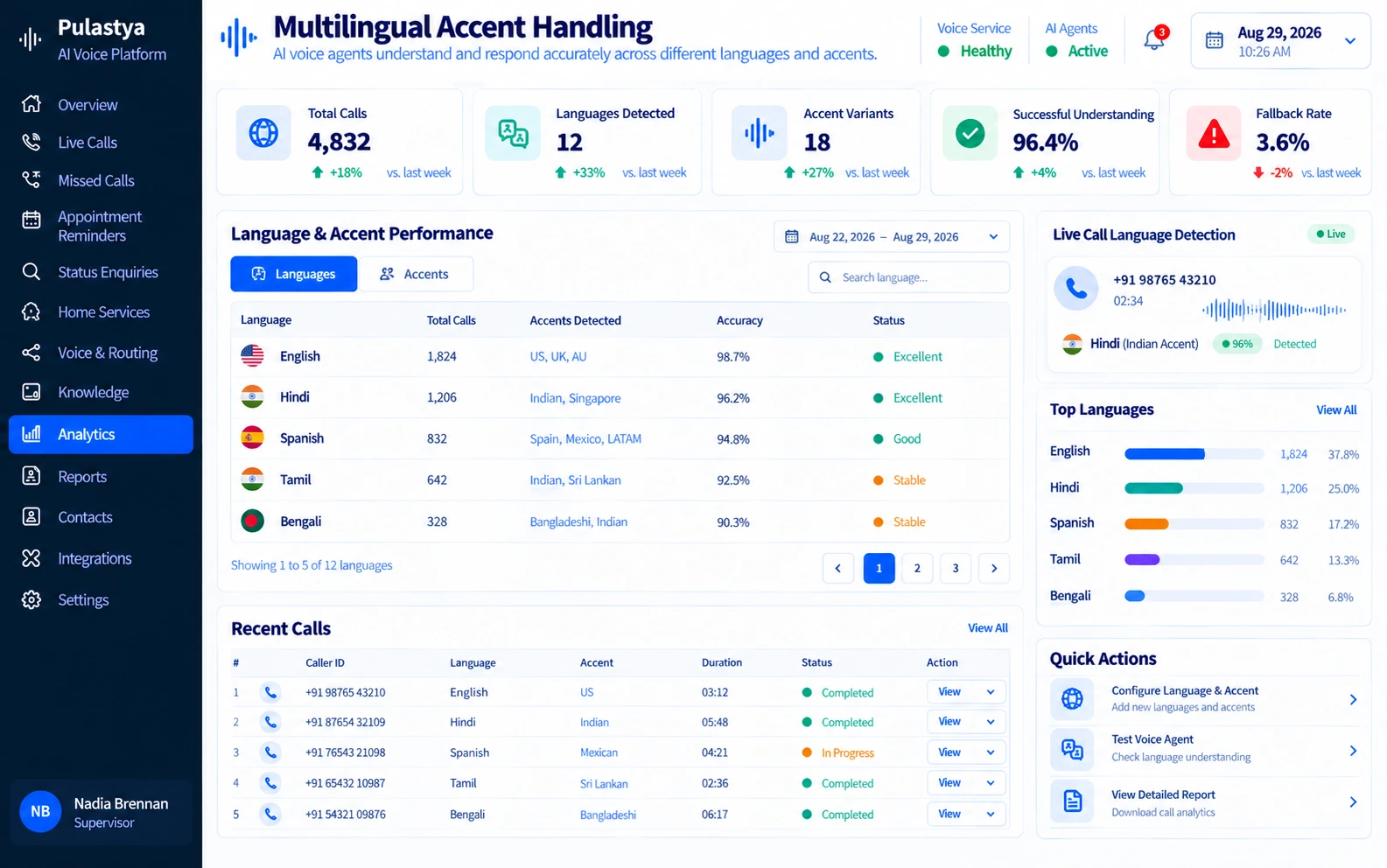
Single multilingual models simplify deployment and can benefit from transfer learning across languages with shared phonetic patterns. They reduce the number of deployed endpoints and make incremental updates easier. However, large multilingual models can demand more compute, risk increased latency, and may underperform on low-resource accents without targeted adaptation.
Language-specific models typically deliver better accuracy for high-demand markets because they allow aggressive acoustic tuning, lexicon curation, and accent adaptation. They do require separate training pipelines, more storage, and orchestration for runtime routing. For enterprises with clear top-language demand and strict latency SLAs, per-language optimized models often yield better call-level outcomes.
A hybrid architecture is common in production: deploy a lightweight multilingual model for initial routing and fallback, and route to language-specific models when LID and intent confidences cross thresholds. This preserves responsiveness while enabling higher accuracy where it matters most, such as billing or legal-sensitive interactions.
- Multilingual model pros: fewer endpoints, cross-language transfer, simpler versioning.
- Multilingual model cons: larger model size, potential accuracy loss on rare accents, higher inference cost.
- Language-specific model pros: tuned lexicons, better silence/noise handling per locale, lower error on primary accents.
- Language-specific cons: more infrastructure, complex traffic routing, longer update cycles per language.
- Hybrid approach: use multilingual for cold-starts and language models for high-value sessions when confidence permits.
Hybrid architectures capture the operational benefits of both approaches while limiting compute and routing complexity.
How to Collect and Label Audio Data for Accent Robustness?
Start with production call logs to build a baseline dataset that reflects real microphone characteristics, codecs, and noise profiles. Annotate a stratified sample by language, accent cluster, call channel, and intent. Prioritize labeling for the combinations that drive business impact, such as payment flows or dispute resolution paths, rather than trying to label all call types uniformly.
For accent diversity, supplement call recordings with targeted data collection: recruit speakers from identified accent regions and record scripted and unscripted prompts in realistic environments. Use phonetic prompts to capture specific confusions known to cause errors. Ensure consent and data governance compliance when capturing PII and personally identifiable voice samples.
Labeling strategy should include multiple tiers: full orthographic transcription for core training data, phonetic or error-focused labels for acoustic adaptation, and metadata tags for noise, microphone type, and codec. Use semi-supervised techniques and confidence-based pseudo-labeling to scale while maintaining a quality validation holdout for evaluation.
- Sample real call logs stratified by intent, channel, and known failure modes for the validation set.
- Recruit targeted accent speakers for focused phonetic captures that reproduce frequent ASR confusions.
- Annotate metadata such as background noise level, device type, codec, and caller demographics for covariate analysis.
- Apply semi-supervised labeling with manual review on low-confidence segments to expand training data cost-effectively.
- Maintain a strict holdout set with recorded calls for unbiased performance evaluation after retraining.
Prioritize labeling for call segments that affect key business outcomes and expand with focused accent captures.
What Model Adaptation Techniques Improve Accent Handling?
Fine-tuning on accent-specific data remains one of the most effective strategies, especially when you have enough labeled audio for the target accent. Use continued training with a reduced learning rate and regularization to prevent catastrophic forgetting of other languages. Keep a mixed mini-batch strategy to preserve performance across languages and accents.
Lightweight adaptation techniques are useful when data is sparse: use speaker or accent embeddings to bias acoustic layers, implement feature-space maximum likelihood linear regression (fMLLR) style transforms, or add shallow adapter layers that adjust only a small fraction of model parameters. These approaches permit on-the-fly adaptation without redeploying full models.
Per-call adaptation can be practical in controlled contact center settings: estimate an accent or speaker adaptation vector from the caller's first few utterances and apply it to rescoring for the rest of the call.
This is acoustic adaptation, not voice biometrics. The vector should not be used to identify the caller, and it should be discarded when the call ends so a noisy call never degrades later ones.
- Full fine-tuning on accent data when you have thousands of labeled minutes yields the best gains but requires careful validation.
- Use accent embeddings or adapters when labeled data is limited to achieve fast adaptation with low parameter changes.
- Apply per-call acoustic adaptation in controlled environments to handle extreme accent variance, and discard vectors at call end.
- Regularize adaptation with mixed-language batches to prevent loss of performance on other accents.
- Track adaptation efficacy with call-level KPIs to decide whether to roll out global or localized adaptation.
Use a tiered adaptation strategy: fine-tune when data exists, use adapters or embeddings for sparse cases, and reserve per-call adaptation for high-value flows.
How Should Teams Evaluate Accent and Multilingual Performance?
Evaluation must map to operational outcomes. Design tests that measure containment rate, false transfer-to-agent, intent accuracy, and task completion per language and accent cluster. Word error rate is useful for diagnostic tracking but should not be the sole metric. Measure how recognition errors affect intent classification and dialog state to capture business impact.
Build evaluation suites that include both synthetic prompts and recorded production calls across noise profiles. Include adversarial cases such as code-switching, heavy background noise, and short utterances. Use confusion matrices by phoneme and word to prioritize acoustic fixes that produce downstream gains in intent classification or slot extraction.
Implement continuous monitoring in production with acoustic drift detection and periodic re-evaluation against the holdout set. Create thresholds for automated rollback and for triggering additional data collection campaigns. Correlate ASR confidence with business metrics to refine routing thresholds and to detect when accent handling degrades over time.
- Prioritize containment rate and task completion across languages and accents as primary KPIs.
- Use a mix of synthetic and real recorded calls for stress-testing model robustness in production conditions.
- Analyze errors at the phoneme level to guide acoustic model changes and lexicon updates.
- Set automated alerts for confidence distribution shifts and sudden drops in intent accuracy by locale.
- Use A/B tests to validate that an adaptation or routing change improves business outcomes before full rollout.
Measure accent handling by its impact on containment and task completion, not just by word error rate.
How to Design Runtime Routing, Fallback, and Latency Strategies for Calls?
Design runtime routing to use a fast LID and lightweight ASR to produce an initial hypothesis and confidence. If the initial hypothesis yields a high-confidence intent match, complete the transaction. For lower-confidence cases, escalate to a heavier language-specific ASR and perform rescoring. This staged strategy keeps average latency low while allocating compute where it produces measurable business value.
Define fallback rules for mixed-language or low-confidence segments: prompt for language selection only when automatic detection remains ambiguous after a short retry. Use short clarifying prompts instead of full language menus to reduce friction.
When acoustic conditions are poor, implement a graceful fallback to a human agent, routed by the detected or confirmed language where possible, with prefilled context derived from partial hypotheses to reduce handle time.
Consider distributed inference patterns: run lightweight models at the edge or in contact center racks for initial pass and reserve centralized GPU clusters for adaptation rescoring. Balance cost and SLA by profiling throughput and peak traffic.
Keep per-call adaptation vectors for the life of the call so a transfer between AI pipelines or queues does not restart adaptation, then discard them when the call ends.
- Stage processing: fast LID and light ASR for routing, heavy ASR for disambiguation when needed.
- Prompt users only when automated confidence remains ambiguous to avoid unnecessary friction.
- Fallback to human agents with prefilled context to save agent time when automation fails.
- Redistribute compute: edge for quick passes, centralized GPUs for rescoring and adaptation.
- Keep per-call adaptation vectors across internal transfers during the call, then discard them.
Allocate heavier computation only to contested segments; use confidence-driven staging to control cost and latency.
Language routing at runtime
From Language Detection to Continue, Confirm, Switch or Human
- Detect language on the first audioFast language ID scores short frames and emits a calibrated confidence
- Tag accent for adaptationAccent tag selects adapters or bias for ASR; it never changes the language
- Check confidence and intent stabilityCompare language ID and intent confidence against calibrated thresholds
- Rescore contested audioLow confidence runs a heavier language-specific or multilingual pass first
Possible outcomes
- ContinueHigh confidence: complete the task in the detected language
- Confirm or switch languageStill ambiguous: short prompt with likely languages, then switch pipeline
- Hand off to a humanPoor audio or low confidence persists: transfer with partial transcript
The caller is only asked about language after automatic detection and heavier rescoring both stay uncertain, and a human is the last resort.
Example: Designing a Multilingual Contact Center for Heavy Accent Diversity
A global travel company handles bookings across three languages with substantial accent variation in each region. The engineering team deployed a compact multilingual LID and a lightweight ASR for initial routing.
High-value payment flows routed to language-specific ASR models tuned with accent adapters collected from regional call centers. The goal was to cut false transfers in payment flows by sending contested calls to specialized decoders.
They collected targeted accent samples from speakers who opted in to record short scripted prompts, and from calls where callers consented to their audio being used for training. Accent adapters were trained using a mix of scripted digits, city names, and unscripted complaint passages to capture phonetic and prosodic variation.
Per-call adaptation signals were computed early in the interaction and applied to rescoring only when the session reached the deployment's low-confidence threshold.
Operationally, the team tracked containment rate, payment success rate, and average handle time by language and accent cluster. They used staged processing to keep response time under the SLA: lightweight models ran at the edge; rescoring and heavy adaptation ran centrally on GPUs for the small share of calls that stayed below the confidence threshold.
- Use per-call adaptation only for sessions that need it to limit compute and reduce noisy adaptation.
- Collect accent data from opt-in prompt recordings and consented call audio to lower costs.
- Route payment and high-risk flows to language-specific, accent-adapted models for higher accuracy.
- Profile traffic to limit heavy rescoring to a small percentage of contested calls to meet SLAs.
- Track business KPIs by accent cluster to justify further data collection or broader model updates.
Combine per-call adaptation with staged routing to improve accuracy on high-value flows without raising overall latency.
What Operational and Compliance Factors Affect Multilingual Deployments?
Data governance is paramount when collecting voice samples across jurisdictions. Implement consent capture, data minimization, and retention policies that meet local laws.
Design your annotation and storage pipelines to segregate data by region where required and to support subject access requests. Operational controls should include automated PII redaction and auditable pipelines for data access used in model training.
Cost and scalability considerations influence model selection and adaptation frequency. Track inference cost per call and place budget-aware caps on heavy rescoring.
Use autoscaling policies tied to traffic patterns and set conservative cold-start limits for large models. Plan for continuous retraining windows that align with business cycles to minimize customer impact and to keep models current with evolving accents.
Staffing and tooling must support multilingual QA, error analysis, and monitoring. Create feedback loops from agents and QA teams to collect failure cases and to prioritize model fixes. Maintain a metrics dashboard showing KPIs by language and accent cluster and schedule quarterly reviews to decide where to invest in additional data collection or specialized model work.
- Enforce consent capture and region-specific retention for all recorded voice data to meet compliance.
- Implement PII redaction tools in the ingestion pipeline to reduce annotation risk and exposure.
- Monitor inference cost per session and limit heavy rescoring to contested or high-value calls.
- Automate drift detection and schedule retraining windows to align with business priorities.
- Provide bilingual QA teams and an error-reporting pipeline from agents back to model owners.
Operational success depends on compliance, cost controls, and a closed-loop feedback process between QA, agents, and model teams.
Hotels regularly receive calls from international guests. The guide to AI voice agents for hotels and hospitality covers how language handling fits with reservation enquiries, guest questions and front desk routing.
For sharing calls between AI and staff, see hybrid AI and human call handling.
Conclusion
Multilingual accent handling in voice AI requires more than identifying a caller’s language. Reliable customer interactions depend on accurate speech recognition, accent-aware adaptation, effective model routing, and carefully designed fallback strategies.
Enterprises should choose between multilingual, language-specific, and hybrid models based on real call conditions, supported language coverage, latency requirements, and measurable outcomes. Evaluating performance across different accents and languages helps teams identify recognition gaps and improve the overall caller experience.
By combining representative training data, continuous monitoring, responsible data governance, and smooth human handoffs, organizations can build voice AI systems that support clearer, more accessible conversations across diverse customer groups.
Frequently Asked Questions
Meaningful gains typically appear after a few hundred to a few thousand labeled minutes per accent cluster. Use adapters or accent embeddings when labeled minutes are limited. Prioritize data collection for call flows that impact revenue or compliance to maximize ROI on annotation effort.
Yes, multilingual ASR models can handle code-switching better than language-specific systems when trained on mixed-language corpora. For production calls, complement the ASR with a strong language ID and intent model to decide whether to route or to run a multilingual decoder when code-switching is frequent.
Ask a short clarifying question, such as offering the two most likely languages, instead of guessing or playing a full language menu. If confidence stays low, switch to the language the caller confirms, read key details back, or transfer to a human who speaks that language with the partial transcript attached. Disclose recording, and get consent before keeping caller audio for accent training.
Validate by measuring business KPIs such as containment rate, escalation rate, and task completion before and after changes, broken down by language and accent cluster. Run A/B tests on live traffic and use agent feedback to confirm that perceived improvements translate into fewer transfers and faster resolutions.
Quick wins include updating lexicons with local pronunciations, adding accent-specific n-gram rescoring, implementing shallow adapter layers, improving noise-robust feature extraction, and using post-processing intent correction rules based on common confusions observed in production.