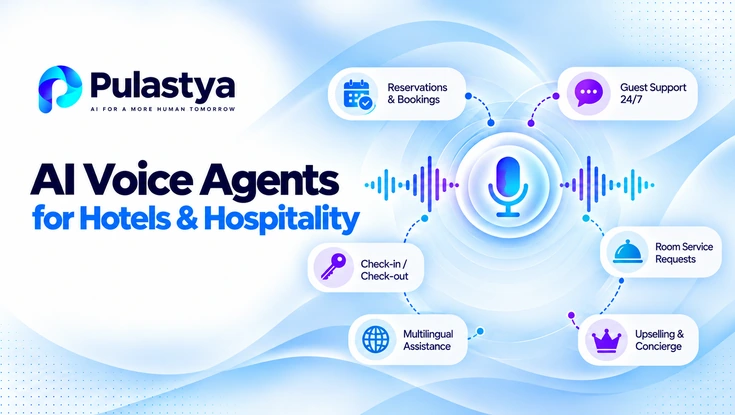
An AI voice agent for hospitality is software that answers hotel phone calls, handles reservation enquiries and common guest questions, captures booking requests, and routes callers to the front desk, reservations, concierge or events team.
It is for hotels, resorts, serviced apartments and hospitality groups whose staff answer phones while guests wait at the desk.
- Answers guest FAQs Check-in times, parking, amenities and directions come from approved hotel documents.
- Availability needs integration Live availability and rates require a reservation system connection; otherwise the agent captures the request.
- Routes by department Reservations, front desk, concierge and events calls reach the right team with the caller's details.
The practical outcome is a lighter phone load on busy staff. Prospective guests get a useful answer on the first call, staff spend less time repeating parking and check-in details, and calls that need a person arrive with the request captured.
The main design decision is data access. Questions about amenities, policies and directions can be answered from approved documents. Live room availability and rates need a connection to the reservation system, and without one the agent should capture the request instead of guessing.
Which Hotel Calls an AI Voice Agent Can Handle
An AI voice agent can handle the high-volume calls a hotel receives on its public lines: reservation enquiries, questions about the property, arrival logistics and requests for specific departments. It works alongside staff rather than replacing them, taking repetitive calls so the team can focus on guests in front of them.
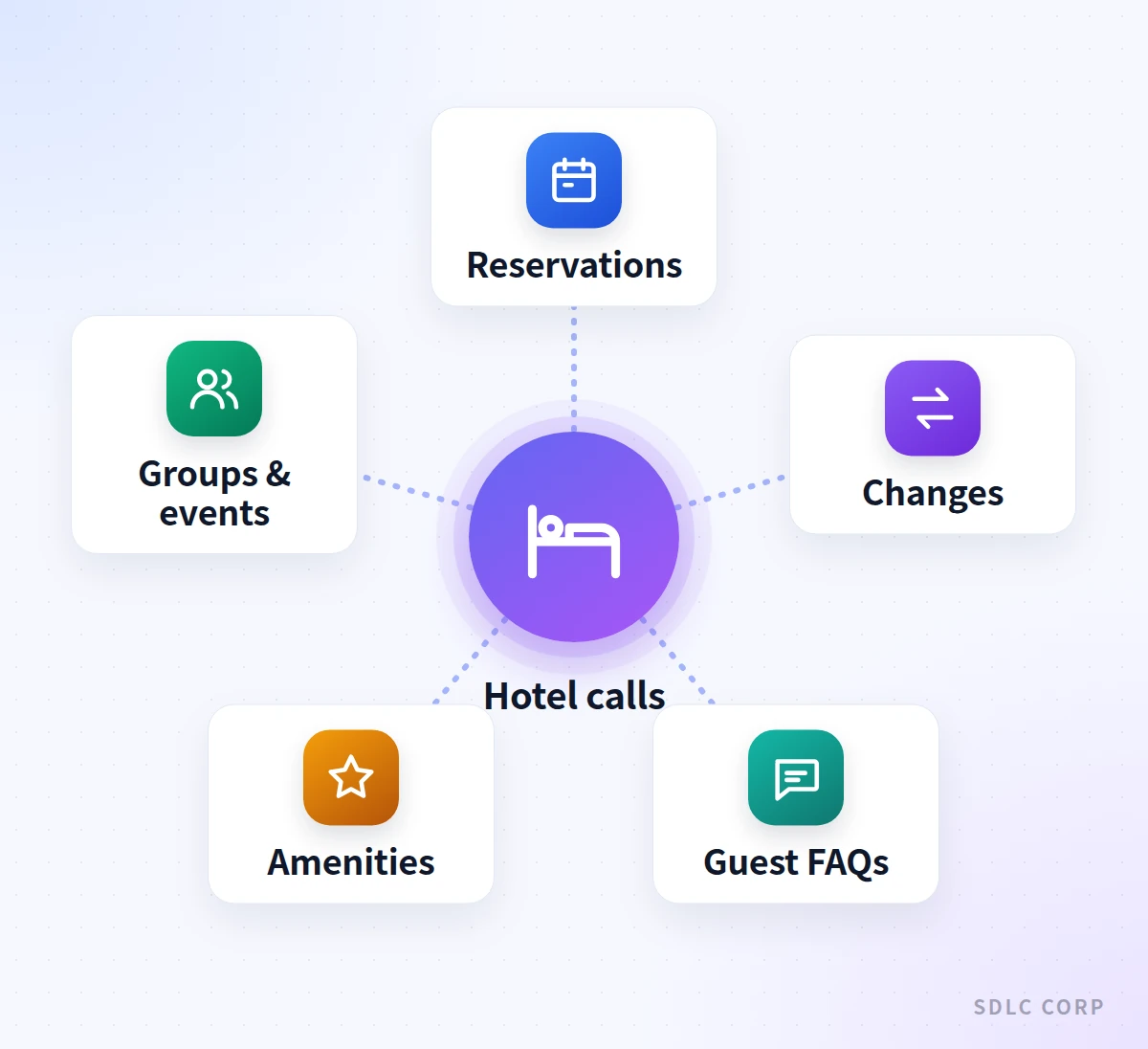
Dates, room types, occupancy, accessible rooms, rate questions and booking requests.
Confirmation questions, changes, cancellations and special requests, which need verification or staff.
Check-in and checkout times, pet, smoking and deposit policies, Wi-Fi and breakfast.
Pool, spa, restaurant and gym hours, parking, published transport options and entrances.
Wedding, meeting and group block enquiries captured for the sales and events team.
How it works
How a Hotel Call Is Handled
- Guest callsMain or reservations number
- Identify propertyConfirm the hotel for multi-property groups
- Identify requestBooking, FAQ, directions or department
- Check approved sourceFact sheet or reservation system
Possible outcomes
- AnswerPolicies, amenities and directions
- Capture booking requestStay details confirmed for reservations
- TransferFront desk, concierge or events
Hotel calls end in an answer, a captured booking request or a transfer to the department that owns the request.
Many of these tasks overlap with the general front-desk call handling role. Hospitality adds three complications: reservation data that changes by the minute, departments that keep different hours, and guest privacy rules a generic setup will not know about.
Every sector adds its own version of that list, and voice AI use cases across other sectors groups them by the job the call is doing rather than the industry on the door.
Decide early which lines the agent answers. A practical starting point is the main and reservations numbers, while in-room extensions usually stay on the hotel's own phone system and ring the front desk directly.
Reservation Enquiries and Live Availability
An AI voice agent can quote room availability and rates only if it is connected to the hotel's reservation or property management system at the time of the call. Inventory, rate plans and stay restrictions change constantly, so a document listing rooms and prices goes out of date almost immediately.
| Guest request | Without reservation system access | With reservation system access |
|---|---|---|
| Do you have a room on these dates? | Capture dates, guests and room preferences for the reservations team | Check availability for the requested dates and room type |
| What is the rate? | Explain that rates vary by date and capture the request | Quote current rates from the system with their conditions |
| I would like to book | Capture a booking request and explain how it will be confirmed | Create or hold a booking only if the hotel permits that action |
| Change or cancel my reservation | Explain the published cancellation policy and route to staff | Look up the booking after verification and apply approved changes |
| Group block or event space | Capture event type, dates and headcount | Usually still routed to the sales and events team |
Without live access, the worst outcome is an agent that sounds confident about a room that is not available. Capturing the request and setting a clear confirmation expectation is safer and still saves the reservations team time. The article on AI appointment scheduling explains the capture versus confirm pattern in more detail.
How a Booking Request Call Works
A booking request call collects the stay details, checks or captures availability, confirms everything back to the caller, and hands the request to a person or system that can complete it. Reading details back is essential, because dates, names and room types are easy to mishear by phone.
- Identify the property and requestFor hotel groups, confirm which property the caller means before anything else.
- Collect stay detailsArrival and departure dates, number of guests, room type, accessibility needs and estimated arrival time.
- Check or capture availabilityQuery the reservation system if integrated; otherwise record the request and acceptable alternatives.
- Confirm details backRepeat dates with the day of the week, spell the guest name and confirm the best contact number.
- Set the next stepExplain how the reservation will be confirmed, and transfer if the caller wants to book with a person now.
Example scenario
Thank you for calling the hotel. How can I help?
Do you have a king room for two nights starting Saturday the 14th? And is parking included?
I can take your request so our reservations team can confirm availability and your rate. Parking is available on site for a daily fee. May I have your name?
Maria Lopez. We will arrive late, probably around 11 at night.
Thank you. That is Lopez, L, O, P, E, Z. I have a king room for two nights from Saturday the 14th, arriving around 11 p.m. Is this the best number to reach you?
Yes. Can I also ask about booking the rooftop terrace for a birthday dinner?
Private events are handled by our events team, so I will transfer you now and pass along your details.
The agent answered the parking question from approved content, did not invent availability or a rate, and confirmed the date with the day of the week. It then sent the event enquiry to the team that owns it.
Guest FAQs, Amenities and Directions
An AI voice agent answers guest FAQs well when it works from a maintained property fact sheet and policy documents rather than general knowledge. Hotel details are specific and seasonal: pool hours change, restaurants close for private events, and parking differs between self-park and valet.
- Policies: check-in and checkout times, early arrival and late checkout rules, deposits, pets, smoking and minimum age.
- Amenities: seasonal opening hours, reservation requirements for spa or dining, and what the rate includes.
- Arrival: parking options and fees, EV charging, vehicle height limits, entrances and luggage help.
- Directions: routes from the airport and train station, and transport options the hotel has published.
- Accessibility: accessible room features, step-free routes and the service animal policy.
Local recommendations need extra care. Limit them to an approved concierge list, otherwise a model may describe restaurants or attractions that have closed. Seasonal content needs an owner and a review date, and the guide to keeping an AI voice knowledge base accurate covers update routines.
Grounded answering is the capability that makes this work. The agent retrieves from the hotel's own approved content and speaks from that, rather than from whatever a language model happens to recall about hotels in general.
It is the difference between a deposit rule a manager can stand behind and a plausible sentence a guest will quote back at the desk. Pulastya AI, SDLC Corp's voice agent platform for inbound and outbound calls, is one implementation of this pattern, and it names hotel booking, room, parking and check-in questions among its use cases.
The maintenance obligation follows from the same design. When a policy or an opening time changes, the source content has to be updated and reindexed before the agent will speak the new answer, which makes the review cycle part of the system rather than an afterthought.
When a question falls outside the approved content, the correct behavior is for the agent to say it does not have that detail and offer a transfer, instead of producing a confident guess the front desk then has to walk back.
Routing Calls to Front Desk, Reservations, Concierge and Events
An AI voice agent routes hotel calls by matching the caller's request to the department that owns it, then applying rules for hours and staff availability. A transfer to an unstaffed sales office is worse than a captured request.
- Reservations: new bookings, rate questions and changes to existing reservations.
- Front desk: arriving guests, in-house guest issues and anything time-sensitive on the day of stay.
- Concierge or guest services: transport bookings, restaurant reservations and special arrangements.
- Sales and events: weddings, meetings, group blocks and venue enquiries.
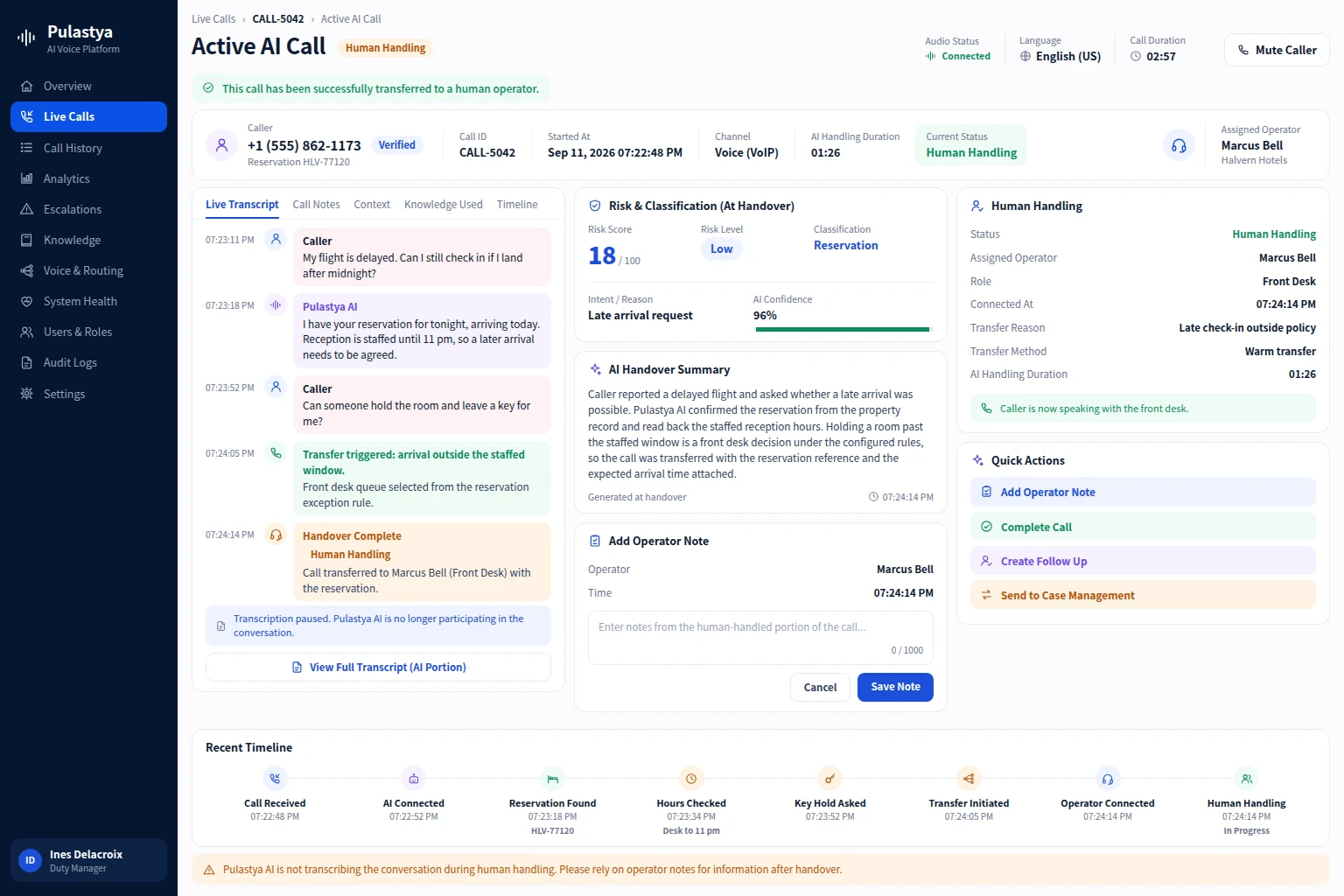
Each transfer should carry what the caller already said, so the front desk does not restart the conversation during a busy check-in period. The article on how warm transfer works in AI voice agents explains how summaries reach the receiving person.
Three routing settings are worth deciding before launch. The transfer destination can be a single extension or a hunt group that rings several desk phones in turn, which matters when the front desk is away from the counter.
The handoff itself should carry the conversation context and a call summary, so the guest is not asked to repeat dates or spell a name they have already given.
A failover path should send calls straight to a staffed human line if the agent cannot continue for any reason, because a hotel line that rings out costs more than a call answered by a person with no context.
After-Hours and Overnight Hotel Calls
An AI voice agent covers calls that arrive when reservations, sales and concierge desks are closed, even though the front desk itself is staffed around the clock. Overnight, a small team may be handling late check-ins, the night audit and guest requests at once, so every routine call the agent absorbs helps.
- Answer FAQs and directions for late arrivals from approved content.
- Capture reservation and event enquiries for teams that open in the morning, with honest callback expectations.
- Transfer in-house guest issues, such as lockouts or noise complaints, to the on-duty staff line.
- Follow the hotel's emergency policy for safety concerns, and never try to assess an emergency.
The coverage gap that matters in hospitality is wider than the overnight window. It is weekends, holiday periods and the volume spikes around events and the check-in rush, the windows where a reservations enquiry that rings out becomes a booking placed with another property.
What makes that coverage useful the next morning is a transcript and a written summary of each call, so the team opening the reservations desk can act on the request without phoning the guest back to ask what they wanted. The rules for time-based routing, holiday schedules and urgent exceptions are covered in after-hours call handling with AI voice agents.
Serving Multilingual and International Guests
An AI voice agent can serve international guests when its speech recognition and voices perform well in the languages those guests actually speak, which must be tested rather than assumed. Accents, airport background noise and weak mobile connections all affect recognition quality.
- Read dates back with the day of the week, since numeric formats such as 04/05 mean different dates in different countries.
- Spell out guest names and confirmation numbers rather than trusting recognition alone.
- Offer a route to a staff member who speaks the caller's language when one is available.
- Keep approved content consistent across languages, so policies do not drift in translation.
Language and voice are configuration choices on the platform rather than something the agent decides for itself, so the evaluation question is narrow: which languages does the speech recognition actually handle on phone-quality audio, and how natural is the synthesised voice in each of them.
Voices are usually drawn from a small set of speech vendors, and quality varies noticeably between languages from the same vendor, so a language being listed is not evidence it sounds right.
Test with real guest accents on a real phone line rather than a browser demo. The guide to multilingual and accent handling in voice AI explains recognition and fallback across languages.
Guest Privacy, Payments and Calls the Agent Should Not Handle
An AI voice agent should not confirm whether a named person is staying at the hotel, take payment card details in the conversation, or decide on compensation. These boundaries protect guests and the business, and they should be written down before launch.
- Guest presence and room numbers: follow the hotel's privacy policy, which usually means offering to take a message without confirming a stay.
- Payments and guarantees: hand off to reservations staff or the hotel's secure payment process.
- Complaints, refunds and compensation requests: transfer to a manager or guest relations.
- Safety, security and medical situations: follow the emergency policy and connect staff immediately.
- Repeated misunderstanding, or any caller who asks for a person.
Decision guide
Hotel Call Handling Decisions
| Call type | Agent action | Handled by |
|---|---|---|
| Parking, check-in or amenities | Answer from approved content | AI voice agent |
| Room availability, no integration | Capture dates and preferences | Reservations team |
| Group or event enquiry | Capture details and transfer | Sales and events team |
| Is a named guest staying here? | Do not confirm, offer to take a message | Front desk policy |
| Complaint or compensation request | Transfer with call summary | Manager or guest relations |
| Safety or medical concern | Follow emergency policy and connect staff | On-duty staff |
Deciding the action and owner for each hotel call type keeps availability, privacy, payments and safety decisions with the right people.
Emergency support, financial advice and sensitive identity verification belong with a person or an existing authenticated channel; a voice agent taking them on is a liability rather than a feature. For hotels, write those limits into the configuration as design rules: the agent answers and captures, while staff handle payments, identity checks and emergencies.
How to Launch a Hotel Voice Agent
Launch with FAQs, directions and captured booking requests, then add live availability once the reservation integration and routing rules are proven. That order keeps the risk of a wrong quote or a wrong transfer low while the team learns what guests actually ask.
- Collect real call reasonsAsk front desk and reservations staff which questions they answer most, by season.
- Build the property fact sheetWrite policies, amenities, parking and directions as spoken answers, with an owner for each.
- Map departments and hoursDefine transfer destinations, backup lines and what happens when a department is closed.
- Test guest scenariosInclude late arrivals, group enquiries, noisy lines, non-native speakers and callers asking about another guest.
- Review transcripts after busy periodsCheck holiday weekends and event dates for missed questions and wrong transfers.
Two practical details decide how disruptive the launch feels to the property. The published number does not have to change: an existing business number can usually be kept by pointing its webhook at the voice platform, so printed collateral, listings and booking confirmations stay valid.
A test call made from the browser before the number is switched over lets the team hear the real answers, check how the property name is pronounced, and correct the fact sheet while nothing is live on the guest-facing line.
Reservation system integrations vary by property management platform, so confirm support for yours before promising live availability to guests.
Once the scope is clear, Pulastya AI from SDLC Corp is one platform built around this pattern: its voice AI for hospitality page sets out the inbound and outbound call handling, and you can book a voice agent walkthrough before committing to a rollout.
Conclusion
An AI voice agent for hospitality can reduce repetitive hotel calls by answering approved guest FAQs, capturing reservation enquiries and routing requests to the right team. Its value depends on accurate property information, reliable department handoffs and clear expectations. Live room availability and rates should only be quoted when a properly configured reservation system integration provides up-to-date information.
Hotels can start with common questions, directions and booking requests, then expand after testing real guest scenarios, after-hours coverage and multilingual calls. Regularly review call summaries and update property policies to keep responses accurate. Payments, guest identity verification and emergencies should remain with authorised staff, so the voice agent supports service without compromising guest trust.
Frequently Asked Questions
Only if it is connected to the hotel's reservation or property management system during the call. Without that integration, it should not quote availability or rates. Instead it captures the dates, guest count and room preferences, and tells the caller how the reservations team will confirm.
It can capture a booking request with the stay details confirmed back to the caller. Creating a confirmed reservation requires reservation system access and the hotel's permission for that action. Payment card details and guarantees should be handled by staff or the hotel's secure payment process.
Yes. A well-configured agent routes calls to the front desk, reservations, concierge or events team based on the request and department hours. With a warm transfer, the receiving staff member gets a summary of what the caller already said, which helps during busy check-in periods.
It can, if the platform's speech recognition and voices perform well in the languages your guests speak. Test with real accents and noisy lines, read dates back with the day of the week, and keep a route to multilingual staff for calls the agent cannot handle confidently.