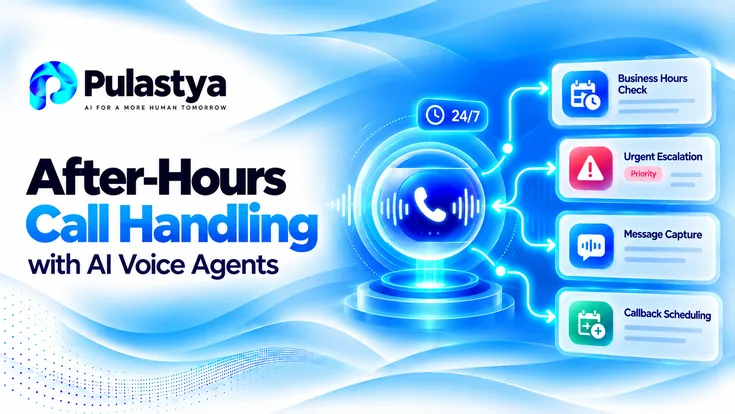
After-hours call handling with AI voice agents reduces operational risk and protects customer experience outside staffed hours. It depends on concrete rules for detecting after-hours conditions, presenting approved content, capturing required information, and routing exceptions.
- Clear detection Use source-aware business hours, location rules, and holiday calendars to determine after-hours status at call start, and re-evaluate on transfer or callback.
- Policy-driven escalation Treat confidence scores as policy inputs: low confidence triggers clarification, mid confidence can reclassify to a case, and critical utterances escalate to on-call or emergency workflows.
- Actionable intake Capture the minimum verified fields needed for downstream workflows, attach recorded audio and metadata, and create callbacks or cases with required SLAs and ownership.
Organizations that depend on phone intake must balance availability, regulatory requirements, and staffing costs. When configured well, AI voice agents cover routine requests, capture validated information, and escalate urgent calls at any hour.
The essentials are detecting after-hours conditions at the call edge, presenting approved answers, and creating durable callbacks and cases so work queues remain actionable when staff return.
Program owners, operations leads, and platform engineers each own part of this work: call flows, routing rules, and policies for confidence, clarification, and escalation. A typical deployment connects a contact center platform, an on-call schedule, CRM or case management, and audit logging for compliance and SLA reporting.
Detecting After-Hours Conditions
After-hours handling starts with a clear time and availability decision. The agent should evaluate the destination's operating calendar, holiday overrides, queue availability, the service type requested, and the caller's location where that matters.
A single "closed" message is rarely enough. A billing question, an outage report, and a request for emergency support may need different next steps. Explicit rules also make the behavior explainable when a caller asks why they were routed, offered a callback, or transferred.
The conversation should state the current situation in plain language, set expectations for the next step, and avoid promising a response time that is not configured.
If a caller is eligible for self-service, the agent can offer the approved option. If the request needs follow-up, it should capture only the details required for a useful case and confirm them back before ending the call.
Detection begins at telephony ingress. Evaluate business hours from the entry point (DNIS), the caller's number and country code, and a centrally managed business-hours schedule. For multi-site operations, combine caller location, service type, and the specific site's published hours.
When the caller is in a different time zone from the site, present a localized greeting and the after-hours options that apply to that site.
Implement a layered ruleset: primary business hours from the corporate calendar, secondary overrides from local site schedules, and tertiary overrides for holiday or emergency closures. Keep these calendars in a single source of truth that the voice routing layer can read.
Calendar changes should propagate within a controlled window so that scheduled maintenance or daylight saving time transitions do not misclassify calls.
Re-evaluate after-hours status when routing decisions change during the call. If a queued call crosses into staffed hours, treat it as in-hours for callback eligibility. If the caller asks to reach a location that is open while the entry point is closed, follow the destination site's rules. Log every detection decision with the rule version for audits and post-incident review.
- Use DNIS to map entry point to product line and its business hours.
- Derive caller location from ANI and confirm if time zone differs.
- Apply a three-level calendar override: corporate, location, and ad hoc emergency.
- Log detection metadata including rule id, timestamp, and evaluated fields.
- Provide a localized after-hours greeting when caller location differs from DNIS.
Detect business hours at call ingress and re-evaluate on routing changes to avoid misclassification.
Approved Answers and Information Capture
Outside normal hours, approved information matters more because no live specialist may be available to correct an uncertain answer. The agent should draw from a controlled knowledge source for opening hours, service instructions, emergency guidance, and callback expectations, and it should not fill gaps with plausible-sounding policy.
When the answer depends on the caller's account or a changing operational status, the safer pattern is to retrieve the live record when allowed, or explain that the next available team will review the item.
Information capture also needs a schema. A maintenance request may require a location, contact method, urgency indicator, and short description; a general inquiry may need far less.
The agent should validate names, numbers, and addresses conversationally, mark uncertain fields, and record the caller's preferred contact window. That makes the record useful to the team that opens it instead of creating another call to clarify basic facts.
Keep an approved-answer repository with versioning, legal sign-off, and metadata for each script line. If a caller asks about billing due dates, for example, the agent reads the sanctioned phrasing, then offers secure channels for sensitive information. Approved answers reduce compliance risk and keep customer messaging consistent.
Design capture around the minimum data needed for downstream action. For a service request, that usually means verified caller name, account identifier, callback number, incident type from a controlled vocabulary, and free-text notes when needed.
Use confirmatory prompts: repeat the captured account ID and ask for explicit confirmation before committing. Store the captured fields with the raw transcription and audio snippet for audit and quality review.
Include consent and privacy prompts when capturing personal data after hours. If a caller will not share certain data by phone, offer a secure callback passcode or an online intake link.
Build field-level validation into the dialog flow so malformed account numbers or dates are rejected and corrected. Record whether identity was verified, and by which method.
- Maintain an approved-answer catalog with version and approver metadata.
- Capture only required fields for the downstream workflow and verify each entry.
- Store raw audio, transcription, and captured fields together for audit.
- Offer secure alternatives if the caller will not share sensitive data on an after-hours call.
- Use structured vocabularies to classify incident types for routing and reporting.
Approved answers and minimum viable capture protect compliance and ensure intake is actionable.
Callbacks, Cases, and Closed Destinations
A callback promise is an operational commitment, so it needs an owner and a destination. When a request qualifies for follow-up, the voice workflow should create or update the correct case, preserve the caller's summary, and route it to the responsible queue for the next business window.
A case identifier or clear acknowledgement reassures the caller without exposing internal workflow details. If a destination is closed, the system should not transfer blindly; it should offer the approved alternative, such as a message, a case, a scheduled callback, or a published self-service route.
Define when a request can be completed during the call, when it becomes a queued task, and when it needs human review before anything is created. These boundaries prevent duplicate cases and incomplete notes downstream.
They also make reporting practical: teams can see which callers received information, which cases were created, which callbacks were completed, and where the experience still breaks down.
Map each boundary to a standard disposition. Routine requests that need staff action become a case with priority, owner team, and required SLA. Callback requests get a window tied to staffing schedules.
Inquiries that cannot be routed, such as requests for unsupported products, get a closed-destination disposition with the logged reason and next steps.
Callback scheduling should reflect real workforce availability. When a caller asks for a morning callback, the agent should check the owning queue's first available slot and offer specific options: a morning window, an afternoon window, or the next business day.
Record the chosen slot, create a callback task in the contact center platform, and attach the captured fields and audio so the person returning the call has context.
Cases created after hours should carry a minimal triage level and a recommended routing target. Tag urgency from keywords or confidence signals so the oncoming shift can prioritize correctly. Do not leave cases in indeterminate states: require the minimum fields before creation, or log an approved exception.
- Map call outcomes to standardized dispositions: callback, case, closed destination, or escalate.
- Confirm callback windows against real agent availability before promising times.
- Attach audio, transcription, and verified fields to callback tasks and cases.
- Tag case urgency using keyword rules and confidence-based policies.
- Prevent case creation without minimum required fields unless an exception is approved.
Make callbacks and cases explicit, schedulable, and attached to recorded context so follow-up work is efficient.
Urgent Exceptions and Configured Failover
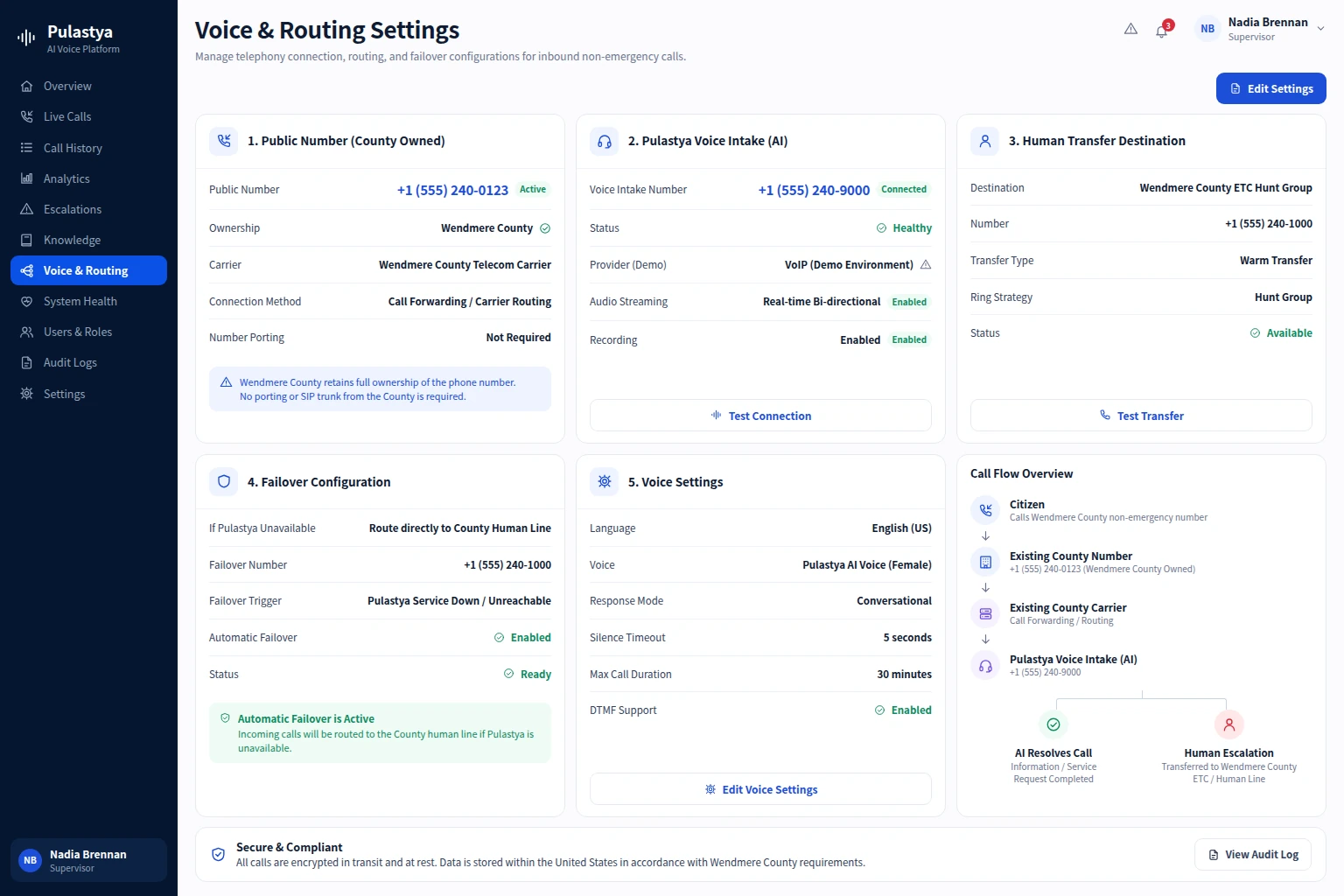
After-hours automation needs a narrow, visible exception path. Define the signals that trigger an urgent response, the language used to confirm the situation, the destination that is actually staffed, and what happens if that destination is unavailable.
The agent can ask a few safety-focused clarifying questions, but it should not keep a caller in a long diagnostic flow when policy calls for immediate escalation. For non-urgent ambiguity, a focused follow-up question or a reviewed callback request is enough.
Failover deserves the same care. A transfer target may be unavailable because of a provider issue, a staffing change, or a maintenance window. The configured behavior should be testable: retry only when appropriate, route to the approved backup, capture a message, or explain the next available option.
Recording the selected route and the reason for it gives supervisors an audit trail and helps them improve coverage without guessing from outcomes alone.
Urgent exceptions bypass normal after-hours routing. Keep a maintained list of trigger phrases and patterns that indicate critical conditions, such as life-safety risks or regulatory incidents.
For these triggers, configure immediate escalation paths: page the on-call engineer, direct the caller to the appropriate emergency number, or open an incident in the incident management system. Document who can add or change trigger definitions, and require change approval.
Plan for platform outages too. If telephony or speech understanding fails, shift to a degraded mode that still gives callers options: a recorded message with a safe escalation path, SMS-based intake, or voicemail that maps into the case system.
Health checks and automated alerts should notify SRE and contact center operations whenever failover occurs so they can remediate quickly.
Balance false positives and false negatives with confidence signals and human confirmation for borderline cases. High trigger confidence escalates automatically; borderline confidence gets a brief clarification or an offer to transfer to the on-call person. Record the confidence value and decision path so policies can be tuned from real incident data.
- Maintain a vetted trigger list for urgent exceptions with change control.
- Provide direct escalation channels: on-call paging, incident creation, or emergency transfer.
- Use degraded intake modes and alternative channels during platform failures.
- Alert SRE and operations automatically when failover or urgent escalation occurs.
- Log confidence metric and decision justification for every urgent escalation.
Configure urgent triggers and failover paths with clear ownership and measurable alerts to avoid missed critical events.
Routing Rules and Business Hours Models
Enterprises need routing models for 24-7 support, follow-the-sun coverage, and regional after-hours service. Define policies that combine caller intent, product line, and geography.
For example, a cloud outage report should route to the on-call incident team regardless of local business hours, while billing questions default to callback or self-service after hours. Implement routing as a policy layer that can be audited and versioned.
Test routing with scenario-driven validation. Construct test calls for edge cases: international callers with mismatched DNIS, transfers that straddle business hours, and holiday overrides.
Use synthetic monitoring to confirm that routing follows the declared policy and that callbacks are scheduled correctly. Run a regression suite after every calendar or routing rule change so urgent calls never end up in voicemail by accident.
Weigh economic tradeoffs when assigning calls to human or automated paths. Low-risk, high-volume requests suit automated paths with approved answers; human escalation is best reserved for high-impact or ambiguous intents.
Set capacity thresholds and overflow rules so that during spikes the system can draw on available staff from adjacent queues or activate pre-arranged overflow agreements.
- Model routing with intent, product, and geography for deterministic behavior.
- Create scenario-based tests for transfers, holidays, and cross-zone calls.
- Version and audit routing policies and calendar changes.
- Set capacity thresholds and overflow rules to manage spikes.
- Use policy-driven routing to prioritize urgent intents over routine after-hours traffic.
Treat routing as a policy artifact with tests, versioning, and capacity controls to ensure predictable after-hours behavior.
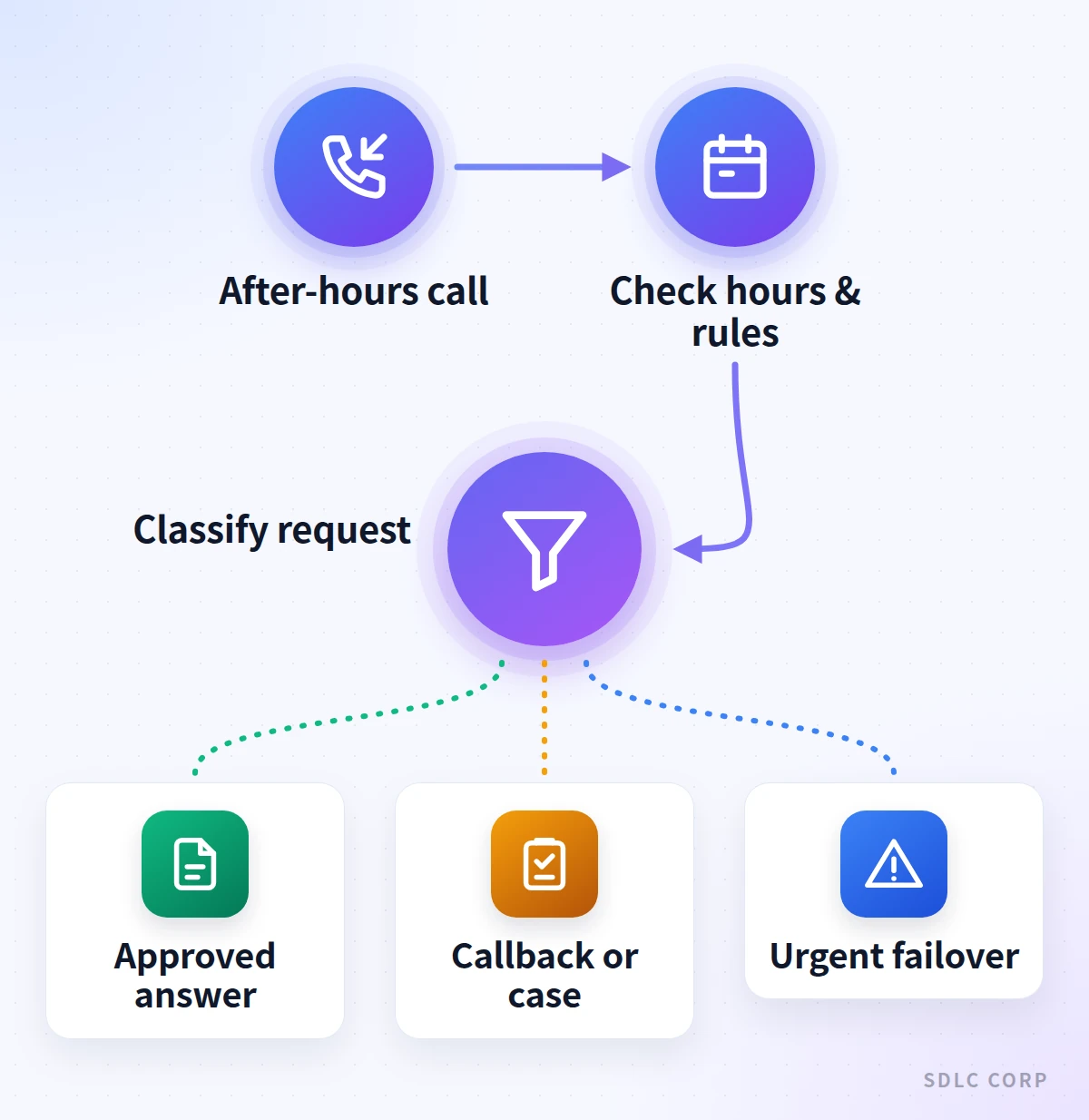
After-hours decision flow
How an After-Hours Call Reaches the Right Next Step
- Business hours checkEntry point, caller location and site hours decide if the line is staffed
- Holiday and closure checkHoliday, local site and emergency closure overrides apply before routing
- Urgency screenTrigger phrases flag safety or critical incidents; urgent calls skip to escalation
- Answer, capture or book a callbackApproved answer, verified minimum fields, then a case or callback tied to staffing
Possible outcomes
- Urgent: escalate to on-callPage on-call staff or open an incident with the captured context
- Routine: case or callback queuedOwner, priority and callback window are ready for the next shift
- Target unavailable: fallbackRoute to the backup human line, take a message or offer the next option
Urgent calls leave the routine path at the screening step, and a closed or unavailable destination still falls back to a staffed line or message.
Voice-Agent Confidence and Clarification Policy
Confidence is an operational signal, not a binary truth. Use bands such as high, medium, and low to set the next step.
High confidence in intent and extracted details can proceed directly to case creation or callback scheduling. Medium confidence should trigger a short prompt that validates the critical fields. Low confidence should go to human review or a secure alternative so downstream work does not start from wrong assumptions.
Keep clarifying prompts brief and deterministic. If the agent captured an incident type with medium confidence, ask a closed question: 'Do you need an emergency repair or general maintenance?' If the caller chooses the emergency option or uses urgent keywords, escalate immediately.
Record confidence values for each field in the case metadata so the people who pick up callbacks understand the evidence behind the classification.
Allow policy-driven reclassification when new evidence emerges. If clarification moves a field from medium to high confidence, update the case urgency and routing. If clarification fails or the caller is unsure, flag the case for same-day human review. Keep thresholds configurable and log every confidence-based decision.
- Categorize confidence into bands and map them to specific actions.
- Use brief, deterministic clarification prompts to raise confidence when needed.
- Attach confidence values to case metadata and callback tasks.
- Provide automatic reclassification rules when clarifying evidence appears.
- Log the clarification transcript and decision history for quality tuning.
Treat confidence as an actionable input: clarify, reclassify, or escalate according to policy and evidence.
Monitoring, Reporting, and SLA Implications
After-hours handling affects SLAs and customer experience metrics. Instrument the full flow: detection accuracy, approved-answer delivery rate, callback fulfillment rate, time to first contact for escalations, and failed intake incidents.
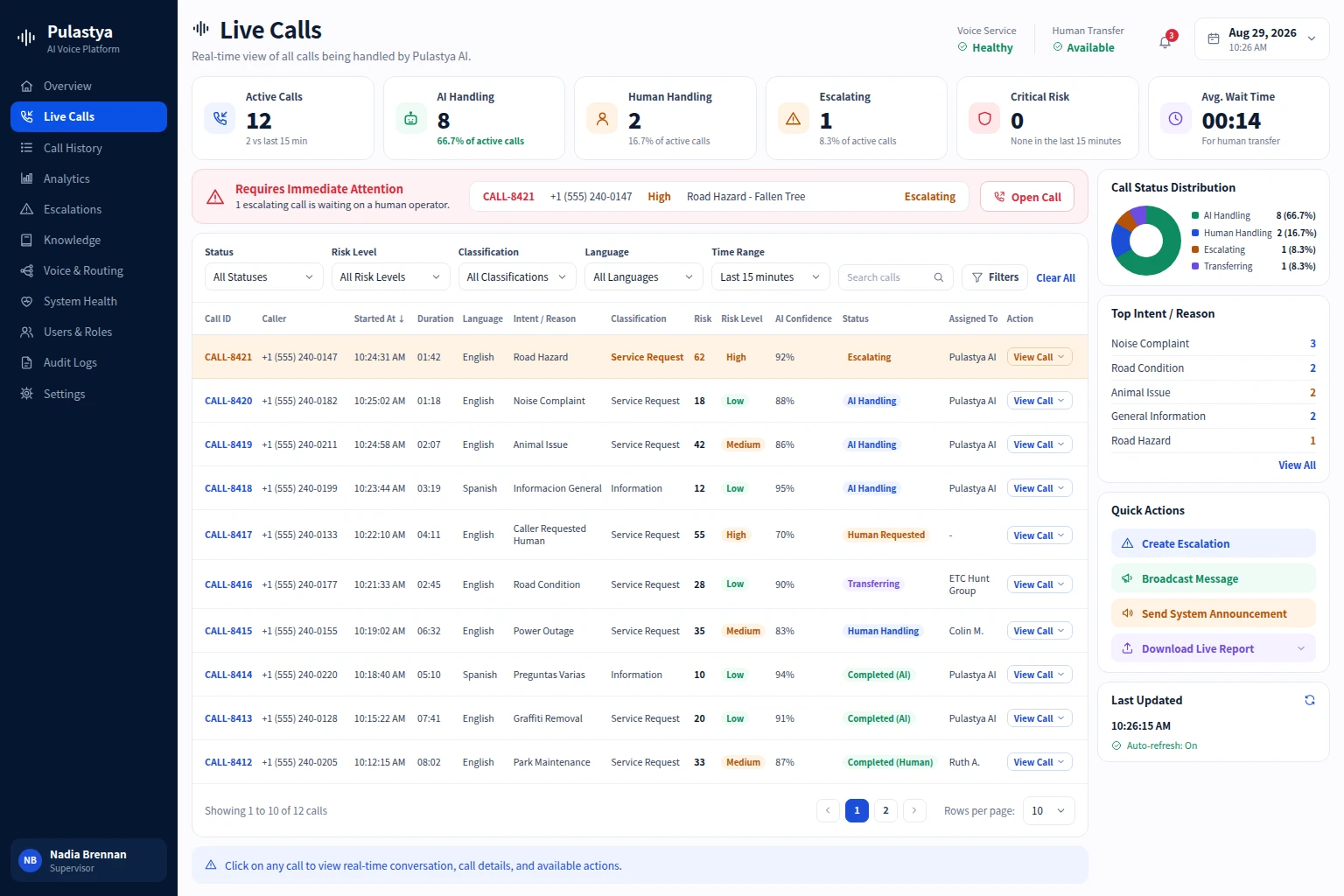
Correlate those metrics with staffing schedules and incident queues so leaders can see which after-hours policies drive rework or missed SLAs. Dashboards should drill down into specific dispositions and audio evidence.
Use those metrics to set runbooks and escalation thresholds. If callback fulfillment slips during the morning surge, for example, reallocate agents temporarily or activate overflow. Anomaly detection on after-hours volume and urgent trigger hits can raise proactive alerts.
Review every missed urgent escalation and update trigger or clarification rules based on the root cause.
Measure compliance and quality by sampling recorded interactions against approved answers and required verification steps. Automate checks where possible: consent prompts presented, minimum fields captured, and critical phrases escalated.
Feed quality findings back into approved-answer content and dialog design so after-hours handling improves over time without sacrificing safety or compliance.
- Instrument detection, callback, escalation, and fulfillment metrics with timestamps and rule ids.
- Correlate performance metrics with staffing schedules and capacity.
- Automate alerts for anomalies in urgent trigger frequency or callback failure.
- Run post-incident reviews for missed escalations and apply corrective actions.
- Automate compliance checks for consent, required fields, and approved-answer delivery.
Monitor and correlate after-hours metrics with staffing and SLA targets to drive corrective actions and continuous improvement.
After-hours rules are one part of a broader front-desk role. The guide to an AI receptionist for business calls shows how the same agent answers routine questions, captures requests and routes callers during staffed hours too.
For the related design choices, see AI call intake and routing, routing calls to the right team, and conversation context in AI voice agents.
Conclusion
Effective after-hours call handling depends on more than answering calls when staff are unavailable. AI voice agents need accurate business-hours detection, approved responses, structured information capture, and reliable callback and escalation rules. By connecting these capabilities with existing customer support workflows, organizations can maintain service continuity while ensuring that routine requests and urgent situations follow the appropriate paths.
For enterprise teams, the priority should be building an after-hours process that is controlled, measurable, and easy to improve. Clear routing policies, verified information, human failover options, and SLA monitoring help reduce missed requests and support timely follow-up. With these safeguards in place, AI voice agents can extend customer service availability while maintaining operational accountability.
Frequently Asked Questions
Re-evaluate business hours at the time of routing decisions. Use the caller's confirmed location and the destination site hours to decide whether to treat the call as in-hours. Log the decision and present localized options such as immediate transfer if the destination is open or scheduled callback windows otherwise.
Require a verified account identifier, caller name, callback number, and a controlled incident type. Prevent case creation if required fields are missing unless an exception is recorded. Attach raw audio and transcription to the case to support later validation and triage.
Map confidence bands to actions: high confidence proceeds to execution, medium prompts clarification, and low routes to human review or a safe alternative. Record confidence values with the case so follow-up staff understand the evidence behind classifications and can reclassify if needed.
Urgent exceptions are trigger phrases or patterns indicating critical conditions like safety risks or regulatory incidents. Maintain a vetted trigger list with change control. Configure immediate escalation paths such as paging on-call staff or creating an incident in the alerting system and require logging of trigger metadata for audits.
Before confirming a callback, check owning queue availability and present explicit windows tied to published staffing. Create a callback task with the chosen slot and attach captured context. If availability changes, notify the caller proactively with rescheduling options and record the communication trail.