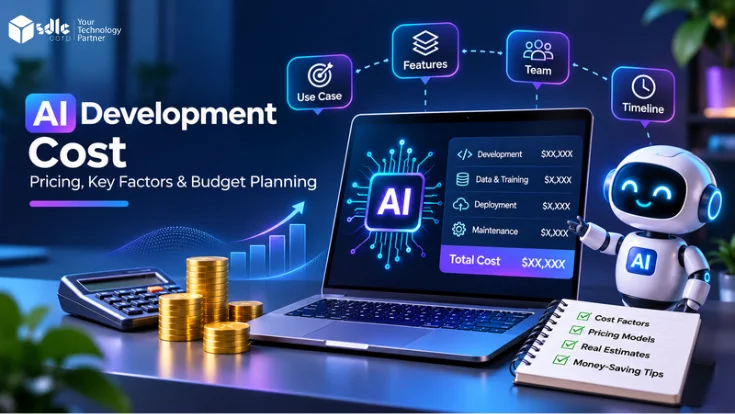
AI development cost covers much more than building the model. Businesses must also budget for data preparation, software engineering, integrations, security, deployment and operations. As a result, the final investment depends on the application's complexity, data, integrations and production needs.
There is no single reliable price for every AI application. For example, a proof of concept, a minimum viable product (MVP) and a production-ready AI system involve different levels of engineering and operational responsibility.
So, before requesting a quotation, businesses should understand what they are paying to build, what it will cost to operate and how they will measure its business value.
Quick answer: SDLC Corp plans AI projects at $25,000 to $50,000 for a proof of concept, $50,000 to $150,000 for a production MVP and $150,000 to $500,000+ for an enterprise platform. Data, integrations and security set the final figure.
Estimate my AI budget →Who this guide is for: CTOs, product leaders, founders and operations heads who are planning an AI project or comparing vendor quotes.
Key Takeaways
- AI development costs depend on project scope, data readiness, integrations and security requirements.
- Proofs of concept, MVPs and production systems require different levels of engineering.
- Budget development, model usage, hosting and maintenance separately.
- AI agents can generate additional expenses through tool calls, retries and multi-step workflows.
- Total cost of ownership (TCO) provides a more realistic financial picture than the initial development quotation.
- A documented scope and phased implementation help businesses manage uncertainty before scaling.
AI Development Cost Estimates at a Glance
For an initial AI development cost reference, here are the planning ranges SDLC Corp publishes for its AI development services:
| AI project category | Indicative development range | Typical timeline |
|---|---|---|
| Proof of concept (POC) | $25,000 to $50,000 | 4 to 8 weeks |
| Production MVP | $50,000 to $150,000 | 8 to 16 weeks |
| Enterprise AI platform | $150,000 to $500,000+ | 4 to 9 months |
These ranges are a starting point, not a fixed quotation. The final estimate depends on the technical scope, data readiness, integrations, security needs and delivery responsibilities.
What the ranges generally cover:
Proof of Concept
Covers a focused feasibility assessment, a working prototype for one AI use case and initial performance evaluation using representative business data.
Production MVP
Delivers a focused AI application with essential workflows, core business integrations, testing and deployment controls.
Enterprise AI Platform
A broader implementation involving multiple system integrations, enterprise security and governance, production monitoring and lifecycle management.
Important exclusions: These ranges do not include model API usage, cloud infrastructure, third-party licenses, retrieval services or ongoing support. Custom foundation-model training, extra integrations, complex data cleanup and added compliance work also need their own scope.
First, use these ranges to identify an initial project category. Then validate the actual requirements through a documented technical assessment. The detailed examples below explain how individual scope decisions influence the final budget.
What Determines AI Development Costs?
Several factors shape AI development cost, so it helps to know them before you compare vendor quotations.
Project Complexity
A single-workflow assistant requires less engineering than an enterprise platform supporting multiple departments.
Data Readiness
Unstructured documents, inconsistent records and inaccessible data sources increase preparation requirements.
Model Selection
Hosted APIs, open-source models, fine-tuning and custom foundation-model training involve different infrastructure and engineering requirements.
Enterprise Integrations
Connecting AI applications with CRM, ERP, databases and third-party platforms requires additional development and testing.
Security and Compliance
Access controls, audit logs, privacy requirements and human approvals influence implementation scope.
Usage Volume
Internal employee applications and customer-facing platforms have different inference and infrastructure requirements.
Industry requirements also affect implementation scope. Healthcare applications may need sensitive-data handling, validation and clinical-system integrations. Financial applications may require decision traceability, audit controls and human review. Manufacturing systems can involve image datasets, inspection equipment and production-system integration.
However, these requirements do not add a fixed industry surcharge. Instead, their cost impact depends on the controls, systems and validation work included in the project.
How Project Scope Changes AI Development Cost
Instead of relying on broad price estimates, compare AI development cost by what each project needs to deliver.
| Project type | Typical implementation scope | Main cost drivers |
|---|---|---|
| Basic AI integration | Existing model API connected to one defined workflow, with an application interface and basic testing | API integration, application development and testing |
| Enterprise RAG assistant | Retrieval-augmented generation (RAG) using document ingestion, embeddings, retrieval, permissions and response evaluation | Data preparation, retrieval quality, access controls and integration |
| AI agent system | Multiple tool integrations, workflow orchestration, state management, approval controls, retries and monitoring | Orchestration, tool execution, exception handling and operational controls |
The delivery stage also changes what must be included in the estimate:
| Delivery stage | What it should demonstrate | Typical scope considerations |
|---|---|---|
| Proof of concept (POC) | Whether the proposed AI approach can solve a defined problem | Limited data, controlled testing, one workflow and minimal integration |
| Minimum viable product (MVP) | Whether intended users can use the solution in a realistic business workflow | Core application features, necessary integrations, user feedback and functional testing |
| Production-ready system | Whether the application can operate reliably under real business conditions | Security, permissions, monitoring, scalability, recovery, documentation and ongoing support |
For this reason, do not price or judge a POC as if it were a production system. Similarly, an MVP may demonstrate business value without including every security, operational and scalability requirement needed for a wider rollout.
Businesses should also distinguish between fine-tuning an existing model and training a foundation model from scratch. Fine-tuning adapts an existing model, while foundation-model training requires a substantially different data, computing and engineering approach. So, estimate them separately.
Need a cost estimate for your AI project?
Share your use case, and our team will help you scope the build, the data work and the running costs.
How to Estimate the Total Cost of an AI Project
In practice, a reliable AI development cost estimate begins with documented requirements, technical assumptions, and a structured engineering work breakdown.
The US Government Accountability Office's Cost Estimating and Assessment Guide provides a general framework for defining technical baselines, assumptions, work breakdown structures, and estimation risks. Although it is not AI-specific, its methodology helps make project estimates more transparent.
Worked Example: Estimating the Cost of an Enterprise RAG Assistant
For instance, consider a hypothetical enterprise RAG assistant that retrieves information from business documents and connects with one existing enterprise system.
Project assumptions:
- One clearly defined business workflow
- One existing enterprise-system integration
- An existing cloud tenant with separate development, testing and production environments
- An available document collection that may need preparation
- Standard application security, access permissions and response evaluation included
- No custom foundation-model training or new hardware
- Model API usage and third-party retrieval charges budgeted separately
The delivery team includes a business analyst or solution architect, data engineer, AI/ML engineer, application developer, QA engineer and cloud specialist. Each member joins at the stage that needs them, not full time across the project.
The following estimate represents total engineering person-hours across the team, not elapsed project duration.
| Development activity | Estimated hours |
|---|---|
| Discovery and architecture | 40 |
| Data preparation | 120 |
| Development and integration | 240 |
| Evaluation and security testing | 80 |
| Deployment and monitoring setup | 40 |
| Total | 520 |
Assume an illustrative blended engineering rate of $100 per hour.
| Cost component | Estimated amount |
|---|---|
| Engineering: 520 × $100 | $52,000 |
| Risk contingency (10%) | $5,200 |
| First-year hosting and infrastructure | $6,000 |
| Annual support and maintenance | $9,000 |
| Illustrative first-year cost | $72,200 |
This $72,200 is a first-year figure for the stated scope. It does not include model API usage, vector database charges, third-party retrieval services or other external tools, unless the infrastructure scope covers them.
How Would the Estimate Change?
Now suppose the project needs another enterprise integration. The additional engineering effort would depend on authentication, data mapping, business rules, sandbox access, failure handling and testing.
Using the same illustrative rate:
For example, if the additional integration required 40 engineering hours, it would add $4,000 in engineering effort before any applicable contingency adjustment. If the extra work falls within the contingency's scope, recalculate the contingency too.
As a result, the estimate follows actual scope changes instead of an unsupported fixed surcharge.
Planning an AI application?
Talk to our team about your use case, data readiness and architecture before you finalize the project scope.
Ongoing AI Development Costs: Inference, Hosting and Maintenance
AI development cost does not end at deployment. Businesses must also budget for model usage, cloud infrastructure, storage, monitoring and ongoing engineering support.
Calculating AI Model Inference Costs
In general, hosted AI models charge by input and output token use.
Consider an application processing 50,000 conversations monthly, with an average of 3,000 input tokens and 500 output tokens per conversation.
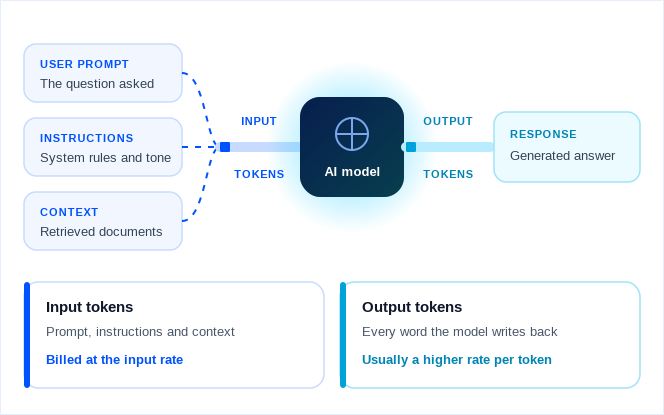
This produces:
- Monthly input consumption: 150 million tokens.
- Monthly output consumption: 25 million tokens.
For example, OpenAI's API pricing lists GPT-6 Luna at $0.10 per million input tokens and $0.50 per million output tokens. GPT-6 Sol, a more capable model, costs $2 and $10.
| Cost item | GPT-6 Luna | GPT-6 Sol |
|---|---|---|
| Input (150M tokens) | $15 | $300 |
| Output (25M tokens) | $12.50 | $250 |
| Monthly cost | $27.50 | $550 |
| Annual cost | $330 | $6,600 |
The same workload costs 20 times more on Sol. So, choose the model by the quality, speed and reliability your workflow needs, not by token price alone.
This example covers token charges only. Production applications also pay for vector databases, retrieval, hosting, storage, monitoring, external tools, data processing and human review.
Why AI Agents Can Cost More
AI agents can cost more to build and run because they often take several steps to finish one business task. For example, an invoice-processing agent may retrieve an invoice, extract its details and compare them with ERP records.
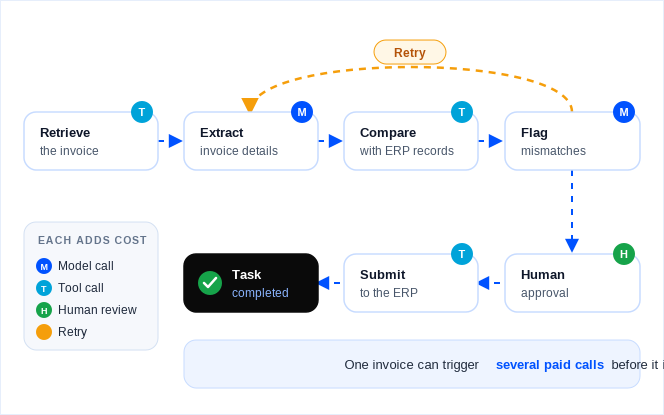
It may then flag mismatches, retry failed steps, request human approval and submit the approved data. Each model call, tool call or failed retry adds to the bill.
Therefore, measure the cost per completed business task, not the price of a single API call. Tracking repeated processing, failed retries and human intervention also shows where agent spending can be cut.
Maintenance and Operational Expenses
After deployment, the AI system still needs regular work. This includes performance monitoring, model evaluation, security updates, infrastructure upkeep, data pipeline fixes, API compatibility checks, regression testing and model upgrades. Teams often run this work through MLOps services.
In addition, post-launch support and incident response keep the system reliable as business needs change. A maintenance agreement should define responsibilities, monitoring frequency, response times and the support activities included.
How to Control AI Development Costs and Evaluate Vendors
Because AI development cost surprises usually come from missed scope, a structured planning process improves predictability.
Define the Business Problem
Identify the workflow, intended users and measurable success criteria.
Assess Data Readiness
Review data quality, accessibility, formats and permissions.
Select the Architecture
Compare existing model APIs, RAG, predictive ML, agents and custom development.
Estimate Engineering Effort
Break down discovery, development, integration, testing and deployment.
Calculate Recurring Expenses
Include inference, hosting, storage, monitoring, external tools and maintenance.
Evaluate Vendor Proposals
Compare deliverables, ownership, exclusions, licensing and support responsibilities.
Validate Before Scaling
Test the solution against a defined business workflow before expanding production usage.
Comparing AI Development Pricing Models
AI development pricing models depend on project scope and long-term needs:
Fixed Price
Best when requirements, deliverables and acceptance criteria are clear.
Time and Materials
Suits projects where requirements or data dependencies may change.
Dedicated Team
Fits ongoing AI product development.
Milestone-Based Payments
Links payments to agreed delivery stages.
Whatever the model, a complete proposal should cover discovery, architecture, data preparation, model development, integrations, testing and deployment. It should also state source-code ownership, licensing, recurring infrastructure costs, maintenance duties and the change-request process.
How SDLC Corp Helps Businesses Plan and Build AI Solutions
Through its AI consulting services, SDLC Corp helps businesses settle requirements, architecture, data readiness and production integration before development begins.
In addition, SDLC Corp's capabilities support different parts of this process. Its RAG development services suit retrieval-based applications that use business documents and knowledge sources. Its Agentic AI development services address multi-step workflows involving tools, orchestration and controlled actions.
For businesses connecting AI applications with existing enterprise systems, AI Integration and Implementation Services are relevant to application integration, workflow implementation, validation and production deployment.
These decisions shape the engineering effort a working solution needs. Reviewing them early shows what belongs in the first release and what should wait for a later phase or a separate operating budget.
Real-World Example: AI Document Processing for Transworld Logistics
SDLC Corp's published Transworld Logistics case study describes an AI document-processing implementation designed to extract and validate invoice and bill-of-lading information.
According to the published case study:
Processing time decreased from 48 hours to 4 hours.
Error rates decreased from 4–5% to 0.1%.
Cost per invoice decreased from $2.50 to $0.45.
In short, these outcomes show how AI document processing can improve efficiency and reduce manual work.
For similar projects, track processing time, error rates, manual review effort and cost per transaction. These metrics build the business case and show which gains to monitor after deployment.
These results come from one engagement, so each new project needs its own cost and operating-expense assessment.
Want similar results for your document workflows?
Contact our team to scope your project.
Calculating AI Development ROI
AI return on investment should account for implementation expenses, operational costs, adoption and measurable financial benefits.
Let's apply this to the RAG assistant from the worked example. Assume it goes live at the start of month 5, uses GPT-6 Sol ($550 a month) and saves staff time worth $8,000 a month at full adoption.
| Period | Costs | Productivity value | ROI |
|---|---|---|---|
| Year 1 | $76,600 | $64,000 | -16% |
| Year 2 | $21,600 | $96,000 | 344% |
| Two-year total | $98,200 | $160,000 | 63% |
Year 1 costs include the $72,200 estimate plus 8 months of model usage. Year 2 covers hosting, support and model usage only. As a result, the project pays back in month 15.
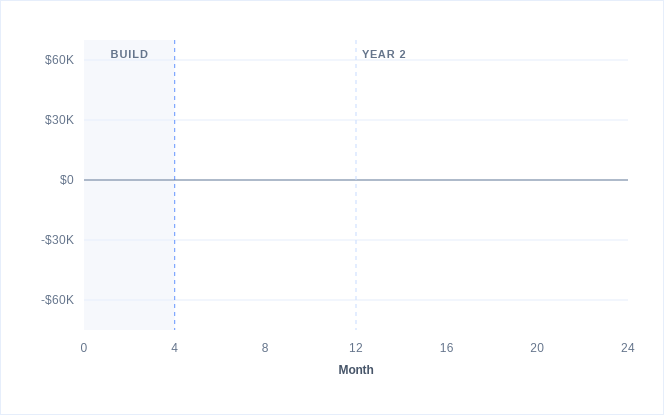
However, real value depends on adoption and human review:
Lower adoption or more review effort delays payback. Also, if the value only frees staff time for other work, report it as productivity value rather than cash savings.
Conclusion: Making AI Development Costs More Predictable
In the end, AI development costs depend on much more than model selection. Data preparation, integrations, security, infrastructure and ongoing operations all influence the final investment.
Before approving a project, evaluate the full build, run and maintain lifecycle. Clear estimates, documented assumptions, defined vendor duties and phased delivery reduce uncertainty on the path from proof of concept to production.
Above all, begin with a clearly defined business problem, select an appropriate architecture and measure whether the application delivers real operational improvements.
Ready to discuss your AI project?
Contact SDLC Corp to discuss your requirements, integrations and implementation approach.
AI Development Cost FAQs
Quotes may differ because vendors make different assumptions about data preparation, integrations, security, testing, architecture, infrastructure and post-launch support. That is why comparing detailed deliverables is more useful than comparing headline prices.
A proof of concept usually takes 4 to 8 weeks, an MVP 8 to 16 weeks and an enterprise AI platform 4 to 9 months. However, data readiness, integration count and security reviews can extend the schedule.
Some proposals exclude model API usage, cloud hosting, third-party licenses, vector storage, ongoing monitoring, security assessments, maintenance and future upgrades. Ask vendors to list these exclusions in writing before you approve a quotation.
A chatbot that connects an existing model to one workflow usually fits the proof-of-concept or MVP stage. However, costs rise with document retrieval, CRM integrations, multiple languages and human handoff. Model usage adds a monthly charge.
Using an existing hosted model can reduce initial development and infrastructure requirements. However, customization, fine-tuning, integrations, data preparation and usage charges still affect the total cost. Custom training makes sense only when existing models cannot meet specific needs.
Identify measurable operational improvements, estimate their financial value and compare them with development and recurring expenses. Also account for adoption, implementation timing, human review and the difference between productivity gains and actual cash savings.