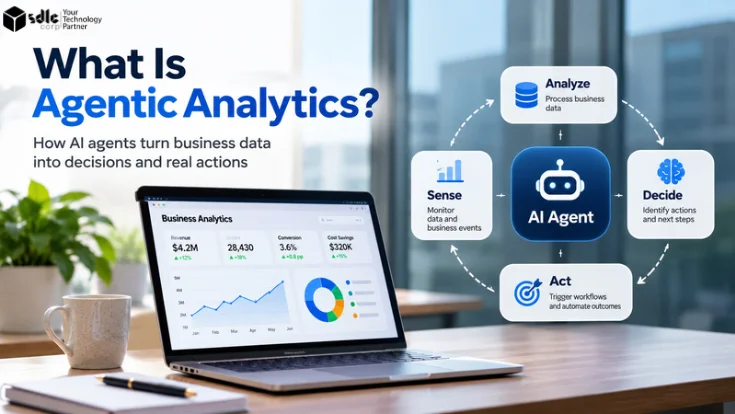
Every business dashboard eventually raises the same question: why did that number move? Agentic analytics answers it by giving AI agents the job of investigating changes in business data and preparing the next step.
Today, most of that work is still manual. When revenue dips or stock runs short, an analyst pulls data from several systems, tests a few theories and writes up the cause, often days after the event.
Autonomous analytics removes most of that delay. The agent handles the digging, while people keep control over what the business actually does with the answer.
Quick answer: Agentic analytics uses AI agents that watch business metrics, investigate why they change and recommend or carry out the next step. People set the goals and approve any action above an agreed risk level.
Key Takeaways
- Agentic analytics turns monitoring and root cause analysis into work an AI agent can run continuously.
- Agents investigate in a loop: detect a signal, plan, query governed data, verify and hand off.
- Four action levels, from explain to execute within limits, decide what an agent may do without approval.
- A semantic layer, inherited permissions and fresh data keep agent answers consistent with finance reports.
- Most failures come from definition drift, faulty queries, stale data, tool misuse and permission creep.
- A pilot on one metric, run in observation mode first, proves value before autonomy grows.
What Is Agentic Analytics?
Agentic analytics is the use of AI agents to monitor business data, investigate why a metric changed and recommend or take the next step, within approval limits the business defines.
Gartner's 2025 Market Guide for Agentic Analytics describes the category in similar terms. It applies AI agents across the data-to-insight workflow, working semiautonomously or autonomously toward stated goals to support, augment or automate insights.
What separates an agent from a smarter dashboard is behavior. An agent works toward a defined goal, plans several analytical steps on its own and finishes with an output a manager can act on, not just a chart.
Consider a 6% overnight drop in online revenue. A dashboard simply shows the dip. An agent, by contrast, checks traffic, conversion and payment logs, traces the drop to a failing payment gateway in one region and alerts its owner.
The analyst's role changes accordingly. Instead of rebuilding the same investigation every week, analysts define the metrics, review the agent's reasoning and step in when a case falls outside the agreed rules.
Under the hood, analytics agents rely on the same building blocks as any AI agent: goals, memory, planning and tool use. Agentic AI Fundamentals explains how those parts fit together.
Agentic Analytics vs Traditional BI, Augmented Analytics and Alerts
Agentic analytics vs traditional BI comes down to two questions: who starts the analysis, and where it stops. Most companies already run several of these approaches at once, so the differences matter in practice.
| Factor | Traditional BI | Augmented Analytics | Rule-Based Alerts | Agentic Analytics |
|---|---|---|---|---|
| Trigger | An analyst or business user | A user, with AI suggestions | A preset threshold | A goal, a data signal or a question |
| Output | Dashboards and reports | Highlighted insights and charts | A notification | A diagnosis, evidence and a next step |
| Reasoning | Done by people | Single step | None | Multi-step, with self-checks |
| Ability to act | None | None | Fixed, predefined actions | Graded actions within approval limits |
| Human role | Builds and reads reports | Reviews suggestions | Responds to alerts | Sets goals and approves actions |
The sharpest line in agentic analytics vs augmented analytics is depth. An augmented tool flags an unusual spike in product returns. An agent goes on to test the likely causes, rank them by evidence and propose a response.
That said, rule-based alerts still have a place. When both the cause and the fix never change, such as reordering a fixed item at a set level, a simple alert costs less and fails less.
In most stacks, agentic BI sits on top of existing tools rather than replacing them. Agents reuse the warehouse, the BI layer, current anomaly detection signals and the metric definitions finance already trusts.
How AI Agents for Data Analysis Work
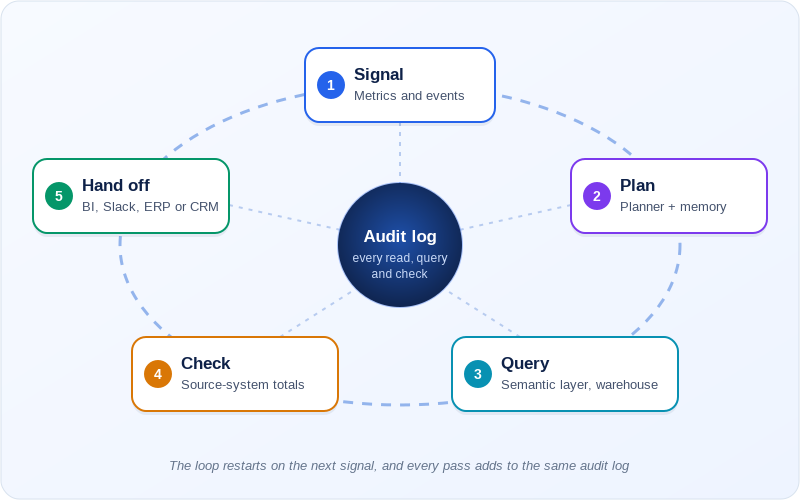
AI agents for data analysis work in a loop rather than through a single query. Each pass moves from a raw signal to a finding a manager can trust, and production systems usually follow five steps.
Detect a signal
The agent monitors agreed metrics and events, such as a forecast miss or a sudden fall in orders. A manager can also start the loop by asking a question through natural language queries.
Plan the investigation
The agent breaks the goal into testable steps. For a margin decline, it might examine pricing, discount use, product mix and supplier costs, starting with the most likely cause.
Query governed data
Next, it writes and runs queries against approved sources only. Because it uses shared metric definitions, its figures match finance reports instead of creating a second version of the truth.
Verify the result
Before reporting, the agent reconciles totals with source systems, checks data freshness and flags low confidence. That discipline keeps root cause analysis from resting on a single faulty query.
Explain and hand off
Finally, it writes a short explanation backed by evidence. Depending on its permissions, it then recommends an action, drafts one for review or completes a low-risk task itself.
Throughout the loop, the agent keeps a record of the data it read, the queries it ran and the checks it passed. Reviewers rely on that trail once agents start acting on what they find.
Larger deployments often split the loop across several agents. A monitoring agent spots the signal, a query agent investigates, and a reviewing agent checks the work before anything reaches a person, which makes errors far easier to catch.
Which Actions AI Agents Can Take on Business Data
Investigating data carries little risk; changing it carries a lot. Consequently, the most important design decision is how much an agent may do on its own and who signs off on everything else.
Most teams settle on four action levels. Each level grants more autonomy, so each one also needs a firmer human-in-the-loop approval rule:
- Explain: The agent reports what changed and why. No approval is required, because no system changes.
- Recommend: The agent proposes a step, such as shifting budget between campaigns, and a person decides.
- Draft: The agent prepares the change, such as a revised forecast or a supplier ticket, for review before release.
- Execute within limits: The agent acts alone, but only below agreed thresholds, and every action stays logged and reversible.
Level four usually involves write-back, where the agent updates an ERP, CRM or ticketing system directly. Safe write-back depends on scoped APIs, narrow permissions and review steps, as set out in How to Integrate AI into Existing Enterprise Systems.
For that reason, AI agents for business intelligence should start at level one or two. Autonomy can then rise one level at a time, once accuracy and override rates prove the agent deserves it.
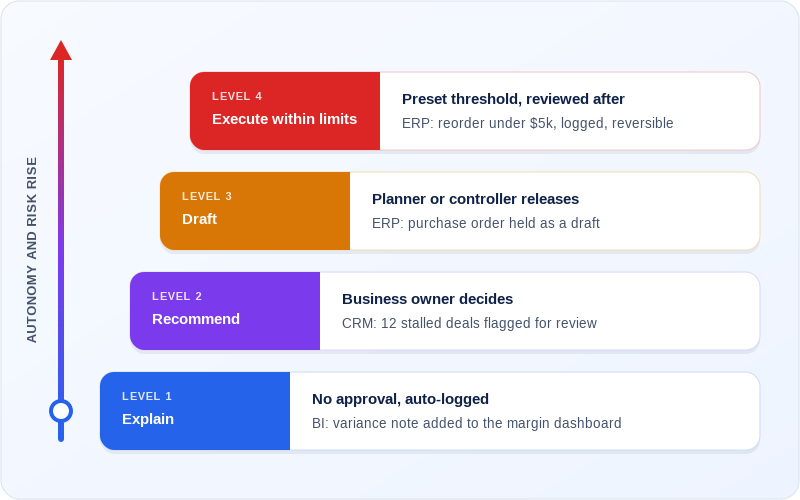
A documented ladder also gives auditors and business owners a shared reference. Anyone can see which actions an agent takes alone, which wait for sign-off and where each decision is recorded.
The Semantic Layer AI Agents Need
An agent is only as reliable as the definitions it reads. If "active customer" means one thing in sales and another in finance, the agent will produce confident answers that contradict your own reports.
A semantic layer for AI agents solves this by holding agreed metric definitions, table joins and business rules in one governed place. Every agent query then follows the same logic as your dashboards and month-end close.
Access rights matter just as much. The agent should inherit the permissions of the person or role it serves, so a regional manager's agent never reads another region's payroll data, however the question is phrased.
Freshness completes the picture. Each source needs a known refresh schedule, so the agent can recognize stale figures and say so, rather than explaining today's problem with last week's numbers.
Most of this groundwork belongs in the data platform, not in the agent. How to Build an AI-Ready Data Foundation sets out the quality, ownership and access steps involved.
Agentic Analytics Use Cases by Business Function
The best agentic analytics use cases share a pattern: the signal recurs often, the cause varies each time, and someone currently spends hours tracking it down. Four business functions fit that pattern especially well.
Finance and Accounting
How is agentic analytics used in finance? In finance, agentic analytics uses AI agents to monitor ledgers and budgets, explain each variance and prepare month-end commentary for review. Exceptions reach the right controller early instead of surfacing during the close.
Month-end variance reviews consume days of finance time. An agent can trace each variance to cost centers, vendors and journal entries, draft the commentary and route exceptions, such as duplicate payments, to a controller.
The controller still approves every adjustment, so accountability stays where auditors expect it. Reconciliation and close workflows follow the same pattern, with worked examples in Agentic AI in Finance.
Sales and Revenue
How is agentic analytics used in sales? In sales, an agentic analytics system watches pipeline and win-rate data, finds where deals are slipping and recommends where the team should focus. Leaders get the breakdown the same day rather than waiting on a manual report.
When pipeline value falls, sales leaders usually wait on an analyst for the breakdown. An agent can split the decline by region, stage and rep, then show whether deals slipped, shrank or went to competitors.
It then recommends a response, such as reviewing stalled deals above a set value. The sales leader makes the call, and the agent tracks whether win rates recover over the following weeks.
Supply Chain and Operations
How is agentic analytics used in supply chain operations? In supply chain operations, an agentic analytics system tracks demand, inventory and supplier signals to spot stockout risk before it happens. It links each risk to a likely cause, such as a late supplier or a demand spike.
Stockouts rarely have a single cause. An agent can combine demand forecasts, open purchase orders and supplier lead times, applying anomaly detection to order patterns to flag at-risk items before shelves run empty.
It can also draft a purchase order or escalate a supplier delay to the planner. Because purchase orders commit spend, the planner still reviews and releases each one before it reaches the supplier.
Customer and Product Teams
How is agentic analytics used by customer and product teams? For customer and product teams, an agentic analytics system tracks funnels and churn signals to show where users drop off and which accounts are at risk. It turns a vague metric drop into a specific step, release or account to act on.
Product teams often see a funnel drop without knowing which step broke. An agent can compare sessions, devices and release versions to locate where users abandon, then tie the drop to a specific change.
Likewise, it can watch churn signals such as declining logins or rising support tickets. At-risk accounts then reach the customer success team with evidence attached, not just a bare risk score.
Agentic Analytics Governance: Where Agents Fail and How to Control Them
Agents fail in predictable ways, and recognizing the patterns early turns agentic analytics governance into a design task rather than post-incident cleanup. Six failure modes appear most often:
- Definition drift: The agent uses a metric that differs from the official one, so a plausible answer conflicts with finance.
- Faulty queries: A wrong join or filter silently drops valid rows and skews the result.
- Stale data: The agent explains a problem with figures that have not refreshed.
- Tool misuse: A poisoned document or prompt manipulates the agent into using a legitimate tool unsafely.
- Permission creep: Over time, the agent accumulates access it no longer needs.
- Runaway cost: Always-on monitoring runs thousands of queries that nobody reads.
Tool misuse deserves particular attention because it is specific to agents. The OWASP Top 10 for Agentic Applications ranks tool misuse and identity and privilege abuse among the leading risks for systems that plan and act.
Four controls address most of these risks: least-privilege access for every agent, human-in-the-loop approval thresholds at each action level, a complete audit trail of reads and writes, and regular testing against a fixed question set.
Access design starts by separating what users, agents and service accounts may each do. Role-Based Access Control for AI Governance Platforms describes how to define those roles and permissions.
Finally, anchor these controls in a recognized framework. The NIST AI Risk Management Framework organizes AI risk work into four functions, govern, map, measure and manage, which risk and audit teams already use.
How to Run an Agentic Analytics Pilot
A well-run pilot proves value on one narrow problem before access widens. Most teams can complete one within a quarter by following five steps in order:
Choose one metric and one decision
Pick something like weekly gross margin and whether to adjust a discount. A narrow scope keeps the evaluation honest.
Build a test set
Collect 25 to 50 real questions your analysts answered recently, together with the verified answers.
Run in observation mode first
The agent investigates and explains but takes no action, while analysts compare its findings with their own.
Measure the results
Track answer accuracy, time to root cause, false alert rate and how often reviewers override a recommendation.
Raise autonomy one level at a time
Move from explain to recommend only after the numbers hold for several weeks.
Keep the pilot team small: a business owner, a data engineer and an analyst who knows the metric well. Together, they can judge whether the agent's answers are correct, not merely plausible.
How SDLC Corp Helps Teams Build Agentic Analytics
SDLC Corp's agentic AI development services take analytics agents from a scoped use case to governed production, covering agent design, data access, evaluation and rollout.
Most analytics agents depend on clean, well-owned pipelines. Data Engineering Services build the governed data layer agents query, including metric definitions, lineage and access controls.
When an agent needs to act, AI Integration and Implementation Services connect it to ERP, CRM and BI tools with scoped APIs, approval steps and production monitoring.
Reviewing these pieces early shows which actions belong in the first release and which should wait until the agent has earned more autonomy.
Real-World Example: AI Workflow Automation for QuantusTechnik
SDLC Corp's published QuantusTechnik case study shows the same pattern in manufacturing. QuantusTechnik serves precision manufacturing businesses across India, and its teams had rich machine and sales data yet still reviewed signals by hand.
SDLC Corp added AI that reviews machine usage, cycles, output and efficiency changes, then prepares KPI notes, exceptions and suggested actions for managers. People kept every final decision.
According to the published case study
Weekly → Daily
Machine signal review moved from weekly to daily checks.
4h → 45 min
Manager report preparation time dropped.
60% → 95%
Lead follow-up visibility improved.
For a similar project, track review frequency, report preparation time and how often managers act on the agent's suggestions. QuantusTechnik AI Workflow Automation covers the full stack and rollout.
These results come from one engagement, so each new deployment needs its own baseline, measured before the agent goes live, to show a real gain.
Conclusion: Putting Agentic Analytics to Work
Agentic analytics turns analytics from something people read into something that acts. The value comes from faster answers to recurring questions, not from replacing the people who own the decisions.
Start with one metric, a governed semantic layer and a clear action ladder. After that, let measured accuracy, rather than enthusiasm, decide how much autonomy each agent earns.
Agentic Analytics FAQs
No. Agentic analytics changes where analysts spend their time rather than replacing them. Agents absorb repetitive checks and first-pass investigations, while analysts define metrics, validate findings, handle edge cases and decide which questions matter.
It needs governed data: agreed metric definitions, clear access rights and known refresh schedules. In practice, that means a warehouse or lakehouse, a semantic layer for AI agents, and connections to the relevant BI and business systems.
Not quite. An AI agent is the general technology, software that plans steps and uses tools toward a goal. Agentic analytics applies that technology to one job: investigating business data and turning findings into decisions.
Usually, yes. Most agentic BI deployments sit on top of the existing warehouse and BI tools and reuse their metric definitions. The real work lies in connecting the agent to governed data and setting approval rules.
A focused pilot on one metric typically fits within a quarter. Data readiness drives the timeline: where definitions and access rights already exist, testing starts quickly; otherwise, the data work comes first.
Cost depends on the number of data sources, the systems the agent connects to, the highest action level allowed, the depth of testing and hosting. A read-only pilot on one governed source costs far less than one with write-back.
A well-designed agent makes its mistakes visible and reversible. Confidence checks flag weak findings, reviewers catch errors at the recommend and draft levels, and the audit trail records every action. Each confirmed mistake then becomes a new test question.
The two overlap but answer different needs. Decision intelligence models and governs how decisions get made, while agentic analytics supplies the agents that investigate data and act. In practice, AI decision intelligence solutions often combine both.