Introduction
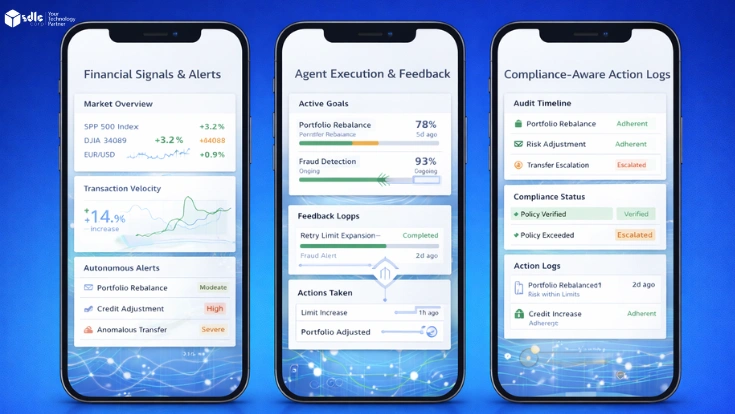
Agentic AI for Finance enables financial systems to observe data, make decisions, and act with limited human input. Traditional automation relies on fixed rules, which often fail in volatile markets. Agentic systems introduce autonomy, reasoning, and context-aware execution, allowing financial workflows to respond continuously within defined constraints. As transaction volumes increase and regulatory pressure grows, organizations need AI that goes beyond analysis and supports responsible action across operations. Many organizations begin this journey by exploring enterprise AI development services for modern financial systems.
Understanding Agentic AI in Financial Contexts
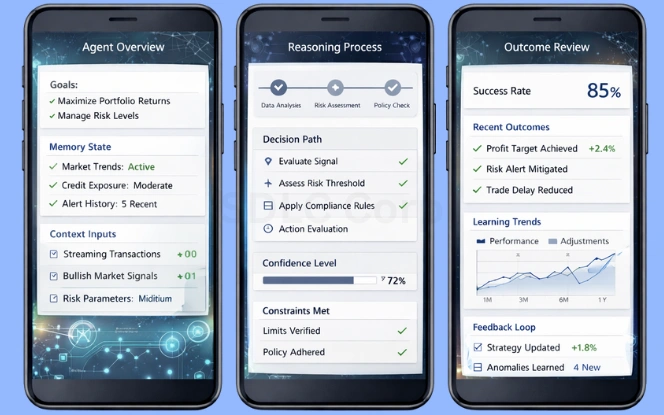
Agentic AI differs from conventional AI because it operates with goals, memory, and controlled autonomy. Instead of stopping at recommendations, it executes actions within defined constraints.
Core characteristics include:
- Continuous observation of financial data
- Context-aware reasoning based on outcomes
- Policy-bound autonomous execution
In practice, Agentic AI in Financial Services supports ongoing evaluation of transactions, portfolios, and market signals. These systems adapt their behavior over time, allowing finance teams to shift from manual intervention to strategic oversight.
This architecture closely reflects how intelligent AI agents are designed for regulated financial workflows.
Why Finance Requires Agentic Systems
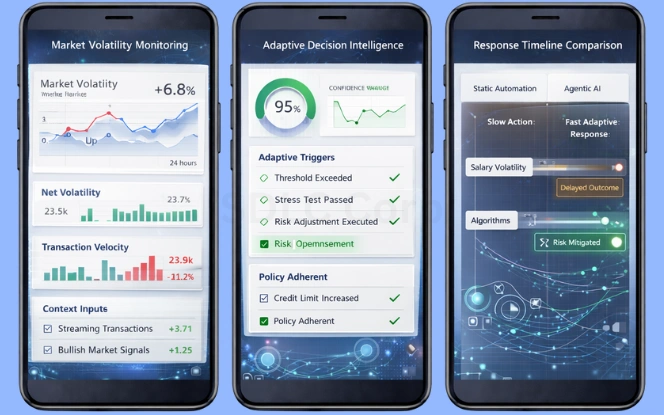
Finance operates under constant uncertainty. Market volatility, evolving risks, and regulatory pressure challenge static automation models. Traditional systems follow predefined paths and struggle to adjust.
Agentic systems address these gaps by:
- Learning from prior outcomes
- Reassessing decisions in real time
- Acting without waiting for manual triggers
With Agentic AI for Financial Decision Making, financial operations respond faster to change while maintaining accuracy and governance. This capability is essential during high-risk or time-sensitive scenarios.
Many financial institutions apply this approach while strengthening decision intelligence frameworks within finance operations.
Finance Workflows Where Agents Are Actually Useful

Agentic AI changes how financial decisions move from insight to execution: agents act inside approved boundaries rather than routing every step through several layers of review. They earn their place where the work is repetitive, evidence-heavy and spread across systems, which is usually part of a wider automation-led financial process optimization effort. Six workflows come up repeatedly.
Reconciliation agents
Matching bank statements, ledger entries, payment processor reports and intercompany balances, explaining breaks in plain language and proposing the journal that clears them. The agent assembles evidence and drafts; posting stays behind an approval threshold and a named approver.
Collections and receivables
Prioritising overdue accounts by likelihood of payment and relationship value, drafting the next contact in the right tone, logging promises to pay and escalating disputes to a human. Contact frequency and wording need rules, because collections communication is regulated in most markets.
Treasury and cash operations
Cash position assembly across banks and entities, short-term forecasting, sweep and funding suggestions, and covenant or limit monitoring. Execution of any transfer stays with treasury staff inside existing payment controls.
Research and analysis agents
Gathering filings, market data and internal reports, summarising with citations, and drafting the first version of a briefing. Investment recommendations and client-facing advice carry regulatory obligations and stay with licensed staff.
Document and review agents
Contract, invoice and KYC document review: extraction, comparison against policy, exception flagging and file assembly for the reviewer. This is the highest volume and lowest risk entry point for most finance teams.
Compliance workflow agents
Alert triage in transaction monitoring, evidence gathering for cases, regulatory change tracking and draft control documentation. The filing decision and the record remain with the compliance function.
Risk Management with Agentic Intelligence

Risk management benefits significantly from agentic systems because risk conditions change continuously. Periodic assessments often miss emerging threats.
Using Agentic AI for Risk Management, organizations gain:
- Continuous exposure monitoring
- Real-time anomaly detection
- Automated low-risk resolution
- Context-rich escalation for high-impact risks
This balance reduces noise for risk teams while ensuring serious issues receive timely attention with full operational context.
Application Across Banking and Investment Operations
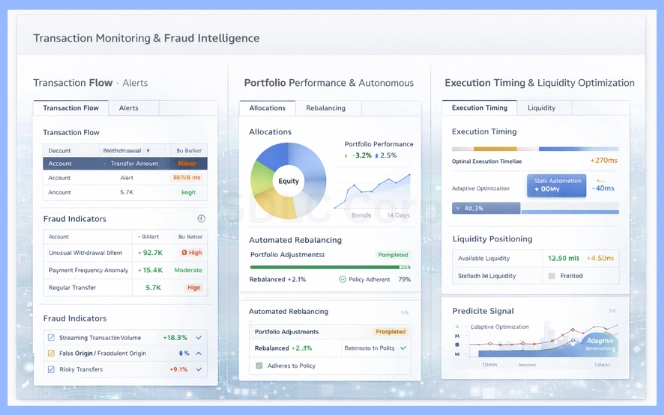
Agentic systems adapt well to both retail and institutional finance. In banking, they manage transaction flows, detect fraud, and adjust credit controls. In investments, they monitor assets and optimize execution timing.
Within Agentic AI in Banking and Investment Operations, agents:
- Coordinate across multiple systems
- Align execution with strategic intent
- Reduce delays between insight and action
This coordination improves efficiency while maintaining consistency across financial operations.
Controls: Permissions, Thresholds and Audit

Finance agents act on systems that move or record money, so control design is the project rather than an add-on.
- Tool permissions. Read access to ledgers, statements and documents is routine. Write access to the ledger, payment files or customer records is separate, scoped per workflow and never held as a standing credential.
- Approval thresholds. Define the value, risk and exception conditions above which a human must approve, and make them configurable without a code change.
- Segregation of duties. An agent preparing an entry cannot be the mechanism that approves it. Map agent steps onto the existing control matrix before go-live.
- Escalation. Ambiguous matches, disputed balances, sanctions hits, suspected fraud and anything customer-affecting route to a named role.
- Audit trail. Inputs, retrieved evidence, reasoning steps, tool calls, proposed output, approver and final state, retained under the same retention policy as the underlying records.
- Limits. Step counts, spend, runtime and blast radius per run, with a documented way to stop a run and reverse its effects.
- Model change control. A model or prompt change is a change to a financial process: version it, test it against a known case set and record the approval.
Designed this way, autonomy increases trust rather than eroding it, because every action is bounded, logged and attributable to a named approver.
Integration and Implementation Reality

The work is mostly integration. ERP and core banking systems, treasury management platforms, payment processors, document stores and data warehouses each have their own access model, and few of them were designed for an autonomous caller.
- Start read-only. Run the agent in proposal mode against live data, compare its output with what the team decides, and measure agreement before granting any write access.
- Use the orchestration layer for permissions. The model proposes; the orchestrator validates arguments, checks entitlements and executes.
- Plan for partial failure. Multi-system updates need compensating actions, because a half-completed reconciliation is worse than none.
- Evaluate on outcomes. Match rate, exception rate, time to close, rework rate and approval overturn rate say more than model accuracy.
- Data residency and retention. Financial records carry jurisdiction-specific rules; confirm where inference runs and what the provider retains.
Most teams reach production faster by narrowing to one workflow, proving the control model there, then reusing the orchestration and audit layer for the next. That build, connecting finance systems to a governed agent with permissions and evidence, is where agentic AI development effort goes, with AI governance setting the control framework around it.
The Strategic Impact on Financial Roles
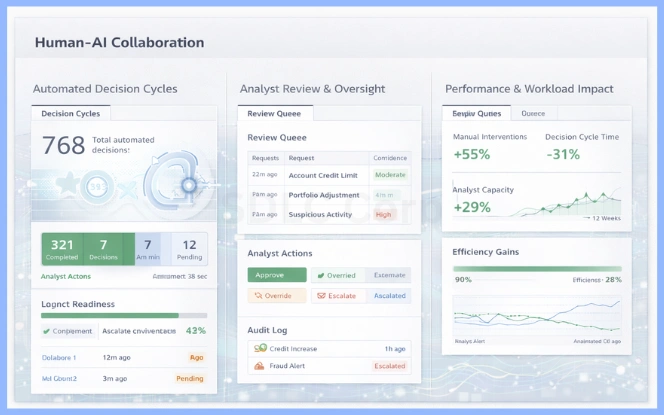
Agentic AI does not replace financial expertise. Instead, it reshapes how expertise is applied. Analysts move toward oversight, interpretation, and policy design.
Operational benefits include:
- Reduced manual decision cycles
- Improved consistency across workflows
- Greater focus on judgment-driven tasks
This shift allows finance professionals to operate at a higher strategic level.
Conclusion
Agentic AI for Finance represents a practical evolution in financial intelligence. By combining autonomy, reasoning, and accountability, agentic systems support faster decisions, adaptive risk management, and controlled execution. These capabilities help financial teams maintain governance while improving responsiveness. As finance grows more complex, organizations adopting agentic approaches gain resilience and operational clarity. Contact us SDLC Corp to explore how agentic systems can be applied responsibly within your financial environment.
FAQs
What Is Agentic AI for Finance?
Agentic AI for Finance refers to autonomous AI systems that observe financial data, make decisions, and take action within defined rules while adapting based on outcomes.
How Does Agentic AI Work in Financial Services?
Agentic AI in Financial Services uses intelligent agents to monitor transactions, risks, and market signals in real time while operating under governance constraints.
Why Is Agentic AI Important for Financial Decision Making?
Agentic AI for Financial Decision Making improves speed and accuracy by enabling systems to evaluate situations and act without manual delays.
Can Autonomous AI Agents Be Used Safely in Finance?
Autonomous AI Agents for Finance include audit trails, escalation thresholds, and policy controls to ensure transparency and regulatory compliance.
How Does Agentic AI Improve Risk Management?
Agentic AI for Risk Management continuously assesses exposure, resolves low-risk issues automatically, and escalates critical risks with full context.
Is Agentic AI Applicable to Banking and Investment Operations?
Agentic AI in Banking and Investment Operations supports fraud detection, portfolio monitoring, liquidity management, and execution optimization.
How Is Agentic AI Different From Traditional Financial Automation?
Traditional automation follows fixed rules, while Agentic AI adapts its behavior based on outcomes and changing conditions.