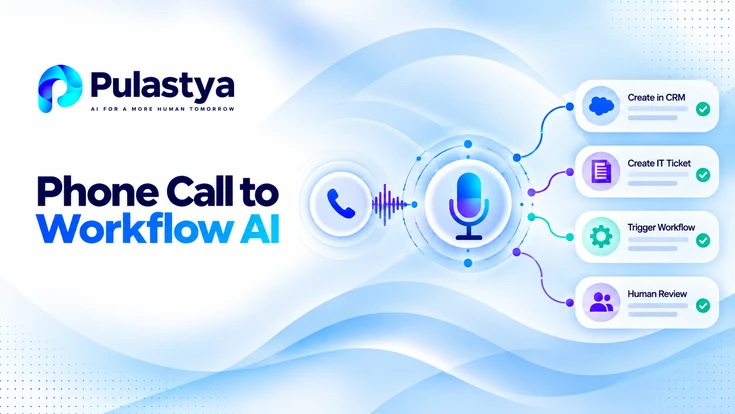
Phone calls remain a critical intake channel for complex enterprise workflows. AI voice agents can convert conversational audio into actionable tasks, routing and enriching workflows across CRM, ticketing, and case-management systems without human transcription bottlenecks.
- Capture Convert spoken input into validated structured fields using ASR, intent models, confidence thresholds, and short verification prompts.
- Map Translate intents and slots into workflow triggers and payloads that align with CRM, ticketing, and RPA systems using a declarative mapping layer.
- Orchestrate Implement deterministic handoffs, retries, and audit trails so downstream systems receive consistent, auditable inputs and humans can step in when needed.
Enterprises face three common constraints when bridging phone calls to downstream workflows: loss of structured data, slow handoffs, and compliance gaps. Modern speech-to-intent pipelines combine real-time ASR, intent classification, slot filling, and business-rule mapping to preserve context and create immediately routable artifacts that align with existing workflow engines.
Designing an effective phone-call-to-workflow solution requires decisions about latency, privacy, error handling, and integration pattern. Success depends on capturing reliable call data, mapping intents to enterprise workflows, orchestrating handoffs, and measuring operational impact, with each tradeoff tested against real intake flows.
Capture Structured Call Data With Real-Time ASR and Intent Extraction
Start by choosing an ASR engine that supports domain adaptation and low-latency streaming for the languages and accents typical of your contact base. For enterprise intake, favor models that allow on-the-fly custom vocabulary and entity lists so product names, policy codes, or ticket types are recognized reliably. Plan for streaming-inference latency and validate it with production-like traffic.
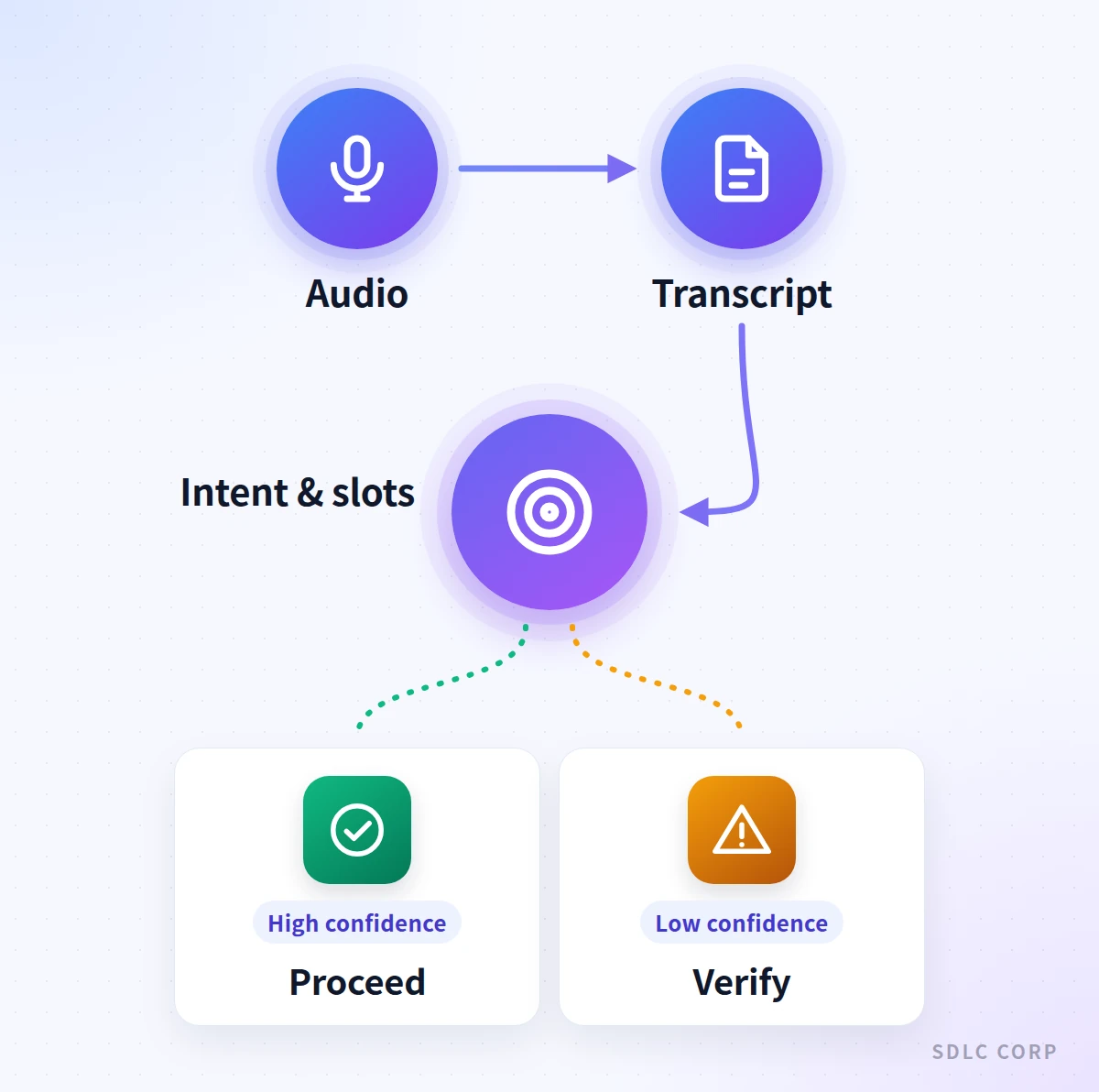
Layer intent classification and slot filling on top of raw transcripts to turn free-form responses into discrete fields. Use a hybrid approach: a statistical intent model for broad intent routing and rule-based slot validators for critical fields such as account numbers, dates, or regulatory selections. Maintain confidence scores and record alternatives for downstream validation.
Implement brief verification prompts only for low-confidence fields to avoid call friction. For example, on a 0.6 confidence account number, ask a single confirmation: 'Did I get your account number as 123456?' Log every confirmation and the resulting structured value to create an auditable path from audio to workflow input.
- Customize ASR vocabulary with enterprise-specific terms and sensitive identifiers to reduce substitution errors.
- Produce word-level timestamps to enable selective replays and targeted redaction during audits.
- Emit confidence scores for intents and slots and set thresholds that trigger verification or human escalation.
- Store raw audio and transcript hashes for compliance, ensuring retention policies match regulatory needs.
- Use session IDs to correlate call audio with other system events and later analytics.
Treat ASR and intent layers as separate components that communicate via a simple event schema.
Map Intents and Slots to Workflow Triggers
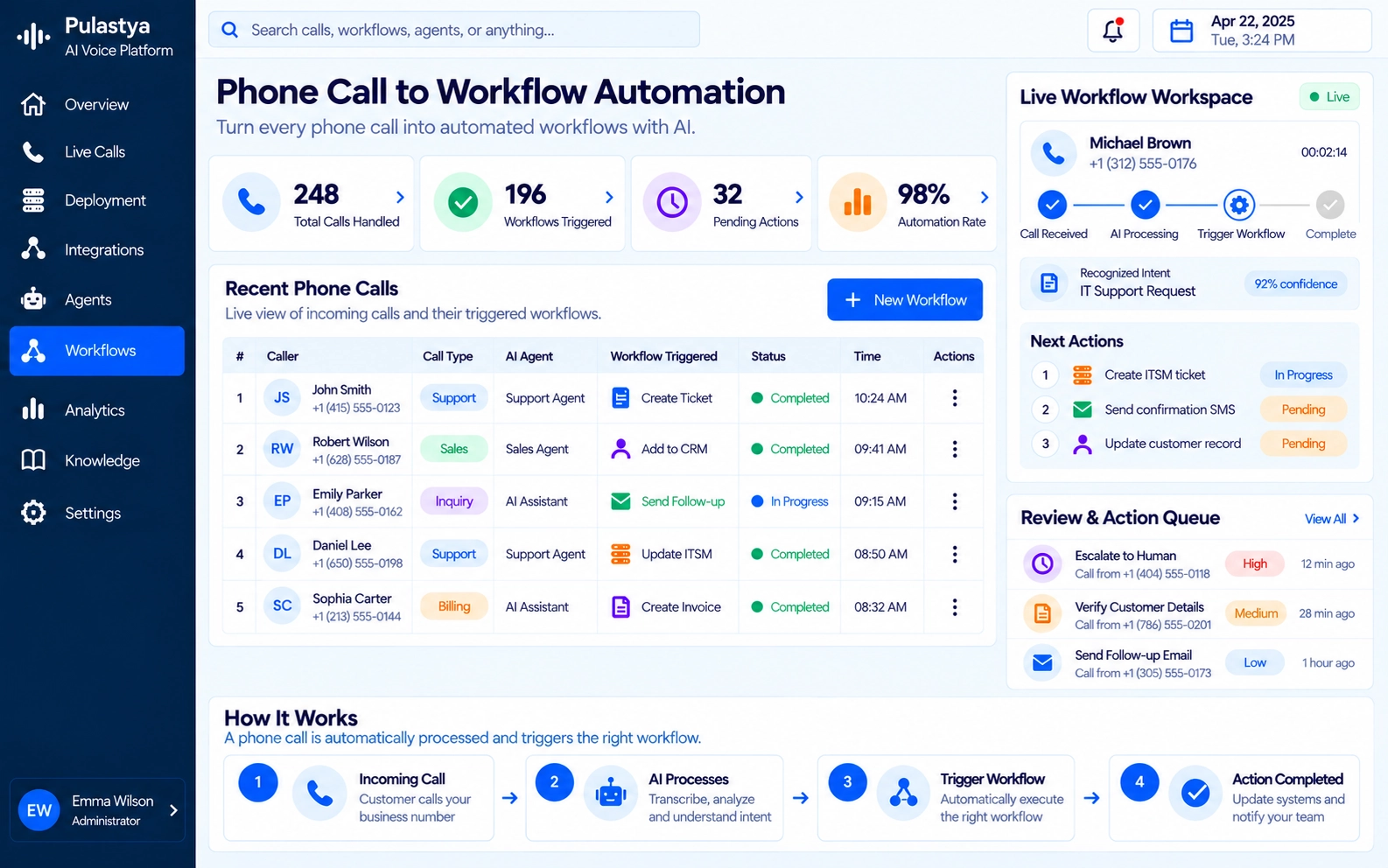
Translate extracted intents and validated slots into explicit workflow triggers using a declarative mapping layer. Map rules should express intent-to-workflow mapping, required fields, optional enrichments, and preconditions like account status or authorization level. Keep mapping rules external to model code so business teams can update routing without redeploying intent models.
Design payload schemas that downstream systems expect: normalize fields, convert formats like dates and currency, and include provenance metadata such as transcript excerpts and confidence vectors. When mapping to multiple systems, produce a canonical envelope that contains per-system payload adapters to avoid duplicative parsing logic.
Support multi-intent calls where a single call spawns multiple workflows. For example, a customer may report both a billing dispute and an account update. Create transactional boundaries and idempotency tokens for each spawned workflow so retries or duplicate events do not create inconsistent downstream records.
Close the loop with the caller before the call ends. When the downstream system returns an object ID, read back a short confirmation such as the case or ticket number; if creation is queued for retry or human review, say so instead of implying the work is already done.
- Define mapping artifacts in JSON/YAML with version tags and changelogs for auditability.
- Implement schema validators that reject mappings missing required fields before they enter runtime.
- Use adaptors to transform the canonical envelope into CRM tickets, case objects, or RPA tasks.
- Include provenance fields: audio URI, transcript snippet, and model confidence to support audit and dispute resolution.
- Support conditional mappings tied to business rules, such as account balance thresholds or SLA tiers.
Keep mapping logic declarative and versioned so business and compliance teams can review routing behavior.
Call to workflow
How a Spoken Request Becomes a Validated Workflow Trigger
- Caller describes the requestStreaming ASR with custom vocabulary produces a transcript and confidence
- Extract intents and slotsIntent model routes the call; slot validators check IDs, dates and codes
- Validate before actingConfirm only low-confidence fields; check required fields and preconditions
- Trigger the mapped workflowDeclarative mapping builds the payload with an idempotency token per workflow
- Confirm to the caller and logRead back the case or ticket number, or say the request is queued for review
Possible outcomes
- Human reviewLow confidence, missing fields or a failed integration go to a triage queue
Validation sits between extraction and the trigger, so only confirmed, complete payloads create downstream records.
Integrate Voice Agents With CRM, Ticketing, and RPA Systems
Choose integration patterns based on downstream system capabilities: push-based REST webhooks for cloud-native systems, queue-based adapters for high throughput, and connector-driven synchronization for legacy on-prem platforms. Always include idempotency keys and backoff strategies to handle transient failures without duplicate records.
When integrating with CRMs, convert voice-derived payloads into existing objects and link to the correct customer record using deterministic match logic. Where deterministic matching fails, create a triage ticket with enriched context and a suggested match list, enabling a human agent to resolve within a single workflow interface.
For RPA and automated remediation, supply RPA bots with structured data and explicit next steps. Ensure RPA adapters validate inputs against live system state and request human approval for sensitive actions. Maintain an audit trail that ties RPA actions back to the originating call and intent payload.
- Prefer event bus patterns for high-volume environments to decouple ingestion from downstream processing.
- Add enrichment steps for external lookups (account status, fraud signals) before creating CRM objects.
- Use connector templates for common systems like Salesforce, ServiceNow, and Zendesk to accelerate integration.
- Implement a triage queue with UI links to call replay and transcript to speed human review.
- Log API call latency and failure rates to detect integration bottlenecks early.
Design integrations to be resumable and auditable, not just fast.
Orchestrate Handoffs, Retries, and Human-In-The-Loop Escalation
Build a lightweight orchestration layer that tracks event state, retries, and escalation paths. The orchestrator should own idempotency, ensure transactional boundaries for multi-workflow calls, and manage timers for SLA-driven escalations. Keep orchestration logic auditable and instrumented for downstream debugging.
Define clear escalation criteria: low confidence, missing required fields, failed integrations, or regulatory checks. When escalation occurs, present a compact agent-facing summary containing the call transcript excerpt, confidence scores, suggested fields, and a prioritized list of corrective actions to minimize handling time.
Handle partial failures by compensating actions rather than blocking the entire call pipeline. If a noncritical enrichment lookup fails, proceed with a minimal ticket and schedule a retry task. For critical failures like account mismatches, pause and escalate to a human queue immediately with contextual data and an option to request caller callback.
- Use state machines with durable checkpoints to maintain consistency across restarts.
- Implement exponential backoff and jitter for retries to avoid thundering herds on downstream systems.
- Expose operator controls to pause, replay, or reprocess specific call events for investigations.
- Create SLAs for each orchestration stage and monitor elapsed time to auto-escalate.
- Store decision logs so compliance teams can reconstruct why a particular handoff occurred.
Orchestration should prioritize deterministic outcomes and clear audit trails over speculative automation.
Example: Insurance Claim Intake Converted Into Three Workflows
Imagine a caller reports a minor auto accident. The voice agent captures the policy number, incident date, vehicle details, and a short description. Intent detection identifies three intents: first notice of loss, roadside assistance, and premium update. The declarative mapping layer spawns three distinct workflows with separate idempotency tokens and priority levels.
The first workflow creates a claim in the claims management system with validated fields and attached transcript excerpt. The second triggers an RPA-driven vendor order for towing where necessary, using an enriched location field. The third opens a CRM task to update policyholder contact preferences and potential premium adjustments, queued for human review if authorization is required.
Escalation rules kick in when the policy number confidence is low or the caller requests immediate payouts. The orchestrator pauses the claim creation, routes a short verification task to a human agent with a single-click approve or reject, and resumes automated actions only after human confirmation. This preserves throughput while maintaining controls for sensitive actions.
- Spawn separate workflows for discrete business outcomes to maintain clear SLAs and retry semantics.
- Attach transcript excerpts and confidence metadata to each spawned workflow for rapid case handling.
- Use location enrichment and vendor lookup to automate roadside assistance without human lookup.
- Keep sensitive financial actions gated behind human approval with one-click validation in the agent UI.
- Record the entire decision chain to support downstream audits and claim disputes.
Model complex calls as multiple smaller workflows to simplify retries, SLAs, and ownership.
Measure Success: Metrics, Quality Assurance, and Compliance Controls
Track end-to-end KPIs that matter to operations: call-to-workflow latency, first-pass automation rate, downstream processing errors, mean time to resolution, and human handling time per escalated case. Measure model-level metrics separately: ASR word error rate on enterprise terms, intent accuracy, and slot extraction F1 for critical fields.
Embed QA loops where random call samples are reviewed against structured outputs. Use adjudication to correct training data and tune confidence thresholds. Create dashboards that surface failure modes like repeated misrecognition of a phrase or a mapping rule that frequently drops required fields so engineering and business teams can prioritize fixes.
Layer compliance controls for regulated data: implement automatic redaction, PII minimization, retention policies, and role-based access to transcripts and audio. Maintain an immutable audit trail that links the audio, transcript, model outputs, mapping version, and downstream object IDs for internal and external audits.
- Report automation rate as the percentage of workflows that required no human intervention.
- Monitor model drift using production vs. training distribution checks and trigger re-training events.
- Define SLOs for latency and success rates and map breaches to incident response playbooks.
- Run periodic red-team tests with edge-case vocabularies and adversarial utterances to spot weaknesses.
- Automate PII redaction and retention enforcement to support GDPR, HIPAA, or industry requirements.
Operational metrics and QA must drive model updates and mapping rule changes, not the other way around.
Implementation Roadmap, Tradeoffs, and When to Engage Enterprise AI Development
Start with a pilot focusing on the highest-value call type that has clear structure and downstream systems. Build a minimal pipeline: streaming ASR, single-intent extraction, simple mapping to one downstream system, and human escalation for low confidence. Measure end-to-end impact on throughput and error rate before expanding scope.
Plan tradeoffs: high automation with permissive confidence thresholds increases false positives and compliance risk; conservative thresholds drive more human escalations and lower ROI.
Latency targets influence architecture choices: strict in-call latency budgets push inference closer to the call path, such as regional or edge deployment, while post-call batch processing tolerates remote cloud-hosted models and reduces engineering overhead.
Engage an enterprise AI development partner when the roadmap needs several custom adapters, complex mapping logic, or regulated-data controls that internal teams cannot staff, and keep ownership of mapping rules and audit data in-house.
- Phase 1 pilot: one call type, one downstream system, verification for low-confidence fields.
- Phase 2 expansion: multi-intent handling, dual-system mapping, orchestration with durable checkpoints.
- Phase 3 scale: high-availability deployment, multi-region inference, advanced QA and automated retraining.
- Tradeoff checklist: latency vs accuracy, automation rate vs auditability, cloud cost vs on-prem compliance.
- Budget for ongoing data labeling, change management, and integration maintenance rather than one-off build costs.
Phased delivery with clear SLOs reduces risk and reveals realistic automation potential.
For the systems around this workflow, compare CRM, ERP, and ITSM integration patterns, real-time API access, and service-request automation.
Conclusion
Turning phone calls into dependable enterprise workflows requires more than accurate transcription. A reliable AI voice agent combines streaming ASR, intent and slot extraction, targeted confirmation of uncertain details, and versioned mapping rules. Validated requests can then create or update CRM records, service tickets, and RPA tasks, while idempotency keys, durable orchestration, and clear caller confirmations keep each action consistent and traceable.
Begin with a narrowly defined call type and one downstream integration, then measure call-to-workflow latency, first-pass automation, processing errors, and escalation rates. Expand to multi-intent calls only after the pilot meets its accuracy and service targets. Keep sensitive data protected through redaction, access controls, and retention policies, and require human approval when confidence is low or decisions carry financial or regulatory risk. This phased approach builds automation that is practical to operate, audit, and improve.
Frequently Asked Questions
Target ASR accuracy that yields reliable slot extraction for critical fields rather than a generic word-error metric. For enterprise intake, aim for high precision on entities like account IDs and policy numbers, and use confidence thresholds and single-step verification prompts for lower-confidence extractions.
Use idempotency tokens tied to call session IDs and canonical payload hashes. The orchestrator should check for existing workflow records before creating new objects and implement deduplication logic at the adapter layer to avoid duplicate tickets across systems.
Apply automatic PII redaction and minimize transcript retention. Only store unredacted audio and transcripts behind strict access controls and for the minimum required retention period. Include provenance metadata instead of raw sensitive fields where possible.
Require human review for low-confidence critical fields, financial authorizations, or regulatory decisions. Use automated processing for high-confidence, high-volume actions where the risk of incorrect automation is low and compensating controls exist.
Measure ROI by combining reduced manual processing time, faster time-to-resolution, and fewer downstream errors. Track cost per handled case before and after automation, volume of human escalations avoided, and any improvements in customer SLA adherence to calculate net operational savings.