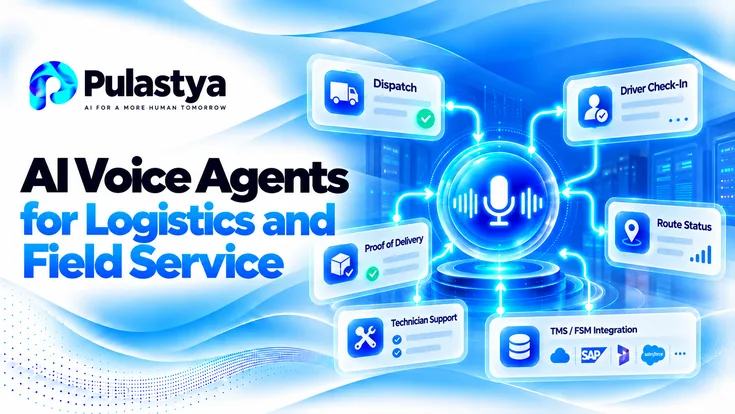
AI voice agents support logistics and field service operations by automating common call and dispatch tasks, reducing wait time, and enabling hands-free interactions for mobile workers.
Designed for real-world noise, intermittent connectivity, and enterprise integration, they cut friction across dispatch, proof of delivery, technician support, and exception handling while preserving auditability and escalation paths.
- Operational focus Design voice agents around high-frequency operational transactions such as check-ins, ETAs, job status updates, and proofs of service to maximize ROI.
- Robust integration Tie voice events directly into TMS, FSM, and ERP systems through durable APIs and event streams to avoid manual reconciliation.
- Noise and connectivity Prioritize noise-robust ASR, on-device fallback, and retry logic to maintain uptime for field workers in challenging environments.
Large-scale logistics and field service operations run on precise, time-sensitive communication between drivers, technicians, dispatch, and customer service. AI voice agents convert spoken interactions into structured events, automate updates to transport management and workforce systems, and provide conversational troubleshooting.
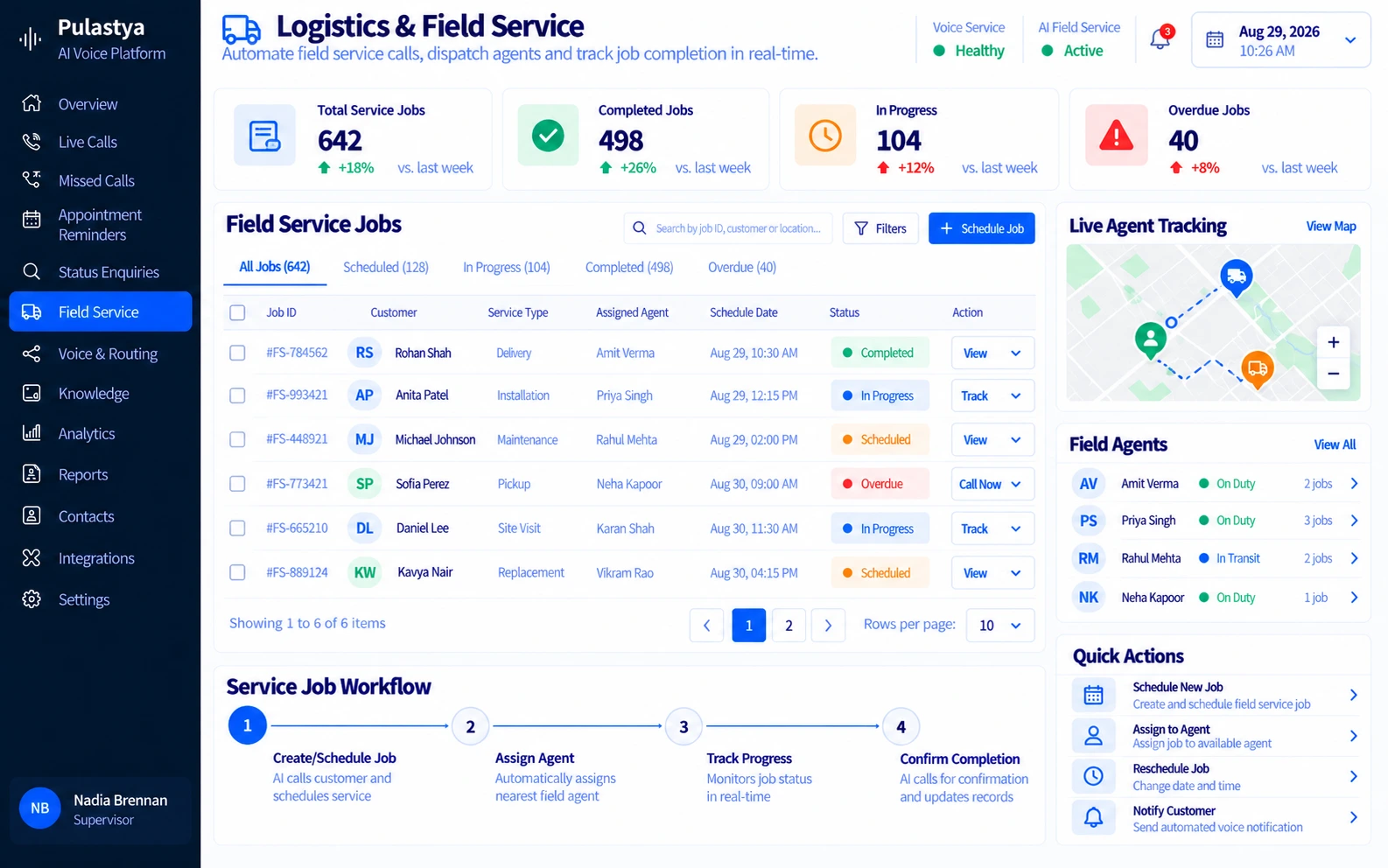
They must be engineered for quality speech recognition in noisy cabs and job sites, low-latency responses for safety-critical workflows, and secure identity verification for compliance and billing.
Results depend on operational design, well-structured call flows, integration patterns, and deployment choices specific to logistics and field service.
A practical driver check-in and proof-of-delivery call flow, an integration architecture that links voice with TMS and FSM platforms, and measurable success criteria form the core of a sound program. Enterprise-scale rollouts also demand pragmatic tradeoffs, monitoring, and governance.
How AI Voice Agents Reduce Field Downtime and Errors
AI voice agents eliminate repetitive tasks that interrupt technicians and drivers, such as manual status reporting and multi-step forms. By allowing spoken updates that convert to coded events in workforce management systems, voice agents reduce data entry latency and the window for miscommunication.
That reduces idle time between jobs, minimizes missed appointments, and shortens investigation cycles when exceptions occur.
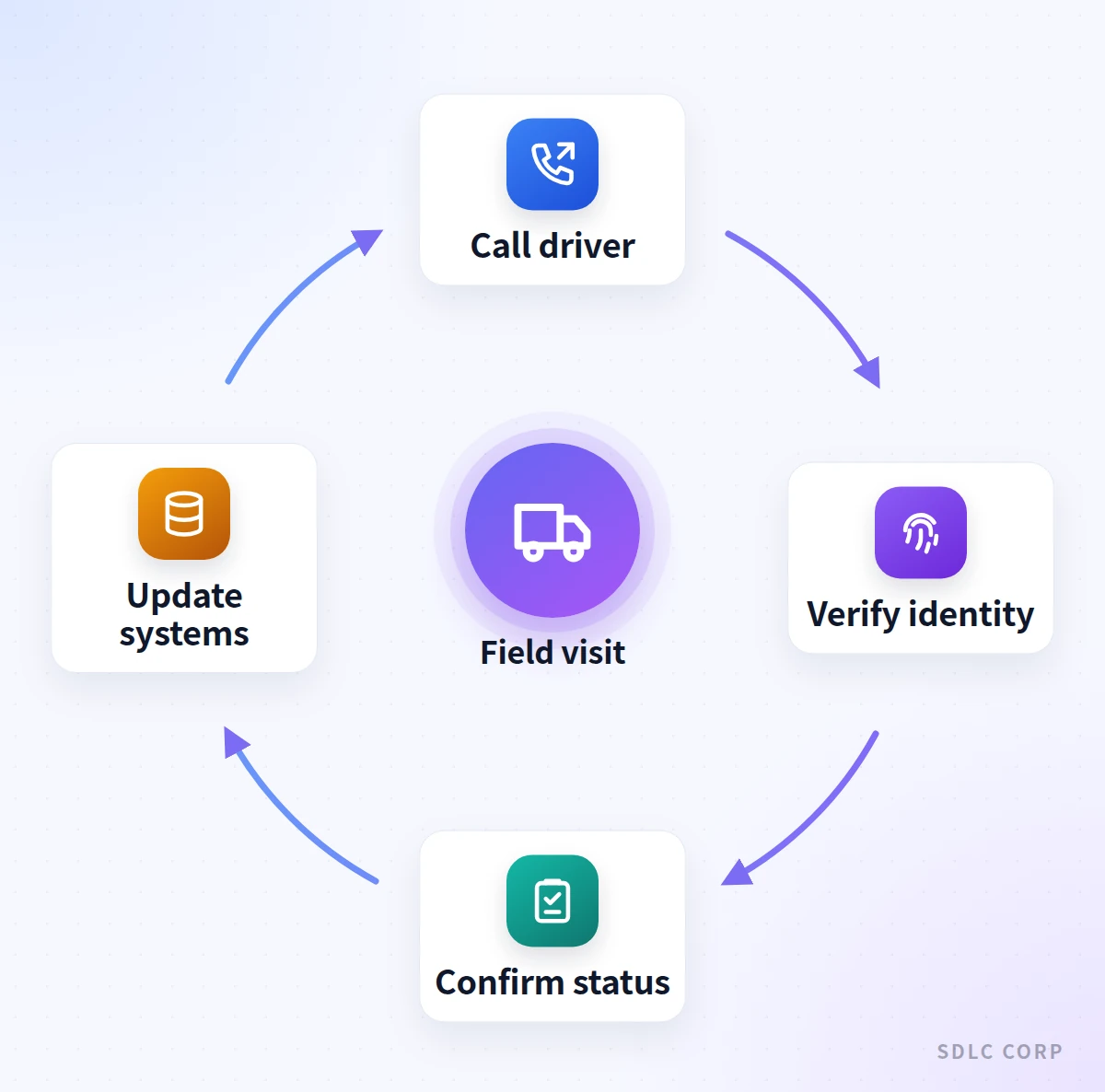
In practice, a voice check-in replaces a five-step mobile form: authenticate, confirm vehicle or asset, state status, attach optional notes, and submit. The agent confirms each step using concise prompts, performs lightweight validation, and writes a normalized record to the FSM.
That record feeds scheduling engines that can dynamically reassign tasks based on real-time availability and proximity, improving resource utilization.
Expect tradeoffs: voice lowers task friction but requires robust intent design to prevent misrouted updates and false confirmations. Institute confirmation prompts for state transitions with safety impact, and log both raw audio and structured events for auditing. Prioritize high-frequency transactional use cases first to generate measurable time savings before expanding into complex dialog tasks.
- Replace manual status updates with spoken transactions that map to discrete FSM/TMS events.
- Use confirmations on safety-critical state changes to avoid erroneous closures.
- Log aligned audio and structured output for audits and dispute resolution.
- Start with high-volume actions like check-ins and proofs of delivery to surface ROI quickly.
- Measure reductions in status-update latency and reconciliation tickets to quantify impact.
Prioritize transactional voice tasks that remove repetitive friction and feed scheduling systems in real time.
What a Production Driver Call Flow Looks Like
A production call flow focuses on short, deterministic turns that minimize cognitive load for drivers. Example: an outbound agent calls a driver approaching a delivery window, verifies the driver with a PIN and the registered phone number, confirms readiness, records which proof was captured in the driver app (photo, signature, or exception code), and logs an ETA update.
Each step should have a fallback: DTMF input, text confirmation, or transfer to a human if recognition fails repeatedly.
Design prompts to be terse and action-oriented. Use a two-turn confirmation for irreversible actions: initial capture and immediate readback of the interpreted value.
For example, after capturing a delivery exception code, the agent should say the code and associated reason, ask for confirmation, and then write the event. Implement silence detection and adaptive reprompts when network latency causes delayed responses.
Operational constraints matter: keep voice interactions under one minute for routine tasks to avoid call costs and driver distraction. For complex troubleshooting, support a transfer to a live dispatcher with context payloads that include transcript, intent, and recent system state. Store call metadata with timestamps and location tags to enable post-hoc analysis and SLA enforcement.
- Authenticate quickly with PIN, device ID, or single-factor voice biometrics when allowed.
- Capture key data with short prompts and immediate readbacks to confirm accuracy.
- Provide DTMF and text fallback paths for noisy environments or connectivity loss.
- Transfer to human agents with a context bundle when confidence is low or escalation needed.
- Attach GPS and timestamp metadata for every status update for traceability.
Keep turns short, confirm irreversible actions, and always provide reliable fallback paths for drivers.
Field call decision guide
How the Voice Agent Handles Each Field Transaction Safely
| Field transaction | Voice handling | Commit rule and fallback |
|---|---|---|
| Driver check-in | Verify PIN, confirm vehicle, state status, write a normalized FSM record | Read back each value; DTMF entry if recognition fails repeatedly |
| ETA update | Capture the new ETA and publish an event with timestamp and GPS | Low risk: auto-commit at a lower confidence threshold |
| Delivery exception | Capture the exception code, then read back the code and its reason | Two-turn confirmation before the event is written |
| Job complete | Map one intent to TMS status, FSM resolution and ERP billing trigger | High confidence or human confirmation; idempotency keys on retries |
| Complex troubleshooting | Collect the problem and recent system state in short turns | Transfer to a live dispatcher with transcript, intent and state |
The riskier the state change, the stricter the commit rule: ETAs can auto-commit, while closures and billing triggers need high confidence or a person.
Integrating Voice Agents With TMS, FSM, and Inventory Systems
Integration should be event-driven, not just REST polling, so voice events produce immediate state changes across transport and field systems. Use a broker or event bus to publish normalized events from the voice layer into the enterprise integration fabric.
Ensure each event contains standardized fields: actor id, event type, timestamp, geolocation, confidence score, and a reference to the audio or transcript.
Implement a canonical data model that translates between the voice agent's output and consumer systems. For example, map a voice 'job complete' intent into a TMS shipment status, an FSM workorder resolution, and an ERP billing trigger. Provide idempotency keys and versioned APIs to handle duplicate or out-of-order voice events during intermittent connectivity.
Operational reliability requires observability and reconciliation. Set up dashboards showing event delivery latency, downstream acknowledgment rates, and confidence thresholds. Automate reconciliation jobs that flag mismatches between voice-derived events and system-of-record status so operators can rapidly resolve exceptions without manual entry.
- Publish voice events to an enterprise event bus for immediate downstream processing.
- Adopt a canonical event schema with confidence, location, and audio references.
- Use idempotency and versioning to handle retries and out-of-order events.
- Map voice intents to actionable TMS/FSM/ERP updates through translation layers.
- Build reconciliation jobs to surface mismatches and prevent billing or inventory errors.
Treat voice outputs as first-class events and ensure reliable delivery and reconciliation across systems.
When TMS, FSM and ERP connectors need more integration capacity than operations IT can supply, an enterprise AI development partner can build them against the canonical event schema.
Designing for Noisy, Low-Connectivity Field Environments
Field environments introduce background noise, overlapping speech, and sporadic connectivity that degrade off-the-shelf ASR. Invest in noise-robust acoustic models, and prefer devices with multi-microphone noise suppression such as beamforming.
For vehicle or handheld deployments, consider an accessory microphone or headsets for critical workflows. Train language models with domain-specific phrases, route numbers, and common exception codes to reduce misrecognition.
Plan for on-device fallback and staggered synchronization in the driver app. When the network is unavailable, capture voice interactions locally as compressed audio plus structured event candidates.
Queue those events for encrypted upload once connectivity resumes and use optimistic UI updates on the device to reflect pending status. Maintain strict conflict resolution rules for simultaneous edits when synchronizing back to central systems.
Deploy an adaptive confidence thresholding strategy tied to risk. For low-risk, informational updates accept lower confidence and allow auto-commit. For safety-critical closures or billing actions require higher confidence or human confirmation. Log confidence metrics to tune thresholds over time and to guide when to escalate to a live operator in noisy conditions.
- Use noise-robust ASR and domain-adapted language models for delivery and maintenance vocabulary.
- Provide on-device capture and encrypted queuing for offline operation and later sync.
- Implement confidence-based commit rules to distinguish low- and high-risk transactions.
- Offer hardware recommendations like headset microphones for high-accuracy workflows.
- Continuously retrain models with field-collected audio to reduce drift and misrecognition.
Combine noise-adapted models, on-device fallback, and confidence-based rules to maintain accuracy in real-world conditions.
Security, Compliance, and Governance for Voice in Logistics
Voice interactions touch regulated data and operational records; treat them as sensitive as other transactional data. Encrypt audio at rest and in transit, tokenize or redact PII in transcripts, and apply role-based access to audio and structured events. Maintain immutable audit trails that link audio to the corresponding transaction, system user, and location to support billing disputes and compliance audits.
Implement privacy-preserving authentication strategies suitable for field constraints: short PINs linked to device IDs, one-time tokens pushed via secure channels, or voice biometrics where allowed by regulation. Log authentication attempts and failures alongside voice events to detect abuse. Ensure retention policies for audio and transcripts match legal and contractual obligations and automate periodic purging.
Operational governance requires a change control process for voice prompts, intent models, and system mappings. Version every dialog flow and record rollout windows with canary testing. Provide an operator dashboard for incident review that ties low-confidence interactions to manual corrections, enabling targeted model retraining and minimizing repeated recognition errors.
- Encrypt audio and transcripts and apply role-based access controls to audio storage.
- Tokenize personally identifiable information and implement configurable retention policies.
- Adopt authentication that balances security and field usability, with logging of attempts.
- Version voice prompts and intent models and use canary rollouts for changes.
- Provide dashboards that link low-confidence interactions to manual corrections for targeted retraining.
Treat voice artifacts as regulated records: secure, auditable, and governed through versioned changes.
Measuring Outcomes and Scaling Deployments
Define success metrics tied to operations: average time to update job status, reduction in manual reconciliation tickets, percentage of on-time deliveries attributable to voice updates, and first-contact resolution rates for driver support calls. Baseline these metrics before pilot rollout and segment by route, vehicle type, or technician team to identify where voice agents deliver the most value.
Run a staged rollout starting with a pilot focusing on a single transaction type and a controlled fleet segment. Collect qualitative feedback from drivers and dispatchers and quantify changes in the KPIs.
Use A/B testing on dialog variations and confidence thresholds to minimize false positives and maximize successful automated resolutions. Use those results to justify incremental expansion across regions and workflows.
Choose a partnership model that supports rapid iteration and operations. If internal teams lack voice or edge expertise, bring in an implementation partner for integration, model tuning, and compliance setup. Ensure the partner provides knowledge transfer so internal teams can assume ongoing model retraining and prompt management after initial delivery.
- Measure transaction latency, reconciliation tickets avoided, and on-time delivery improvements.
- Pilot a single high-volume workflow, gather driver feedback, and iterate via A/B testing.
- Segment KPI analysis by region and vehicle to identify high-impact expansion candidates.
- Ensure the delivery partner includes transfer of operations knowledge and tooling.
- Scale incrementally with monitoring and automated rollback for dialog or model regressions.
Begin with narrow pilots, measure clear operational KPIs, and expand with validated improvements.
Field-service workflows often combine live status enquiries with structured service-request automation.
For a comparable workflow for internal IT support calls, see AI voice agents for IT service desk calls.
Conclusion
AI voice agents can help logistics and field service teams simplify driver check-ins, dispatch communication, job status reporting, and exception handling. Their value comes from turning spoken information into accurate, actionable updates across operational systems while allowing human teams to focus on issues that need judgment.
Successful deployment requires reliable speech recognition, secure authentication, TMS and FSM integration, appropriate safety controls, and a clear escalation path. Start with a high-volume, low-risk workflow, measure results against current operations, and expand only after validating accuracy, driver safety, and business outcomes.
Frequently Asked Questions
A deployment estimate for a transactional flow such as driver check-in should account for requirements, prompts, domain vocabulary, authorized system integration, risk controls, and pilot testing. The duration depends on system readiness and approval depth. Complex integrations, regulatory reviews, or offline-first device work can extend timelines.
Most modern smartphones with good microphones can run voice agents. For high-accuracy needs use certified headsets or vehicle-mounted microphones. For poor-network zones, choose devices that support on-device ASR or robust queuing of audio for later upload.
Combine device-based identity, short PINs, and one-time tokens for standard flows. For high-risk actions add a human verification step or stronger biometric checks where regulation allows. Log all authentication attempts tied to voice events for forensic review.
Continuously collect labeled field audio, monitor confidence and correction rates, and retrain models periodically. Implement targeted retraining based on low-confidence clusters and regional vocabulary drift rather than broad retrains to reduce cost and deployment risk.
Primary costs come from model licensing or cloud ASR usage, telephony minutes for call-based flows, integration engineering with enterprise systems, audio storage and retention, and ongoing model maintenance. Piloting high-frequency workflows first helps justify recurring costs through measurable operational savings.