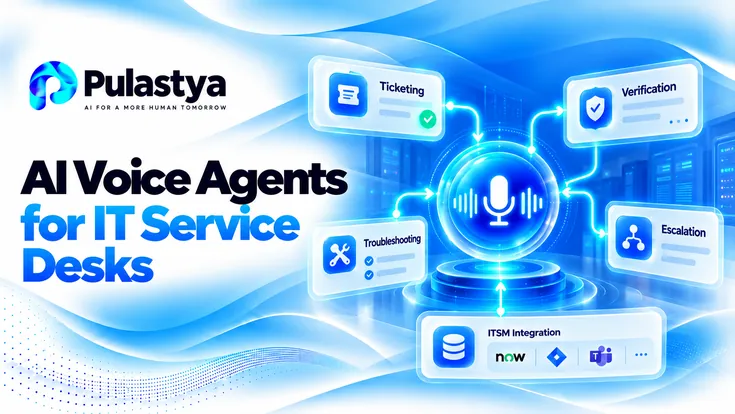
AI voice agents are changing how enterprise IT service desks handle incoming calls by automating routine triage, accelerating mean time to resolution, and reducing agent load.
Successful deployments combine conversational AI with ITSM integration, clearly defined escalation rules, and measurable SLAs to preserve service quality and compliance while lowering call handling costs.
- Primary benefit Offload repeatable call work so human agents focus on complex incidents and projects.
- Operational requirement Integrate with ITSM, SSO, and directory services to enable secure identity and ticket context.
- Risk control Design deterministic escalation and verification steps to prevent automation missteps and reduce rework.
Enterprises deploying AI voice for IT support should focus on deterministic outcomes: faster ticket creation, guided troubleshooting for common issues, and reliable escalation to human engineers when required. Voice agents must map to existing incident models, authenticate callers, and surface the right context to technicians to avoid repeating steps.
The technical stack includes speech recognition tuned for enterprise vocabularies, intent classification, dialog state management, and telemetry that ties call events back into ticket lifecycles.
A pragmatic rollout uses a phased risk plan that starts with low-risk tasks such as password resets and software checks, then expands to device diagnostics and configuration guidance.
Design decisions should prioritize security, privacy, and observability: encrypted call transcripts, short-lived credentials for automated ops, session replay for audits, and dashboards that track containment, escalation, and false positive rates. Clear KPIs and stakeholder alignment prevent scope creep and maintain service continuity.
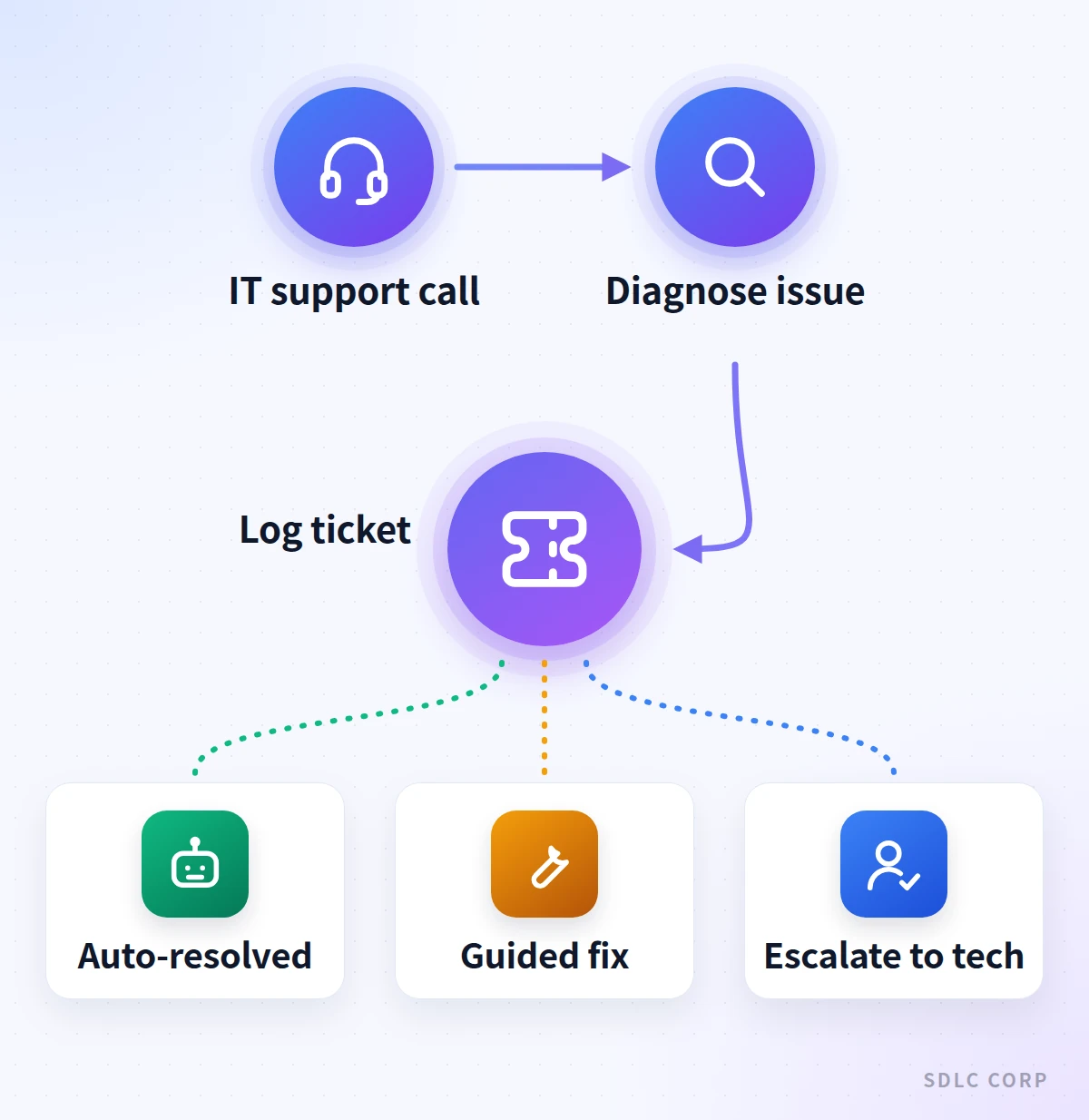
What AI Voice Agents Should Handle on IT Support Calls
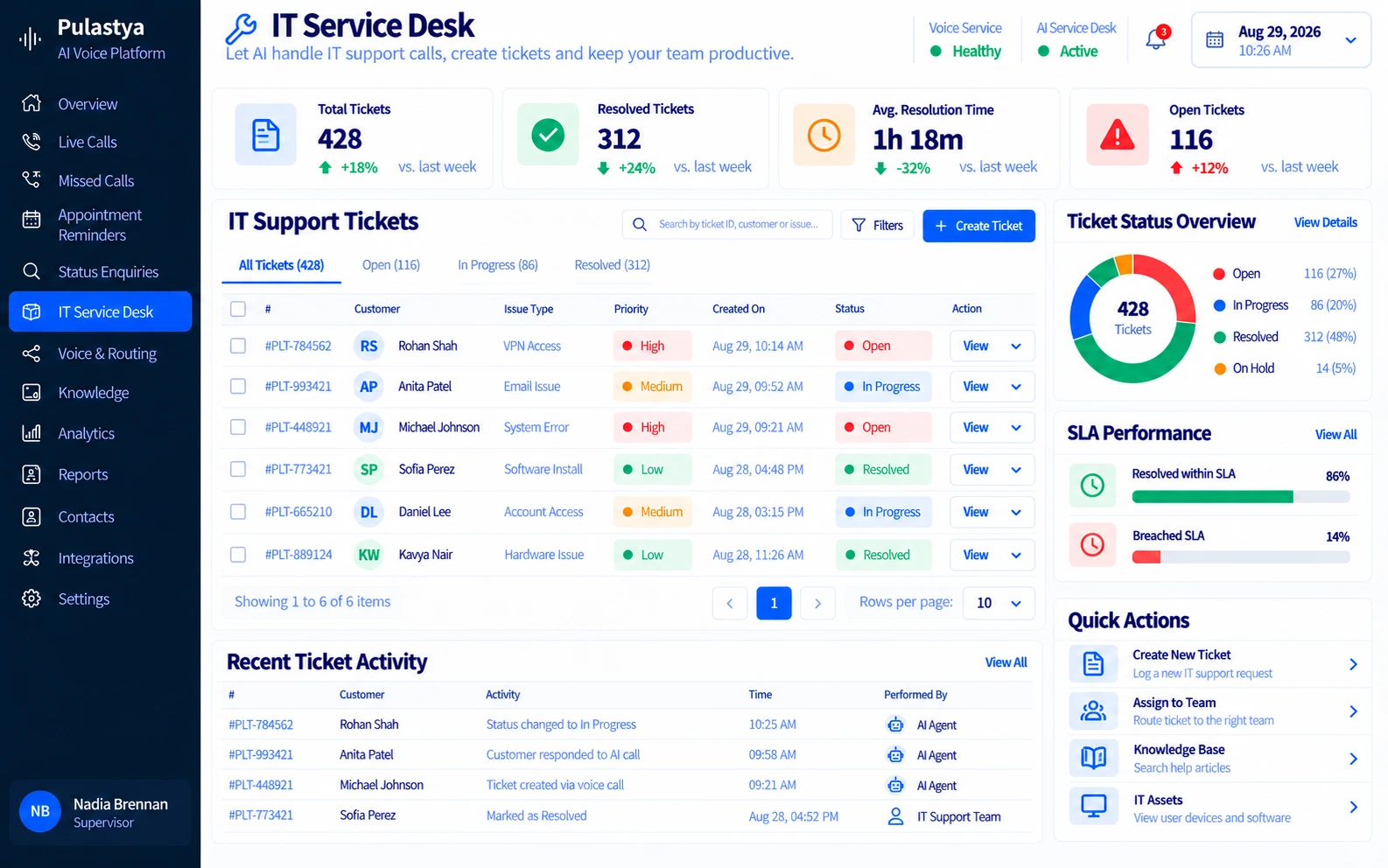
Start by scoping voice agent tasks that are high-frequency and low-risk. Examples include password resets, account unlocks, basic network connectivity checks, and status checks for known scheduled maintenance. These interactions are transactional and can be expressed as clearly bounded dialogues that return a ticket or resolution without human intervention in many cases.
Avoid giving the agent responsibility for configuration changes that alter state without robust verification. Instead, the agent can perform guided diagnostics, collect evidence, and offer step-by-step instructions that the user can execute, or it can create a prefilled ticket with relevant logs and context for a technician to action. That reduces failed automations and protects production systems.
Prioritize smooth handoff when automation is insufficient. The voice agent must transparently surface the reason for escalation, attach transcripts and diagnostic artifacts, and maintain caller identity integrity. This reduces time lost to repeated questioning and allows human agents to resume conversations with full context and the caller's trust intact.
- Automate identity-verified, well-bounded actions like password resets using short-lived tokens.
- Collect diagnostics such as device type, OS version, and error codes before escalation.
- Offer voice-driven guided troubleshooting with decision tree fallbacks to human agents.
- Create prefilled incident records with transcript excerpts and attached logs.
- Limit automated changes to cancelable operations with immediate rollback paths.
Define automation scope by frequency, risk, and reversibility before coding voice flows.
IT service desk scope
What the Voice Agent Automates and When It Hands Off
| Request | Automation | Escalate when |
|---|---|---|
| Password reset or account unlock | Verify through identity-provider MFA, then reset with a short-lived token | Verification fails, the account is privileged, or the target asset is high risk |
| Scheduled maintenance status | Read the status of the known scheduled maintenance to the caller | The reported impact is not covered by any known maintenance notice |
| Connectivity or VPN problem | Guided troubleshooting; collect device, OS version and error codes | Steps fail: create a prefilled ticket with logs and transfer |
| Configuration or access change | No autonomous change; gather evidence and prefill the request | Always: a technician reviews and approves the change |
| Unclear request | Ask a short clarifying question when NLU confidence is low | Low confidence, repeated clarifications, detected frustration, or a request for a person |
Automation scope follows risk and reversibility: state-changing requests always reach a technician, while routine checks escalate only when verification or diagnostics fail.
Core Capabilities: ASR, NLU, Dialog State, and Voice Synthesis
Accurate Automatic Speech Recognition (ASR) tuned for enterprise jargon is the foundation of an IT support voice agent. Generic ASR models often misrecognize product names, error codes, and acronyms. Enterprises should invest in custom language models or vocabulary injection for internal product names, ticket identifiers, and technical terms to reduce misclassification and unnecessary escalations.
Natural Language Understanding (NLU) must classify intents, extract entities like device names and timestamps, and detect uncertainty. Intent models should distinguish between diagnostic requests, change requests, and policy inquiries so the system can apply appropriate authorization and routing. NLU confidence thresholds should drive when to ask clarifying questions versus invoking a human agent.
Dialog state management enforces consistent conversational context across multi-turn exchanges and disconnected call resumes. The system should support transactional patterns, stepwise confirmation, and context propagation to ITSM.
Voice synthesis should sound professional and avoid overly casual phrasing so users treat the interaction as a formal support channel, but the voice should also provide clear guidance and next steps.
- Customize ASR with company-specific vocabulary to improve recognition of technical terms.
- Tune NLU confidence thresholds and add clarifying prompts for low confidence intents.
- Use dialog state to preserve context across transfers and callback interactions.
- Implement voice synthesis with neutral, concise phrasing for enterprise audiences.
- Log structured intent and entity metadata to tie back into analytics and quality review.
Invest in domain-specific ASR and tight NLU confidence tuning to minimize unnecessary escalations.
Integration Points: ITSM, Directory, and Observability
AI voice agents must integrate with ITSM platforms to create, update, and close tickets programmatically. Integration should include mapping dialog outcomes to ticket fields, attaching transcripts and diagnostic artifacts, and setting appropriate priority levels. Avoid one-size-fits-all mappings; work with service owners to align automation outputs to existing incident types and escalation matrices.
Directory and authentication integrations are central to secure operations. Verify caller identity through the identity provider before exposing sensitive operations, such as a push approval to a registered device or a one-time code.
Browser SSO sessions do not carry over to a phone call, and caller ID or knowledge questions alone are weak proof because password reset calls attract social engineering.
Implement role-based checks so actions like password resets or access grants require additional validation layers when callers are in privileged groups or when requests target high-risk assets.
Observability and telemetry close the loop on performance and compliance. Track containment rate, average handling time, false escalation rate, and end user satisfaction per intent. Also capture raw and anonymized transcripts for quality review, with redaction rules for sensitive data. These integrations provide the data needed to iterate and demonstrate the value of voice automation.
- Map dialog outcomes to ITSM fields and attach structured diagnostics to tickets.
- Enforce identity-provider MFA and conditional authentication for actions that affect account state.
- Record redacted transcripts for QA and regulatory audit trails.
- Emit metrics such as containment rate, escalation rate, and mean time to resolve.
- Support callback matching so human agents can resume with full session context.
Treat ITSM and identity as primary integration surfaces to maintain security and operational continuity.
When identity and ITSM connectors need more engineering capacity than the service desk team has, an enterprise AI development partner can build them against the same verification and ticketing rules.
Privacy, Compliance, and Data Handling
Voice interactions often capture personal and sensitive information. Implement data minimization by collecting only required fields, apply in-call redaction for credentials and secrets, and store transcripts with role-based access. Define retention policies that meet legal and internal compliance requirements and ensure that audio and transcript storage is encrypted at rest and in transit.
Regulatory requirements vary by jurisdiction and industry. For organizations subject to data residency rules, deploy regionally isolated storage and processing or use hybrid architectures that keep sensitive steps on private infrastructure. Perform privacy impact assessments and document how voice data is used, who can access it, and how long it is retained to support audits.
Operational controls should include regular access reviews, immutable audit logs, and incident response playbooks specific to voice channels. Train staff on handling sensitive information that might surface during calls and automate alerts when abnormal data patterns appear. These controls lower the risk of data leaks and help maintain user trust in the automated channel.
- Apply in-call redaction rules for credentials and personal identity information.
- Encrypt audio and transcripts at rest and in transit and enforce RBAC on access.
- Use regional processing when data residency or industry rules require it.
- Define retention policies aligned to compliance and auditability.
- Implement access reviews and alerting for unusual retrieval or sharing patterns.
Operationalize privacy through redaction, encryption, and strict access governance.
Deployment Models and Scaling Tradeoffs
Decide between fully cloud native, on-premises, or hybrid architectures based on latency, security, and cost. Cloud services offer rapid model updates and elastic scaling for variable call volumes, but on-premises or edge deployments can be necessary when regulations or low latency voice processing are paramount. Hybrid models can route sensitive verification steps to private infrastructure while using cloud for NLU.
Scaling must balance concurrency, model inference cost, and SLA expectations. Use async ticket creation and callback models to avoid keeping inference threads occupied for long-running tasks. Implement throttling and priority queuing for enterprise callers versus external vendors to protect core user experience during traffic spikes.
Operational readiness includes automated model retraining pipelines, blue-green deployments for voice models, and staged rollouts. Keep rollback plans and feature flags to disable risky intents quickly. Also plan for periodic model evaluation against real call samples to detect drift and ensure the voice agent remains aligned with evolving language and product changes.
- Select cloud, on-premises, or hybrid deployment based on compliance and latency needs.
- Use asynchronous workflows and callbacks to manage long-running interactions.
- Prioritize enterprise caller queues during peak loads to preserve SLA targets.
- Automate retraining pipelines and maintain staged model deployments.
- Use feature flags for rapid rollback of newly exposed intents or actions.
Match deployment topology to compliance and latency requirements while enabling elastic scaling.
Operational Design: Escalation, Monitoring, and Continuous Improvement
Define clear escalation rules and human handoff protocols to protect caller experience. The voice agent should decide escalation based on NLU confidence, number of repeated clarifications, or detected caller frustration. On transfer, pass structured context including attempted steps, captured logs, and suggested next actions so human agents can resolve issues quickly without redundant questioning.
Monitoring requires real-time and historical signals. Real-time alerts should flag rising escalation rates, increased call durations, or frequent ASR failures.
Historical analysis should focus on intent performance, containment success, and user satisfaction trends to prioritize model and dialog improvements. Use A/B testing for revised scripts and measure business metrics such as ticket containment and reduction in human agent call volume.
A disciplined feedback loop accelerates quality. Route a sample of escalated calls and contained calls to quality analysts for annotation. Use those annotations to refine intents, update NLU examples, and adjust ASR vocabulary. Consider a controlled program for human-in-the-loop correction during the first months to reduce edge case errors and build confidence in automation.
- Escalate based on confidence thresholds, repeated clarifications, or explicit user request.
- Pass full context and suggested next steps to human agents to avoid repeated queries.
- Alert on anomalies like rising escalations or ASR accuracy drops for rapid remediation.
- Use A/B testing and business KPIs to validate dialog changes before wide rollout.
- Implement human review sampling to feed continual model and script improvements.
Operational metrics and a human feedback loop are essential to maintain containment and trust.
Practical Rollout Scenario and Vendor Selection Checklist
Example rollout: a large enterprise automates password resets and VPN connectivity checks. Phase one uses a voice agent that verifies the caller with a push approval from the corporate identity provider and issues a temporary password that must be changed at next sign-in, and the team measures containment for these calls before expanding.
Phase two adds guided VPN troubleshooting and automatic ticket creation with attached logs for failed fixes. This staged approach limits blast radius and lets the team measure labor savings at each phase.
Use vendor evaluation criteria focused on enterprise needs: accuracy with domain vocabularies, native ITSM connectors, robust security features, and observability APIs. Prioritize vendors that provide SDKs for custom NLU training and support hybrid deployments for data residency.
Run a proof of concept with real call recordings and a closed feedback loop to validate containment and escalation behavior before full production.
Budget for integration engineering, ongoing annotation labor, and change management for support staff. Document operating procedures for voice agent behavior and train human agents to interpret transcripts and suggested actions.
- Pilot with high-frequency, low-risk tasks and expand after measuring containment and escalation.
- Require native connectors to your ITSM and directory services to reduce integration work.
- Validate vendor ASR and NLU on your own call samples during the POC.
- Confirm hybrid deployment options for data residency and regulatory compliance.
- Budget for annotation, change management, and ongoing model tuning post rollout.
Pilot selectively, validate against real calls, and choose vendors that support hybrid deployment and deep ITSM integration.
Two adjacent workflows deserve separate treatment: creating service requests from calls and answering live status enquiries.
For matching each call to the right team, see routing calls to the right team.
Conclusion
AI voice agents can help enterprise IT service desks manage routine support calls, collect diagnostic information, create ITSM tickets, and guide employees through common troubleshooting tasks. Their value depends on more than conversational accuracy: secure caller verification, reliable system integrations, controlled automation, and effective human escalation are equally important.
Organizations should start with clearly defined, lower-risk use cases, validate results using service desk metrics, and expand automation only after confirming reliability, security, and user satisfaction. With proper governance and monitoring, AI voice agents can deliver more consistent IT support while allowing human technicians to focus on complex incidents.
Frequently Asked Questions
Start with high-frequency, low-risk tasks such as password resets, account unlocks, and scheduled maintenance status checks. These are transactional and have clear success criteria. Automate diagnostics that collect context and create prefilled tickets before attempting automations that change system state.
Enforce caller verification through identity-provider multi-factor checks such as push approvals or one-time codes, use short-lived tokens for automated actions, and implement in-call redaction for sensitive inputs. Also require additional validation for privileged accounts and log all actions with immutable audit trails for review.
Key metrics include containment rate, mean time to resolution for automated versus human-handled calls, escalation rate, and user satisfaction. Track ASR and NLU accuracy, and monitor for increases in repeat calls which indicate automation failures that need refinement.
Yes, but it requires ASR models trained on representative accent and language samples. Use vocabulary injection for product names and regional phrases, test with real recordings across sites, and implement fallback prompts that request keypad (DTMF) entry or transfer to a human when recognition confidence is low.
Establish a continuous improvement pipeline that includes periodic model retraining on annotated calls, a human review program for escalations, and A/B testing for dialog changes. Maintain feature flags and rollback strategies and schedule recurring reviews with service owners to align automation to product or policy updates.