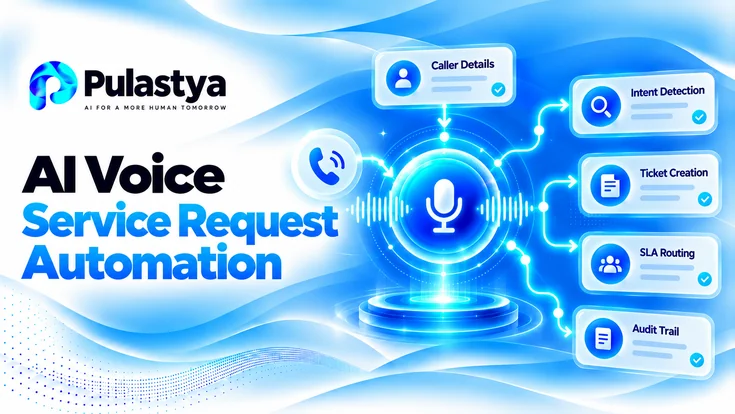
AI voice agents can capture service requests and create tickets directly from customer calls, replacing manual intake and reducing latency for triage teams.
For enterprise IT and field service operations, voice-driven case creation must integrate intent detection, data enrichment, and automated routing while preserving auditability and SLA controls.
- Direct case creation AI voice agents should own ticket creation by enforcing required fields, applying enrichment, and writing to the source of truth without human handoff when confidence thresholds are met.
- Structured data and audit trail Capture structured slots plus full transcript and metadata for compliance, root-cause analysis, and automated escalation while maintaining an auditable change history.
- Integrate with workflows Route, prioritize, and enrich voice-created tickets using existing ITSM rules, business logic, and third-party systems to preserve existing operations and SLAs.
AI voice service request automation combines speech recognition, natural language understanding, and workflow orchestration to intake incidents, requests, and change tickets from voice channels.
Enterprise deployments require deterministic routing rules, identity checks, and structured data extraction so downstream systems receive consistent case fields. Focus gates for production include accuracy thresholds, rollback plans, and clear ownership of case and ticket creation to avoid duplicated work.
Successful programs map voice intents to existing ticketing taxonomies, enforce mandatory attributes during the call, and attach call recordings and transcripts for compliance.
Teams should define acceptance tests that validate field-level accuracy and SLA outcomes. Operational metrics to track include first-call case completeness, reassignments triggered by missing data, and average time from call start to ticket creation.
How AI Voice Intake Captures a Service Request
AI voice intake starts with call signal ingestion, real-time speech-to-text, and intent classification. The agent prompts for specific fields (device ID, error code, location, and urgency) and uses slot-filling to enforce required attributes.
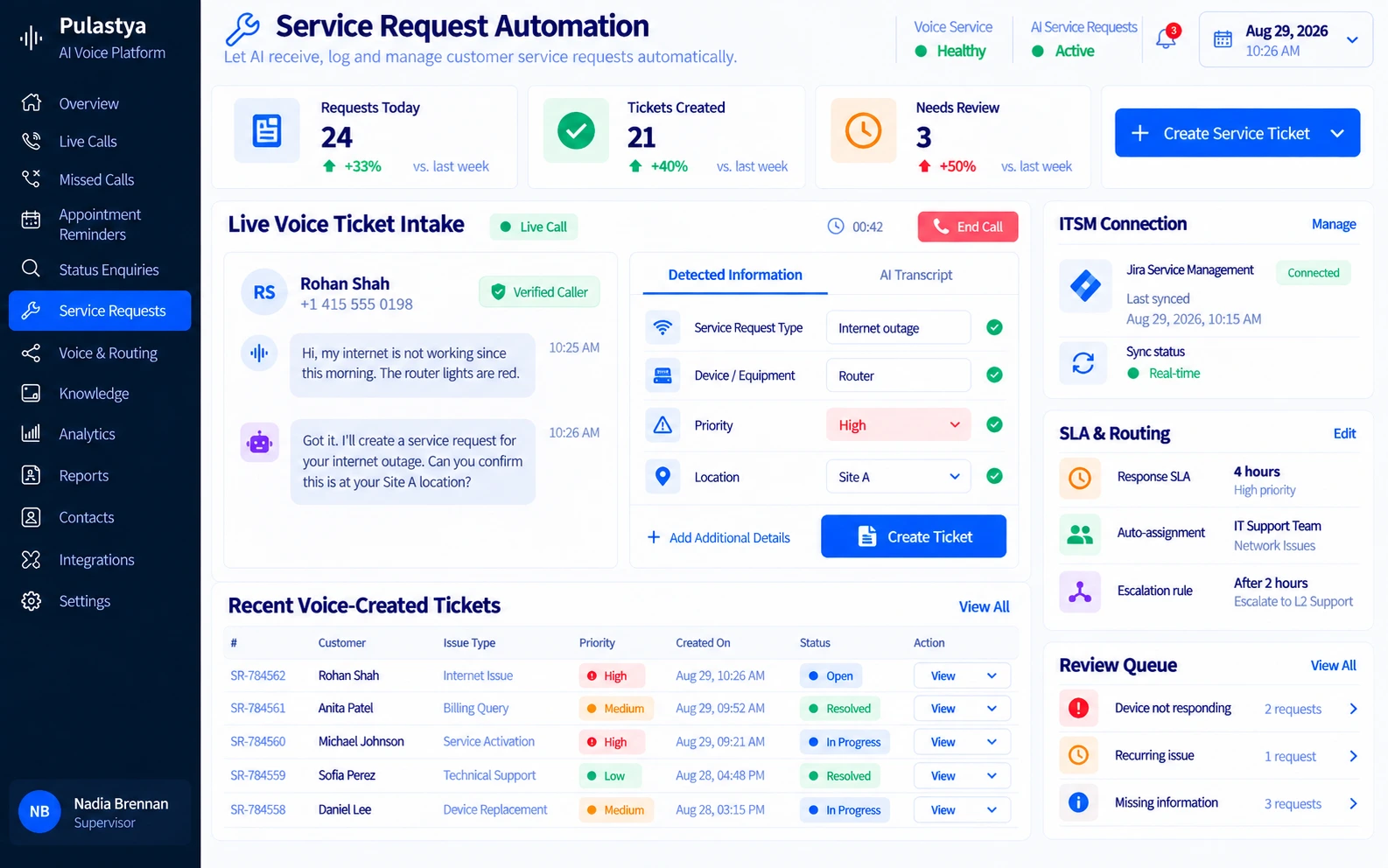
Confidence scoring determines whether the system can auto-create a ticket or should transfer the caller to an agent for confirmation. Once the ticket exists, give the caller its number and the next expected update.
Enterprises must define the canonical ticket schema that voice intake will populate. Mapping spoken slots to ticket fields avoids downstream transformations, and the agent should request missing mandatory fields before closing the call. Validation rules, such as format checks for serial numbers, reduce the incidence of incomplete or duplicate tickets in ITSM systems.
End-to-end processing includes enrichment steps: lookup of customer profile, prior incidents, and service entitlements. The agent attaches transcript and audio as evidence and assigns an initial priority using business rules. Having the voice agent write the ticket directly ensures a single source of truth and reduces lag between call intake and triage.
- Real-time speech-to-text with speaker diarization for multi-party calls
- Slot-filling prompts for mandatory ticket fields during the call
- Confidence thresholds decide auto-create versus agent handoff
- Enrichment with customer profile and prior incident history
- Attach transcript and call recording to the ticket automatically
Design the schema first; voice intake maps to existing ticket fields, not a parallel system.
Voice ticket intake
How a Service Request Call Becomes a Ticket in the System of Record
- Detect intent and verify the callerClassify the request early and bind the call to an account or asset
- Collect mandatory slotsPrompt for device ID, error code, location and urgency from the ticket schema
- Validate and confirm fieldsFormat checks and short readbacks for low-confidence values
- Enrich and check for duplicatesAdd profile, entitlements and open tickets; apply an idempotency key
- Create the ticket through the ITSM APIAttach transcript, audio and confidence; set priority by business rules
Possible outcomes
- Auto-createdThresholds met: caller gets the ticket number and next update
- Agent reviewLow confidence or missing fields: transfer or quarantine for review
- Incident escalationOutage or safety signals raise priority and alert on-call staff
The ticket schema drives which slots the agent must collect, and confidence thresholds decide whether the ticket is created, reviewed or escalated.
Designing Call Flows and NLU for Reliable Slots
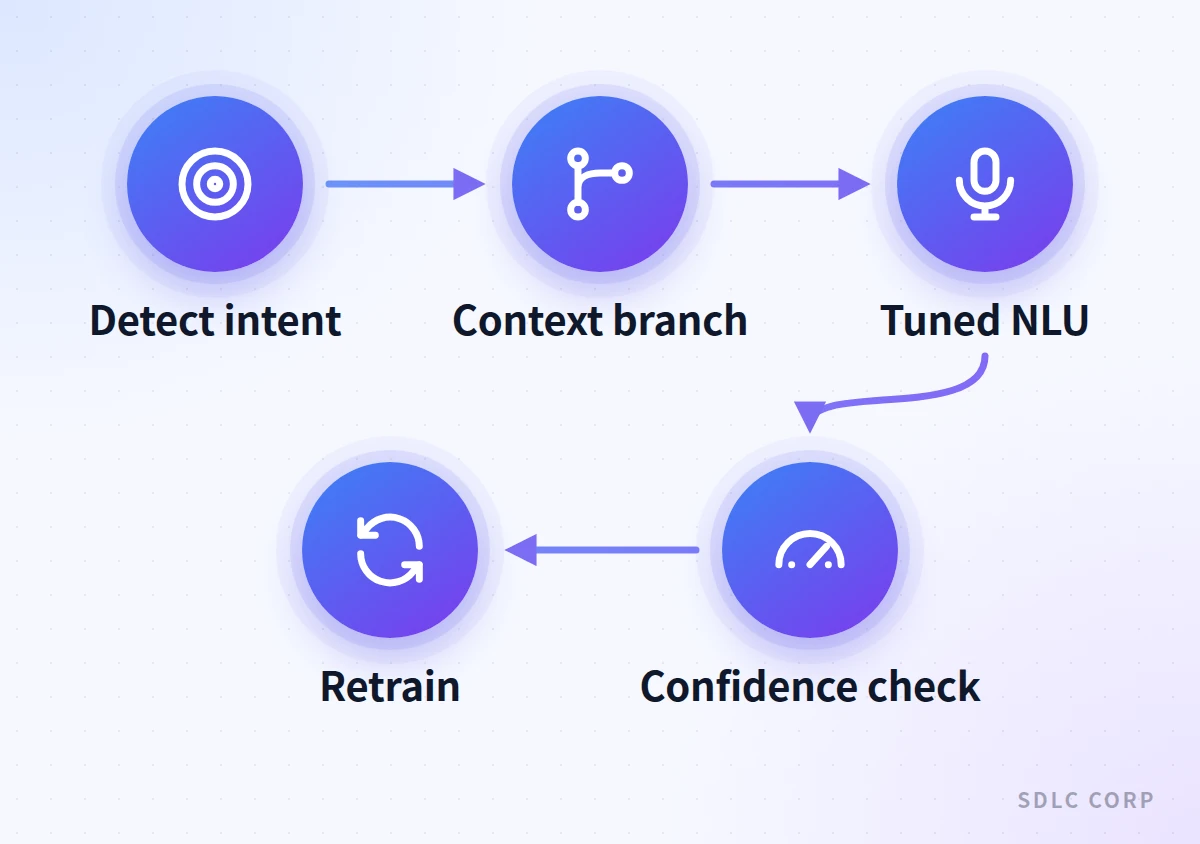
Call flow design must be intent-first: detect intent early, ask concise clarifying questions, and confirm critical fields. Phrase questions in enterprise terms that align with help desk taxonomies to reduce translation errors. Use conditional branches to avoid redundant prompts when the system already knows the caller context from authentication or CRM lookup.
NLU models benefit from training on domain-specific transcripts and ticket descriptions. Include negative examples, abbreviated speech, and accented data to increase robustness. Combine intent classification with entity extraction models tuned to enterprise artifacts like asset tags, incident categories, and error codes to improve field accuracy during noisy calls.
Implement guardrails for confidence and ambiguity. When slot confidence falls below thresholds, the agent should use short reconfirmations or escalate to a live agent rather than guessing. Log every ambiguous utterance and the resolution path to refine models and reduce future handoffs.
- Intent-first detection to identify the request early in the interaction
- Context-aware branching that reduces unnecessary prompts
- Domain-tuned NLU trained on ticket and call corpus
- Confidence-based reconfirmation before critical field acceptance
- Continuous retraining pipeline using resolved tickets as labels
Short, contextual prompts reduce caller friction and improve slot accuracy.
Integrating Voice Agents With Ticketing and Case Systems
Integration must preserve the ticketing system as the source of truth. The voice agent should create, update, and close tickets through the same APIs and business rules that agents use. Implement transactional design patterns so that failed enrichments or API errors trigger compensating actions rather than orphaned voice records.
Map voice-derived fields to ticket states and tags used by triage teams. Include metadata that flags the ticket as voice-created, the confidence score, and the audio transcript location. This enables downstream automation: priority overrides, automatic assignment to a skill group, or alerts to on-call engineers based on voice-derived urgency.
Support two-way updates: when downstream systems annotate or resolve tickets, synchronize status back to the voice platform for reporting and analytics. Maintain idempotency keys to prevent duplicate ticket creation from repeated call segments or reconnections during unstable networks.
- Use ticketing system APIs for create/update to keep a single source of truth
- Attach confidence, transcript, and audio metadata to each ticket
- Transactional patterns and idempotency to avoid duplicate tickets
- Map voice fields to ticket states and triage tags used by teams
- Two-way synchronization so ticket status updates feed analytics
Treat the ticketing platform as the single source of truth for case data.
Quality, Compliance, and Auditability for Voice-Created Tickets
Enterprises require an auditable trail for any voice-created case. Store unedited transcripts, full audio recordings, timestamps, and decision logs that show why the agent auto-created or escalated a ticket. These records support compliance audits, dispute resolution, and post-incident reviews without relying on human memory.
Quality controls include periodic accuracy sampling, automated validation rules, and a feedback loop from agents who review voice-created tickets. Define acceptance criteria for auto-creation, such as minimum field completeness and model confidence, and quarantine tickets that fall below thresholds for agent review.
Privacy and access control must be baked into storage and retrieval policies. Apply role-based access for recordings and PII masking where required. Retention policies should align with legal requirements and corporate policy, and deletion workflows must remove audio and transcripts when retention lapses.
- Store transcripts, audio, timestamps, and decision logs for audit
- Define minimum confidence and completeness for auto-create
- Sampling and agent review feedback to measure field accuracy
- PII masking and role-based access for recordings
- Retention and deletion aligned with legal and corporate policy
Record every decision the agent makes so audits are reproducible and defensible.
Escalation, Routing, and SLA Enforcement
Routing logic should combine voice-derived urgency, customer entitlements, and historical behavior to assign tickets. Use rules to map voice intents to skill groups, on-call rotations, and emergency queues. Where possible, pre-populate suggested assignees and SLO tiers to reduce triage time and manual reassignment.
Escalation policies must be deterministic: define trigger conditions, mapping to human roles, and communication methods. For example, a high-urgency voice ticket that mentions service outage keywords should immediately escalate to the incident management channel and tag on-call engineers while updating the ticket priority.
Implement SLA enforcement through automated timers and alerts tied to ticket states. The voice platform should annotate SLA burn with confidence metadata so operations teams can prioritize tickets created with lower extraction certainty for rapid human validation.
- Map voice intents to skill groups and on-call rotations automatically
- Deterministic escalation rules for outage and safety keywords
- Auto-tagging for priority and SLA tier based on voice inputs
- Pre-populate assignees and suggested actions to speed triage
- SLA timers annotated with confidence level for prioritization
Escalation rules should be deterministic and codified, not ad hoc.
Deployment, Monitoring, and Operational Improvement
Deploy voice agents in phases: sandbox with internal calls, pilot with a limited customer segment, then gradual ramp. Each phase should measure field-level accuracy, ticket duplication rate, and human handoff frequency. Use feature flags to toggle auto-create behavior per segment and to roll back rapidly if metrics degrade.
Monitor operational metrics continuously: percent of auto-created tickets, downstream reassignments, time-to-first-response, and customer sentiment on post-call surveys. Capture model drift indicators such as increased ambiguity rates or falling slot confidence, and schedule retraining or data curation when thresholds are crossed.
Establish a continuous improvement pipeline that routes unresolved or low-confidence cases into supervised learning datasets. Maintain a prioritized backlog for utterance corrections and grammar enhancements.
- Phase deployment with sandbox, pilot, and controlled ramp
- Track auto-create rate, duplication, and handoff frequency
- Detect model drift via confidence distributions and ambiguity
- Feed low-confidence cases into supervised retraining pipelines
- Use feature flags for rapid rollback and controlled experiments
Phase deployments and telemetry-driven retraining keep accuracy stable at scale.
Example Scenario and Practical Implementation Checklist
Scenario: a telecom enterprise deploys a voice agent to intake service outage reports. A customer calls, says 'no internet since this morning, router light red.'
The agent matches the calling number to an account, confirms a second detail such as the service address, extracts account and location, prompts for router model and outage duration, and assigns a high-priority ticket with outage tags. The ticket contains transcript, audio link, and suggested triage steps.
Operationally, that scenario shows required design elements: identity binding to reduce fraudulent reports, domain-specific entity extraction for device models, and outage keyword detection that triggers incident procedures. The voice agent must also attach the call recording and enrich the ticket with last-known modem health from the network management system.
Implementation checklist: 1) define canonical ticket schema and acceptance criteria; 2) build NLU with domain examples; 3) map to ticket API with transactional safety; 4) enforce confidence thresholds and handoffs; 5) monitor metrics and retrain regularly. Use governance gates and phased deployment to limit risk and validate SLA performance before broad rollout.
- Authenticate caller to bind the voice input to an account
- Extract device model and outage duration via domain NLU
- Auto-tag outages to incident management with high priority
- Attach recording and network-enriched diagnostic data
- Phased rollout with governance gates and retraining plan
A tight checklist and phased rollout reduce operational risk and maintain SLA integrity.
Service request capture is one workflow within a broader support program. The guide to an handling support calls with a voice agent shows how it sits alongside FAQ answers, status enquiries and human handoff.
For the intake step that comes before a service request, see AI call intake and routing.
Conclusion
AI voice service request automation helps enterprises turn customer calls into structured, actionable tickets without relying entirely on manual data entry. By combining speech recognition, intent detection, field validation, and ITSM integration, organizations can improve request accuracy, accelerate ticket creation, and maintain consistent service workflows.
Successful implementation depends on more than automated conversations. Clear validation rules, secure integrations, reliable human escalation, and continuous performance monitoring help ensure that every service request reaches the right team with the information needed for resolution. A phased rollout allows businesses to evaluate automation quality while maintaining operational control and customer trust.
Frequently Asked Questions
Yes, when the agent meets defined confidence and completeness thresholds. Enterprises should set minimum field validation, identity checks, and acceptance criteria. Low-confidence cases should route to a human; high-confidence cases can be auto-created and tracked with attached audio and transcript for audit.
Use idempotency keys, session identifiers, and checks against recent open tickets for the same account or asset. The voice agent should perform a lookup before create and merge with existing incidents when appropriate, and log the rationale to avoid duplicate work.
Maintain role-based access to recordings, apply PII masking, and enforce retention policies aligned with legal requirements. Store transcripts, audio, and decision logs for audits and ensure deletion workflows remove sensitive data when retention periods expire.
Track auto-create rate, field-level accuracy, percent of tickets requiring human correction, time to ticket creation, SLA adherence, and customer satisfaction scores. Combine quantitative telemetry with qualitative sampling and agent feedback to drive continuous improvement.