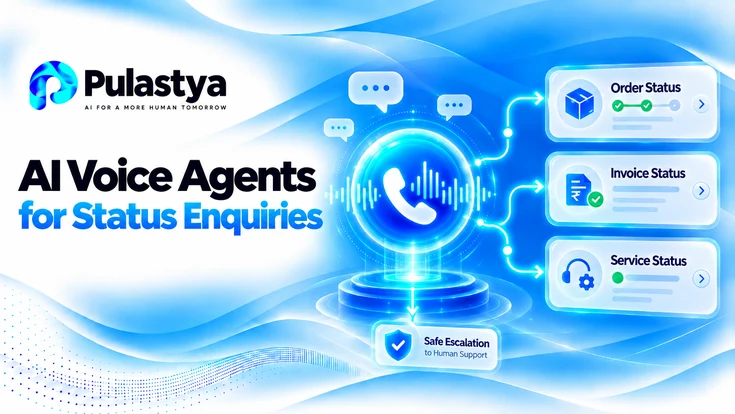
AI voice agents now own routine status enquiries for orders, invoices, and services. Enterprises should design these agents to return authoritative state quickly, escalate when necessary, and log every exchange for audit and reconciliation.
Practical call-flow, data access, and control patterns reduce call time while protecting revenue, privacy, and service-level commitments.
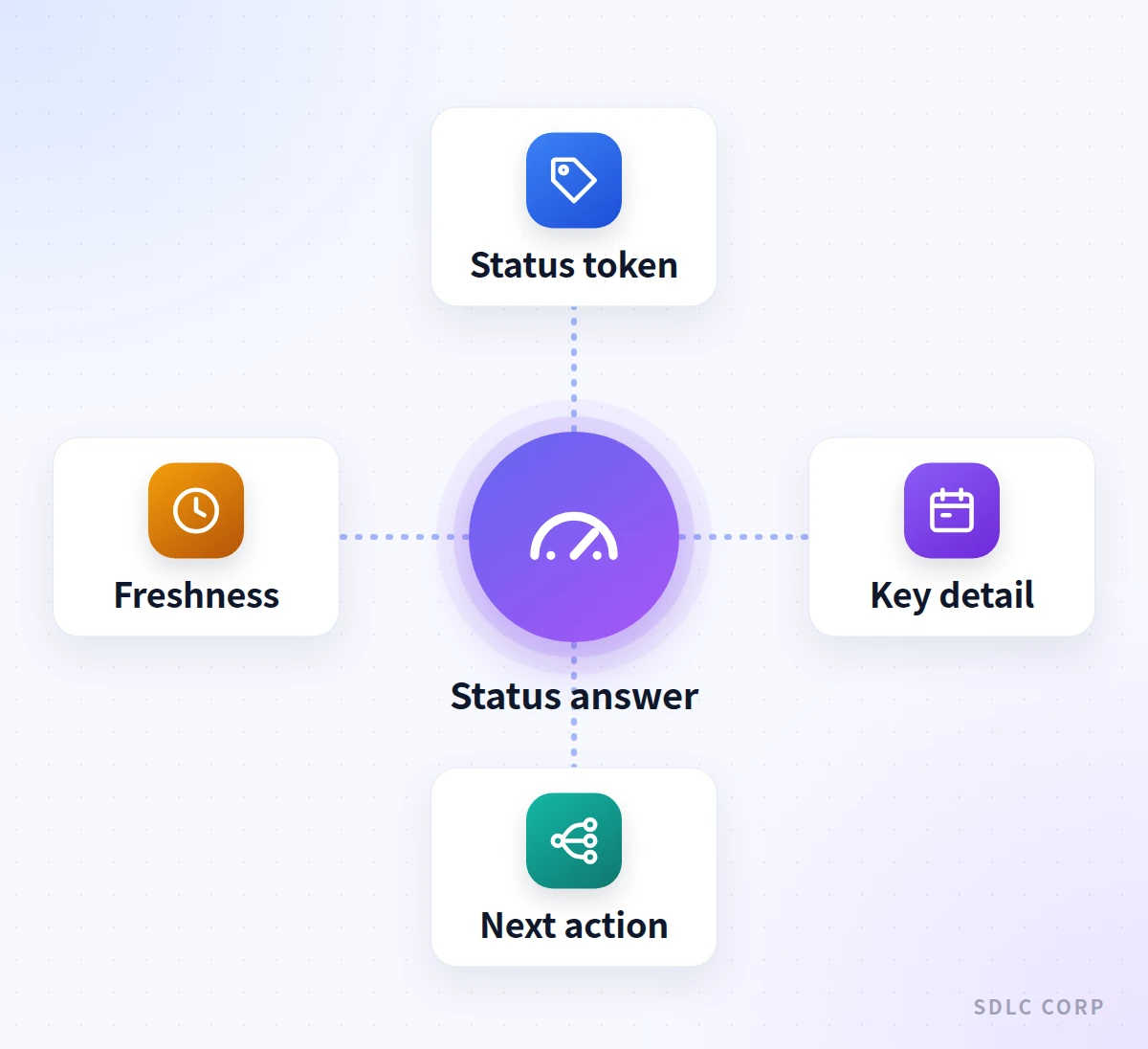
- Design for canonical state Map voice queries to a single source of truth per entity and return a concise status token plus optional details for verification.
- Prioritize identity and verification Use low-friction multi-factor checks where needed and always record verification steps to support dispute resolution.
- Fail fast, escalate safely Detect uncertainty early, provide transparent fallbacks, and route to human agents with context-rich transcripts and suggested next actions.
Status enquiries are among the highest-volume transactional use cases for voice AI because they map to explicit backend state. Successful implementations connect speech understanding to canonical identifiers, verify identity with low friction, and return a minimal, verifiable answer.
The architecture needs deterministic reads for orders and invoices, idempotent confirmations for status changes, and predictable fallbacks when data is stale or incomplete.
Teams must balance speed, accuracy, and compliance. Speed reduces contact center load and improves customer experience; accuracy prevents chargebacks and SLA breaches; compliance preserves privacy and audit readiness. Striking that balance in enterprise operations is tactical work: call flow patterns, data model requirements, integration tradeoffs, and disciplined roll-out and monitoring.
How Voice Agents Identify the Right Record
The first step in any status enquiry is reliable identification. Design the voice flow to request a minimal canonical identifier: order number, invoice number, or service ticket ID.
If the caller lacks the identifier, use contextual alternatives such as account number, phone number, or delivery address with progressive disclosure.
Always confirm the interpreted identifier by reading it back and asking for a simple yes or no confirmation to avoid misrouting. Match verification to what the answer reveals: a delivery status may need only the order number and account phone, while invoice amounts should wait for a stronger check.
Enterprise integrations should resolve the identifier against the canonical data store with a read consistency that matches business risk. For order status, strong read-after-write consistency reduces false stale answers; for non-financial service status eventual consistency can be sufficient.
Tag the response with a data freshness timestamp and include that in the spoken response when data is older than an acceptable threshold to set caller expectations.
When the voice NLP returns multiple candidate identifiers, present the top two or three choices in the same call turn and ask the caller to pick one. That pattern reduces back-and-forth and keeps calls brief.
If the system cannot confidently map the request to any record, fallback immediately to a verification path that collects more context or routes to a human specialist with candidate matches attached.
- Request one canonical ID first, then fallback to account or phone match.
- Read back identifiers verbatim for caller confirmation to prevent errors.
- Include data freshness timestamp in responses when appropriate.
- Use top-k candidate presentation to resolve ambiguous matches quickly.
Confirm identifiers early and attach freshness metadata to every status response.
Status enquiry flow
Verify, Look up, Answer With Freshness, Escalate on Failure
- Capture and confirm the identifierOrder, invoice or ticket ID, read back; fall back to account or phone match
- Verify before disclosureMatch the check to what the answer reveals; invoice amounts need stronger proof
- Look up the canonical recordRead the source of truth and tag the result with a freshness timestamp
- Answer with status and freshnessStatus first, one key field, estimated vs confirmed, then the next action
Possible outcomes
- ResolvedCaller has the current state and next step; the exchange is logged
- Stale or conflicting dataQualify the answer, open an investigation, offer a human
- Lookup fails or no matchTransfer or book a callback with identifier and candidates attached
Verification comes before any status is read out, and every failed or stale lookup ends in a qualified answer or a human, never a guess.
What to Return for Order Status Enquiries
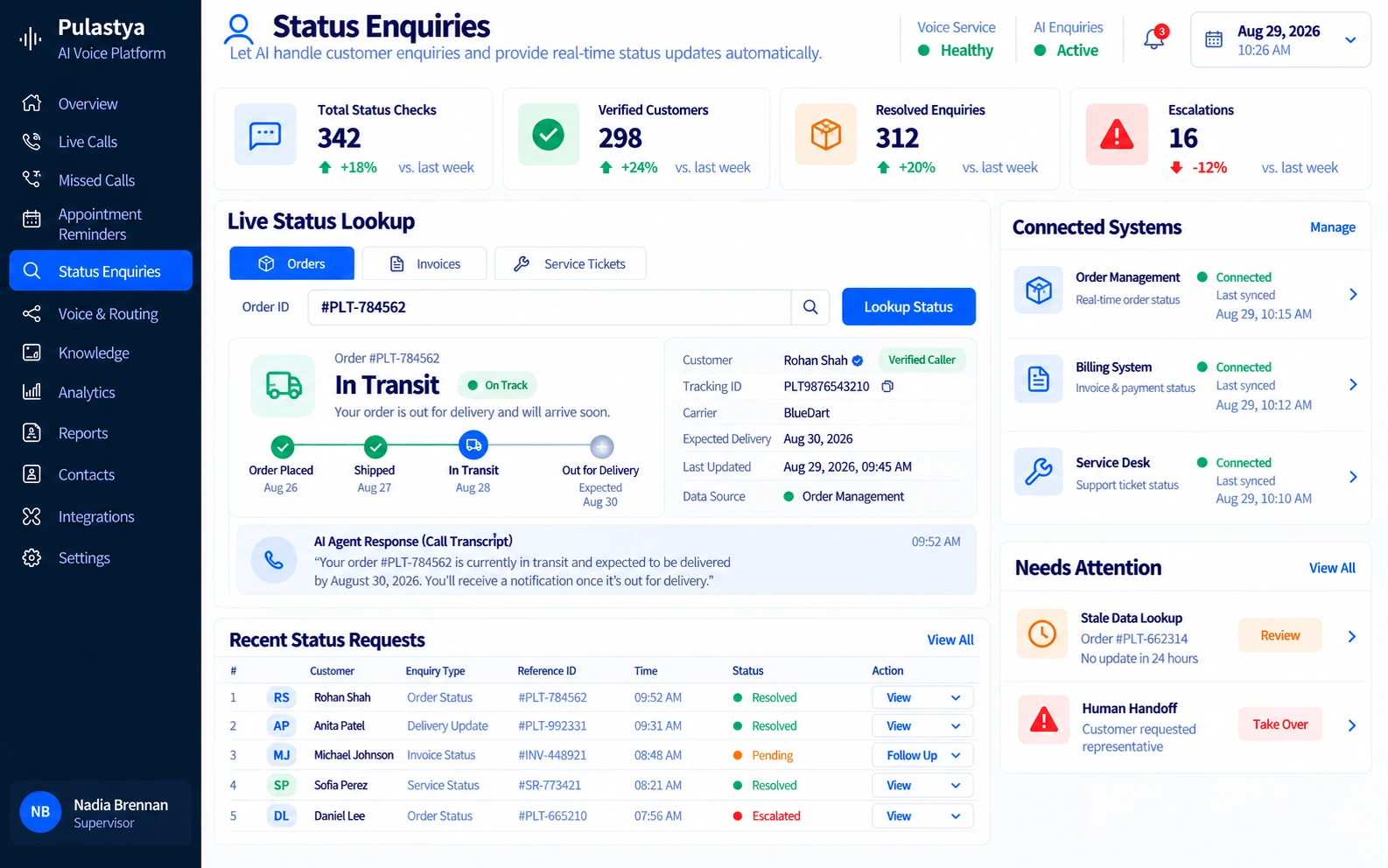
Answer-first design reduces call time: lead with a single, concise status token such as pending, processing, shipped, delivered, or failed. Immediately follow with one or two high-value fields: expected delivery date for shipped orders, last update timestamp, and the next action the customer can take.
Avoid verbose transcripts of events unless the caller asks for detail; callers typically want the current state and next expected milestone.
For orders tied to payment or refunds, include verifiable payment state and a short reference code the caller can use in follow-up communications. Clearly differentiate between system-reported status and estimated events; when a date is estimated, prefacing with the word estimated reduces disputes.
If a shipment has exceptions, summarize the exception reason and present the fastest remedial action the enterprise offers.
When order state is inconsistent across subsystems, surface that inconsistency transparently and propose a safe next step.
For example, if the warehouse shows shipped but the carrier has no tracking, advise the caller that the enterprise will open an investigation and provide an estimated time to resolution or an offer to transfer to an agent. Logging the inconsistency and notifying the relevant operational team should be automatic.
- Lead with a single clear status token then provide one or two supporting fields.
- State whether dates are estimated versus confirmed to reduce disputes.
- Include payment or refund reference codes when they affect status.
- Automatically create an incident when subsystems disagree on order state.
Answer first, then give one high-value data point and the next action.
Voice Handling of Invoice and Billing Status
Invoice enquiries require strict identity verification and non-repudiation. Start with low-friction verification like last four digits of a billing card or a one-time passcode sent by SMS, but escalate to stricter methods when the enquiry could change invoice state.
Once verified, return invoice status tokens such as unpaid, partially paid, paid, overdue, or disputed, followed by the amount due, due date, and the canonical invoice number for cross-reference.
Design the voice response to avoid exposing sensitive payment data. Read amounts and due dates but never read full payment instrument numbers.
If callers ask to make a payment, route them to a PCI-compliant payment module or confirm a secure callback where input collection meets your compliance controls. Record all consent steps and authorization references as structured metadata to support financial audit trails.
When an invoice is disputed, capture the dispute reason in a structured way during the call and create a dispute case with linked audio transcript and verification logs. Provide the caller with an estimated resolution timeframe and a case number. Internally, prioritize disputed invoices by potential revenue impact and SLA commitments so that operations can triage objectively.
- Use low-friction verification first, escalate based on risk and intent.
- Never read full payment numbers; use masked confirmations and references.
- Route payment actions to PCI-compliant modules or secure callbacks.
- Open structured dispute cases with transcript and verification metadata.
Protect payment data, capture consent, and log verification for every invoice inquiry.
Service Status and SLA Enquiries Over Voice
Service status enquiries differ because they often concern shared infrastructure and SLA metrics. Provide a short operational summary: service healthy, degraded, partial outage, or outage.
Include affected regions or customer segments and cite the last corrective action and the incident ticket number. Where SLAs apply, state whether the current condition constitutes an SLA breach and what compensatory steps will follow, if any.
Instrument your status responses with telemetry from monitoring systems, not from customer-facing logs alone. Surface quantitative SLA indicators only if the monitoring system provides reliable, approved metrics. If automated voice status reports might trigger operational escalations, gate that capability behind an internal control to prevent false positives from escalating unnecessarily.
For enterprise customers with dedicated SLAs, allow voice-authenticated callers to request a formal SLA report emailed or uploaded to their portal. That preserves the phone call for a quick summary while ensuring formal documentation resides in the official record. Ensure voice interactions that affect SLA computation are recorded and correlated with monitoring timestamps for forensic and billing purposes.
- Lead with a concise operational state and affected scope.
- Cite incident ticket numbers and last corrective action for transparency.
- Use authenticated voice-to-portal workflows to deliver formal SLA reports.
- Gate automated escalations to avoid amplifying monitoring false positives.
Correlate voice responses with monitoring telemetry and incident records before declaring SLA status.
Example: Online Retailer Order Status Call
Caller: a buyer calls an online retailer asking whether an order due tomorrow will arrive before a scheduled installer visit. The voice agent asks for the order number; the caller provides a partial number and confirms the account phone.
The agent resolves the match, reads back the order number, and confirms identity with a one-time passcode sent by SMS to the account phone, minimizing friction while preserving security.
System check returns shipped with carrier manifest update but no confirmed delivery window. The agent replies: the order is shipped, expected tomorrow, but installation may require confirmation because the carrier shows no time window.
The agent offers two options: a callback from the installation coordinator, or a request to the carrier for an expedited delivery window. The caller chooses the coordinator callback.
The agent logs the callback request with context: order ID, last update timestamp, carrier manifest ID, verification result, and the caller's preferred callback window. Back-end automation opens a coordination ticket and notifies the installer queue. This scenario highlights how concise status, verification, and a clear escalation path minimize friction and create a clean operational trail for follow-up.
- Use partial ID plus phone verification to resolve records quickly.
- Report both system state and what is unknown to reduce caller assumptions.
- Offer explicit next steps: expedited carrier check, human callback, or live transfer.
- Attach structured context to callbacks and transfers to eliminate repeated collection.
Short, verifiable answers plus immediate, context-rich escalation preserve customer time and operational clarity.
Security, Monitoring, and Rollout Best Practices
Security begins at the voice front door. Implement session-level logging that links audio, NLP intent, verification tokens, and data reads. Encrypt logs at rest and control access using role-based policies so only authorized staff can view verification artifacts.
Regularly test the voice verification flow against fraud scenarios such as SIM swap and stolen credentials and tune thresholds to balance false rejects against fraud risk.
Operational monitoring should include call success rates, average time to answer a status query, percentage of escalations, and dispute rates after automated responses. Instrument business KPIs alongside technical metrics so product, operations, and legal teams can evaluate risk and ROI.
Use synthetic calls to validate end-to-end integrity after deployments and to detect regressions in matching accuracy or response latency.
Roll out status-handling features progressively: start with low-risk accounts or read-only invoice states, then expand to higher-risk interactions such as invoice detail and dispute intake. Maintain a rollback plan and monitor for unusual spikes in disputes or agent transfers.
- Log audio, NLP intents, verification tokens, and data reads together for traceability.
- Encrypt logs and enforce role-based access to verification artifacts.
- Track dispute rates and escalation percentages as core operational KPIs.
- Use phased rollout and synthetic monitoring to validate complex integrations.
Combine security testing, synthetic monitoring, and phased rollouts to reduce risk and improve accuracy.
For callers who raise several requests in one call, see handling multiple intents in one call.
Status responses depend on both the data source and the downstream action. See real-time APIs for voice agents and service-request automation for those boundaries.
Order and delivery questions account for many status calls to online retailers. The guide to AI voice agents for e-commerce order, delivery and returns calls covers verification and data boundaries for those calls.
Conclusion
AI voice agents make status enquiries more efficient by helping customers retrieve timely updates about orders, invoices, and services without unnecessary delays. When connected to reliable business systems, these agents can verify customer identity, communicate accurate status information, explain the next steps, and transfer complex enquiries to human representatives with the relevant context.
For enterprises, successful implementation depends on reliable integrations, appropriate authentication, data freshness, secure information handling, and continuous monitoring. By combining automated status checking with clear escalation processes, businesses can reduce repetitive support work, improve response consistency, and deliver a more dependable customer experience.
Frequently Asked Questions
Say plainly that the status cannot be confirmed right now instead of guessing or reading cached data as current. Retry once after a timeout, and ask for another identifier if no record matched. If the lookup still fails, transfer the caller or book a callback with the identifier, verification result and error attached, and log the failure for the integration owner.
When data is stale or uncertain, preface answers with a clear qualifier such as estimated or last confirmed at a timestamp. Offer immediate remediation options: refresh the data, open an investigation, or transfer to a human. Always record the qualifier and the caller choice to support future dispute handling.
Start with low-friction checks like account phone or masked card digits for basic invoice state. For actions that change invoice state, require stronger verification such as one-time passcodes or authenticated portal sessions. Capture all verification steps in structured logs to satisfy financial audit requirements.
Measure success with operational KPIs: average time to resolve a status query, percentage of self-service resolutions, escalation rate to live agents, and post-call dispute rate. Combine these with business metrics such as reduced agent handle time and lower chargeback frequency to quantify value.