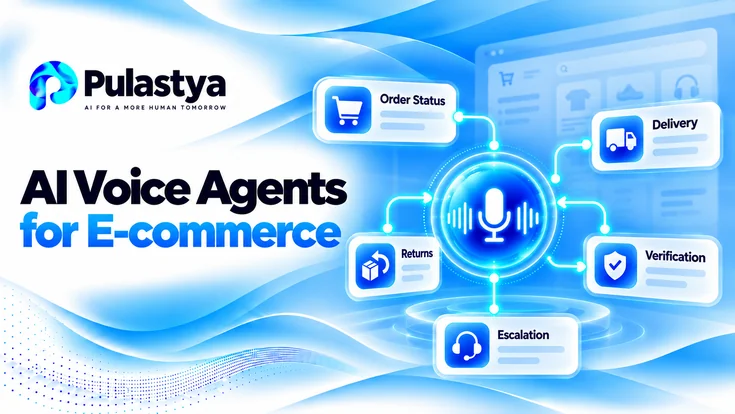
An AI voice agent for ecommerce is software that answers customer phone calls about orders, deliveries, returns, refunds and products, using approved store policies and, where integrated, live order data.
It is for online retailers and direct-to-consumer brands whose support teams answer the same 'where is my order' and 'how do I return this' calls every day.
- Two data modes Policy answers come from approved documents, while live order status requires an integration with the order system.
- Verify before disclosing Addresses, items and refund details should only be shared after a verification step the business approves.
- Escalate with context Damaged items, fraud concerns, disputes and refund exceptions go to staff with the order details attached.
The business outcome is fewer calls waiting for a person. Callers get policy answers and, where systems allow it, order updates straight away, while problem calls reach staff with the order number and request already captured.
What the agent can tell a caller depends on what it is connected to. With approved documents only, it answers policy and product questions and captures requests. With an order system integration and a verification step, it can also share account-specific status. Designing both modes, and the boundary between them, is most of the work.
Which E-commerce Calls an AI Voice Agent Can Handle
An AI voice agent can handle the repetitive calls that fill an online store's phone line: order status, delivery questions, returns and refund policy, and product details. How much it can resolve on the call depends on whether it has only approved documents or also a connection to the order system.
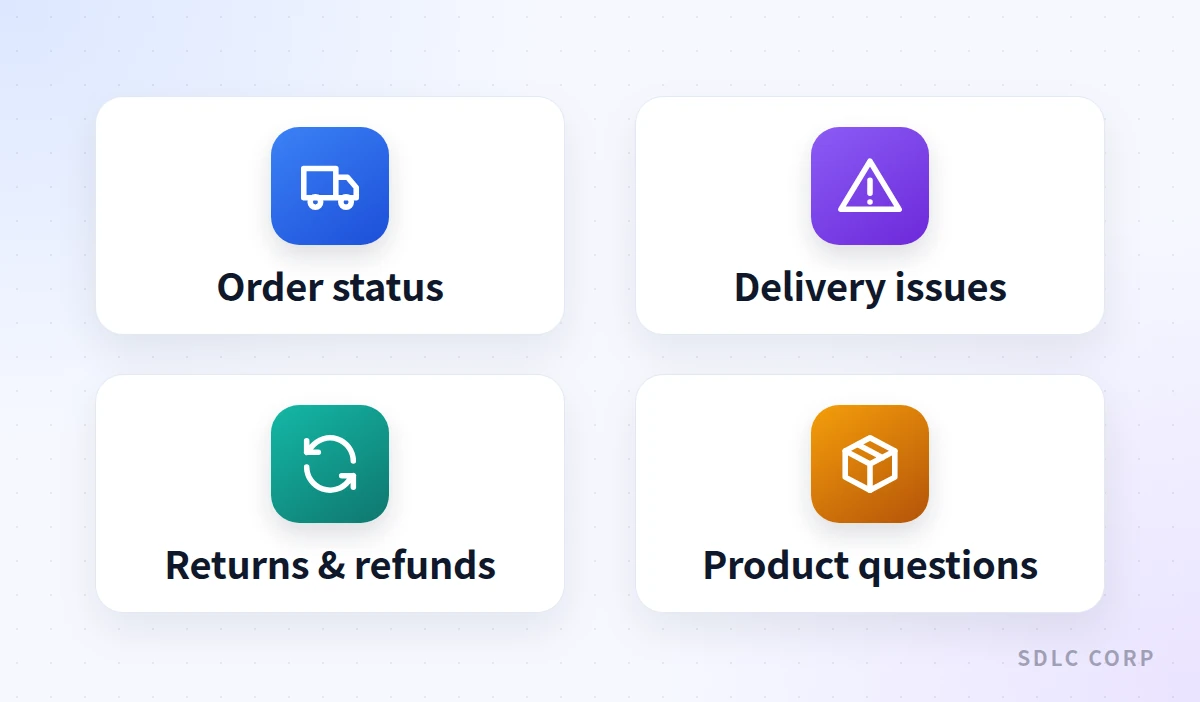
Shipping status, tracking questions and estimated delivery dates.
Late parcels, missed deliveries, address changes and packages marked delivered but not received.
Return windows, eligibility, how to start a return, exchange options and refund timing.
Sizing, compatibility, materials, care instructions, warranty terms and stock questions.
These calls resemble general support, but the workflows are commerce-specific. Most require an order number, many touch personal data, and the correct answer can change within hours. For service calls beyond orders, such as account access or troubleshooting, see the guide to AI voice agents for customer support.
The split behind them, documented answers on one side and account state behind verification on the other, is not a retail invention, and how other industries draw the same line covers the sectors that run it under different names.
Policy Answers versus Live Order Data
An AI voice agent answers e-commerce calls from two different kinds of source. Store policies and product information come from approved documents, while anything about a specific order, such as shipment status or refund progress, has to come from the order, shipping or payment system at the moment of the call.
| Caller request | Documents only (no integration) | With order system integration |
|---|---|---|
| Where is my order? | Explain shipping timelines and capture the order number for follow-up | Look up fulfillment and tracking status after verification |
| Can I return this? | Explain the return window, conditions and exclusions | Check that order's return eligibility and return status |
| Where is my refund? | Explain published refund timing and capture the request | Report the refund status recorded in the system |
| Change my delivery address | Explain the policy and route the request to staff | Submit a change only if the business permits that action |
| Is this item in stock? | Answer from product documents and note that stock changes | Check live inventory for the item |
A common mistake is faking live data with documents, for example uploading an order export or stock spreadsheet to the knowledge base. That data is stale within hours and exposes customer details to any caller who asks. The article on knowledge base vs real-time API explains how to split the sources.
On the documents side, the work is ownership and freshness rather than volume. Shipping, returns, refund and warranty content should each have a named owner, a single approved version the agent is pointed at, and a refresh step built into the same process that publishes a policy change on the website.
Stores that skip that step end up with a phone line quoting a 30-day return window while the site already says 14, and the caller believes whichever one suits them.
How an Order or Delivery Status Call Works
An order status call follows a fixed sequence: identify the request, collect an order identifier, verify the caller, look up the order, and explain the result in plain language. Without an integration, the sequence stops after collection, and the agent confirms how the team will follow up.
- Identify the requestThe agent separates status questions from delivery problems, returns and cancellations, because each follows a different path.
- Collect the order identifierIt asks for the order number and reads it back, since spoken letters and digits are easy to mishear.
- Verify the callerIt checks a second identifier the business defines, such as the email address or postal code on the order.
- Look up the orderThrough an integration, it retrieves fulfillment status, carrier tracking events and any delivery estimate.
- Explain and confirm next stepsIt translates system statuses into plain language and states what happens next, without promising dates the carrier has not given.
Status translation matters. A carrier status such as 'label created' usually means the parcel has not been handed over yet, and a split shipment can show one package delivered while another is in transit. The agent should explain those states, not read raw codes.
What the Integration Layer Typically Provides
- Read-only order lookup by order number plus a matching identifier.
- Fulfillment status and carrier tracking events for each shipment in the order.
- Return eligibility and return or refund status as recorded in the business's systems.
- Separately permissioned write actions, such as canceling an unshipped order, only where the business approves them.
The mechanics of calling external systems mid-conversation, including timeouts and fallback when a lookup fails, are covered in how AI voice agents use real-time APIs. For status call design across industries, see how AI voice agents handle status enquiries.
Verifying Callers Before Sharing Order Details
An AI voice agent should share account-specific order details only after the caller matches identifiers the business has approved. Order records contain names, addresses, purchased items and payment status, and a parcel may be a gift that another household member should not hear about.
Caller ID alone is weak evidence. Numbers can be spoofed, households share phones, and many orders are placed with a different number from the one calling. A common pattern pairs the order number with a second detail from the order, then limits what is disclosed even after a match.
- General status, such as shipped or out for delivery, may be shared after a basic match.
- Full delivery addresses, payment details and itemized order contents need stronger checks or a person.
- Never ask callers for full card numbers, passwords or one-time codes in the voice conversation.
- After repeated failed matches, stop the lookup and offer a person or a secure self-service channel.
These rules belong in a written policy owned by whoever manages privacy and fraud risk, not in a prompt someone edits casually. The guide to AI voice agent security and privacy covers data minimization, transcript access and retention in more depth.
Proving who a caller is should not be a voice agent's job. That decision belongs with a trained person or with a channel the customer is already signed in to, such as the account area or the order-tracking link in their confirmation email.
An agent improvising an identity check creates a compliance exposure for the retailer rather than a shortcut for the customer.
The practical split: policy, product and general shipping answers stay on the voice line, and anything that depends on being sure of the caller's identity routes to staff or to the verification process the business already runs.
Returns, Refunds and Exchanges: Policy First, Then Status
Returns calls split into two questions: what the policy allows, and what is happening with this caller's return. The first can be answered from approved documents on every call. The second needs order data and verification, and exceptions to the policy always need a person.
- Policy the agent can explain: return windows, item condition rules, final-sale exclusions, exchange options and how to start a return.
- Timing it can describe: refund processing steps and published timelines, framed as typical rather than guaranteed.
- Status it needs data for: whether a return was received, inspected or refunded for a specific order.
- Exceptions it must not decide: returns outside the window, damaged or wrong items, missing parts and goodwill refunds.
Example scenario
Thanks for calling our home goods store. How can I help today?
I bought a floor lamp about five weeks ago and it flickers. I want to return it.
Sorry to hear that. Our standard return window is 30 days from delivery, but items that arrive faulty are reviewed separately by our support team. Can I take a few details for them?
Sure, but can you just approve the return now?
I can't approve exceptions, but I can make sure the team has everything. What is your order number?
It's CH48213.
Thanks. That's C, H, 4, 8, 2, 1, 3, a floor lamp that flickers, delivered about five weeks ago. I'm transferring you to a support specialist now, and they will see this summary.
The agent explained the policy, neither approved nor refused the exception, and confirmed the order number character by character. The specialist starts with a clean summary and makes the decision.
Answering Product Questions From Approved Catalog Content
An AI voice agent answers product questions reliably only when it draws on approved product content such as size guides, specification sheets, compatibility lists, care instructions and warranty terms. Without that grounding, a language model may fill gaps with plausible but wrong details, and wrong details turn into returns.
- Tie product documents to current catalog versions, and retire content for discontinued items.
- Answer fit and compatibility questions with the exact guidance in the size chart or spec sheet, not interpretation.
- Treat stock levels and prices as live data that needs an integration, or ask callers to confirm on the product page.
The behavior to insist on is an agent that answers from the retailer's own approved catalog content rather than model recall, and that says plainly when the content does not cover the question instead of producing something plausible.
An agent allowed to admit a gap and offer a transfer is worth more than one that always has an answer: for a store, an uncovered sizing or compatibility question becomes a transfer or a captured callback request, not a confident wrong answer that arrives back as a return three weeks later.
Escalating Order Problems to the Support Team
An AI voice agent should escalate order problems that involve money, fault, fraud or frustration to a person, with the order context already attached. The goal is not to avoid human contact but to make every human conversation start with the facts collected.
- Damaged, defective, wrong or missing items, and parcels marked delivered that never arrived.
- Unrecognized orders or a caller reporting unauthorized account use.
- Payment disputes, duplicate charges and callers who mention a chargeback.
- Failed verification, unexpected lookup results, repeated misunderstanding or a request for a person.
The handoff should include the order number, verification status, the caller's stated problem, what the agent already told them and any policy it cited. The article on what an AI voice handoff should include covers the full context set.
In practice this is a configuration question: a transfer destination, a warm transfer method that passes the conversation before the caller is connected, and a failover line for the case where the agent cannot continue at all.
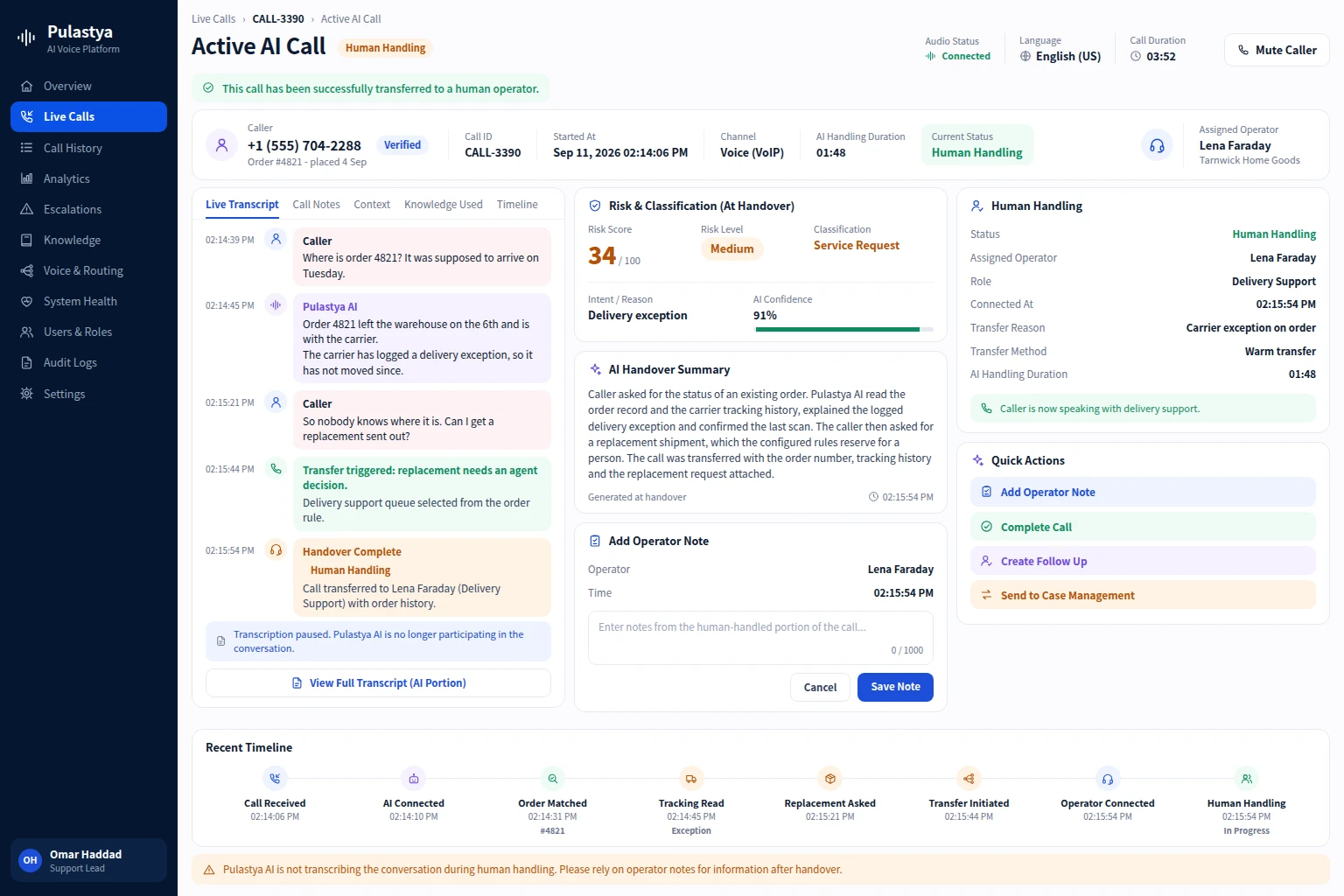
Pulastya, SDLC Corp's voice agent platform, is one implementation of that pattern, and the screen above shows those settings; on a warm transfer the person who picks up sees the live transcript, an AI handover summary and the reason the call was routed to them, so the customer is not asked to repeat the order number they just read out.
The coverage gap worth costing separately is after hours, at weekends and during sale events, because those are exactly the windows when queue times are longest and an abandoned call is an abandoned order.
Decision guide
Resolve, Capture or Escalate Order Calls
| Call type | Agent action | Handled by |
|---|---|---|
| Return or shipping policy question | Answer from approved documents | AI voice agent |
| Order status, no integration | Capture order number and set expectations | Support team follow-up |
| Order status, integrated and verified | Share approved status details | AI voice agent |
| Return outside the policy window | Explain policy and capture details | Support team decides |
| Damaged, wrong or missing item | Transfer with order context | Support specialist |
| Unrecognized order or payment dispute | Transfer immediately | Fraud or billing team |
Mapping each order call type to an action and an owner keeps refunds, exceptions and fraud decisions with people.
How to Plan an E-commerce Voice Agent Rollout
Start with calls that policy documents can answer, add live order data once verification rules are agreed, and expand after reviewing real transcripts. This sequence keeps early risk low, because a documents-only agent cannot disclose order details it cannot see.
- Rank call reasonsUse contact reasons or call notes to find the order, delivery and returns questions that repeat most.
- Prepare policy documentsWrite shipping, returns, refund and warranty content the way it should be spoken, with a named owner.
- Define verification and disclosure rulesAgree which identifiers allow which details to be shared, and what happens after a failed match.
- Scope the integrationStart with read-only order and tracking lookup, and add write actions only after they prove safe.
- Test commerce edge casesInclude split shipments, preorders, partial refunds, gift orders and misheard order numbers.
The guide to testing AI voice agents before production explains how to build scenario sets. Two practical points apply to any commerce rollout.
Run those scenarios as real spoken test calls rather than typed prompts, because a misheard order number, a caller talking over the agent and an order lookup that times out are failures you only hear on the phone.
Check that the published number can move without being reissued, since a store number printed on packing slips and invoices is worth more than the agent behind it.
Order system integrations vary by commerce stack, so confirm what any vendor supports for your order, shipping and payment systems before planning live lookups, and treat a documents-only launch as a legitimate first phase rather than a compromise.
The Pulastya screens above show how order context and a handoff summary reach the support agent along with the caller. Pulastya is delivered and supported by SDLC Corp; the AI voice agent platform for inbound and outbound calls page sets out how setup and call handling work, and a walkthrough of an inbound call shows the flow end to end before you scope a pilot.
Conclusion
An AI voice agent for ecommerce can answer common order, delivery, returns and product questions using approved store information. With the right order-system integration and caller verification, it can also provide current status updates without asking every customer to wait for a support representative.
A reliable rollout starts with accurate policies and clearly defined permissions. Keep sensitive order details behind approved verification, and route damaged items, payment disputes, refund exceptions and failed lookups to trained staff with the conversation context attached. This approach helps online retailers make routine calls easier to handle while preserving human judgment where it matters.
Frequently Asked Questions
Only with an integration to the order management or shipping system. With that connection and a verification step, it can report fulfillment and tracking status. Without it, the agent explains shipping policies, captures the order number and says how the team will follow up.
It can explain the return and refund policy from approved documents and, where integrated, report the status of a specific return. Approving exceptions, issuing goodwill refunds and resolving damaged-item claims should stay with staff, who receive the order details and call summary at handoff.
Match the order number with a second detail from that order, such as the email address or postal code, and limit what is shared even after a match. Caller ID alone is weak evidence, and sensitive verification may belong with staff or a dedicated verification process.
The underlying technology is similar, but e-commerce calls center on order numbers, carrier statuses, return eligibility and payment-related data. That makes integration scope and disclosure rules the main design work, while general support deployments focus on broader service requests and troubleshooting.