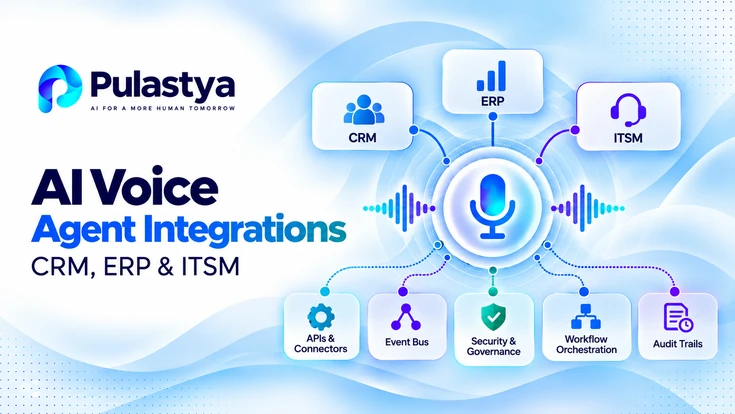
AI voice agent integrations connect conversational voice systems to enterprise CRM, ERP, and ITSM platforms to automate tasks, surface contextual data, and accelerate resolution.
Integrations shift voice from a siloed channel into an enterprise service fabric that enforces data governance, business rules, and secure audit trails for customer and employee voice interactions.
- Integration patterns Use adapter, middleware, or event-driven models based on latency, data volume, and transactional needs.
- Operational controls Design for audit trails, retry semantics, idempotency, role-based data access, and monitored KPIs.
- Business outcomes Reduce handle times, improve first-contact resolution, and automate routine ERP and ITSM transactions.
Enterprises implementing AI voice agent integrations prioritize three outcomes: reliable data flow between voice and back-end systems, predictable business-rule execution inside calls, and measurable reductions in manual work.
Success requires clear mapping of voice intents to CRM records, ERP transactions, and ITSM tickets, as well as runtime orchestration that preserves transactional consistency and auditability for compliance.
IT, contact center, and automation teams need sound integration patterns, clear technical tradeoffs, practical call-flow details, and operational controls. Technical decision makers must evaluate architecture, latency, data mapping, and event-driven behavior to adopt voice automation at scale while minimizing risk to master data and service SLAs.
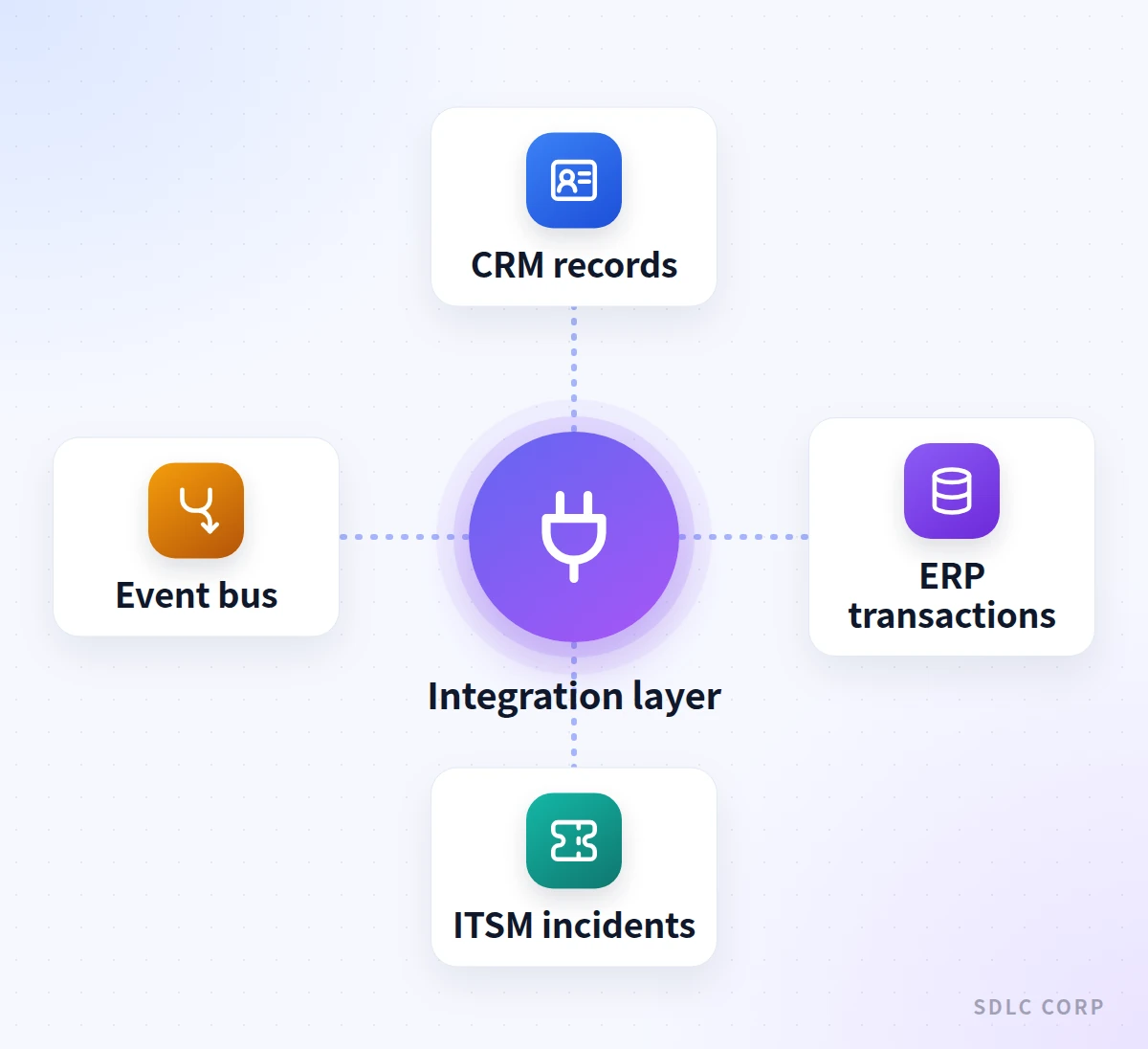
Integration Patterns: Adapters, Middleware, and Events
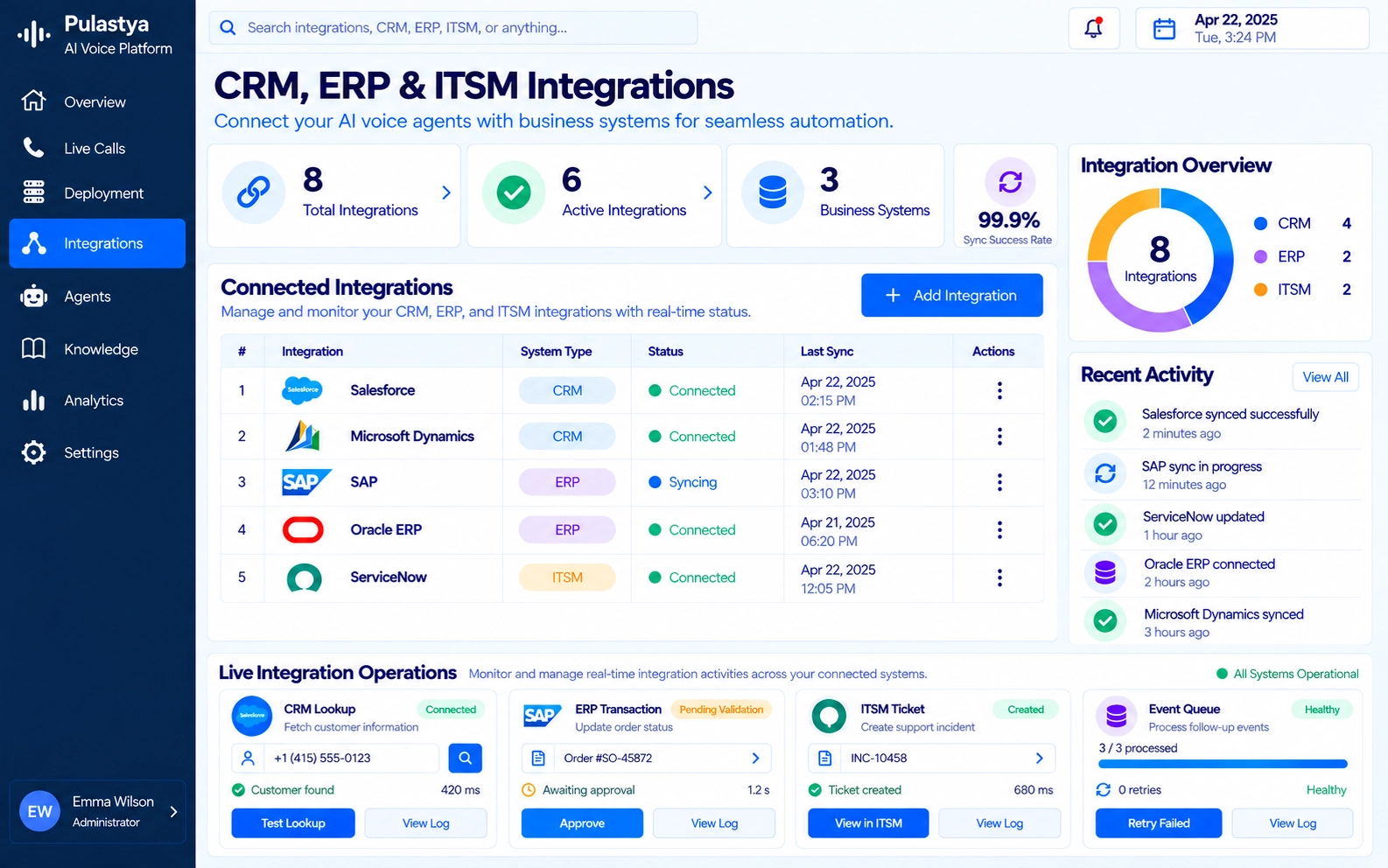
Choose an integration pattern by matching voice latency and transaction complexity to back-end semantics. Adapters are simple for point-to-point CRM or ITSM calls where synchronous reads and writes suffice.
Middleware fits scenarios requiring orchestration, enrichment, long-running transactions, or protocol translation. Event-driven pipelines suit high-volume notifications and eventual-consistency ERP updates where voice triggers asynchronous workflows.
Adapters minimize stack complexity but create brittle coupling if you connect many systems. Middleware centralizes transformation, security, and retry policies at the cost of an extra component to maintain. Event-driven architectures offload synchronous constraints and improve scalability but require rigorous idempotency and reconciliation design to prevent duplicate financial or inventory transactions.
In practice, enterprises often use a hybrid approach: adapter for CRM lookups during a call, middleware for decisioning and enrichment, and events to update ERP and ITSM after call completion. Define ownership for each flow, ensure observability for message routing, and codify SLAs between components so voice teams and back-end owners share operational responsibilities.
Where internal teams cannot staff the middleware and event layer, an implementation partner offering AI development services can design the adapters, orchestration and event contracts together with the CRM, ERP and ITSM owners.
- Adapter: low latency CRM reads and writes
- Middleware: enrich, orchestrate, enforce policies
- Events: asynchronous ERP and inventory updates
- Hybrid: combine sync during call, async after call
Match the pattern to transaction criticality, not convenience.
Integration decision guide
Which Integration Pattern Fits CRM, ERP and ITSM on a Call
| System | Voice use | Integration pattern |
|---|---|---|
| CRM | Look up account, contact or case during the call | Synchronous adapter read; confirm identity before any write |
| ERP | Start an order, check a purchase order or request a hold release | Middleware with staged transactions, idempotent tokens and reconciliation |
| ITSM | Create and enrich incidents from the caller's description | Adapter or middleware create with CMDB links and limited-privilege access |
| All systems after the call | Record outcomes, transcripts and follow-up updates | Asynchronous events with versioned schemas and a reconciliation queue |
Synchronous reads stay in the call, while anything that changes financial or inventory state goes through staged middleware or events.
Mapping Voice Intents to CRM Records
Map intents to stable CRM entities and unique identifiers before using voice to modify records. A pragmatic approach uses intent classification plus slot extraction: identify account, contact, case, or opportunity and extract canonical IDs or stable attributes for disambiguation. If the caller does not provide unique IDs, implement a short verification flow to confirm identity before data access or modification.
Design lookup fallbacks when intent confidence is low: escalate to a human agent, request a verification code, or trigger multi-factor identity checks that adhere to privacy policy.
Never apply unconfirmed updates; require explicit confirmation for destructive actions like order cancellations or payment-method changes. Maintain an audit trail including recognized intent, confidence scores, matched record IDs, and agent overrides.
For enterprise CRMs with complex data models, implement a mapping layer that normalizes fields, enforces business rules, and logs transformation lineage. This layer should also sanitize and redact PII when downstream audit or analytics systems do not require raw data. Clear data retention and purging rules reduce regulatory exposure when voice transcripts and derived data persist across systems.
- Use canonical identifiers for record updates
- Require confirmation for destructive actions
- Log intent confidence and decision lineage
- Sanitize PII before downstream persistence
Never update CRM records from voice without identity confirmation and logged consent.
ERP Integration: Transactional Integrity and Reconciliation
ERP interactions triggered by voice agents must respect financial controls and inventory constraints. Avoid direct synchronous writes for complex transactions; instead use staged transactions with clear rollback or compensation steps. For example, a voice agent that initiates an order should create a provisional order or hold and then trigger a controlled settlement process that includes business validations in ERP.
Design reconciliation processes to catch partial failures: voice may confirm an action to the caller while ERP updates fail downstream. Implement unique transaction tokens and idempotent APIs so retries do not create duplicates. Maintain a reconciliation queue with human review for exceptions, and instrument alerts for unresolved discrepancies older than operational thresholds.
Where regulations require, implement approval workflows that pause ERP finalization until compliance checks complete. Voice-driven approvals can record consent but should not auto-execute high-risk financial transactions without multi-channel validation and explicit authorization steps tied to a recorded audit trail.
- Use staged or provisional ERP transactions for safety
- Implement idempotent APIs and transaction tokens
- Automate reconciliation with exception review queues
- Require multi-channel validation for high-risk actions
Treat voice-initiated ERP changes as business transactions with compensating controls.
ITSM Integration: Incident Creation, Enrichment, and Resolution
Integrate voice agents with ITSM systems to automate ticket creation and pre-populate context from the call. Capture device identifiers, error messages spoken by the user, and recent telemetry keys when available. Use voice analytics to classify urgency and route tickets to the correct assignment group. Ensure the voice flow records caller statements that justify priority changes to satisfy SLA audits.
Enrichment can reduce mean time to resolution: link the ticket to configuration management database (CMDB) records, attach relevant logs, and attach a short transcript plus extracted keywords. Provide agents with a concise summary generated from the call and the steps the voice agent attempted, so human responders understand what was tried before the handoff.
Design closures to require confirmation and record resolution comments. If automated remediation occurs, log script execution details, results, and rollback identifiers. Maintain strict role-based access so voice agents can create and update tickets with limited privileges, while bulk-sensitive operations remain gated to human approval.
- Auto-create tickets with CMDB linkage
- Attach transcripts and extracted error keywords
- Log automated remediation scripts and rollbacks
- Enforce role-based limits for ticket updates
Use voice to accelerate triage, not to bypass ITSM controls.
Runtime Controls: Security, Privacy, and Compliance
Security must be baked into the voice integration fabric: secure token exchange, mutual TLS between middleware and back ends, and short-lived credentials for runtime calls.
Apply least-privilege to what the voice agent can read or write; store secrets in vaults, and rotate them frequently. Log access at the field level so auditors can trace who or what accessed specific data during a voice session.
Privacy controls include on-the-fly redaction, consent capture, and selective transcript retention. Implement configurable redaction filters that remove account numbers, SSNs, or payment data before storing transcripts. For regulated interactions, persist only the metadata and a hashed reference to the transcript to meet data minimization requirements while enabling dispute resolution.
Compliance relies on both technical and operational controls: consent records for calls, role-based audit trails, retention schedules, and regular access reviews. Build monitoring dashboards that surface unusual access patterns, and automate suspension of suspicious sessions. Ensure legal and compliance stakeholders approve the data flow diagrams before production deployment.
- Mutual TLS and vault-based secret management
- Field-level access logs and audit trails
- On-the-fly PII redaction and retention policies
- Automated monitoring for anomalous access
Treat voice sessions as privileged transactions requiring strict controls.
Operationalizing at Scale: Monitoring, SLAs, and Runbook Design
Operationalize voice-agent integrations with end-to-end SLAs across voice, middleware, and back-end systems. Define latency targets for synchronous lookups during calls and separate targets for asynchronous updates. Instrument call success, intent confidence, downstream write success rate, and reconciliation backlog so SREs and business owners have clear, actionable KPIs.
Create runbooks that cover common failure modes: voice transcription degradation, adapter timeouts, ERP reconciliation errors, and identity verification failures. Each runbook must define detection thresholds, immediate mitigation steps, and recovery actions, plus escalation paths to application and data owners. Simulate failure scenarios in staging to validate runbook effectiveness before production use.
Scale operations by applying traffic shaping, circuit breakers, and priority queues so critical calls receive resources during peak load. Use canary deployments for new integration logic and feature flags for rapid rollback. Maintain a single source of truth for integration mappings and keep schema transformations versioned to avoid silent production breakage.
- Define latency SLAs for sync vs async operations
- Create runbooks for transcription and adapter failures
- Use circuit breakers and priority queues under load
- Version transformation schemas and mappings
Measure end-to-end SLAs not component-level metrics alone.
Example: Resolving a Supply-Chain Incident via Voice
A logistics director calls the enterprise voice agent to report delayed shipments linked to a specific purchase order. The agent verifies identity, extracts the PO number, queries ERP for status, and finds a warehouse hold due to missing compliance documents.
During the call the agent reads the hold reason and asks whether it should link the compliance document already stored in the document management system to the order, confirming the director's consent before proceeding.
Once consented, the voice agent routes an event to middleware to link the document and triggers a staged ERP update that requests release of the hold, which stays pending until final validation passes.
The agent creates an ITSM ticket linking the ERP transaction and CMDB record for the responsible warehouse system. If validation fails, a human ops engineer receives the ticket with the call transcript and automated enrichment to triage quickly.
This scenario demonstrates how voice can accelerate incident discovery, decision capture, and cross-system orchestration while preserving approvals and audit trails. The design uses staged ERP commits, idempotent transaction tokens, and middleware enrichment to ensure that voice-initiated actions do not create orphaned transactions or regulatory exposures.
- Verify identity before record access
- Use staged ERP updates with validation
- Create linked ITSM tickets for human follow-up
- Log consent and attach the call transcript
Voice can shorten resolution cycles when integrated with staged transactions and clear audit paths.
The integration boundary becomes clearer when paired with real-time API design and the broader phone-call-to-workflow architecture.
For using CRM data during the call, see CRM personalization in AI voice agents.
Conclusion
Successful AI voice agent integrations with CRM, ERP, and ITSM systems depend on using the right connection pattern for each task. Low-latency adapters support verified CRM lookups, middleware manages controlled ERP transactions, and events coordinate asynchronous updates and ITSM follow-ups. Identity checks, explicit approvals, idempotent operations, and audit trails keep these workflows reliable and secure.
Start with a focused use case, such as authenticated CRM status requests or automated ITSM ticket creation, and test latency, data privacy, failure recovery, and reconciliation before expanding. Measure call resolution, downstream transaction success, and end-to-end SLAs to identify improvements. With clear system ownership and operational controls, AI voice agents can turn conversations into dependable enterprise actions without compromising governance.
Frequently Asked Questions
Design CRM lookups for sub-second to one-second latency during live calls to avoid poor user experience. If back-end constraints prevent that, use a staged approach: perform a quick read for minimal validation in-call, then enrich the record asynchronously and notify the caller when final data is available.
Implement idempotent APIs and unique transaction tokens generated at the start of a voice flow. Store token state until final settlement; reject or reconcile duplicate tokens. Combine tokens with business rules and reconciliation queues so human review resolves ambiguous duplicates efficiently.
Key controls are dynamic redaction of PII, consent records tied to the session, retention schedules aligned with policy, and hashed references when transcripts cannot be retained. Apply access controls and logging so only authorized roles can view raw audio or unredacted transcripts.
SLAs should be jointly owned by the voice platform team, the middleware or integration team, and the back-end application owners. Document end-to-end targets, incident responsibilities, and escalation paths so each team can act decisively during outages or performance degradations.
Begin with a narrow use case that has clear success criteria, such as automated ticket creation for a defined incident class or CRM status lookups for authenticated callers. Validate identity flows, transaction safety, and runbooks in a controlled environment before expanding scope.