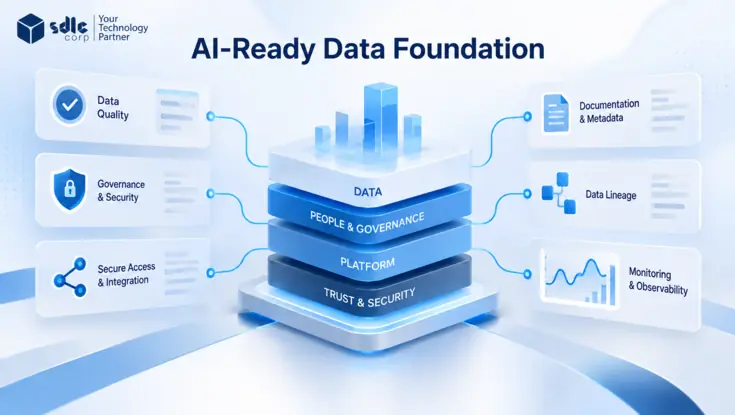
An AI-ready data foundation combines data quality, governance, access, documentation, and monitoring capabilities that allow AI systems to use enterprise information reliably in production.
Many enterprise AI initiatives struggle for reasons beyond the model itself. Problems often arise because teams store required data across fragmented systems with inconsistent formats, weak documentation, or restrictive access paths.
Enterprises can build an AI-ready foundation around a priority use case without waiting for a complete data transformation. The required scope depends on the AI system, the information it consumes, and the operational risk involved.
- What it is: The data quality, governance, access, documentation, and monitoring capabilities a production AI application depends on
- What it is not: A requirement to modernize every enterprise dataset before starting AI
- Scope principle: Assess readiness for each use case rather than assuming it across the enterprise
- Main outcome: AI systems that work with trusted, governed, and monitored information
- Not the same as AI readiness: this page covers the data layer. Strategy, use-case selection, operating model, people and delivery capability are assessed in enterprise AI readiness
What Is an AI-Ready Data Foundation?
An AI-ready data foundation exists when the information required by a specific AI application is reliable, accessible, governed, documented, and monitored.
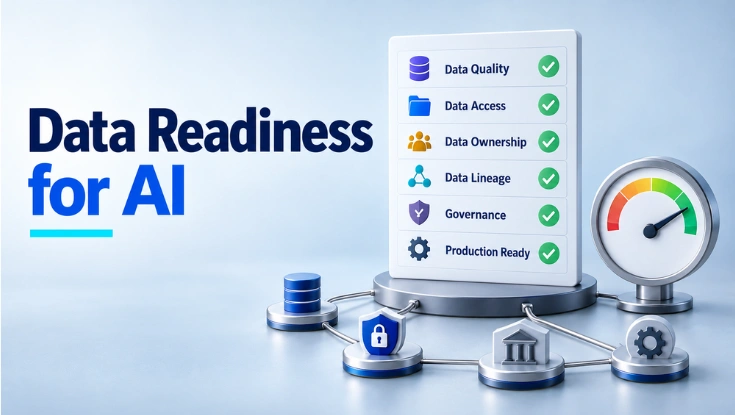
Data that is ready for AI is:
- Accurate and complete enough for the intended use
- Consistent across the systems involved
- Accessible through controlled interfaces rather than manual exports
- Documented with business meaning and known limitations
- Traceable to its sources
- Protected by permissions aligned with each user's role and responsibilities
- Monitored for changes that could affect AI outputs
Readiness is always relative to a purpose. A dataset can support one AI use case and remain unsuitable for another. Therefore, assess each dataset against the intended application instead of making an abstract enterprise-wide judgment.
Why AI Projects Struggle Without a Strong Data Foundation
When AI initiatives stall, weaknesses in the data foundation are often one part of the problem.
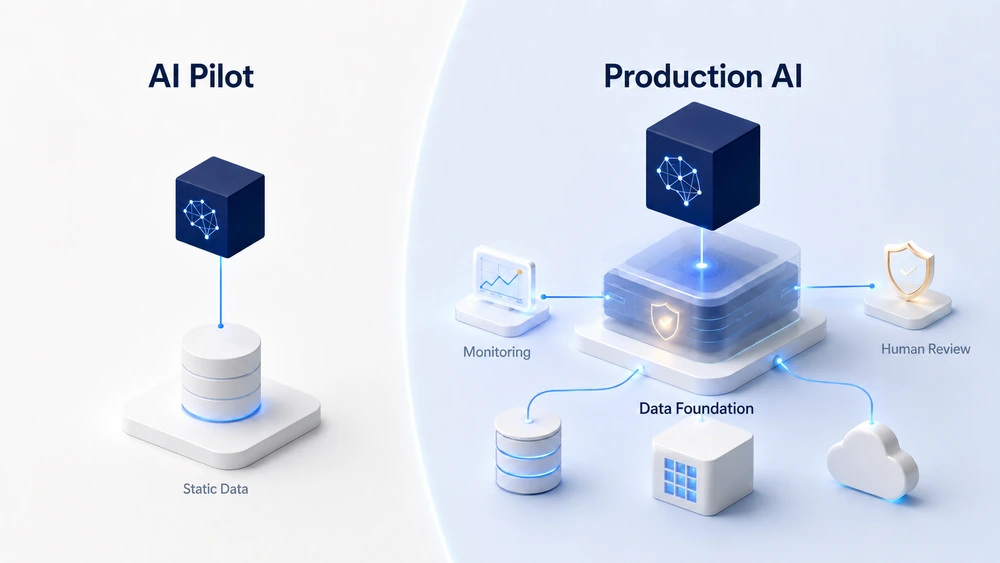
The Pilot Data Does Not Match Production Data
Pilots often run on small, manually prepared datasets. Production systems must work with live data that contains gaps, duplicates, and format differences the pilot never encountered.
Information Is Locked in Disconnected Systems
The knowledge or records an AI system needs may sit across ERP, CRM, document stores, and legacy platforms with no reliable way to retrieve them together.
The Same Facts Exist in Conflicting Versions
When customer, product, or financial records differ between systems, the AI may rely on an outdated source or produce inconsistent outputs unless data owners define source priority.
No One Owns the Data the AI Depends On
Without ownership, nobody is responsible for fixing quality issues, approving access, or reviewing whether the data remains suitable as the application evolves.
Access Rules Are Unclear or Absent
AI systems that retrieve information on behalf of users must respect existing permissions. When an organization lacks clear permission rules, the system may expose information too broadly or restrict access so heavily that users lose value.
No One Notices When the Data Changes
Source systems evolve. Without monitoring, schema changes, new categories, or shifting data patterns can reduce output quality without giving teams immediate visibility into the cause.
Data readiness addresses only one part of production AI; architecture, deployment, governance, and monitoring belong to the wider discipline of enterprise AI modernization.
Core Components of an AI-Ready Data Foundation
An AI-ready data foundation combines six components. Apply each component to the sources, fields, documents, and events that the planned AI system actually uses. This bounded scope helps business, data, security, and AI teams agree on what “ready” means before development begins. Building the pipelines, contracts, and platform layers underneath is data engineering work, and that is where most of the delivery effort usually sits.
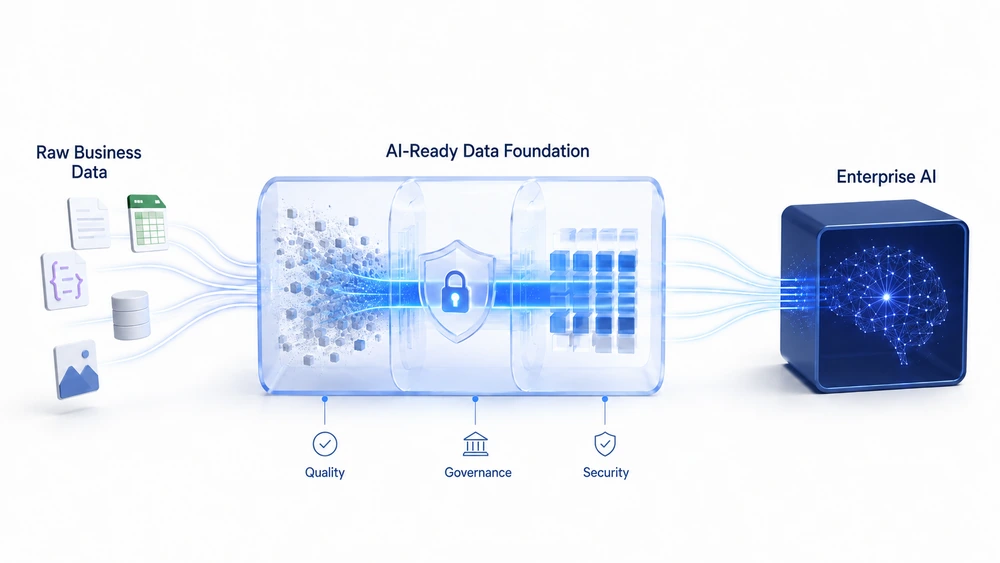
Data Quality
Data quality includes validation rules, duplicate removal, standardized formats, and cross-system reconciliation for the datasets behind the target workflow. Teams should measure completeness, accuracy, consistency, uniqueness, validity, and timeliness against use-case thresholds. Our Data Quality Framework explains how to define those controls and connect failed checks to corrective action.
Quality work continues after the first cleanup. Automated tests should run when data enters a pipeline, after material transformations, and before an AI system consumes the result. Owners then receive an alert with the affected dataset, failed rule, business impact, and expected response time.
Data Governance and Ownership
Data governance establishes named owners, documented business definitions, and clear processes for approving access and resolving recurring issues. It gives AI teams a direct answer about whether they may use a dataset, under which conditions, and who approves that use. The Data Governance Framework provides the wider operating model for councils, stewards, policies, and issue management.
DAMA-DMBOK offers a recognized body of knowledge for governance, data quality, metadata, integration, security, and other data-management disciplines. Enterprises can use its common language to organize responsibilities while adapting the practices to their own risk, scale, and technology.
Integration and Access
Integration provides controlled interfaces such as APIs, governed datasets, event streams, and retrieval services. These interfaces let AI systems access information without depending on manual exports. Each path needs an owner, service expectation, authentication method, version policy, and recovery process.
Good access design separates convenience from entitlement. A fast retrieval service still must evaluate the user's identity, role, purpose, and data classification. It should also record which source items contributed to an output so investigators can reconstruct important results.
Metadata and Lineage
Metadata documents what each dataset means, where it comes from, who owns it, how engineers transform it, and how recently it changed. Lineage connects an AI output to source data, transformations, retrieval steps, prompt versions, and model versions. This evidence speeds troubleshooting and supports review.
Start with metadata that changes a decision. Owners, sensitivity, freshness, approved purpose, schema, known limitations, and source priority usually matter more than a large catalog with incomplete fields. Automate technical metadata capture wherever possible, then ask stewards to maintain business context.
Security and Permissions
Security controls include role-based access, sensitivity classification, encryption, masking, retention rules, and isolation of sensitive information. The AI system should reach only the data that its current user may view. Designers should exclude sensitive fields whenever the workflow does not need them.
The NIST AI Risk Management Framework organizes AI risk work around Govern, Map, Measure, and Manage. Data controls support all four functions by documenting context, measuring quality and risk, assigning accountability, and maintaining safeguards throughout operation.
Document and Retrieval Preparation
AI systems that answer questions from documents need organized, current, and searchable content. Content owners should remove obsolete versions, resolve duplicates, preserve headings, add useful metadata, and split documents into meaningful retrieval units. Evaluation sets must test whether retrieval returns the right evidence for representative questions.
NIST's Generative AI Profile extends the AI RMF with risks and actions specific to generative AI. Teams can use it to shape retrieval testing, content provenance, incident handling, and human oversight for knowledge assistants.
Management System and Continual Improvement
Strong technical controls need a durable management process. ISO/IEC 42001 specifies requirements for establishing, implementing, maintaining, and continually improving an AI management system. Its lifecycle perspective reinforces the need for assigned roles, documented objectives, performance evaluation, and corrective action.
An enterprise does not need to pursue certification before it improves data readiness. It can still borrow the management-system discipline: define scope, assign accountability, retain evidence, review performance, and improve controls when risks or operating conditions change.
Organizations normally develop these capabilities through broader enterprise data modernization work. However, they can apply them first to the information required by a priority AI application and expand the pattern with each new use case.
Data Requirements for Different AI Systems
Different AI systems place different demands on the data foundation. Match preparation to the system type so the team neither overlooks a critical control nor spends time improving unrelated data. The table turns three parallel requirement sets into one practical comparison.
| AI System Type | Required Data Characteristics | Essential Controls and Evidence |
|---|---|---|
| Predictive Analytics, Machine Learning, and Analytics Assistants |
|
|
| Knowledge Assistants and Document AI |
|
|
| Workflow and Decision Automation |
|
|
Teams should translate each row into measurable acceptance criteria. For example, a service assistant may require that approved policies enter the retrieval index within four hours, while a fraud model may need transaction features within seconds. The business decision sets the freshness target; the technology follows that need.
Risk also changes the depth of evidence. A recommendation that helps an analyst explore options may tolerate a lower threshold than an automated action that changes a customer's account. Higher-impact systems need stronger validation, clearer escalation, and more detailed decision records.
How Much Data Readiness Is Enough?
Enterprise-wide data perfection is not the goal, and waiting for it can delay useful AI initiatives unnecessarily.
The practical standard is readiness for the selected use case: its data must meet the required reliability, access, governance, and fitness thresholds. Teams can improve information outside that scope when future AI applications need it.
Key principle: make the data ready for the use case, and make the work reusable. Each improvement should follow the long-term data architecture so it becomes a permanent part of the foundation, not a throwaway fix.
This approach reduces the risk of launching AI on unreliable data without delaying the initiative until teams modernize every enterprise dataset.
For the broader workstream decision, compare data modernization vs AI modernization.
Consider an internal policy assistant. The organization may not need to modernize finance, customer, and product data first. It does need current and approved policy documents, clear ownership, useful metadata, and retrieval that follows each user's access permissions. Preparing that limited information properly can support the assistant while also creating reusable document governance controls.
Set Acceptance Criteria Before Development
Translate readiness into thresholds that the team can test. A customer model might require a defined match rate for customer identifiers, a maximum percentage of missing values in key fields, and an agreed update interval. A knowledge assistant might require approved sources, citation coverage, permission checks, and a target retrieval score on a representative question set.
Business owners should choose thresholds according to the consequence of error. Data engineers can then explain the cost and feasibility of reaching them. This discussion produces a clear release decision instead of a vague claim that the data looks good enough.
Use Evidence, Not Confidence
A readiness decision should point to evidence: profiling results, quality-rule outcomes, access tests, source inventories, lineage records, retrieval evaluations, and owner approvals. Store that evidence with the use-case documentation and update it when the system or its sources change.
The Data Readiness Assessment gives teams a structured way to identify gaps, assign actions, and record the decision to proceed. It also helps separate launch blockers from improvements that can follow in later releases.
Apply Risk-Based Release Gates
Not every use case needs the same gate. A low-impact assistant that drafts internal summaries may launch with strong user review and limited access. An automated system that affects pricing, eligibility, safety, or regulated reporting demands stricter data validation, independent review, decision logging, and rollback controls.
Define three outcomes for every gate: ready, ready with controls, or not ready. “Ready with controls” might require human approval, narrower scope, lower transaction limits, or more frequent monitoring. Teams should document the control owner and the date for reassessment.
Reassess When Conditions Change
Readiness can expire. A source-system migration, new product category, policy revision, permission-model change, or user expansion may invalidate earlier evidence. Connect these events to a reassessment trigger so the AI owner does not rely on an old approval.
Regular reviews should compare current metrics with the release baseline. When a measure moves outside tolerance, the owner can pause the affected workflow, route cases to people, repair the source, or temporarily narrow the system's scope.
How to Build an AI-Ready Data Foundation Step by Step
Building a reusable foundation for a selected AI application follows a repeatable sequence:
- Select the AI use case firstDefine the business outcome, the users, and the decisions or actions the AI system will support.
- Map the data the planned system needsIdentify the systems, datasets, documents, and fields involved, including where the same facts exist in multiple places.
- Assess quality, access, and ownershipReview the data, confirm who owns it, and document quality issues, permission rules, and missing information.
- Prepare the required dataStandardize formats, remove duplicates, reconcile conflicting records, and validate the data the application requires. Establish controlled access paths.
- Document and governRecord definitions, lineage, limitations, and approved uses. Assign ongoing ownership and define how owners will resolve data issues.
- Connect the AI system through controlled interfacesIntegrate through APIs or retrieval services that respect permissions, rather than copies and manual exports.
- Monitor the data in productionTrack quality, freshness, and changes in source systems, and alert the responsible owners when a source changes in a way that could affect AI outputs.
The first use case often requires the most foundational work. Later use cases can reuse the interfaces, governance controls, and monitoring already established.
Define Deliverables for Every Step
Each stage should produce something that the next stage can verify. Use-case selection produces an outcome statement, risk classification, user group, and success measures. Data mapping produces a source inventory, field list, flow diagram, and record of conflicting sources. Assessment produces measured gaps, owners, and priorities.
Preparation should deliver tested transformations, resolved duplicates, reference-data rules, and controlled access paths. Governance work adds definitions, approvals, lineage, retention decisions, and known limitations. Integration delivers versioned interfaces with authentication, logging, service expectations, and recovery procedures. Monitoring adds thresholds, alerts, response playbooks, and review schedules.
Run Business and Technical Work Together
Business owners understand meaning and acceptable risk, while data teams understand sources and failure modes. Security teams define access and handling requirements. AI engineers explain how retrieval, features, prompts, models, and agents consume the information. Bring these roles into the same review instead of passing documents between isolated workstreams.
A short weekly readiness review can remove delays. Review new profiling evidence, unresolved ownership questions, access decisions, evaluation results, and risks to the release date. Record decisions and named actions immediately so the same uncertainty does not return in the next meeting.
AI-Ready Data Foundation Checklist
Use this checklist to assess whether the data behind a planned AI application is ready for production.
- Teams measure quality levels instead of assuming them
- Data owners resolve duplicates and conflicts within the required data
- Validation rules run at the frequency the AI application requires
- Every critical data source required by the application has a named owner
- Stewards maintain clear business definitions
- Owners follow a defined process for resolving data issues
- AI systems access data through controlled interfaces
- Permissions match each user's approved access
- Controls exclude or mask sensitive fields when the workflow does not need them
- Lineage traces sources and transformations
- Owners record known limitations
- Users can see when the data last changed
- Production monitors track quality and freshness
- Material source-system changes that could affect the AI system trigger alerts
- Named owners investigate findings and follow defined response actions
Treat unchecked items as deployment risks. Resolve them, add appropriate controls, or formally accept the risk before launch.
Common Mistakes When Preparing Data for AI
- Preparing Data Without a Use CaseTeams cannot assess readiness in the abstract. Select the use case, decision, users, and risk level before defining the required data.
- Waiting for Enterprise-Wide PerfectionPerfect enterprise data does not need to precede AI. Establish readiness for the selected use case and reuse each improvement later.
- Connecting AI Through Manual ExportsSpreadsheet exports can fail silently, become stale, and bypass permission controls. Replace them with governed, repeatable interfaces.
- Ignoring Document Hygiene for RetrievalOutdated policies, duplicate files, and unclear owners weaken retrieval. Curate the source collection before tuning prompts or changing models.
- Treating Readiness as a One-Time ProjectSource data changes continuously. Keep quality, freshness, permissions, and retrieval performance under active monitoring after launch.
- Building Throwaway FixesShort-term pipelines create future rework when they ignore the target architecture. Use reusable contracts, interfaces, metadata, and controls.
Where an AI-Ready Data Foundation Fits in Data and AI Modernization
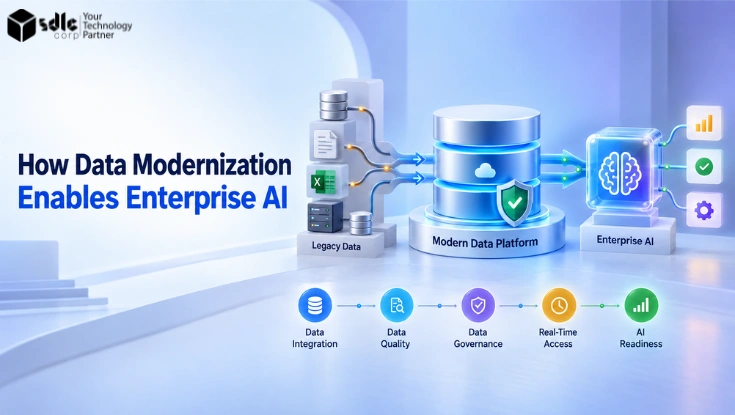
An AI-ready data foundation connects two broader workstreams. Enterprise data modernization provides the integration, quality, governance, and platform capabilities that make each new readiness effort easier, while enterprise AI modernization turns governed information and suitable models into monitored production systems.
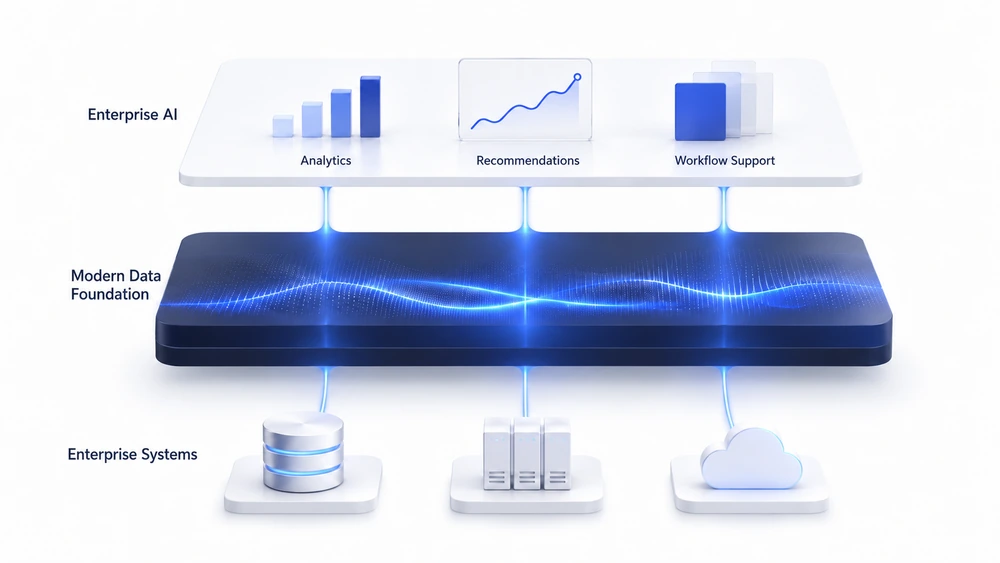
Organizations running both workstreams can make the data required by each AI application a focused part of the wider data-modernization program. They can then prioritize the work according to the planned order of AI releases.
Conclusion
An AI-ready data foundation is one of the main requirements for moving an AI pilot into reliable production.
The foundation does not require enterprise-wide data perfection. Each production use case needs trusted, governed, and continuously monitored data. Every improvement should also follow the long-term architecture so later initiatives can reuse it.
Select the AI application, map the data it requires, address the relevant quality and access gaps, establish governance and monitoring, and connect the AI system through controlled interfaces. Each pass strengthens the foundation for the next.
For organizations planning this work as part of a broader program, our Enterprise Data and AI Modernization Services page explains how data readiness, data modernization, and AI modernization can be delivered together.
Frequently Asked Questions
What Does AI-Ready Data Mean?
AI-ready data is reliable, accessible, governed, and monitored for a specific AI use case, with its meaning and limitations documented. Readiness is always assessed against the intended purpose rather than in the abstract.
Do We Need To Clean All Our Data Before Starting AI?
No. Start with the data required by the selected AI application. Other data can be improved later as additional applications require it.
How Is An AI-Ready Data Foundation Different From A Data Platform?
A data platform provides the technical environment for storing, processing, and accessing information. An AI-ready foundation also requires data quality, ownership, documentation, permissions, and monitoring for the information an AI application consumes. A modern platform alone does not make its data AI-ready.
What Data Do AI Assistants And Chatbots Need?
Knowledge assistants and enterprise chatbots need current, approved content with duplicate and draft material removed. Retrieval must follow user permissions, and answers should be traceable to their original sources.
Who Should Own Data Readiness Work?
Each important data source should have a named business owner, supported by data, security, and AI delivery teams. The AI use case owner should be accountable for confirming that the required data is ready before deployment.
How Long Does It Take To Make Data AI-Ready?
It depends on the number of systems involved, current data quality, and access requirements. A focused application with a limited data scope may take weeks or months, while broader programs usually take longer. The first use case often requires more foundational work because reusable interfaces, governance, and monitoring may need to be established.
How Do We Keep Data AI-Ready After Deployment?
Through monitoring and ownership: track quality and freshness in production, alert owners when source systems change, and review readiness whenever the use case or its data scope evolves.