Home / Blogs & Insights / AI Readiness: How to Assess Your Enterprise Before Scaling AI

AI Readiness: How to Assess Your Enterprise Before Scaling AI

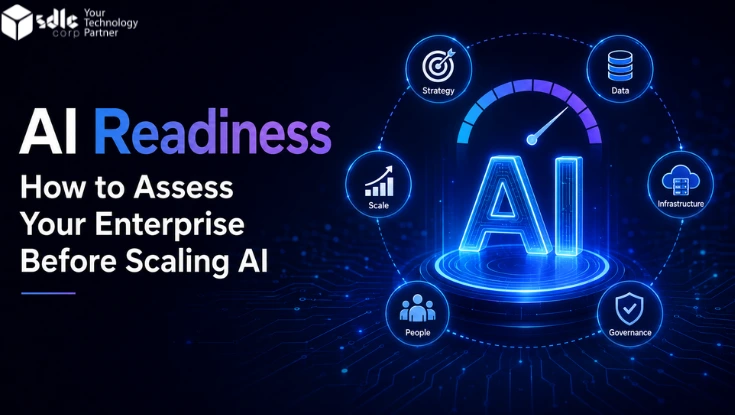
AI readiness assessment showing strategy, data, infrastructure, people, governance, and enterprise AI scalability.

Table of Contents

Enterprise AI Readiness

Access to an AI model does not make an enterprise AI-ready. Production requires reliable data, secure integrations, clear ownership, performance, and cost control.

AI readiness measures whether an organization can build, deploy, govern, operate, and scale AI safely across data, architecture, people, and operations.

This guide provides a practical AI readiness framework to identify gaps and move AI initiatives from pilot to production.

In short: AI readiness is the ability to move a valuable use case from idea to reliable production with the right data, controls, people, architecture, and economics.

Key Takeaways

Readiness is use-case specific. A company can be ready for a low-risk assistant but not for an autonomous financial workflow.
Data is necessary, not sufficient. Architecture, governance, people, and production operations matter just as much.
Production changes the risk profile. Permissions, failures, latency, monitoring, cost, and incident response become real operating concerns.
Assessment should lead to action. Score the gaps, fix the foundations, pilot carefully, validate, and scale proven capabilities.

What Does AI Readiness Really Mean?

AI readiness is the ability to turn a suitable AI use case into a dependable business capability. It covers more than technical access. Instead, it connects business goals with data, technology, controls, people, operations, and cost.

Enterprise AI readiness also differs from AI adoption. A company may already use copilots or chat tools across teams. However, broad adoption does not prove that its data, security, integrations, or operating model can support critical workloads.

AI maturity is different as well. Maturity describes how advanced an organization's AI practices have become over time. Readiness asks a more immediate question: Can this organization deliver this AI use case safely and reliably now?

Use-case test: An internal knowledge assistant may only retrieve approved policy documents. A credit decision system may influence financial outcomes and customer rights. The second use case needs stronger validation, auditability, access control, and human oversight.

Core AI Readiness Framework
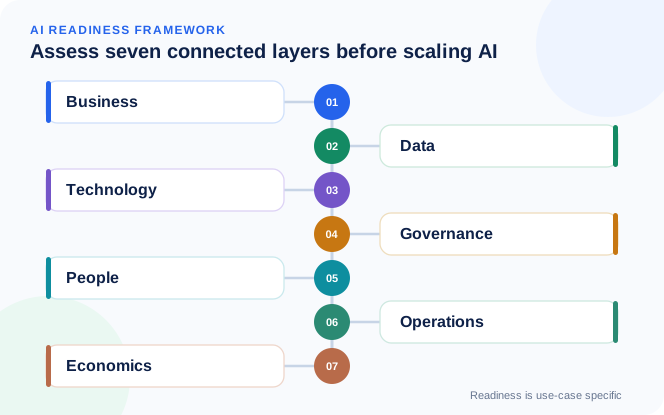
Enterprise AI readiness framework showing business data technology governance people operations and economics
Framework sequence: Business → Data → Technology → Governance → People → Operations → Economics

Each layer can block the next one. Teams should assess the whole system rather than score isolated technologies.

Why AI Initiatives Get Stuck Between Pilot and Production

AI pilots often work because teams limit the data, users, and workflow. Production removes those limits. Consequently, issues that looked small during testing can become operational risks.
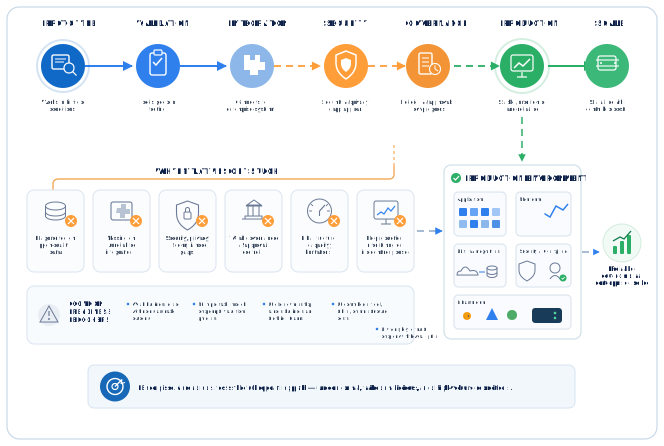
AI pilot to production readiness showing prototype, validation, integration, security, governance, production, and scale

Common Readiness Blockers

A weak business case with no measurable outcome
Fragmented or poor-quality enterprise data
Legacy systems without reliable APIs
Unclear ownership across business and technical teams
Privacy, security, and compliance gaps
No repeatable model or prompt evaluation process
Weak AI governance and approval controls
Missing production monitoring and incident response
Uncontrolled model, token, or infrastructure costs
Low employee trust or poor workflow adoption

Pilot-to-Production Blocker Matrix

BlockerPilot Warning SignProduction ImpactRequired Control
Business ValueNo baseline, owner, or measurable outcomeLow adoption and unclear returnNamed owner, KPI baseline, and acceptance target
Data ReadinessCurated sample data hides quality gapsInaccurate, incomplete, or stale outputsProduction data profiling, lineage, and quality thresholds
IntegrationManual files or temporary connectorsBroken workflows and delayed decisionsSupported APIs, resilient pipelines, retries, and ownership
Security & GovernanceBroad access and informal approvalsUnauthorized actions or compliance exposureLeast privilege, risk classification, approvals, and audit logs
OperationsManual testing and no service targetsUndetected failures and slow recoveryAutomated evaluation, monitoring, incident response, and rollback
Cost & ScaleSmall test volume masks unit economicsBudget overruns and capacity limitsLoad tests, quotas, cost thresholds, and scaling policies

Pilot → Production Gap

The journey looks simple. The hard work sits in the controls between stages.

Prototype
Validation
Integration
Security
Governance
Production
Scale

However, most difficulty sits between these stages. A prototype may answer a question correctly, for example, yet fail when permissions change. Likewise, a useful agent may become unsafe when it receives access to email, payments, or ERP actions.

Enterprise AI readiness should test the complete operating path. A team needs to know how the system behaves under normal, failed, malicious, and high-volume conditions.

Start AI Readiness With the Business Use Case

The best AI readiness framework starts with business value, not model selection. First, define the problem, process owner, affected users, and expected outcome. Then decide whether AI offers a better option than rules, analytics, search, or standard automation.

Assess business value

  • Financial Impact

    Revenue impact, operating cost reduction, or conversion improvement.

  • Operational Impact

    Employee productivity, faster cycle times, and automation rate.

  • Experience & Risk

    Customer experience improvement and measurable risk reduction.

For example, “deploy a support chatbot” describes a solution. “Reduce average resolution time by 20% without lowering first-contact resolution” defines a business outcome.

Assess technical feasibility

Required data availability
Workflow complexity
Integration dependencies
Accuracy requirements
Response-time expectations
Human review requirements
Required level of automation
Build, buy, or integrate decision

High-value use cases can still be poor first projects. For instance, an autonomous workflow may touch six legacy systems with inconsistent customer identifiers. In that case, integration work may outweigh early AI value.

At this stage, also decide whether to build, buy, or integrate the capability. Compare implementation effort, data control, vendor dependency, customization, support, and long-term cost. If the decision is unclear, an AI consulting assessment can help connect the use case to architecture and delivery options.

Classify risk

Low RiskInternal assistance, limited permissions, easy human verification.
Medium RiskCustomer-facing or workflow-impacting use with defined review controls.
High RiskFinancial, legal, safety, or autonomous actions that need stronger oversight.

An internal summarization tool may need moderate controls. In contrast, AI-driven credit approval needs stronger governance, validation, explainability, and human review.

Define success before development

Resolution time
Automation rate
Task accuracy
Cost per completed task
Conversion improvement
Human escalation rate
User acceptance rate

The pilot should prove business value and operational feasibility at the same time.

AI Data Readiness: Can Your Data Actually Support AI?

AI data readiness asks whether an AI system can access the right information with enough quality, context, control, and traceability. This area often becomes the main constraint when organizations move from pilots to enterprise scale.

Scope: For a deeper data-specific review, see AI Data Readiness. That guide focuses on data availability, quality, governance, lineage, permissions, structured and unstructured pipelines, and RAG retrieval readiness. This enterprise assessment also covers business value, architecture, security, people, production operations, and cost.

Check data availability and quality

  • Accuracy

    Does the data reflect the real business state?

  • Completeness

    Are required fields and records present?

  • Consistency

    Do systems use compatible values and definitions?

  • Freshness

    Does the workflow receive updates fast enough?

  • Uniqueness

    Can duplicates distort retrieval or decisions?

  • Validity

    Does the data follow expected formats and rules?

However, “clean data” is not a universal threshold. A weekly planning assistant may tolerate older data. A fraud workflow may require near-real-time events.

Assess structured and unstructured data

Structured sources often include ERP transactions, CRM records, product databases, and financial systems. Meanwhile, generative AI also relies heavily on unstructured content. Examples include contracts, PDFs, emails, images, support transcripts, and knowledge articles.

RAG Data Pipeline

Every transformation can affect what the model eventually receives.

Source
Parse
Clean
Chunk
Enrich
Embed / Index
Retrieve / Model

Teams should test more than the original file. They should also validate extraction quality, chunk boundaries, metadata, embedding updates, retrieval relevance, and index freshness.

Preserve metadata and lineage

Data owner
Original source
Record or document version
Sensitivity level
Transformation history
Index or embedding version
AI applications that consume the data

This lineage helps teams investigate incorrect answers. For example, they can trace a response back to the retrieved chunk and source version.

Enforce permissions after retrieval

Source-system permissions should not disappear after indexing. Instead, access controls must follow content into search indexes, vector stores, RAG services, prompts, and generated answers.

Access-control rule: Without retrieval-time authorization, an employee could receive content they cannot access in the source application. Combine document-level or attribute-level permissions with identity-aware retrieval.

Assess AI Architecture and Integration Readiness

Cloud access alone does not prove architecture readiness. Instead, teams must confirm that existing systems can provide data, invoke models, enforce controls, and support production traffic.

Use the Azure Cloud Adoption Framework Ready guidance and the Google Cloud Adoption Framework to assess landing zones, governance, security, operations, and organizational cloud readiness before scaling AI workloads.

Review Enterprise Integration

Map every dependency across ERP, CRM, e-commerce, warehouses, lakehouses, SaaS tools, legacy platforms, and external APIs. Then select integration patterns based on freshness and workload needs.

For larger programs, AI development services should cover more than model building. The delivery scope should include integration, evaluation, deployment, monitoring, and support.

  • REST APIs

    Request-response interactions and application integration.

  • ETL / ELT

    Batch analytics and data preparation.

  • CDC

    Incremental database changes with lower refresh delay.

  • Event Streaming

    Near-real-time business events.

  • Message Queues

    Reliable asynchronous processing.

For example, a sales assistant may use batch product data but require real-time inventory. Therefore, one use case can need several integration patterns.

Define the AI Application Stack
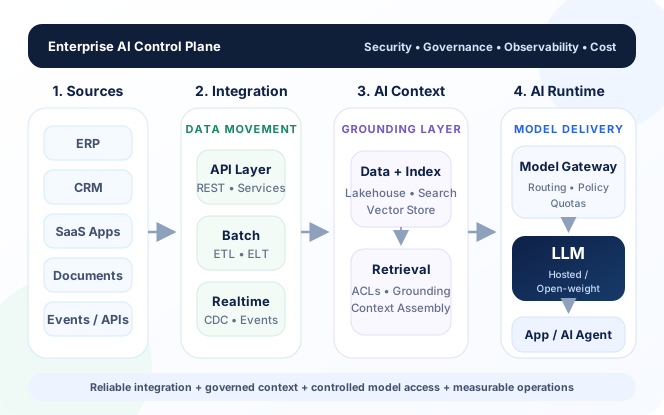
Enterprise AI architecture and integration readiness showing enterprise data sources integration layers retrieval model gateway LLM and AI application

The stack can vary, but most enterprise AI applications follow a common path: enterprise sources, integration and data movement, retrieval or indexing, model access, and business application delivery.

The model gateway can centralize provider access, authentication, routing, logging, rate limits, and cost policies. The retrieval layer should enforce permissions and return relevant context with source references.

Test Infrastructure Capacity

Cloud, on-premises, or hybrid deployment
CPU and GPU requirements
Storage volume and I/O
Network throughput
Model endpoint quotas
Expected concurrency
P50 and P95 latency targets
Availability and recovery targets

P50 is the median response time. P95 shows the response time that 95% of requests meet. Together, they reveal both normal performance and slower user experiences.

Self-hosted models also require capacity planning for model size, GPU memory, batching, and peak concurrency. Hosted APIs remove much of that infrastructure work. However, teams still need quota, latency, privacy, availability, and cost controls.

Choose the Right Model Strategy

Use hosted models when speed and managed operations matter most. Consider open-weight models when control, deployment location, or customization drives the decision. Meanwhile, use RAG when answers depend on current enterprise knowledge.

Fine-tuning can improve task behavior or domain patterns. However, it does not replace retrieval for frequently changing facts. Therefore, model strategy should follow the use case instead of vendor preference.

Review Provider and Portability Risk

If the solution depends on an external model provider, review data retention, regional processing, rate limits, version changes, service availability, and exit options. Avoid designs that make one provider difficult to replace when portability matters.

Assess AI Security, Governance, and Compliance

AI systems create familiar security risks and new AI-specific ones. Therefore, an AI readiness assessment should test controls across data, models, applications, agents, and human workflows.
AI security governance and compliance controls across data models applications and AI agents

Control identity and data access

Identity and Access Management (IAM)
Role-Based Access Control (RBAC)
Attribute-Based Access Control (ABAC)
Service identities
Least-privilege access
Encryption in transit and at rest
PII handling and masking
Data Loss Prevention (DLP)
Secrets management
Data residency controls

Then extend these controls to AI-specific components. For example, an agent should use a scoped service identity rather than a shared administrator credential.

Test AI-specific threats

The OWASP GenAI Security Project highlights risks such as prompt injection, sensitive-information disclosure, excessive agency, and vector or embedding weaknesses. Security testing should include malicious prompts, poisoned content, unauthorized retrieval, unsafe tool calls, and unexpected model outputs.

  • Prompt & Retrieval Abuse

    Test prompt injection, poisoned content, unauthorized retrieval, and hidden instructions.

  • Agent Permissions

    Limit tools, validate parameters, restrict permissions, and require approval for high-impact actions.

Establish AI governance

  • System & Business

    Assign an AI system owner and business process owner.

  • Data & Model

    Assign data ownership plus model or platform ownership.

  • Risk & Approval

    Assign security/risk ownership and human approval for sensitive decisions.

Maintain a working inventory of models, prompts, approved use cases, evaluations, incidents, and major configuration changes. As a result, teams can audit what changed and why.

Formalize these controls through ISO/IEC 42001:2023, which defines requirements for an AI management system. Organizations operating in or serving the EU should also map each use case to the risk, transparency, documentation, and oversight duties in the EU AI Act (Regulation (EU) 2024/1689).

NIST AI RMF Baseline

The NIST AI Risk Management Framework is voluntary and use-case agnostic.

Govern
Map
Measure
Manage

Organizations should still map controls to their industry, geography, contracts, and internal policies. Finally, review fairness, bias, transparency, explainability, human oversight, and accountability according to the use case.

Assess People and Operating-Model Readiness

Technology cannot create enterprise AI readiness on its own. People must understand the system, own the workflow, and know when human judgment takes priority.

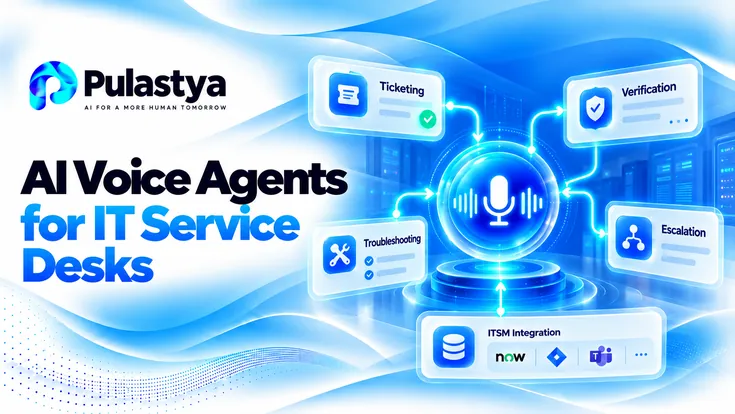
Build a Cross-Functional Team

  • Build & Data

    AI/ML engineers, data engineers, and software engineers.

  • Product & Domain

    AI product managers, domain experts, and business process owners.

  • Control Functions

    Security, governance, risk, legal, and compliance specialists.

Domain experts matter because they define acceptable output quality. Likewise, process owners determine where AI should automate, assist, or escalate.

Improve AI Literacy

Approved AI use cases
Data that users may enter
Output verification requirements
Known limitations
Escalation paths
Security and privacy rules

This approach builds practical trust. In contrast, broad “AI awareness” sessions rarely prepare employees for real workflows.

Define the Operating Model

Business
Data
Engineering
Security
Governance
Operations

A simple RACI model can clarify who approves use cases, data access, model changes, and incidents. Moreover, shared ownership prevents AI from becoming an isolated innovation project with no production support.

Can You Operate AI Reliably in Production?

A successful prototype proves that an idea can work. Production readiness proves that it can keep working under real conditions. A serious readiness review must test both.

Evaluate models and prompts

Accuracy
Relevance
Groundedness
Unsupported or hallucinated claims
Safety
Task completion

Do not rely only on manual spot checks. Instead, combine automated evaluations with expert review for high-impact outputs.

Evaluate RAG separately

  • Retrieval Relevance

    Did the retriever return useful evidence for the question?

  • Context Precision & Recall

    Measure useful context and whether required evidence was missed.

  • Citations & Grounding

    Check whether answers are supported by the sources returned.

For example, a model cannot cite the correct policy if retrieval never returns it. That failure belongs to the retrieval layer, not the LLM.

Production Monitoring

AI observability should connect technical health with business quality.

P50 / P95 LatencyNormal and tail response time.
Token & Task CostCost per request and successful task.
Errors & FailuresModel, tool, request, and fallback failures.
Human EscalationWhere AI cannot safely complete the work.

Cost per request alone can mislead. A cheaper model may require more retries or human correction. Therefore, cost per successful task often gives a better business signal.

Version every important component

Track model versions, prompt versions, retrieval settings, evaluation datasets, and knowledge-base versions. Otherwise, teams may struggle to reproduce failures after a change.

In addition, run regression evaluations before major model or prompt releases. A newer model can improve one task while reducing performance on another.

For predictive ML systems, production controls should also cover drift, retraining, and model performance over time. These practices are core parts of machine learning development and MLOps.

Plan for failure

Retry rules and timeouts
Rate-limit handling
Fallback models
Human handoff
Rollback procedures
Incident response

Safe failure: For high-impact actions, an unavailable model should route a payment exception to a human rather than guess.

AI Readiness Assessment: Score Your Enterprise

A practical AI readiness assessment converts broad discussion into measurable gaps. Use the score to prioritize work, not to create a marketing badge.

Method note: The model below is a practical planning tool, not an industry certification or NIST scoring standard. Adjust the weights for use-case risk, regulatory needs, and operating context.

Eight AI Readiness Dimensions and Assessment Questions

Readiness DimensionCore Assessment Question
Business & Use-Case ReadinessIs the problem valuable, measurable, suitable for AI, and owned by the business?
AI Data ReadinessIs the required data available, accurate, complete, fresh, traceable, and permissioned?
Technology & ArchitectureCan the target architecture meet performance, reliability, security, and portability needs?
Security & GovernanceAre risks classified, access controlled, decisions auditable, and approvals clearly assigned?
Integration ReadinessCan enterprise systems exchange data and invoke AI reliably through supported interfaces?
People & Operating ModelDo the required business, data, engineering, risk, and support roles have clear accountability?
Production & LLMOpsCan teams evaluate, monitor, version, recover, and improve the AI system in production?
Financial ReadinessAre build, run, support, model, infrastructure, and scaling costs understood and controlled?

Recommended scoring framework

Readiness DimensionWeight
Business & Use-Case Readiness15%
AI Data Readiness20%
Technology & Architecture15%
Security & Governance15%
Integration Readiness10%
People & Operating Model10%
Production & LLMOps10%
Financial Readiness5%
Total100%

Score each dimension from 1 to 5. Then calculate its weighted contribution:

RatingPractical meaning
1Major gaps exist and the capability is mostly absent.
2Some capability exists, but controls remain inconsistent.
3Basic capability works for limited or controlled use cases.
4The capability is documented, repeatable, and production-ready.
5The capability is governed, measured, scalable, and continuously improved.

Weighted score = (Dimension rating ÷ 5) × Dimension weight. For example, a data-readiness rating of 3 produces 12 points from the 20-point data category.

Readiness levels

0–39 — Foundation Not ReadyCritical business, data, security, or architecture gaps block safe deployment.
40–59 — Pilot ReadyControlled, low-risk experiments can run with defined limits.
60–79 — Selected Production ReadyDefined workloads can deploy with suitable controls and monitoring.
80–100 — Scale ReadyReusable platforms, governance, operations, and monitoring support wider adoption.

The total score should never override use-case risk. A company may score 82 overall yet remain unready for automated financial decisions. Combine the enterprise score with a separate review for each proposed workload.

Build an AI Readiness Roadmap From Pilot to Scale

The assessment only creates value when teams turn gaps into action. Therefore, use a phased roadmap with clear entry and exit criteria.

Assess Review opportunity, data, architecture, integrations, security, skills, operations, and economics.
Fix Foundations Resolve high-impact gaps such as weak data, access controls, APIs, or ownership.
Prioritize Rank use cases using business value, feasibility, and risk.
Pilot Use real users and representative data with measurable KPIs.
Validate Test accuracy, security, cost, reliability, integration behavior, and adoption.
Productionize Add CI/CD, evaluation gates, monitoring, rollback, escalation, and incident response.
Scale Standardize reusable pipelines, gateways, retrieval, guardrails, governance, and observability.

Phase Details

  1. Assess & Fix

    Document blockers by severity and owner. Resolve missing APIs, poor data quality, weak access controls, unclear ownership, or absent evaluation processes first.

  2. Prioritize & Pilot

    Choose high-value cases with manageable technical and governance demands. Record baseline performance so improvement can be measured.

  3. Validate & Productionize

    If a use case misses agreed thresholds, fix the cause before production. Define service ownership and support expectations.

  4. Scale Carefully

    Reuse platform capabilities, but keep use-case approval separate because risk differs across workflows.

Reassess Readiness as Conditions Change

Readiness is not a one-time result. Review it again after major model changes, new data sources, architecture changes, new regulations, security incidents, or higher-risk use cases.

Final Progression

Assess
Fix
Prioritize
Pilot
Validate
Productionize
Scale

This sequence helps enterprises scale proven capabilities instead of multiplying isolated pilots.

Need an Independent AI Readiness Review?

Assess gaps across data, architecture, governance, security, and production operations before committing to a broader rollout.

Talk To Experts

Conclusion

AI readiness is not about having access to the latest LLM. Instead, it shows whether an enterprise can turn AI into a reliable business capability.

Strong enterprise AI readiness combines a valid business case with AI-ready data, sound architecture, secure integrations, governance, skilled teams, production controls, and sustainable economics. Organizations should assess these areas before committing to broad deployment.

Use the AI readiness assessment to find the weakest links first. Then strengthen those foundations and validate each use case against real production requirements. This approach creates a safer path from experimentation to measurable AI scale.

Frequently Asked Questions About AI Readiness

These questions cover the points enterprise teams most often need to resolve before moving AI from experimentation to production.

How do you know if an enterprise is AI-ready?

An enterprise is AI-ready when it can move a suitable use case from idea to production with reliable data, secure integrations, clear ownership, measurable quality, governance, monitoring, and cost control. Readiness should be tested for each use case because risk and technical requirements differ.

What should an AI readiness assessment include?

An AI readiness assessment should review business value, AI data readiness, architecture, integrations, security, governance, people, production operations, and economics. It should also identify blockers and assign owners before a pilot moves toward production.

What is the difference between AI readiness and AI maturity?

AI readiness asks whether an organization can deliver a specific AI use case safely and reliably now. AI maturity describes how advanced its AI capabilities, processes, governance, and operating practices have become over time.

How do you assess AI data readiness?

Check whether the required data is available, accurate, complete, consistent, fresh, traceable, and properly permissioned. For RAG systems, also test parsing, chunking, metadata, embeddings, retrieval quality, index freshness, and source-level access controls.

Does an enterprise need its own GPUs to be AI-ready?

Not always. Hosted model APIs can remove much of the infrastructure burden. Teams still need to assess latency, quotas, privacy, data retention, availability, provider dependency, and cost. Self-hosted models require additional GPU capacity and operations planning.

How often should AI readiness be reassessed?

Reassess readiness after major model changes, new data sources, architecture changes, new regulations, security incidents, or higher-risk use cases. Production metrics can also reveal new gaps as usage grows.

ABOUT THE AUTHOR

Anuj Yadav

Anuj Yadav is the CBO of SDLC Corp, leading business strategy across AI, blockchain, Web3, and digital innovation. He focuses on helping businesses plan and commercialize AI-led products, including generative AI and machine learning, while aligning technology with market fit, implementation, and growth.
PLAN YOUR SOLUTION

More Insights
You Might Find Useful

Explore expert perspectives, practical strategies, and real-world solutions related to this topic.

AI Data Readiness Assessment Checklist

AI Data Readiness Assessment Checklist

AI data readiness is an evidence-based decision about a specific

Air-gapped AI facility with isolated GPU servers, blocked external connections, and secure enterprise workload access.

Air-Gapped AI Deployment: Enterprise Guide

Enterprise AI InfrastructureEnterprises often use cloud AI because it offers

AI chatbot cost comparison showing Build vs License with developer tools, chatbot dashboard, subscription plan, and SDLC Corp logo.

AI Chatbot Cost Build Vs License: 2026 Pricing Comparison

Comparing AI chatbot cost build vs license is the first

Let’s Talk About Your Product

Get expert guidance on scope, architecture, timelines, and delivery approach so you can move forward with confidence.

What happens next?