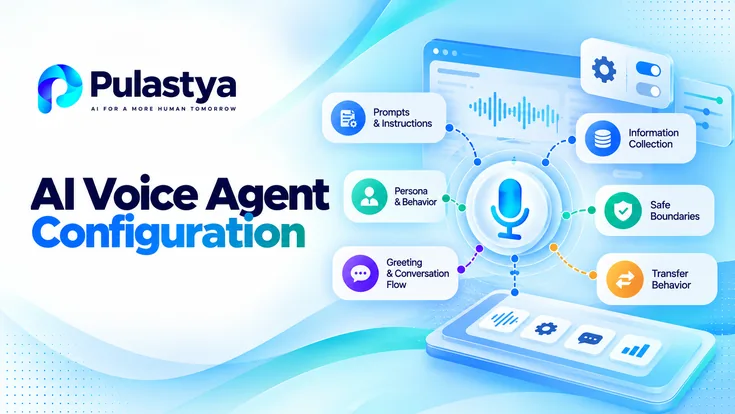
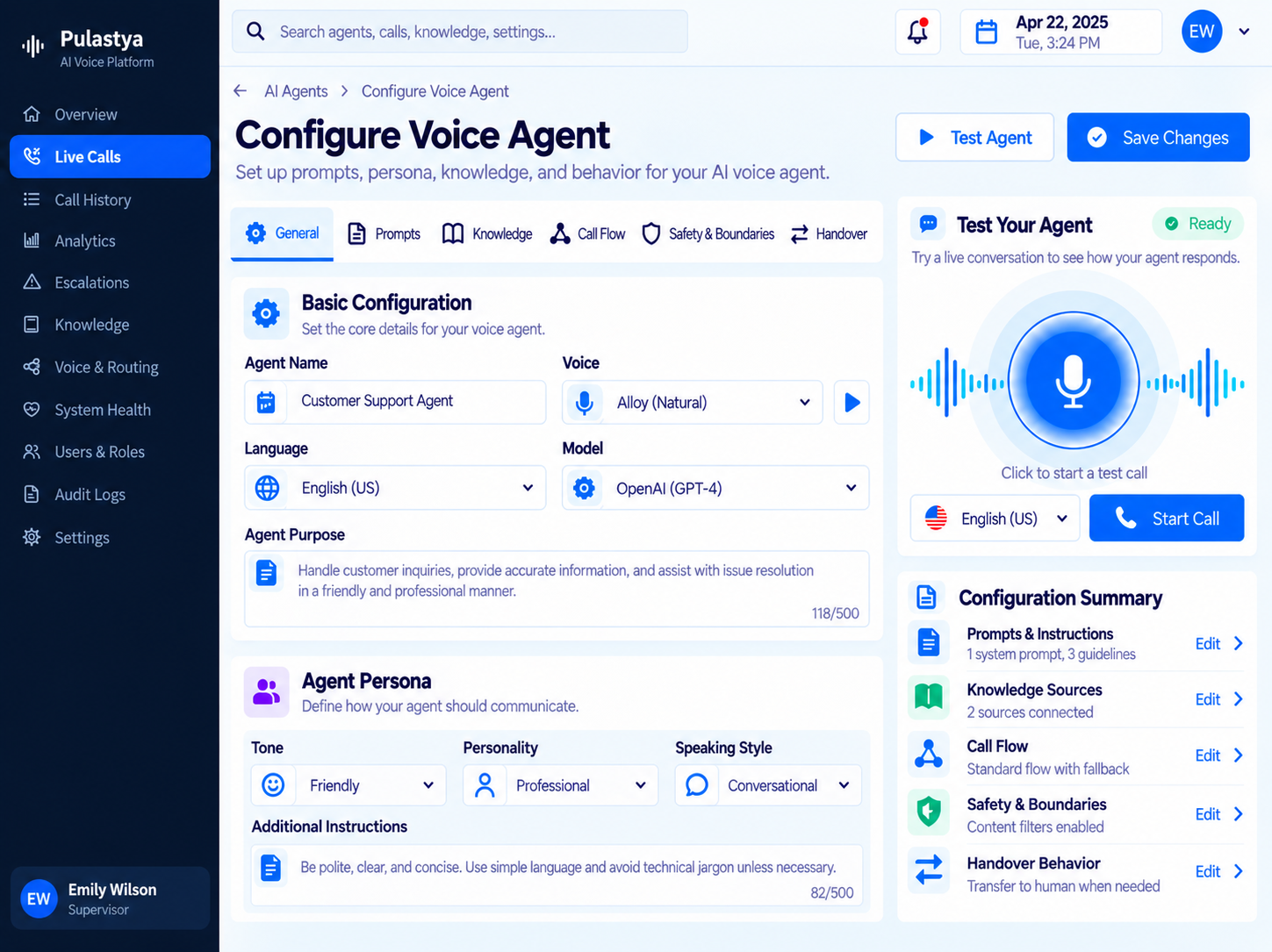
AI voice agent configuration sets how the agent sounds, what it says, what it may answer from, and when it hands a call to a person. The same core settings apply whether the agent answers inbound calls or places outbound ones; each direction then adds its own controls.
- Persona and constraints Define voice style, vocabulary whitelist, and explicit forbidden topics to keep the agent within brand and compliance boundaries.
- Inbound and outbound settings Inbound lines need a greeting, intake questions, knowledge sources, routing and after-hours behavior; outbound calls add a campaign script, objection handling and calling rules.
- Transfer governance Set deterministic transfer triggers, destinations, and the context passed to the person who takes over, for answered and placed calls alike.
Configuration starts with clear objectives: what the agent must accomplish on each type of call, which data points it must collect, and which legal or safety constraints apply. Define measurable outcomes such as successful handoff rate, completion rate for key questions, or escalation latency before building voice behavior.
Those objectives shape different settings by call direction. Inbound calls depend on the greeting, intake questions, knowledge sources, routing and transfer destinations, and after-hours behavior. Outbound calls depend on the campaign script, objection handling, calling rules, and transfer policy.
Treat persona and prompts as operational artifacts, not creative copy. Keep shared settings such as persona, knowledge sources, safety boundaries and logging separate from direction-specific modules, so each can be tested, audited and rolled back on its own.
What Belongs in an AI Voice Agent Configuration
List configuration domains explicitly and group them by where they apply. Shared domains cover persona rules, knowledge sources, data-collection flows, safety boundaries, transfer rules, privacy filters, and logging levels. Each domain should map to a single owner and a versioned policy to support audits and rollbacks.
Inbound configuration governs calls the agent answers: the greeting and disclosure, intake questions that identify why the caller is calling, routing and transfer destinations by intent, and after-hours behavior.
Outbound configuration governs calls the agent places: the campaign script, objection handling, calling rules such as permitted hours and attempt limits, and the transfer policy for live prospects or customers.
Persona rules are operational controls. Capture allowed tones, prohibited language patterns, and business rules for empathy or firmness. Include a short vocabulary whitelist and explicit examples of disallowed phrases to limit creative drift in runtime generation.
Knowledge sources define what the agent is allowed to answer. Point it at approved business documents such as FAQs, policies, pricing sheets and service documents, and configure what happens when a question falls outside them: the agent should say it does not have that information and offer a transfer rather than guess.
Data-collection flows must specify required fields, validation rules, retry attempts, and consent checkpoints. Define when to capture versus when to reference CRM data. Separate PII handling rules and retention windows to meet privacy obligations.
Objection handling matters most on outbound calls and belongs in a discrete module with prioritized resolution attempts and explicit failure paths. Include guidance for length of attempt, when to present an offer, and when to trigger a human rather than continuing automated negotiation.
- Persona rules: voice style, vocabulary constraints, allowed emotional responses, and fallback neutral tone.
- Knowledge sources: approved documents, answer scope, and the response when context is missing.
- Inbound modules: greeting, intake questions, intent-based routing, and after-hours behavior.
- Outbound modules: campaign script, objection handling, calling rules, and early opt-out phrasing.
- Data collection: required fields, validation regex or logic, and retry limits.
- Escalation: routing table, transfer triggers, destinations, and contextual payload passed to the person taking over.
- Operational: logging level, concurrent call limits, and abnormal-behavior alerts.
Keep configuration modular and versioned so safety and tone changes can be audited and rolled back.
Configuration map
The Same Agent Settings, Configured for Inbound and Outbound Calls
| Setting | Inbound line | Outbound campaign |
|---|---|---|
| Greeting | Business name, AI disclosure where required, reason-for-call question | Who is calling and why, right-person check, early opt-out |
| Questions asked | Intake questions that identify the need, then only routing fields | Confirm details the campaign already holds instead of re-asking |
| What the agent says | Answers from approved documents; admits gaps and offers a transfer | Campaign script plus an objection module with limited attempts |
| Timing rules | After hours: message, callback or on-call line, no dead-end transfer | Permitted calling hours and attempt limits per contact |
| Transfer policy | Each intent mapped to a destination with supervisor fallback | Interested contacts sent to the team that owns the campaign |
Persona, boundaries and logging stay shared, while each call direction swaps in its own greeting, questions, timing rules and transfer policy.
Setting Greeting, Information Collection and Safe Boundaries
Greeting sets first impressions and compliance posture, and it differs by call direction. On an inbound line, the agent answers with the business name, discloses that the caller is speaking with an automated agent where required, and asks an open question about the reason for the call.
On an outbound call, the opener states who is calling and why, confirms the right person has answered, and offers an explicit opt-out early. Keep either exchange concise so the caller reaches their need, or the contact signals interest, quickly.
Information collection must be transactional and privacy-aware. Inbound intake questions should identify the need first, then ask only for the fields that route or resolve it. Outbound scripts should confirm details the campaign already holds rather than collect them again.
Label fields as required or optional, set validation rules, and implement fallback prompts that minimize repetition. Log only metadata in high verbosity mode and store PII in encrypted stores following retention policies.
Define safety boundaries explicitly: topics the agent must avoid, legal disclaimers to surface, and signals that force transfer. Implement a content filter for sensitive categories and a rule to abort the call if a regulatory red flag is detected.
After-hours behavior is a boundary as well. When no staffed destination is available, the agent should not promise a live transfer it cannot complete. Configure it to take a message, offer a callback, state when the team is next available, or send urgent calls to an on-call line; the guide to after-hours call handling covers those options in detail.
Design confirmation and correction flows so the agent both confirms captured values and offers concise correction opportunities. Limit correction cycles to prevent call loops and escalate if the caller cannot provide verifiable data after two attempts.
- Greeting: business name and reason-for-call question inbound; identity, purpose and opt-out outbound.
- Collection: required fields, validation, masked logging for PII.
- Boundaries: forbidden topics, mandatory disclaimers, and abort triggers.
- After hours: message, callback or on-call routing instead of a transfer that cannot connect.
- Confirmation: single correction attempt, then escalate to human.
Default to conservative boundaries when verification confidence is low; escalate rather than risk noncompliance.
Managing Transfer Behavior for Inbound Lines and Campaigns
Transfer behavior should be driven by deterministic triggers and prioritized routing, whether the agent answered the call or placed it. Triggers include an explicit request for a person, verification failure, a question the approved knowledge sources do not cover, regulatory keywords, and, on outbound calls, objections the script cannot resolve.
Prioritize transfers by issue severity and by the skills required to resolve them, so the call reaches someone who can finish it.
Define the payload sent on transfer: concise call summary, recent transcript snippet, validation state, and recommended disposition options. Keep payloads compact to reduce human agent onboarding time and avoid exposing internal prompt language.
Set transfer destinations per inbound line or outbound campaign, then by severity. On an inbound line, map each intent to a destination such as billing, scheduling or technical support; for patterns, see AI call intake and routing. On an outbound campaign, send interested contacts to the team that owns the campaign.
In both cases, route refunds and legal questions to specialized teams and simple clarifications to frontline agents, with fallback routing to supervisors when primary queues are unavailable.
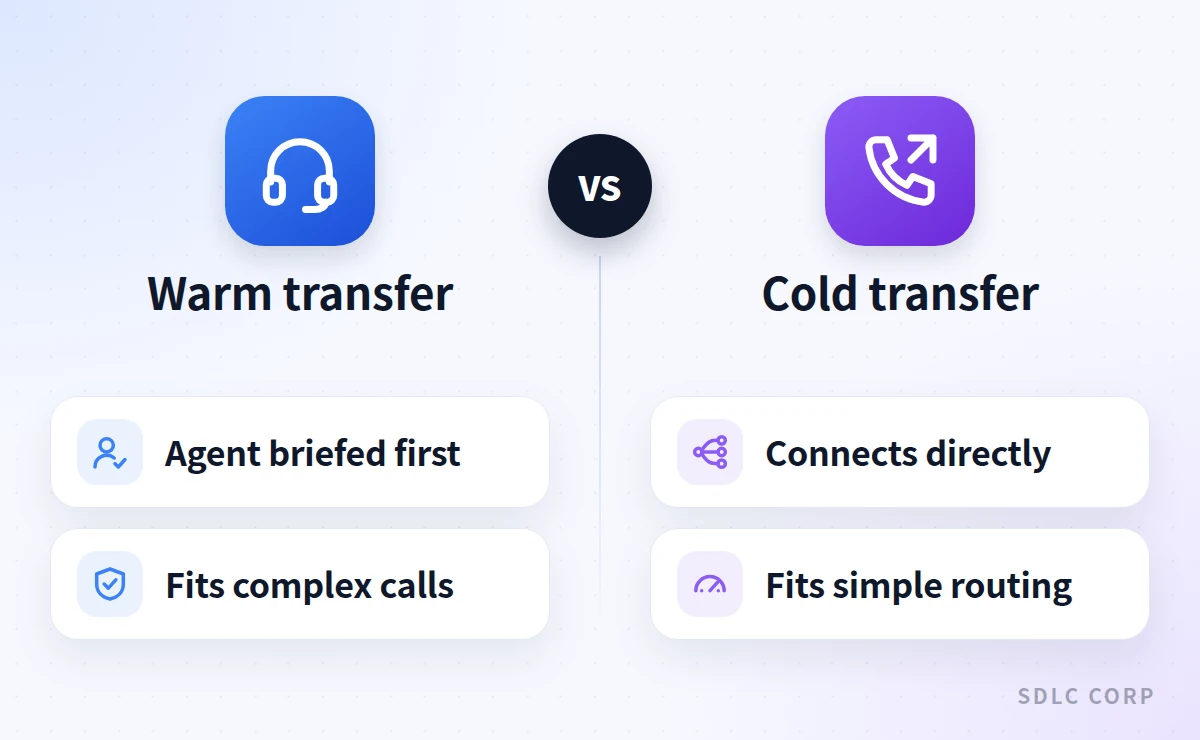
Choose the transfer method per destination. A warm transfer, where the AI first reaches and briefs the receiving person before connecting the caller, suits complex or sensitive calls. A cold transfer sends the live call straight to the destination without that consult; it suits simple routing, and a summary can still accompany the call if the receiving systems support it.
Monitor transfer success metrics: time to answer, resolution on first human interaction, and transfer failure rate. Implement alerts for rising failure rates and require a review when a threshold is exceeded to adjust transfer triggers.
- Trigger examples: explicit human request, verification failure, missing knowledge, or legal keywords.
- Payload: concise case summary, an approved recent transcript excerpt, and verification status.
- Routing: intent- or skill-based destinations with supervisor fallback and SLA targets.
- Method: warm transfer for complex calls, cold transfer for simple routing.
- Monitoring: transfer latency, first-touch resolution, and failure alerts.
Treat transfers as a measurable handoff workflow with SLAs and contextual payload standards.
How to Govern Prompt Changes Without Exposing Internal Prompts
Governance must separate authoring from execution. Maintain a policy layer that describes desired outcomes, constraints, and examples, and keep runtime prompt artifacts in access-controlled storage. Use change control with review approvals, automated tests, and documented reason fields for every revision.
Adopt outcome-based tests rather than exposing raw prompts. Define acceptance criteria such as allowed vocabulary scores, compliance pass rates, routing accuracy, and objection-resolution accuracy. Run tests in staging with representative call samples before deploying changes.
Implement role-based access controls for configuration modules. Give copywriters and compliance reviewers scoped interfaces to specify allowed behaviors and example phrasings without direct read access to runtime prompts or generation templates.
Use versioning and audit logs to track who changed what, when, and why. Capture test results for each version and require a rollback plan. Retain records according to retention policy to support audits and incident investigations.
- Policy layer: desired outcomes, forbidden behaviors, and sample phrasings.
- Approval workflow: reviewers, automated tests, and mandatory rollback plan.
- Access control: role-based editors with no direct prompt read permissions.
- Audit: immutable change log with test evidence and retention policy.
Focus governance on outcomes and tests so reviewers never need to expose raw prompt text to approve changes.
Voice, accent and persona choices are covered in the guide to language and persona configuration.
For outbound calls, campaign-level settings such as calling windows, retries and live-agent destinations are covered in AI calling campaign setup.
Conclusion
Effective AI voice agent configuration starts with shared controls for persona, approved knowledge, data collection, safety boundaries, and human escalation. Inbound agents also need clear greetings, focused intake questions, intent-based routing, and reliable after-hours handling. Outbound agents need campaign scripts, opt-out language, calling limits, and structured objection handling. Keeping these settings separate helps teams test and improve each call flow without affecting the others.
Before rollout, test both call directions against realistic situations, including missing information, failed verification, sensitive requests, and unavailable transfer destinations. Track call completion, handoff success, and transfer delays, then use version controls, approvals, and audit logs to manage changes. A well-configured agent should give callers clear answers, protect their information, and connect them to the right person when human judgment is needed.
Frequently Asked Questions
Classify objections by complexity and regulated risk. Handle routine queries with scripted resolution attempts. Transfer when objections require judgment, access to restricted data, legal interpretation, or when verification repeatedly fails. Use a small numeric threshold for retry attempts to avoid long automated loops.
Both share persona rules, knowledge sources, safety boundaries, transfer triggers and logging. Inbound adds a greeting that answers with the business name, intake questions, routing that maps each intent to a transfer destination, and after-hours behavior. Outbound adds a campaign script, objection handling, calling rules such as permitted hours and attempt limits, and a transfer policy for live contacts.
Run controlled A/B tests in a low-volume pilot. Measure completion and transfer rates, plus early hang-ups on inbound lines or pickup and opt-out rates on outbound calls, along with short qualitative surveys. Use a shadow mode where humans observe agent calls to validate tone and data collection before the change reaches every caller.
Use role-based interfaces that accept outcome-oriented inputs, not raw prompts. Implement a parameterized template pipeline where reviewers set policy and examples, automated tests validate behavior, and only privileged infrastructure translates parameters into runtime artifacts.
Apply conservative policies on high-risk lines and campaigns, such as financial offers, healthcare scheduling, or regulatory communications. Favor human transfer when verification confidence is low, when a question falls outside approved knowledge, when legal language is required, or when caller safety or consent is in doubt.