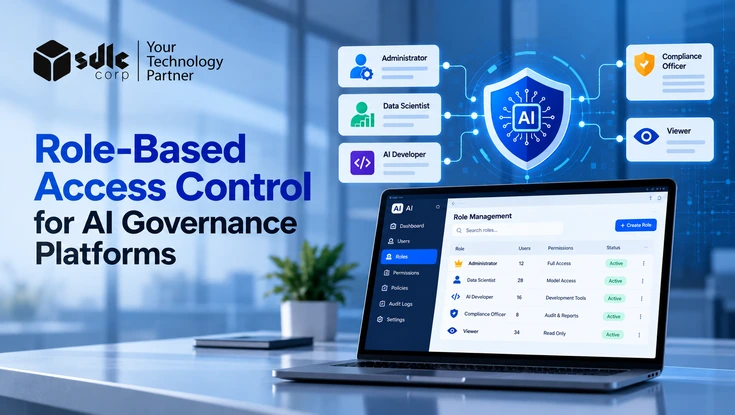
Enterprise AI is not just employees signing into a platform. Business users consume AI applications, developers build them, risk and compliance teams assess them, and AI agents, service accounts, pipelines, and API clients reach models, data, and tools on their own. Those identities should not carry the same authority.
Role-based access control (RBAC) turns organizational responsibilities into enforceable permissions. Inside an enterprise AI governance framework, it decides who or what can view, modify, assess, approve, deploy, monitor, or audit AI resources.
What Is RBAC in AI Governance?
The benefits of role-based access control in AI governance are least privilege, separation of duties, consistent approvals, and an auditable record of who did what. RBAC assigns permissions to defined roles instead of configuring every permission separately for every user. In an AI governance platform, roles might include AI System Owner, AI Risk Manager, Compliance Officer, Developer, Data Steward, Security Administrator, Business Approver, or Auditor.
Authentication answers the question of who an identity is. Authorization determines what that identity can do. RBAC provides a structured way to organize those permissions around documented responsibilities.
For example, a Risk Manager may create and update an AI risk assessment yet still lack the authority to approve the production deployment of the same system. A developer may submit an AI system for review without receiving permission to approve that submission.
Why Do AI Governance Platforms Need RBAC?
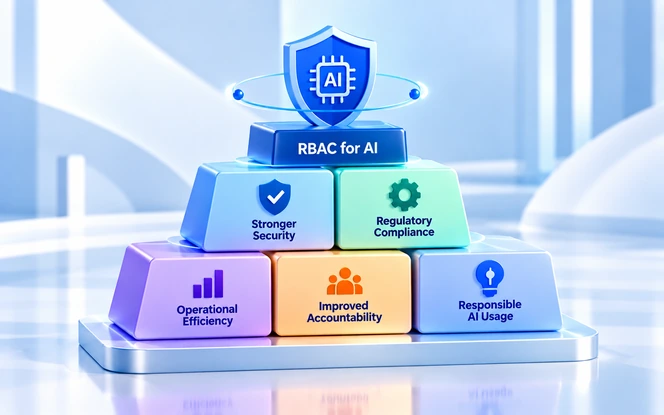
Least Privilege
NIST SP 800-53 AC-6 defines least privilege as allowing only the access necessary for users, or processes acting on their behalf, to accomplish assigned organizational tasks.
For AI governance, a Risk Manager who can assess an AI system does not automatically need access to the production dataset behind it. Permission to evaluate a system and permission to reach its underlying data should be separate decisions.
Separation of Duties
NIST SP 800-53 AC-5 calls for identifying duties that require separation and defining access authorizations that support that separation. The person who submits an AI system should not automatically be able to approve its production deployment, because separating those responsibilities creates an independent control point in the workflow.
Sensitive AI Data Protection
AI programs can involve training data, evaluation datasets, prompts, model artifacts, business records, customer information, and governance evidence. The FINOS AI Governance Framework recommends role-based access controls for AI data and connects them with controls for data access, auditability, and least privilege.
The important point is simple: permission to manage an AI system does not automatically mean permission to reach every dataset, model artifact, or business record associated with it.
Governance Accountability
The NIST AI Risk Management Framework identifies clearly defined roles and responsibilities as part of the Govern function, and treats AI risk management as a continuous activity across the AI system lifecycle. RBAC gives organizations a technical mechanism for translating those responsibilities into permissions.
For broader AI risk management, pair role-based access control for AI governance with an operating model that assigns ownership for inventory, assessment, monitoring, policy, and accountability.
Auditability
For high-risk AI systems, the EU AI Act includes requirements around automatic event logging and human oversight. Article 12 addresses logging, while Article 14 addresses effective human oversight.
Authorization records should therefore let an investigator identify the requesting identity, the resource, the action, the outcome, the timestamp, and the rule that drove the decision. That evidence becomes valuable when an organization needs to investigate an access decision or show how governance controls operated.
Key Roles in an AI Governance Platform: RBAC Examples
The table below gives worked role-based access control examples for a platform. A practical enterprise role model may include a governance administrator, AI system owner, AI risk manager, compliance officer, AI developer, data steward, security administrator, business approver, auditor, and read-only user. Exact names will vary by organization. What matters is that each role has a defined purpose and limited permissions.
| Role | Typical permissions | Should not automatically have |
|---|---|---|
| Governance Administrator | Manage roles, policies, and workflows | Unrestricted business-data access |
| AI System Owner | Manage assigned AI systems | Organization-wide administration |
| AI Risk Manager | Create and update assessments | Approval of own systems |
| Compliance Officer | Review controls and evidence | Technical deployment rights |
| AI Developer | Submit systems and technical data | Approval of own submissions |
| Data Steward | Manage classification and data access | Deployment approval |
| Security Administrator | Manage identities and security controls | Business-risk approval |
| Business Approver | Approve assigned systems | Technical administration |
| Auditor | Read records and evidence | Modify governance records |
| Read-Only User | View authorized information | Create, edit, or approve |
A useful distinction is that role establishes baseline authority, while scope and context determine how that authority applies. Risk managers might assess systems only within an assigned business unit. Business approvers might sign off only within a particular legal entity or environment.
Keeping these boundaries separate helps prevent broad administrative roles from becoming the default answer to every access request.
What Permissions Should an AI Governance Platform Control?
Role-based access control should cover the resources an organization is trying to govern, the actions users and workloads can perform, and the scope that limits those actions.
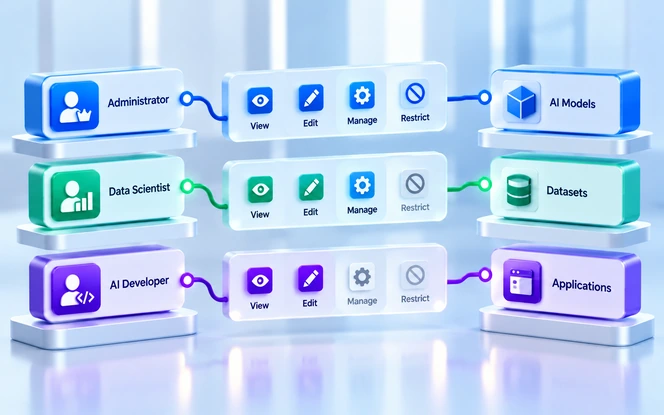
AI systems, models and model versions, datasets, policies, risk assessments, controls, approval records, reports, and governance evidence.
Viewing, creating, editing, submitting, approving, rejecting, deploying, exporting, assigning, configuring, and retiring.
An organization, business unit, project, region, legal entity, environment, or individual AI system.
A developer working on one AI application should not automatically receive organization-wide deployment authority. An administrator managing governance workflows does not necessarily need access to every business dataset.
How Does RBAC Change Across the AI Governance Lifecycle?
Role-based access control should reflect the governance workflow rather than remain a static permission list. During discovery and inventory, users may need permission to register AI systems and record ownership. At the risk assessment stage, risk managers need to create and update assessments. Designated business or compliance stakeholders then receive approval rights. After deployment, operational teams may need monitoring permissions while approval authority stays restricted.
The NIST AI RMF treats governance as cross-cutting and continuous across the AI lifecycle, including defined roles, monitoring, inventory, and accountability. The practical consequence is that permissions may need to change as a system moves between lifecycle stages.
Approval Does Not Equal Permanent Deployment Authority
Approval should not automatically create permanent deployment authority. A person may hold authority to approve a system yet lack authority to deploy it, modify it after deployment, or change its production configuration. Separating these permissions reduces the risk that authority granted for one lifecycle stage quietly becomes authority over later stages.
How Does RBAC Apply to Source-Data Permissions in RAG?
AI governance becomes more complicated when LLM applications use retrieval-augmented generation (RAG). A user may hold permission to use an AI application yet lack permission to reach every source connected to it. If documents from different permission groups sit in the same retrieval system, the AI application should not expose information the user could not open directly.
Tracing data lineage for AI governance also helps show where each retrieved record came from. The FINOS guidance on preserving source-data access controls identifies preserving source entitlements as an important mitigation for AI systems. A practical implementation should consider the user identity and source entitlements at retrieval time rather than treating the vector store or AI application as a new permission boundary.
Permission to use an AI system is not automatically permission to reach everything that AI system can retrieve.
How Should RBAC Handle AI Agents and Non-Human Identities?
AI agents are not the only non-human identities that need governance. Service accounts, MLOps pipelines, automation workflows, API clients, and tool integrations may also act on AI resources. Unapproved tools make the picture harder still, so shadow AI belongs in the same inventory.
The OWASP GenAI Security Project identifies excessive agency as a risk tied to excessive functionality, permissions, or autonomy. Its guidance emphasizes minimizing unnecessary permissions, using appropriate user context, requiring approval for high-impact actions, and enforcing authorization in downstream systems. FINOS similarly recommends granular controls for agent APIs, tools, and data, including contextual restrictions, time-bounded privileges, separation of duties, and privilege de-escalation.
No single identity model fits every agent architecture. Some agents operate under their own identity and permissions. Others act on behalf of a user through delegated authority. In some architectures both identities matter, because the system needs to know which agent performed the action and which human initiated the request.
A mature design should establish:
- An attributable identity
- A named human or team owner
- Tool, model, and data permissions
- Limits on destructive or high-impact actions
- Request-level authorization where appropriate
- Logs connecting the action to the agent and, where relevant, the originating user
Why Request-Level Authorization Matters
Login-time authorization is not always enough for agentic systems. An agent may hold general permission to use a tool while policy still blocks one particular request, because a large language model has no way to judge that on its own. The decision may depend on the resource, the user identity, the business unit, the environment, the requested action, transaction value, AI risk level, or current approval state.
That means authorization may need to happen at the moment of the request, not only when the user or agent first authenticates. FINOS recommends contextual privilege adjustment, API-level controls, and pre-execution validation for agent actions. OWASP also recommends complete mediation, so downstream systems validate each request against security policies rather than letting the large language model decide whether an action is permissible.
Enterprise Example: RBAC Authorization for an AI Agent
Consider a finance AI agent that needs information from a confidential financial dataset. The agent may retrieve approved information for a defined business purpose while policy blocks it from writing directly to a production database.
| Decision | Scenario |
|---|---|
| Allow | A Risk Manager edits an assessment assigned to them |
| Deny | A Developer attempts to approve their own AI system |
| Allow | A finance agent retrieves an approved dataset within its authorized scope |
| Deny | The same agent attempts to write to a production database without the required authority |
| Deny | A revoked user attempts to reach the dataset after an administrator removes their authorization |
This is the difference between RBAC as a user-management feature and RBAC as an authorization control.
RBAC vs. ABAC for AI Governance
Role-based access control and ABAC solve related problems, but they work differently. RBAC works well when permissions map to relatively stable organizational responsibilities. ABAC becomes more useful when access depends heavily on context.
For example, a Compliance Officer might generally have permission to review governance records. An attribute-based policy could further restrict that access to records belonging to a particular business unit, carrying a specific data classification, or running in a specific environment.
A practical enterprise design can use RBAC as the baseline and apply additional attributes or contextual conditions when the situation requires finer control. This reduces the need to create a separate role for every combination of department, resource, environment, and data classification.
How RBAC Compares With Other Access-Control Models
Teams evaluating role-based access control usually weigh it against five neighbouring models.
| Model | Decision is based on | Typical fit in AI governance |
|---|---|---|
| RBAC | Assigned role | Stable organizational responsibilities and approval workflows |
| ABAC | Attributes and context | Region, environment, or data-classification conditions |
| ACL | Per-object permission list | Individual documents or datasets rather than whole systems |
| DAC | Resource owner discretion | Collaboration spaces, weak for regulated AI data |
| MAC | Central classification labels | Classified or highly regulated environments |
| PBAC and ReBAC | Central policy, or relationships between entities | Tenanted platforms and agent-to-resource relationships |
Most enterprises land on role-based access control plus selected attributes, because the other models either scale badly or assume a classification scheme the organization does not run.
RBAC vs. AI Gateway Access Control
Governance platforms and AI gateways solve different access-control problems. A governance platform typically manages ownership, roles, risk assessments, approval workflows, policies, and governance evidence. A gateway or other runtime enforcement point controls live model, API, or tool requests.
The distinction matters because approval inside a governance platform does not automatically guarantee that a runtime system will enforce the same decision. A governance platform could list an AI agent as approved while an underlying API still permits an action that policy forbids. That is a governance enforcement gap.
The key question is whether the authorization decision remains enforceable when the request reaches the runtime layer.
The FINOS AI Governance Framework emphasizes layered controls, while its agent least-privilege guidance places enforcement at tool-manager and API-gateway levels.
How to Implement RBAC in an AI Governance Platform
- Inventory identitiesIdentify employees, contractors, service accounts, agents, pipelines, API clients, and other non-human identities.
- Define governance rolesMap roles to documented AI responsibilities rather than relying only on job titles.
- Build the authorization modelDefine which identities can perform which actions on which resources and within which scopes. Document both allowed and denied combinations.
- Classify resourcesRecord ownership, sensitivity, AI risk level, environment, and lifecycle status. Public bodies should consider role-based access control for AI governance within their government framework for agency data, vendor access, and human approvals.
- Apply least privilegeGrant only the authority required for the task. For sensitive functions, consider temporary or just-in-time access rather than permanent privilege.
- Integrate IAM and SSOConnect enterprise identity systems so onboarding, role changes, and deprovisioning propagate consistently.
- Synchronize and review policiesWhen governance status changes, determine how that change reaches connected APIs, gateways, agents, and runtime systems. Align role-based access control for AI governance with the policy-management process that defines and reviews those rules.
Use Just-in-Time Access for Sensitive Permissions
Permanent access is not always the best model for high-impact permissions. An organization may allow a security administrator to receive temporary production access for an investigation, or allow an agent to receive a narrowly defined privilege for a specific approved task. The privilege should carry a clear business justification, limited scope, expiration conditions, and an auditable approval.
FINOS agent least-privilege guidance recommends time-bounded privileges and controlled privilege escalation for situations requiring temporary additional access. The goal is not to eliminate privileged access, but to reduce how long and how broadly that privilege stays effective.
How Do You Test RBAC Before Calling It a Governance Control?
Do not call a platform RBAC-complete simply because its administration console has a role-management screen. The real test is whether those permissions hold when someone interacts with the system through different paths.
Test whether the platform blocks unauthorized actions through both the user interface and the APIs. Test whether agents can exceed their assigned authority. Check whether users can cross project or business-unit boundaries. Test whether a person can approve their own restricted submission.
Also test privilege conflicts. If one person holds multiple roles, verify that the combined permissions do not silently defeat separation-of-duties controls. Test revocation as well, and confirm that removing access reaches connected enforcement points rather than only changing status inside one administration console. For each allow or deny outcome, retain the identity, resource, action, scope, and policy that determined it. Connect those test results to the owners and evidence requirements in your enterprise AI governance framework.
Measure Revocation, Do Not Just Claim It
A useful operational metric is revocation propagation time, which answers a single question: how long can an identity keep working after an administrator revokes its authorization?
The acceptable answer depends on the organization's risk tolerance and architecture. A high-impact permission may require faster revocation than a low-risk administrative capability. The important point is that revocation is not complete simply because one system shows the user as disabled.
What Are the Most Common RBAC Challenges?
Role explosion. Creating a separate role for every team, resource, environment, and business condition makes permissions hard to maintain, which is one reason organizations combine RBAC with attribute-based conditions.
Privilege creep. Users can retain permissions after changing teams or responsibilities. Periodic access reviews and identity lifecycle integration help identify stale privileges.
Conflicting role assignments. Someone holding both system-submission and final-approval permissions may bypass a control even though each role looks valid on its own.
Orphaned non-human identities. Agents and service accounts can stay active without accountable owners. Every non-human identity should have an owner, a defined purpose, and controlled permissions.
Permission drift. Governance, cloud, ML, and runtime platforms can develop inconsistent policies, which is dangerous when the governance platform shows one authorization state and the runtime enforces another.
Agent privilege escalation. An agent may receive access to a tool whose underlying identity carries broader authority than the task requires, so tool permissions deserve evaluation separately from the agent's general role.
Revocation gaps. Removing access in one system does not necessarily remove it at every enforcement point, so organizations should map where their systems cache, propagate, and enforce authorization decisions.
Taken together, these problems show why RBAC is a lifecycle control rather than a one-time configuration.
Best Practices for RBAC in AI Governance
- Apply least privilege to human and non-human identities.
- Separate submission, assessment, approval, and deployment authority.
- Keep scope independent from role, and flag conflicting roles.
- Elevate privilege temporarily, and check agent actions at request time.
- Preserve source-data entitlements during retrieval.
- Enforce at every control point, then test UI, API, agent, and revocation paths.
- Review privileges, set a revocation target, and keep decisions as evidence.
How to Evaluate RBAC Capabilities in an AI Governance Platform
Do not treat "RBAC supported" as a meaningful vendor evaluation by itself. Ask what the platform can actually enforce, which layer enforces each decision, how quickly an administrator can revoke permissions, how the platform resolves conflicting roles, whether it covers agent permissions, and whether your team can prove what happened during an authorization decision.
| Capability | Why it matters |
|---|---|
| Custom roles and granular permissions | Adapts authorization to organizational responsibilities |
| Resource and scope controls | Limits access to specific systems, projects, environments, or business units |
| IAM and SSO integration | Helps synchronize identity lifecycle changes |
| Agent and non-human identity support | Governs service accounts, agents, pipelines, and API clients |
| Request-level authorization | Controls context-sensitive actions |
| Approval workflows and separation of duties | Prevents self-approval and conflicting authority |
| Just-in-time access | Limits the duration of sensitive privileges |
| API and runtime enforcement | Prevents authorization from stopping at the UI |
| RBAC plus ABAC | Supports contextual access decisions without excessive role creation |
| Access reviews and revocation controls | Detects stale permissions and reduces residual access |
| Authorization logs | Provides evidence of access decisions |
| Policy synchronization | Connects governance decisions with downstream enforcement |
The Best Evaluation Question
Can the platform consistently enforce, test, review, revoke, and prove who or what may perform each action across the AI lifecycle? That question is more useful than asking whether a vendor has an RBAC feature.
Organizations evaluating broader capabilities should assess the access-control model alongside AI inventory, risk management, policy management, monitoring, and compliance workflows rather than as an isolated login feature.
How SDLC Corp Supports AI Governance
Role-based access control works best alongside the broader controls that govern enterprise AI, including data access, identity, monitoring, auditability, and evidence.
SDLC Corp offers Foresite as an analytics platform to evaluate alongside your AI governance controls. Before relying on it for access control or audit evidence, confirm which permissions, integrations, and logs are available in your deployment with the product team.
The same role-based pattern carries into adjacent compliance work. The Limina accessibility remediation workflow platform routes findings to developers, content editors, remediators, and reviewers, so each role sees only the work it owns.
For implementation help, discuss role-based access control for AI governance with the AI consulting team.
Conclusion
Role-based access control for AI governance is not simply about deciding who can log into a platform. It determines who or what can perform which action on which AI resource, within which scope and context.
A mature implementation connects organizational roles with lifecycle-specific permissions, least privilege, separation of duties, governed non-human identities, source-data entitlements, request-level authorization, runtime enforcement, revocation controls, and auditable decisions.
The goal is simple: governance decisions should translate into permissions your systems actually enforce, test, review, and revoke when necessary.
Frequently Asked Questions
These questions cover the access-control decisions teams face when governing AI systems, agents, data, and approvals.
Why is RBAC important for AI governance platforms?
Role-based access control supports least privilege, separation of duties, accountability, controlled workflows, and auditable access to AI resources. It turns documented responsibilities into permissions a platform can actually enforce.
What should RBAC control in an AI governance platform?
RBAC should control access to AI systems, models, datasets, policies, assessments, approvals, evidence, and related governance functions, with permissions constrained by role, resource, scope, lifecycle stage, and, where necessary, contextual attributes.
How should RBAC work for AI agents?
Agents should have attributable identities and narrowly scoped permissions. Depending on the architecture, they may operate as their own principal, through delegated user authority, or through a combination of both.
What is request-level authorization?
Request-level authorization evaluates each specific action at the moment someone requests it. The decision can weigh identity, resource, action, scope, and context rather than relying only on the permissions a login already carries.
What is the difference between RBAC and ABAC?
RBAC establishes permissions based on roles. ABAC evaluates additional attributes and contextual conditions such as data classification, environment, geography, or resource ownership. Many enterprises use RBAC as the baseline and add attributes for finer control.