Almost nobody evaluates voice agent platforms from a standing start.
The search begins with one already running, a bill or a build that has stopped working, and a question about what else exists. That starting point is more useful than it looks: the reason a team is leaving narrows the field faster than any feature list.
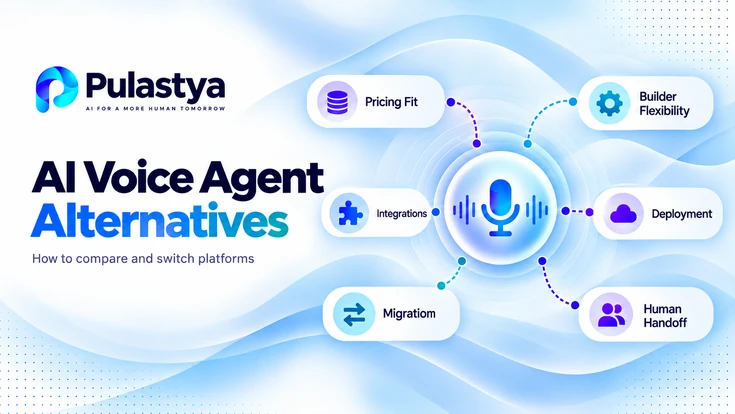
- Start from the reason The reason a team is leaving narrows the options faster than a feature list does.
- Each reason points somewhere Rate, engineering time, builder status and deployment shape each rule out a different group, and sometimes each other.
- Price the move, not the platform Numbers, prompts, integrations and source material all have to be rebuilt, and that effort belongs in the comparison.
A switch is rarely about a missing feature. What is being left usually answers the calls, grounds the answers and hands over to a person. What stops working is the shape of the arrangement: the rate at production volume, the engineering time the build assumes, a builder that changed, or a deployment and contract model that no longer fits.
So the first useful step is to write that reason down in one sentence, precisely enough to test. Too expensive is not testable. The charge above provider usage is now a visible budget line at the minutes we run is testable, and it tells you when to stop looking.
Teams Leave a Platform, They Do Not Shop in the Abstract
By the time a team searches for alternatives it already has a voice agent answering or placing calls. There is a number routed somewhere, a prompt someone maintains, source material behind the answers and a transfer destination staffed by real people.
That changes the question being asked. It is not which option is best. It is whether a different one resolves the specific thing that stopped working, and whether that is worth rebuilding what already runs.
Choosing from scratch is a different exercise: the side-by-side comparison of voice agent platforms covers who the platforms are and how to evaluate them. What follows starts from the reason you are leaving the one you have.
Write the reason for leaving as one sentence you could test on a call or in a spreadsheet. A reason that cannot be tested cannot be satisfied, and it will never tell you the search is over.
The Reasons Teams Leave, and Where Each One Points
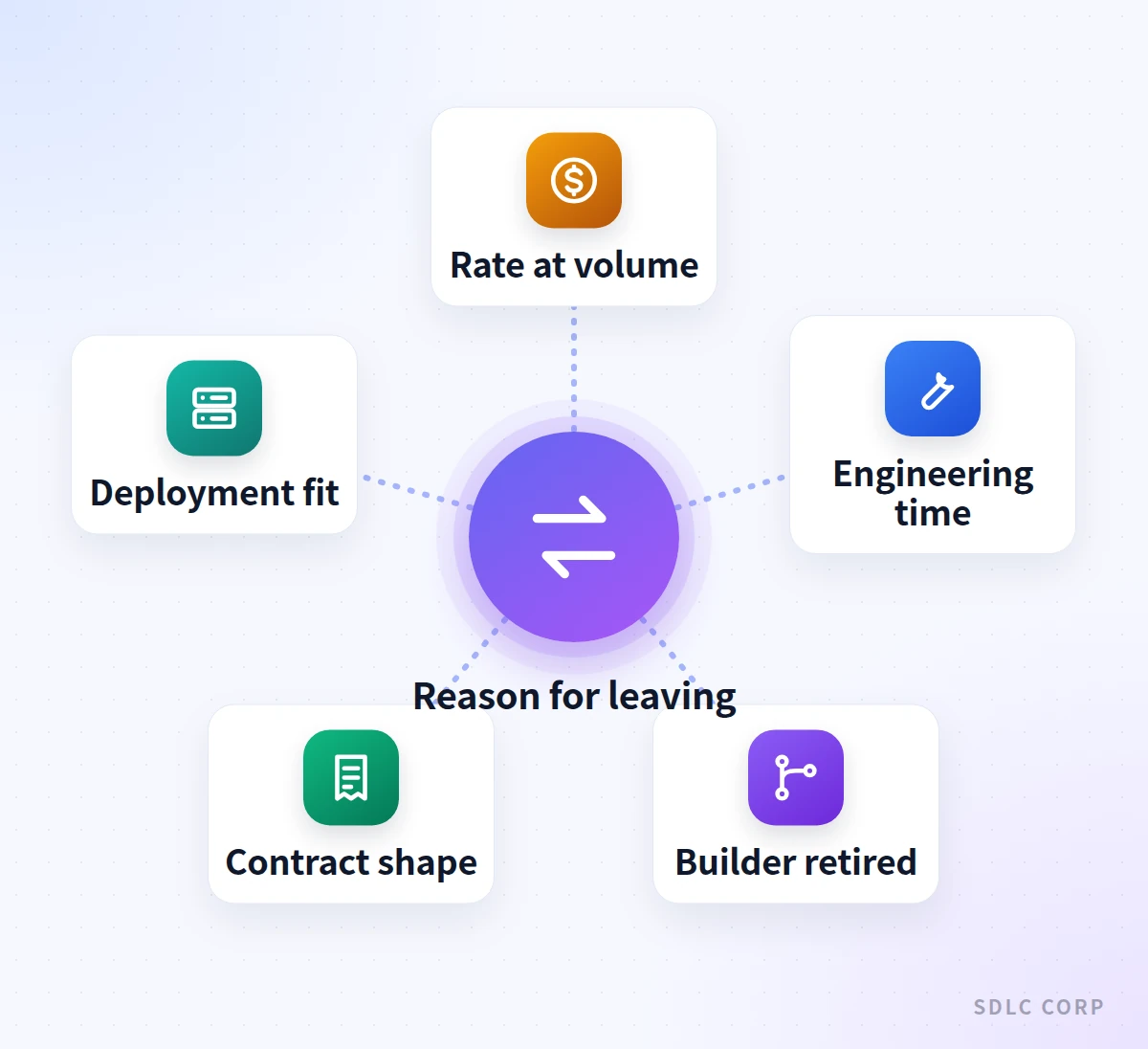
Four reasons account for most switches. They are worth separating, because they point in different directions, and a team carrying two at once usually finds the two pull apart.
The Per-Minute Rate Does Not Survive Production Volume
A charge that is rounding at trial volume is a line item at production volume. Nothing about the software changed; the multiplier did. This reason tends to arrive suddenly, because it arrives with an invoice rather than a complaint.
The published shapes differ enough to matter. Vapi lists a $0.05 per minute platform fee above provider usage. Retell AI quotes a single pay-as-you-go rate of $0.07 to $0.31 per minute. Bland AI charges $0.14 per minute on Start or $0.12 per minute plus $299 a month on Build.
Those are different structures, not just different numbers. A separately stated per-minute fee is charged on every minute, including minutes where your own validated provider key has already paid the model provider. A bundled rate cannot be separated at all, and a monthly component changes the effective per-minute cost as volume moves.
Where this points: toward a charge above provider usage that is stated separately or absent, and away from a shortlist built on headline rates. Model each finalist at the minutes you run. The breakdown of what drives voice agent cost shows which parts of a call move the total.
The Build Needs Engineering Time the Team Does Not Have
Developer-first platforms assume an engineer, and say so. Vapi works as an orchestration layer over a transcriber, a language model and a voice that an engineering team selects, with prompts, tools and webhooks written and maintained in code.
That is fine while the engineer is there. It stops being fine when the person who built the agent moves on, or when the operations team fielding the calls has to raise a ticket to change an escalation rule.
Where this points: toward setups the team answering the calls can configure itself. The test is not who can build it, but who changes the greeting, the transfer rule and the source documents three months after launch.
A Visual Builder Was Retired or Changed
Conversation designers work in a canvas rather than a file, and when that canvas changes status the work does not simply move. Vapi retired its Workflows visual builder on August 18, 2026, and Composer is in alpha, which is a reason to look around that has nothing to do with price.
Where this points: toward a canvas that is generally available now rather than announced, and toward a blunt question about tiers. Access to one sometimes depends on the plan or account type, which turns a design tool into a commercial negotiation.
The Deployment or Contract Shape Does Not Fit
Some constraints have nothing to do with the conversation. An organization may be required to use a particular model provider, or may already hold a model contract it intends to use. Bland AI runs its own models and speech rather than third-party AI providers, so on that platform the model layer is not a customer choice.
Contract shape works the same way. A capability packaged into an enterprise agreement is out of reach for a team not buying one: warm transfer on Bland AI requires an enterprise account, which turns a routing decision into a procurement one.
This reason runs both ways. If VPC, on-premise or air-gapped deployment is a hard requirement, Bland AI offers those options and no hosted alternative replaces them. A requirement that only your current platform meets is a reason to stay, not a reason to shop.
When to Consider an Alternative to Retell AI, Vapi or Bland AI
Those reasons land differently depending on which platform you are leaving, because each one is strong somewhere and constrained somewhere else. Published terms change often, so confirm current pricing and packaging with the vendor before deciding.
When to Consider an Alternative to Retell AI
Retell AI quotes one pay-as-you-go band, and the shape matters more than the size. Telephony, speech and model usage sit inside a single number, so a provider contract or a key you already hold cannot be credited against it, and the effective cost per minute moves with the mix of calls rather than with anything you control.
That makes rate at production volume the usual trigger here. If the objection is the shape of the bill rather than the conversation, look for a charge above provider usage that is stated separately or absent, so the two halves can be modeled independently at the minutes you actually run.
When to Consider an Alternative to Vapi
Vapi states its platform fee separately, so billing is rarely what sends a team away from it. Two other reasons are. The first is engineering time: the platform assumes an engineer, and prompts, tools and webhooks live in code, which becomes a problem when the person who built the agent moves on or the operations team has to raise a ticket to change a transfer rule.
The second is the canvas. Work done in a visual builder does not live in a file, so a change of status for that builder strands it. Either way, the test to put to a replacement is not who can build it: it is who changes the greeting, the transfer rule and the source documents three months after launch.
When to Consider an Alternative to Bland AI
Bland AI runs its own models and speech rather than third-party providers, so the model layer is not a customer choice. An organization required to use a particular provider, or already holding a model contract it intends to use, has a constraint the platform cannot relax. Packaging is the other trigger, since a capability folded into an enterprise agreement turns a routing decision into a procurement one.
Read that constraint in both directions before moving. If VPC, on-premise or air-gapped deployment is a hard requirement, it is a reason to stay rather than to shop, because a hosted replacement does not meet it at any price.
One Concrete Alternative, and the Shape It Takes
One worked example helps show what a differently shaped arrangement looks like. Pulastya is SDLC Corp's voice platform for business teams, and it sits at a particular point on two of the four reasons above rather than being a faster version of the same thing.
On billing, customers connect their own telephony and model accounts and those providers bill usage directly, with no Pulastya software fee above that usage. On setup, it is a four-step configuration aimed at business teams rather than developers, ending in a browser test call before launch.
- Inbound and outbound business calls, answered from documents the organization provides rather than from model recall.
- The agent says when it lacks context and offers a transfer instead of guessing, and a warm transfer carries the conversation context and call summary to the person picking up.
- Failover to a human line, barge-in and end-of-speech detection, voices including Amazon Polly, OpenAI TTS and ElevenLabs, and transcripts, call summaries and a call dashboard.
- An existing business number can be kept by pointing its webhook at the platform, and the model layer is configurable across OpenAI and open-source models.
It answers the rate and engineering-time reasons directly. It does not answer a deployment requirement, because it is a hosted service: a team needing air-gapped or on-premise hosting should say so early and stop there.
Try a voice agent on a test call before you compare quotes, or read the business voice automation platform overview for the capabilities and the commercial model.
What to Check Before You Move
The useful checks are not a generic feature list. They are the places where what you have and what you are moving to actually differ, because those are where something breaks quietly a week after cutover.
- Whose name the accounts, phone numbers and provider invoices sit in, before the move and after it.
- What the destination charges above telephony and model usage, and whether that is stated separately or folded into a rate.
- Who maintains prompts, source material and transfer rules after launch, and whether that person has to write code to do it.
- Which handover types exist, what context reaches the person picking up, and whether any of it depends on the plan or account type.
- Which models and voices are supported, and whether an account or key you already hold still applies.
- What you give up: a hosting option, a canvas your designers already know, or compliance wording a security team has reviewed.
That last line is the one teams skip. A switch is a trade, and a reason worth less than the thing traded away is a reason to stay.
Turn whatever is still unknown into questions with written answers. The evaluation checklist for voice agent software turns these checks into questions you can put in an email and keep.
Consent, disclosure and recording duties depend on jurisdiction, call direction and purpose, sector and legal basis, and they do not travel with a move. Establish the applicable rules with counsel, then confirm which settings carry them out.
What a Migration Actually Involves
A voice agent is not one artifact. It is a number, a configuration, a set of connections and a body of content, and each moves differently. Inventory all four before picking a cutover date, and keep the current agent answering until the new one has proved itself.
- Numbers and routingList every number and trunk and where each one lives. A number held in your own carrier account can generally be repointed at a new platform, while a number provisioned through a vendor may need porting, as the comparison of porting and forwarding sets out. Confirm the process with both vendors and your carrier.
- Prompts and agent configurationPrompts, flow branches, variables and business rules rarely import. Treat them as a rebuild rather than a transfer, and use the rebuild to drop the instructions that accumulated as patches for problems the destination may not have.
- Integrations and toolsDocument every custom tool, webhook and connector, then decide which are native on the destination, which need fresh work and which can quietly be retired. Test what reaches the downstream system, not only that the call completed.
- Knowledge and dataExport the source material behind the answers, review it for accuracy, and convert it into the format the destination expects. Decide separately where transcripts, summaries and call records will live, and who keeps the material current.
- Transfers, failover and parallel runningRebuild transfer destinations, the context staff receive, and the busy, no-answer and after-hours paths. Then run the same scenarios on both platforms and move a limited slice of live traffic before the rest.
Two guides carry the depth here: designing the test calls that prove an agent is ready and the phases a rollout moves through. Plan the move as a project with owners and dates, not a switch to be flipped.
Let the Reason Decide Where You Land
The reason that started the search should also end it. Each one has a different finish line, and a pilot that does not test the actual reason produces a comfortable decision rather than a correct one.
| Why you are leaving | What the pilot has to prove |
|---|---|
| The rate at production volume | Your real monthly minutes priced on the destination, with any charge above provider usage counted separately from the provider invoices |
| Engineering time the team does not have | The person who will own the agent completes the setup, then makes a change a week later without a developer |
| A builder that changed or went away | Your designers rebuild one real flow, on a generally available builder, on the plan you intend to buy |
| Deployment or contract shape | The constraint is written into the contract rather than described on a call, and nothing you need sits behind a tier you are not buying |
Staying is a legitimate outcome. A reason smaller than the rebuild it would require has been resolved rather than ignored, and it is worth writing down so the same search does not start from scratch in six months.
Conclusion
An AI voice agent alternative is only better if it resolves the problem that prompted the search without creating a bigger one. Compare Retell AI, Vapi, Bland AI or a business-focused option such as Pulastya against your actual call volume, maintenance capacity, required integrations, transfer rules and deployment needs. A polished demo or a low headline rate cannot establish whether the move is worthwhile.
Before changing platforms, account for the work of rebuilding numbers, prompts, connections and source material. Test the replacement with real call scenarios, verify total costs and contractual requirements, and move traffic gradually once it proves the improvement you need. If the gain does not justify the migration effort or the capabilities you would lose, staying with the current platform is a sound decision.
Frequently Asked Questions
Write down the single reason you are looking, then price the rebuild against it. A move means recreating numbers, prompts, integrations, transfers and source material, and that effort is real. If the reason is a growing invoice or a team that cannot maintain the agent, the trade usually holds. If it is a preference, it usually does not.
The cost is mostly effort rather than fees. Prompts and flow logic rarely import, so budget a rebuild. Integrations need recreating and retesting against the downstream systems, and source material needs exporting and converting. Add parallel running on both platforms before cutover, since that is what keeps a bad surprise off live calls.
It depends on where the number lives. A number held in your own carrier account can generally be connected elsewhere by repointing its webhook, so the line keeps working and the account stays in your name. A number provisioned through a vendor may need porting instead, so confirm the process with both vendors and your carrier before setting a date.
Look for something the team answering the calls can configure and then change without help. Pulastya is one example: a four-step setup aimed at business teams, with answers grounded in documents the organization provides and warm transfer to a person. Test it by having the future owner make a change after launch, not only by watching a setup walkthrough.
Often. If a hosting requirement such as on-premise or air-gapped running is the constraint, the option that already meets it is the one to keep. The same applies to extensive visual flows your team relies on, or compliance wording a security review has cleared. Those are things a move costs you rather than things it buys.