
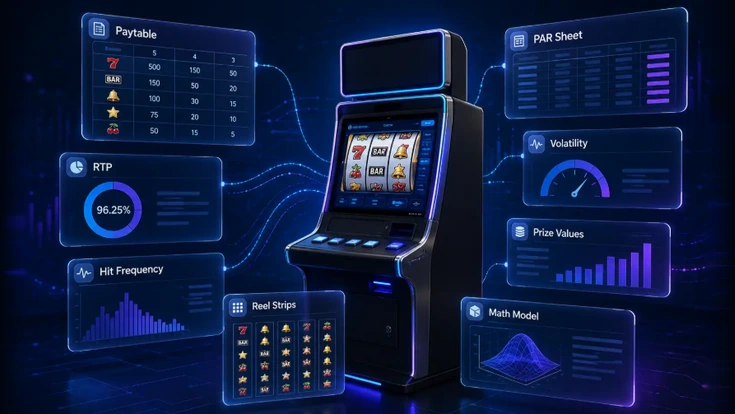
EGM paytables show symbol payouts and prize values. Meanwhile, PAR sheets explain the deeper math behind the game. Together, they help operators review win frequency, payout structure, game settings, and expected long-term return.
Shows what prizes are available: winning symbols, combinations, bonus triggers, and payout values.
Explains the math behind how the game is expected to perform: RTP, hit frequency, volatility, and probabilities.
Quick Summary of EGM Paytables and PAR Sheets
| Area | What It Means |
|---|---|
| Paytable | The visible prize table showing winning symbols, combinations, and payout values |
| PAR sheet | A math document that explains theoretical game performance |
| Used in | Slot machines, EGMs, VLTs, and other gaming terminals |
| Key values | RTP, hit frequency, volatility, prize distribution, reel strips, symbol weights |
| Main users | Math teams, operators, labs, compliance teams, technical reviewers |
| Operator value | Game review, configuration control, audit support, payout understanding |
What Is an EGM Paytable?
An EGM paytable is a list of prizes available in an electronic gaming machine.
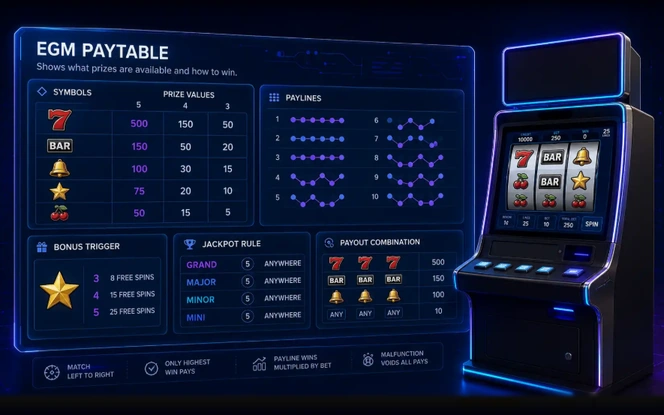
It usually shows how much the machine pays for specific winning combinations. In a slot machine, this may include:
- Symbol combinations
- Line wins
- Scatter wins
- Wild symbol rules
- Bonus triggers
- Free spin awards
- Jackpot combinations
- Multiplier rules
- Denomination-based prize values
- Bet-level payout differences
In simple terms, a paytable defines what the player can win under the game rules.
In a more complex EGM, the paytable may include several paylines, bet levels, bonus features, jackpots, multipliers, and mystery awards. It may also show different prize values for each denomination.
Why Paytables Matter
Paytables matter because they define the visible prize structure of the game. For example, they help answer questions such as:
- What combinations pay?
- How much does each combination pay?
- Which symbols are high-value symbols?
- Which symbols are low-value symbols?
- Which combinations trigger bonuses?
- Which prizes are tied to jackpots?
- Does the prize value change by bet level or denomination?
- Does the game include free spins, multipliers, or bonus awards?
For players, the paytable explains the reward rules. For operators and technical teams, it is part of the configuration that must match the approved math model and machine setup.
What Is a PAR Sheet?
A PAR sheet is a technical math document that describes how a slot machine or EGM is expected to perform.
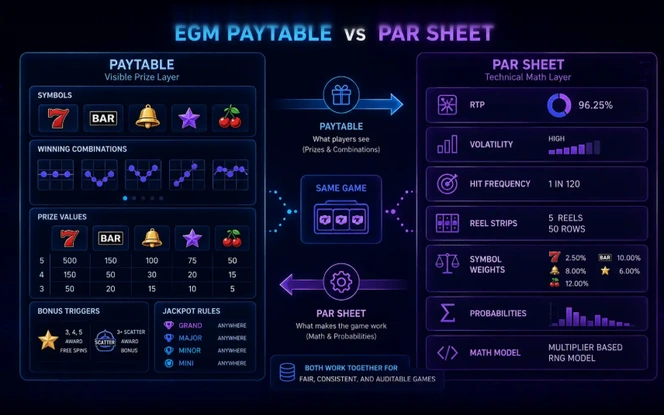
PAR is commonly understood as a math and probability reference for the game. A PAR sheet may include:
- Theoretical return to player
- House edge
- Hit frequency
- Volatility
- Prize distribution
- Reel strips
- Symbol counts and weights
- Payout combinations
- Paytable values
- Bonus feature probabilities
- Free spin probabilities
- Jackpot probabilities
- Denomination options
- Game configuration options
A PAR sheet is usually not written for casual players. Instead, math teams, labs, operators, manufacturers, and reviewers use it to understand the game's technical behavior.
Paytable vs PAR Sheet
Although a paytable and PAR sheet are connected, they do different jobs.
| Area | Paytable | PAR Sheet |
|---|---|---|
| Main purpose | Shows prize values and winning combinations | Explains the math model behind the game |
| Visibility | Often visible to players | Usually technical or internal |
| Focus | What pays and how much | Why the game performs a certain way |
| Includes | Symbols, prizes, bonus triggers, payout values | RTP, hit frequency, volatility, reel strips, probabilities |
| Used by | Players, operators, reviewers | Math teams, labs, compliance teams, operators |
| Main question | What can the game pay? | How is the game expected to behave over time? |
The paytable is the visible prize map, while the PAR sheet is the math model behind it.
How Paytables and PAR Sheets Define Game Math
The paytable sets the prize rules. Then the PAR sheet explains how those rules combine into the game's expected performance.
How Paytables Define Prize Values
Paytables define prize values by connecting symbols, combinations, and payout rules. A paytable may define:
- How many matching symbols are needed
- Which paylines are active
- Whether wins pay left to right
- Whether scatter symbols pay anywhere
- Whether wild symbols substitute for other symbols
- Whether multipliers apply
- Whether bonus rounds are triggered
- Whether prizes scale by bet level
- Whether jackpots require max bet
- Whether feature buys or side features apply
In a basic slot machine, the paytable may be simple. However, a modern EGM may use a more layered paytable with bonuses, jackpots, free spins, symbol upgrades, wilds, multipliers, and mystery awards.
How PAR Sheets Support Slot Math
A PAR sheet supports the math side of the slot game. It explains how the game reaches its expected theoretical performance. This may include the relationship between:
- Symbol distribution
- Reel strips
- Random number selection
- Paytable values
- Winning combinations
- Bonus probabilities
- Hit frequency
- Volatility
- RTP
- Jackpot contribution
- Feature contribution
The paytable says what a prize pays. By contrast, the PAR sheet explains how often outcomes may appear and how they contribute to the overall return.
RTP, Volatility, and Hit Frequency
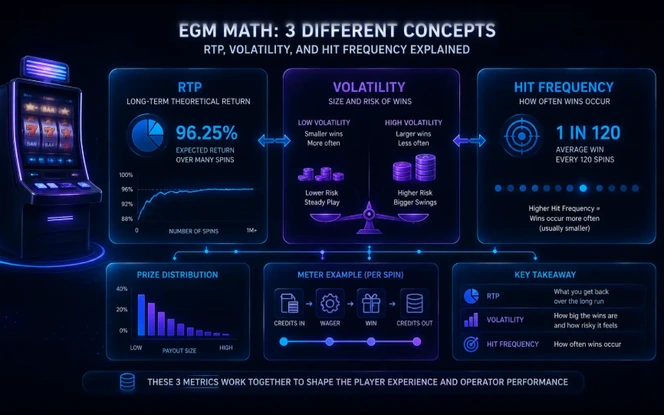
Three values explain most of how a slot game behaves over time.
RTP in Paytables and PAR Sheets
RTP means return to player. It is the theoretical percentage of total wagers that the game is expected to return over long-term play.
For example, a 94% theoretical RTP does not mean every player gets 94% back in a short session. Instead, the math model is expected to return that percentage over a very large number of plays.
PAR sheets document how RTP is calculated from the game math. This may include base-game returns, bonuses, jackpots, free spins, and other feature contributions.
Volatility in EGM Math
Volatility describes the risk and reward pattern of a slot game. A low-volatility game may produce smaller wins more often, while a high-volatility game may produce bigger wins less often.
Therefore, two games with the same RTP can still feel very different.
PAR sheets help operators and reviewers understand this behavior before the game goes live.
Hit Frequency
Hit frequency refers to how often a game produces a winning result. A game with high hit frequency may produce more frequent wins, while a low-hit-frequency game may win less often.
However, hit frequency can be misunderstood. A high hit frequency does not always mean a better player experience.
Some wins may be smaller than the wager amount. They may still count as hits in reports, but they may not feel meaningful to the player. This is why hit frequency should be reviewed together with RTP, volatility, prize distribution, and average win size.
Reels, Paylines, and Features
The math model runs through the reel setup, the win-evaluation rules, and the feature layers of the game.
Reel Strips, Symbols, and Weighting
In many slot machines, reel strips and symbol weighting form an important part of the math model. A reel strip is the sequence or distribution of symbols that can appear on a reel.
In digital games, symbol weighting may also control how often symbols are selected. The PAR sheet may show:
- Number of reels
- Number of symbol stops
- Symbol positions
- Symbol counts
- Symbol weights
- Wild symbol distribution
- Scatter symbol distribution
- Bonus symbol distribution
- Jackpot symbol distribution
As a result, this information explains why some symbols appear often and others appear rarely. A high-paying symbol may be listed in the paytable, but if it appears rarely in the math model, the overall probability of that prize may be low.
Paylines, Ways, and Winning Patterns
Paytables also define how winning patterns are evaluated. An EGM may use:
- Fixed paylines
- Selectable paylines
- Ways-to-win mechanics
- Cluster pays
- Scatter pays
- Adjacent symbol pays
- Left-to-right or right-to-left wins
- Both-way wins
- Feature-based wins
The PAR sheet should align with the game's actual win-evaluation model. For example, a 20-line slot and a 243-ways slot may both use reels and symbols.
However, their math structures differ. The number of winning patterns affects hit frequency, prize distribution, and overall game behavior.
Bonus Features and Free Spins
Modern EGMs often include bonus features and free-spin rounds. Because these features can affect the game math, a PAR sheet may describe:
- Bonus trigger probability
- Free spin trigger rules
- Average free spin value
- Retrigger probability
- Multiplier probability
- Bonus prize distribution
- Feature contribution to RTP
- Jackpot contribution
- Mystery award probability
A paytable may show that a bonus can be triggered, but the PAR sheet explains how that bonus contributes to the game's theoretical performance.
Progressive Jackpots and Mystery Awards
Some EGMs include progressive jackpots or mystery awards. These features may use separate math layers, contribution rates, reset values, increments, and award probabilities. Operators should review:
- Jackpot trigger rules
- Jackpot contribution percentage
- Reset value
- Maximum value, if applicable
- Eligibility rules
- Bet-level requirements
- Jackpot meter behavior
- Reporting requirements
- Payout record handling
Progressive features can make the game more complex because jackpot value and contribution may affect the overall payout model.
How Paytables Connect Across the EGM
The paytable does not work alone. Instead, it connects to outcome logic, meters, the platform model, and cabinet configuration.
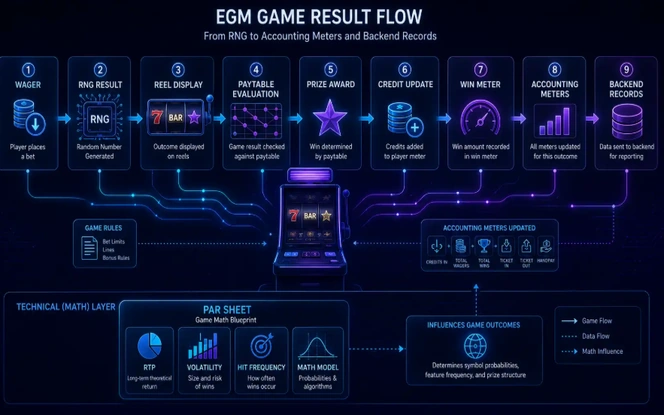
How Paytables Connect With RNG Outcomes
Paytables do not create random outcomes on their own. The random number generator or game outcome logic selects the result.
Then the paytable defines what that result pays. Nevada's technical standards define an RNG as a hardware, software, or combined device used for generating number values. A simplified flow looks like this:
The player starts a game.
The machine receives the wager.
The RNG or configured outcome logic determines the result.
The reels or game display show the result.
The paytable is used to evaluate the result.
The game awards credits if the result wins.
Credit meters and win meters update.
Event records and backend reports may update.
This is why the paytable, RNG, reel mapping, prize rules, and meter updates must align. The full sequence is covered in how EGM slot machines work.
How Paytables Connect With Accounting Meters
Although paytables and accounting meters are closely connected, they are not the same. The paytable defines what should be paid for a result.
Meanwhile, accounting meters record what actually happened during play. For example:
- The paytable says a symbol combination pays 100 credits.
- The game result creates that symbol combination.
- The machine adds 100 credits to the player balance.
- Win meters and credit meters update.
- Backend records may update.
If a payout event occurs, accounting meters help record the result. This is why paytable logic and meter logic must remain aligned. EGM accounting meters help operators compare game activity, payout records, TITO records, handpay records, and backend reports.
EGM Paytables vs Online Slot Paytables
EGM and online slot paytables may look similar at a game-design level. However, their operating environments are different.
An EGM is a physical machine connected to cabinet hardware, meters, ticketing, event logs, and backend reporting. By contrast, an online slot usually connects to player accounts, wallets, platform logs, payment systems, and remote game servers.
This is one of the key differences explained in EGM vs online slot games.
| Area | EGM Paytable | Online Slot Paytable |
|---|---|---|
| Environment | Physical machine or terminal | Web or mobile platform |
| Value layer | Credits, cash, TITO, tickets | Wallet balance and account credits |
| Records | Machine meters, cabinet events, ticket records | Platform logs, wallet logs, account records |
| Review focus | Machine configuration, paytable, PAR sheet, meters | Game server, wallet, RTP display, account logs |
| Support issue | Meter mismatch, cabinet fault, ticket dispute | Wallet dispute, session issue, payment delay |
Both need accurate math and clear rules, but they connect to different operating systems.
Paytable Configuration and Cabinet Setup
Paytables also connect with EGM cabinet components and configuration options. A cabinet or terminal setup may include:
- Denomination settings
- Bet configuration
- Button panel options
- Touchscreen layout
- Game theme
- Ticket printer
- Bill validator
- Logic board
- Game storage
- Critical memory
- Backend connection
If a machine supports multiple denominations or paytable options, operators must confirm that the selected setup matches the approved configuration. A mismatch between game math, cabinet setup, denomination, and reporting can create operational and audit issues.
Operator Review: Checks and Common Issues
Paytable and PAR sheet review works best as a structured process. Therefore, known failure points should be checked from the start. GLI-11 is commonly referenced for requirements covering paytable display, game rules, and metering behavior.
What Operators Should Check
Operators and technical teams should review paytables and PAR sheets before deployment, configuration changes, or approval review. Useful questions include:
- What paytable version is installed?
- What PAR sheet version is being used?
- Does the paytable match the approved math model?
- What is the theoretical RTP?
- Are there multiple RTP settings?
- What is the volatility profile?
- What is the hit frequency?
- How are bonus features triggered?
- How are free spins calculated?
- How are jackpot features handled?
- Are denominations and bet levels configured correctly?
- Do progressive features have separate requirements?
- Does the machine display the correct prize rules?
- Do meters update correctly after winning events?
- Does backend reporting receive the correct game records?
Common Paytable and PAR Sheet Issues
Operators should watch for issues that affect game review, reporting, and player understanding. Common issues include:
- Wrong paytable version
- Wrong denomination setup
- Mismatch between displayed paytable and configured math
- Incorrect bonus trigger display
- Unclear jackpot eligibility
- Wrong feature contribution
- RTP setting mismatch
- Volatility not understood by operations team
- Hit frequency misread as player return
- Prize table not matching game rules
- Incomplete PAR sheet review
- Incorrect meter connection after payout
- Configuration change not logged
- Backend report mismatch
These issues should be handled through configuration control, review procedures, machine testing, event logs, and backend reporting checks.
Common Misunderstandings About Paytables and PAR Sheets
A Paytable Is Not the Full Math Model
The paytable shows prize values and winning combinations. It does not fully explain RTP, volatility, symbol distribution, hit frequency, feature probability, or jackpot behavior.
RTP Is Not a Session Guarantee
RTP is a long-term theoretical value. It does not guarantee what one player will receive during a short session.
A High Prize Does Not Mean a Frequent Prize
A paytable may show a large prize, but the PAR sheet explains how likely that prize is within the math model.
Hit Frequency Is Not the Same as Profitability
A game may hit often but still return small wins. Hit frequency should be reviewed together with RTP, volatility, and average win size.
PAR Sheets Are Not Only for Math Teams
PAR sheets are technical, but operators, compliance teams, and reviewers should understand the key values because they affect game review, reporting, and player experience.
Checklist for Reviewing EGM Paytables and PAR Sheets
Before deployment or approval review, operators and product teams should check:
- Paytable version
- PAR sheet version
- RTP value
- Volatility profile
- Hit frequency
- Reel strips
- Symbol distribution
- Prize distribution
- Bonus trigger rules
- Free spin rules
- Jackpot rules
- Denomination and bet-level settings
- Feature contribution to RTP
- Jackpot contribution
- Displayed prize rules
- Configured prize rules
- Meter update behavior
- Backend reporting behavior
- Change control records
Overall, this checklist helps operators review paytables and PAR sheets as part of the full EGM operating model.
Need Help Reviewing EGM Paytables and PAR Sheets?
Improve math validation, RTP review, prize configuration, meter alignment, and backend reporting with a structured EGM review process.
Talk to Our EGM ExpertsFAQs About EGM Paytables and PAR Sheets
An EGM paytable is a prize table that shows winning symbol combinations, payout values, bonus triggers, jackpot rules, and other prize rules used by the game.
A PAR sheet is a technical math document that explains the expected performance of a slot machine or EGM. It may include RTP, hit frequency, volatility, reel strips, symbol weights, prize distribution, and feature probabilities.
No. A paytable shows what prizes are available. A PAR sheet explains the math model behind the game and how the game is expected to perform over time.
RTP means return to player. It is the theoretical percentage of total wagers that the game is expected to return over long-term play.
Volatility describes how wins are distributed. A low-volatility game may pay smaller wins more often, while a high-volatility game may pay larger wins less often.
Yes. Two games can have the same RTP but different volatility, hit frequency, prize distribution, and bonus behavior. This can make the player experience feel very different.
A slot machine par sheet shows the game’s payout settings, symbols, paytable, and expected return. It helps explain how the machine is designed to pay over time.
Check the game’s RTP, hit frequency, paytable, reel setup, and bonus rules. These details show how often wins may happen and how payouts are calculated.
A paytable shows how much each symbol combination pays. It explains possible prizes, but it does not guarantee when or how often you will win.
Final Thoughts
EGM paytables and PAR sheets are central to slot machine math and game review. The paytable explains what the game can pay. The PAR sheet explains the math behind how the game is expected to perform.
For operators, these documents help review RTP, volatility, hit frequency, symbol behavior, prize distribution, feature contribution, jackpot rules, and configuration options. A strong review process should connect the paytable, PAR sheet, RNG outcome flow, accounting meters, cabinet setup, backend records, and audit trail. This helps the EGM operate as a clear, reviewable, and controlled gaming machine.