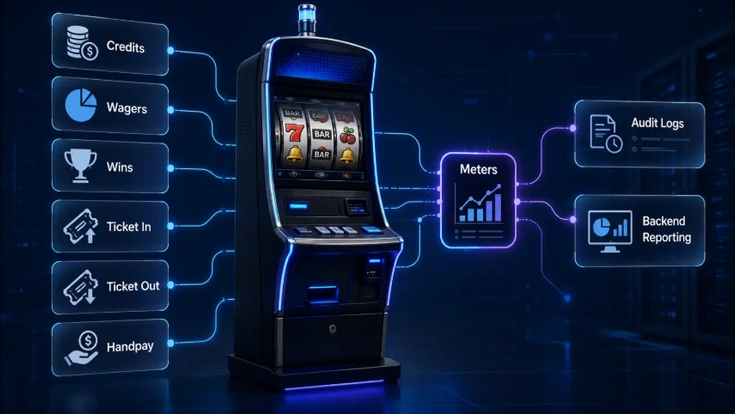
EGM accounting meters track key machine activity, including wagers, wins, payouts, ticket values, handpays, and cancelled credits. As a result, casino operators and technical teams get a clear record of what happens inside each gaming machine.
They help operators review game activity, reconcile ticket and cashout records, investigate disputes, monitor machine performance, and support audit or compliance review.
Quick Summary of EGM Accounting Meters
| Area | What It Means |
|---|---|
| Main purpose | Track machine-level gaming and payment activity |
| Used in | Slot machines, EGMs, gaming terminals |
| Common records | Credits, wagers, wins, ticket-in, ticket-out, handpays |
| Main users | Operators, auditors, technical teams, compliance teams |
| Connected systems | TITO, ticket validation, cabinet events, backend reporting |
| Operator value | Reconciliation, reporting, dispute review, audit trail |
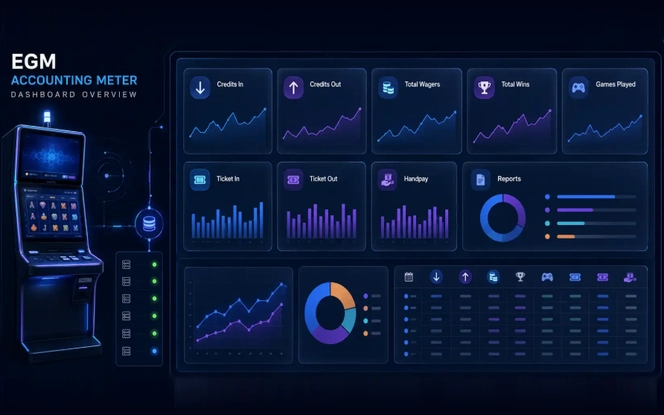
What Are EGM Accounting Meters?
EGM accounting meters are electronic records that track the financial and operational activity of an electronic gaming machine. They may record:
- Credits accepted
- Credits paid out
- Total wagers
- Total wins
- Games played
- Ticket-in values
- Ticket-out values
- Cancelled credits
- Handpay amounts
- Jackpot values
- Bill validator activity
- Printer activity
- Door events
- Configuration changes
These records help operators understand what the machine accepted, what it paid, what it printed, what it logged, and what needs to be reconciled. In an EGM, accounting meters sit between the game activity, payment devices, cabinet events, and backend reporting system.
Why Accounting Meters Matter
Accounting meters matter because slot machines handle value. A machine may accept cash, tickets, cards, or cashless credits.
During play, it updates balances after wagers and wins. It may also print tickets and record faults, handpays, ticket events, or door openings. Without accurate meter records, operators may struggle to answer basic questions such as:
- How much value entered the machine?
- How much value left the machine?
- How much was wagered?
- How much was won?
- Was a ticket printed?
- Was a ticket inserted?
- Was there a handpay?
- Did the meter update correctly?
- Was there a machine fault?
- Does the backend record match the machine record?
Meters help operators compare machine activity with cashier records, TITO records, ticket validation systems, and backend reporting.
Main Types of EGM Accounting Meters
EGM accounting meters can vary by machine, jurisdiction, cabinet setup, and backend system. However, most operators will see a few common meter categories.
Credit Meters
Credit meters help track value available or moving through the machine. A credit meter may relate to:
- Current credits
- Credits in
- Credits out
- Cashable credits
- Non-cashable credits
- Promotional credits
- Residual credits
- Cancelled credits
The player may see a current credit balance on the screen. Meanwhile, the machine and backend systems track credit changes in more detail.
For operators, credit meters help connect player-facing balance changes with actual machine records.
Wager Meters
Wager meters track how much value is bet on the machine. Common wager-related records may include:
- Total wagers
- Number of games played
- Bet amount per game
- Denomination-based wagers
- Bonus wager activity
- Promotional wager activity
Therefore, wager meters help operators understand machine activity and performance. They also support reporting, game review, and reconciliation.
Win Meters
Win meters track value won by players. Win-related meter records may include:
- Total wins
- Game wins
- Bonus wins
- Jackpot wins
- Handpay wins
- Progressive wins
- Win values by denomination or game setup
Win meters help operators compare game activity, payout behavior, and reporting records. A win meter does not explain the entire game math by itself. It records what happened on the machine. RTP, volatility, paytables, and PAR sheets explain the theoretical and configured side of the game.
Ticket-In and Ticket-Out Meters
Ticket-in and ticket-out meters are important in TITO-enabled slot machines. Ticket-in happens when a player inserts a valid barcoded ticket into the machine.
Ticket-out happens when the player presses cashout and the machine prints a new ticket. Related meters may track:
- Ticket-in amount
- Ticket-out amount
- Number of tickets inserted
- Number of tickets printed
- Ticket value accepted
- Ticket value issued
- Ticket validation activity
- Ticket rejection events
- Printer-related events
These meters help operators reconcile machine activity with the ticket validation system and cashier records.
Bill and Cash-In Meters
Bill and cash-in meters track value accepted through the bill validator or cash acceptor. These records may include:
- Bills accepted
- Bill denominations
- Total cash inserted
- Voucher-in values
- Rejected bills or tickets
- Bill validator errors
- Cash box-related records
For operators, these meters help connect physical intake with machine credits and backend records. If the bill validator accepts value, the machine should update the correct records and credit balance.
However, when it rejects value, the machine should show or record the correct status.
Cashout and Payout Meters
Cashout and payout meters track value leaving the machine. These may include:
- Ticket-out values
- Credits paid out
- Handpay values
- Cancelled credits
- Jackpot payout records
- Voucher-out values
- Cashout requests
- Cashout completion status
These meters help operators confirm whether the machine paid, printed, or triggered the correct payout process.
Handpay and Jackpot Meters
Some wins may require a handpay or manual review, depending on machine setup, payout threshold, jurisdiction, or operator process. Handpay and jackpot meters may track:
- Handpay amount
- Handpay event time
- Jackpot amount
- Progressive jackpot activity
- Cancelled credit amount
- Manual payout status
- Attendant or operator action
- Related event logs
These records are important because high-value payouts often require extra review, staff involvement, and proper reporting.
Event Meters and Cabinet Records
Not every meter is purely about wagers or payouts. Some records track machine events and cabinet activity. Event-related records may include:
- Door open events
- Logic door events
- Cash box access
- Bill validator faults
- Printer faults
- Printer paper low
- Printer jam
- Communication failure
- Power loss
- Machine restart
- Configuration change
- Game option change
- Tilt condition
These records help operators understand machine health, security events, and servicing history. Event records are especially important because an EGM is a physical machine. Cabinet access, power recovery, printer faults, and validator issues can all affect operations and audit review.
How Meters Work During a Slot Machine Session
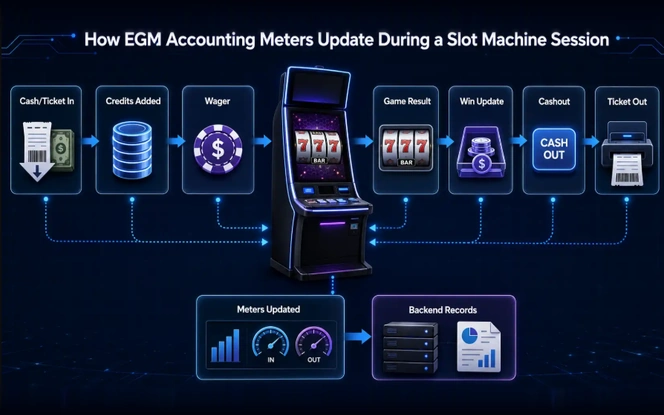
Meters update at different points during the player session. This activity sits inside the broader flow covered in how EGM slot machines work.
A simplified session may look like this:
The player inserts cash or a ticket.
The bill validator or ticket reader accepts the value.
Credits are added to the machine.
Credit-in or ticket-in meters update.
The player places a wager.
Wager meters update.
The game result is shown.
Win meters update if the player wins.
The credit balance changes.
The player continues play or presses cashout.
Ticket-out or payout meters update.
Event logs and backend records are updated.
This flow shows why meters must connect to the full machine process. They are not separate from the game. Instead, they form part of how the machine records value movement.
How Meters Connect Across the EGM
Meters do not work in isolation. Instead, they connect to the ticket system, cabinet hardware, and the machine's reporting model.
EGM Accounting Meters and TITO
TITO in slot machines and accounting meters are closely connected. In a TITO-enabled machine, the machine must record ticket-in and ticket-out activity accurately. The ticket validation system, cashier system, and backend reporting system may also need matching records. A TITO meter review may ask:
- What ticket value entered the machine?
- Was the ticket accepted or rejected?
- Did the credit meter update?
- What value was played?
- What value was printed during cashout?
- Was the ticket-out record created?
- Did the ticket validation system receive the record?
- Was the ticket later redeemed?
- Did the cashier record match the ticket record?
This is why TITO should not be treated as just a printer function. It is a ticket, meter, validation, and reporting workflow.
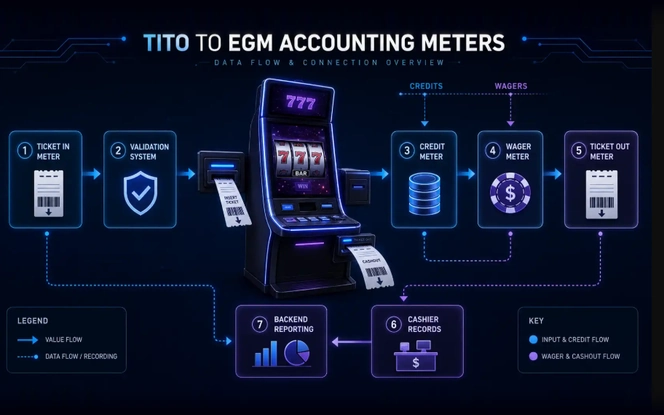
EGM Accounting Meters and Cabinet Components
Accounting meters also connect with EGM cabinet components. A machine cabinet may include a display, button panel, touchscreen, bill validator, ticket printer, card reader, logic board, secure memory, door sensors, and network module. Many of these parts can trigger meter or event records. Examples:
- A bill validator accepts value.
- A ticket printer prints a cashout ticket.
- A door sensor records cabinet access.
- A logic board processes a game event.
- Critical memory stores important state.
- A network module sends meter data to the backend.
- A printer fault creates a service event.
This is why meter planning should be reviewed alongside cabinet design. The cabinet hardware and the meter records need to work together.
EGM Meters vs Online Slot Platform Records
EGM meters and online slot records are not the same. This is one of the key differences explained in EGM vs online slot games. An EGM is a machine-centered environment. It records machine credits, cabinet events, ticket-in, ticket-out, meter values, and physical device activity.
An online slot platform is usually account-centered. It records player login, wallet balance, game session, wallet debit, wallet credit, bonus activity, device information, and payment events.
| Area | EGM Accounting Meters | Online Slot Platform Records |
|---|---|---|
| Main object | Physical machine or terminal | Player account and game session |
| Payment layer | Cash, ticket, card, TITO | Wallet, payment gateway, account balance |
| Key records | Credits, wagers, wins, ticket-in, ticket-out | Wallet debit, wallet credit, session logs |
| Event focus | Cabinet events, printer, validator, power events | Login, payment, KYC, device, session events |
| Reporting style | Machine-first reporting | Player-first and platform-first reporting |
| Support issue | Meter mismatch, printer fault, ticket dispute | Wallet dispute, payment delay, account issue |
Both need strong records, but they track different operating models.
Reconciliation, Recovery, and Audit Trails
Meters earn their value when records are compared, when machines recover from interruptions, and when reviews need a clear history.
How Meters Support Reconciliation
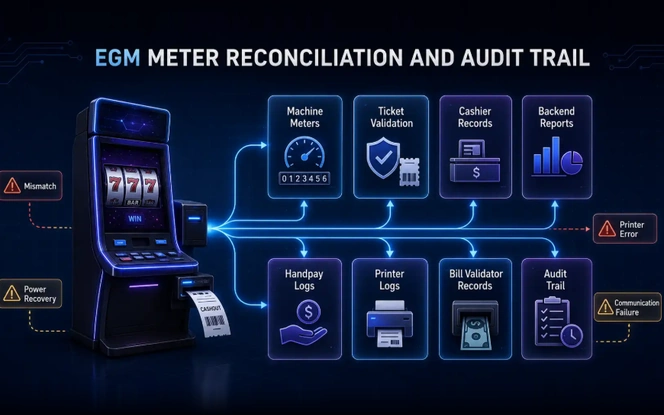
Reconciliation is one of the most important reasons accounting meters exist. Operators may need to compare:
- Machine meters
- Ticket validation records
- Cashier records
- Backend reports
- Handpay records
- Printer logs
- Bill validator activity
- Cash box records
- Player tracking records
- Audit logs
For example, if a machine shows a ticket-out value, the backend system should also show that the ticket was issued. If a player redeems the ticket at a cashier, the redemption record should match the ticket record. If records do not match, operators need to investigate.
Possible causes may include:
- Communication failure
- Printer error
- Ticket validation delay
- Meter update issue
- Cashier process issue
- Manual payout issue
- Machine restart
- Power interruption
- Configuration mismatch
Good meter design does not remove every issue, but it helps operators find and explain issues faster.
Common Meter Issues Operators Should Watch
Operators should monitor accounting meters regularly because issues can affect reporting, support, and audits. Common problems include:
- Meter mismatch
- Ticket-in value mismatch
- Ticket-out value mismatch
- Credit meter not matching expected value
- Cashout event not recorded clearly
- Printer event missing
- Bill validator event missing
- Handpay not linked to the correct event
- Machine restart without clear recovery record
- Communication failure between machine and backend
- Duplicate or missing ticket records
- Configuration change without proper log
- Incorrect denomination setup
- Reporting delay
These issues should be handled through machine logs, backend reports, service alerts, and operator review processes.
Accounting Meters and Critical Memory
Accounting meters are closely connected to machine state and critical memory. The EGM must preserve important machine data so it can recover after a restart, power loss, or fault.
This data can include current credits, meter values, configuration details, and recent game or event information. GLI-11 is commonly referenced for gaming-device requirements, including accounting, metering, and critical memory controls.
This matters because a player balance, cashout event, ticket print, or payout record should not be lost or duplicated because of a machine interruption. For operators, this means meter records are not only reporting tools. They also support recovery, dispute handling, and machine integrity.
Accounting Meters and Audit Trails
Meters are part of the broader audit trail of an EGM. An audit trail may include:
- Meter values
- Ticket records
- Game events
- Cabinet events
- Door events
- Configuration changes
- Cashout events
- Printer faults
- Validator faults
- Handpay records
- Power recovery records
- Backend communication records
This audit trail helps operators understand what happened before, during, and after a machine event. Singapore's Gambling Regulatory Authority states that EGMs deployed in Singapore must be secure, reliable, and auditable. That framing is useful because meters, logs, and records all support reviewable machine operation.
What Operators Should Check Before Reviewing EGM Meters
Before reviewing EGM accounting meters, operators and technical teams should ask:
- Which meters are required for this machine type?
- Which values does the machine track?
- Which values does the machine send to the backend?
- Which meters are connected to TITO?
- Which meters are connected to the bill validator?
- Which meters are connected to the ticket printer?
- How does the system record handpays?
- How does the system record cancelled credits?
- How does the system record jackpot events?
- How does the system record door events?
- How does the system record printer faults?
- How does the system record communication failures?
- How does the machine recover after power loss?
- How does the machine protect meter values?
- How often do operators review reports?
- What happens if machine records and backend records do not match?
These questions help operators review accounting meters as part of the full EGM operating model.
Common Misunderstandings About EGM Accounting Meters
Meters Are Not Only for Finance Teams
Accounting meters support finance, but they also help technical, compliance, floor operations, and support teams. They help explain machine activity and support dispute review.
Credit Balance and Accounting Meters Are Not the Same
The credit balance is what the player sees during play. Accounting meters are backend records that track machine activity over time.
TITO Needs Meter Accuracy
Ticket-in and ticket-out flows depend on accurate meter updates. If ticket records, credit meters, and backend records do not align, operators may face reconciliation issues.
A Printer Error Can Affect Meter Review
A printer jam or failed ticket print is not only a hardware issue. It may affect cashout records, ticket status, player support, and backend reporting.
Meters Do Not Replace Audit Logs
Meters record values. Audit logs provide event context. Operators usually need both to understand what happened on the machine.
Checklist for EGM Accounting Meter Review
Before deployment or routine review, operators and product teams should check:
- Credit-in meters
- Credit-out meters
- Total wager meters
- Total win meters
- Games played meters
- Ticket-in meters
- Ticket-out meters
- Bill validator meters
- Voucher meters
- Handpay meters
- Cancelled credit meters
- Jackpot meters
- Door event records
- Printer event records
- Configuration change records
- Power recovery records
- Backend reporting records
- Ticket validation records
- Cashier reconciliation records
- Audit trail requirements
Overall, this checklist helps operators review meters as part of machine operation rather than only as accounting fields.
Need Help Reviewing Your EGM Accounting Meters?
Improve meter accuracy, TITO reconciliation, payout records, recovery checks, and backend reporting with a structured EGM review.
Talk to Our EGM ExpertsFAQs About EGM Accounting Meters
EGM accounting meters are machine-level records that track credits, wagers, wins, ticket-in values, ticket-out values, handpays, cashout activity, and other important gaming machine records.
Slot machines need accounting meters to record value movement, support reporting, help with reconciliation, review disputes, and maintain a reliable machine activity record.
A credit meter tracks credit-related activity on the machine. It may include current credits, credits in, credits out, cashable credits, promotional credits, and other credit changes.
An EGM is an Extraordinary General Meeting held outside the regular annual meeting. Businesses use it to discuss and approve urgent decisions that cannot wait.
An AGM is a scheduled yearly meeting. An EGM is called only when an urgent or special business decision needs shareholder approval.
You may need an EGM for urgent matters such as changing directors, approving major transactions, updating company rules, or raising new capital.
A ticket-in meter tracks the value of tickets inserted into a TITO-enabled slot machine. It helps operators compare machine records with ticket validation and cashier records.
A ticket-out meter tracks the value of tickets printed by the machine during cashout. It helps operators review ticket issuance, cashout activity, and reconciliation records.
Accounting meters help operators compare machine activity with ticket records, cashier reports, backend records, handpay logs, and other operational reports.
Yes. Accounting meters are part of the broader EGM audit trail. They help show what happened on the machine and support reviews of credits, tickets, wagers, wins, payouts, and events.
Final Thoughts
EGM accounting meters are one of the most important recordkeeping layers inside a slot machine or electronic gaming machine. They help operators understand credits, wagers, wins, ticket-in values, ticket-out values, handpays, cabinet events, cashout activity, and backend reporting.
A strong meter setup supports reconciliation, player dispute review, machine monitoring, audit trails, and operational control. For casino operators and product teams, accounting meters should be reviewed alongside the game flow, TITO setup, cabinet components, ticket validation process, and backend reporting system.