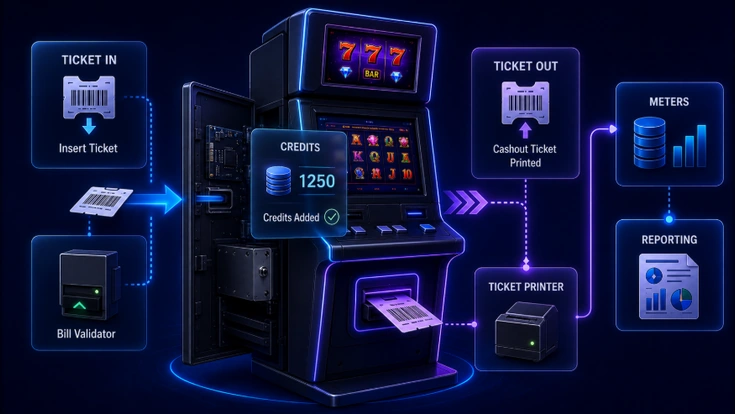
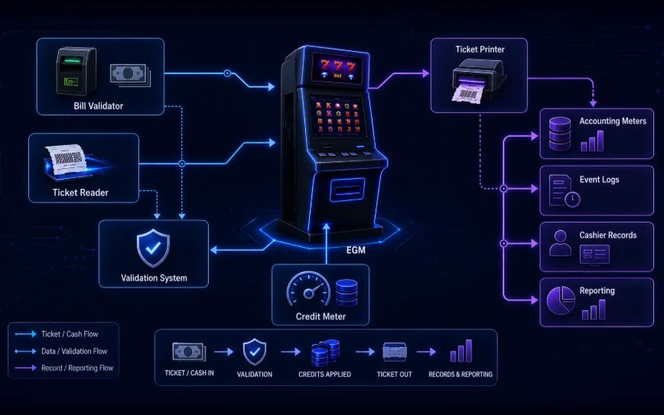
TITO means Ticket-In, Ticket-Out. It replaces coins with barcoded tickets, so players can cash out, redeem a ticket, or insert it into another compatible machine.For players, TITO feels simple: insert a ticket, play, and print a new ticket when finished. For casino operators, TITO is more than a ticket printer. Instead, it connects the validator, printer, credit meter, validation system, accounting meters, logs, cashier process, and backend reporting.
In simple terms: TITO helps move value through a physical slot machine environment without relying only on coins or direct cash payouts.
Quick Summary of TITO
| Area | What It Means |
|---|---|
| Full form | Ticket-in ticket-out |
| Used in | Slot machines, EGMs, gaming terminals |
| Ticket-in | Player inserts a barcoded ticket into the machine |
| Ticket-out | Machine prints a ticket during cashout |
| Main devices | Bill validator, ticket printer, ticket validation system |
| Records involved | Ticket records, credit meters, accounting meters, event logs |
| Operator focus | Cashout control, reconciliation, reporting, security, floor operations |
What Is TITO in Slot Machines?
TITO allows a slot machine to accept and issue barcoded tickets. The Victorian Gambling and Casino Control Commission describes it as technology that lets patrons collect machine credits through a barcoded ticket. A player can insert a valid ticket into a TITO-enabled machine.
Then the machine reads the barcode, validates the ticket, and adds the approved value to the credit balance. When the player presses cashout, the machine prints a new ticket for the remaining value. The player can then redeem it or use it in another compatible machine.
As a result, TITO is an important part of modern casino floor operations. It usually works with:
- Bill validator or ticket reader
- Ticket printer
- Credit meter
- Ticket validation system
- Machine meters
- Event logs
- Cashier or redemption process
- Casino backend reporting
In an electronic gaming machine, TITO sits between the player's credit balance and the operator's payment and reporting system. For broader machine and casino-floor context, see slot machines for casino floors explained.
Why TITO Matters for Casino Operators
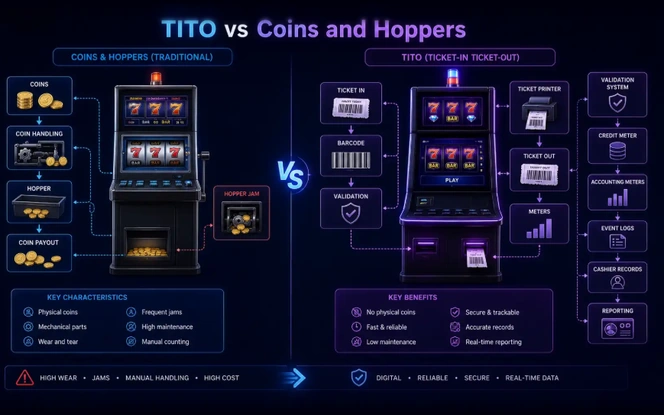
TITO changes how value moves across the casino floor. Older slot environments relied more heavily on coins, hoppers, manual payouts, and direct cash handling.
By contrast, TITO uses tickets to move value between machines and redemption points. For operators, this can support:
- Faster cashout flow
- Less coin handling
- Easier movement between machines
- Cleaner floor operations
- Better ticket-level records
- Better reconciliation
- Reduced manual payout friction
- Stronger machine-level reporting
TITO also changes the support model. Therefore, operators need to monitor printer status, validation, barcode quality, expiry rules, cashout events, and ticket values.
How TITO Works in a Slot Machine
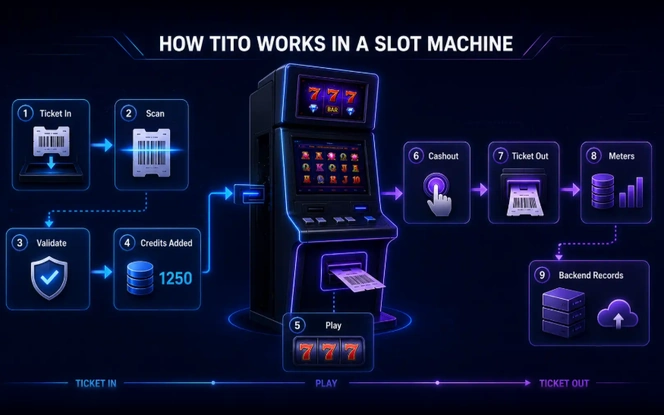
A basic TITO flow includes insertion, validation, credit updates, gameplay, cashout, printing, and recordkeeping. This process sits inside the broader machine flow covered in how EGM slot machines work.
A simplified flow looks like this:
The player inserts a barcoded ticket.
The bill validator or ticket reader scans the ticket.
The machine checks the ticket with the validation system.
If the ticket is valid, credits are added to the machine.
The player plays the slot game.
Wagers and wins update the credit balance.
The player presses cashout.
The machine prints a new barcoded ticket.
Ticket-out value is recorded.
The ticket can be redeemed or inserted into another compatible machine.
Because this process affects credits, payments, meters, and disputes, it must remain reliable.
TITO Ticket-In Flow
Ticket-in happens when a player inserts a ticket into the slot machine. The machine does not simply trust the paper ticket.
First, it scans and validates the barcode before adding credits. A ticket-in flow may include:
Player inserts the ticket.
Ticket reader scans the barcode.
Machine sends ticket data to the validation system.
Validation system checks ticket status.
Machine accepts or rejects the ticket.
If accepted, credits are added.
Ticket-in meters and logs are updated.
The player can start or continue play.
A ticket-in event may fail because of a damaged barcode, communication issue, expired ticket, prior redemption, invalid status, or system mismatch.
TITO Ticket-Out Flow
Ticket-out happens when the player cashes out. Instead of dispensing coins, the slot machine prints a new ticket for the available value. The flow may include:
Player presses cashout.
Machine checks the current credit balance.
Machine sends the cashout request to the ticket system.
Ticket printer prints a barcoded ticket.
Ticket-out meter is updated.
Event log records the cashout.
Player collects the ticket.
Ticket can be redeemed or used in another compatible machine.
The ticket-out flow must be carefully controlled because it creates a new value-bearing record.
Main Components Used in TITO
TITO is not controlled by one device alone. Instead, it depends on several connected parts inside and outside the slot machine.
Bill Validator or Ticket Reader
The bill validator may read cash, vouchers, or barcoded tickets, depending on the setup. In a TITO flow, it may:
- Scan the ticket barcode
- Read ticket information
- Reject unreadable tickets
- Send ticket data for validation
- Trigger ticket-in records
- Add approved value to credits
If the ticket cannot be read or validated, the machine should reject the ticket or display an error message.
Ticket Printer
The ticket printer creates the ticket-out during cashout. It may print information such as:
- Ticket barcode
- Ticket value
- Machine number
- Date and time
- Venue or system information
- Validation number or ticket identifier
- Expiry information, if applicable
The printer is a key cabinet component. However, a jam, low-paper condition, or print failure can affect cashout and machine status.
Ticket Validation System
The ticket validation system checks whether a ticket is valid, redeemed, expired, cancelled, or available for use. It prevents the same ticket from being used more than once.
In addition, it connects the machine, cashier, redemption terminal, and backend records. The system may track:
- Ticket number
- Ticket value
- Issue time
- Redemption status
- Machine ID
- Venue or location
- Cashout event
- Ticket-in event
- Ticket cancellation or expiry
This is one reason TITO should be treated as a system, not only as a machine printer feature.
Credit Meter
The credit meter shows the player's available credits on the machine. When a ticket is accepted, credits increase.
During play, wagers reduce the balance and wins increase it. At cashout, the remaining value is printed as a ticket. The credit meter must stay aligned with the ticket-in value, wagers, wins, cashout value, and machine records.
Accounting Meters
Accounting meters track machine-level values. For TITO, common meter areas may include:
- Ticket-in value
- Ticket-out value
- Credits in
- Credits out
- Total wagers
- Total wins
- Games played
- Cancelled credits
- Handpay values
- Voucher values
- Cashable credit changes
These meters help operators reconcile machine activity with ticket records, cashier records, and backend reports.
Event Logs
Event logs record important TITO-related machine activity. Examples include:
- Ticket inserted
- Ticket accepted
- Ticket rejected
- Ticket validation failed
- Credits added
- Cashout requested
- Ticket printed
- Ticket print failed
- Printer paper low
- Printer jam
- Communication failure
- Ticket redemption issue
These logs are useful for troubleshooting, audit review, reporting, and player disputes. The guide to EGM audit logs and event records explains how machine events support traceability and operational review.
TITO vs Coins and Online Wallets
TITO replaced older coin-based payout handling in many venues, and it also differs from the wallet systems used in online slots.
TITO vs Coins and Hoppers
Older slot machines often used coin hoppers. Operators had to manage fills, hopper levels, jams, and collections. TITO replaces much of that flow with printed tickets.
| Area | Coin/Hopper Slot Machine | TITO Slot Machine |
|---|---|---|
| Cashout method | Coins or tokens | Barcoded ticket |
| Payout device | Hopper | Ticket printer |
| Player movement | Carry coins or buckets | Carry ticket |
| Floor handling | More coin handling | Less coin handling |
| Records | Coin and meter records | Ticket, meter, and validation records |
| Main support issue | Hopper jams or fills | Printer, barcode, or validation issues |
| Reuse value | Usually cash out or reinsert coins | Insert ticket into compatible machine |
TITO does not remove the need for control. It changes the control from coins and hoppers to tickets, printers, meters, and validation systems.
TITO vs Online Wallets
TITO is used in physical gaming machine environments. Online slot games usually use wallet systems instead.
| Area | TITO in Slot Machines | Online Slot Wallet |
|---|---|---|
| Environment | Physical slot machine or EGM | Online casino or mobile app |
| Value format | Barcoded ticket and machine credits | Player account balance |
| Cashout | Printed ticket or cashier redemption | Withdrawal request |
| Identity | Ticket, machine, venue, or session based | Player account based |
| Records | Ticket logs, meters, machine events | Wallet logs, payment records, account logs |
| Operator risk | Ticket validation, printer error, cashout dispute | Payment fraud, chargebacks, wallet dispute |
The purpose is similar: move value in and out of gameplay. However, the operating model is different. TITO is machine-centered, while online wallets are account-centered.
TITO Records, Reporting, and Security
Because tickets carry value, TITO depends on accurate meters, clear reports, reliable player flows, and strong security controls.
TITO and Accounting Meters
TITO must connect correctly with accounting meters. GLI-11 includes meter requirements covering ticket-in and ticket-out values for gaming devices. When a ticket is inserted, the system should record the ticket-in amount.
Likewise, it should record the ticket-out amount after printing. These values support reconciliation. Important questions include:
- What value was accepted through ticket-in?
- What value was issued through ticket-out?
- Which machine accepted the ticket?
- Which machine printed the ticket?
- Was the ticket redeemed?
- Was the ticket used in another machine?
- Did the credit meter update correctly?
- Did the ticket-out value match the cashout request?
- Was there a printer or validation error?
Good meter design helps operators investigate disputes and compare machine records with backend records.
TITO and Casino Reporting
TITO creates records that support casino reporting and reconciliation. Reports may include:
- Tickets issued
- Tickets redeemed
- Tickets expired
- Tickets voided
- Ticket-in values by machine
- Ticket-out values by machine
- Outstanding ticket liability
- Printer error reports
- Validation failure reports
- Cashier redemption reports
- Machine-level cashout activity
These reports help operators manage floor activity, cashier processes, machine performance, and payment records. Operators can also review EGM monitoring and backend reporting systems to understand how machine status, meters, tickets, alerts, and reports are connected.
TITO and Player Experience
For players, TITO can make machine play more convenient. A player can:
- Insert a ticket instead of cash
- Move value between compatible machines
- Avoid carrying coins
- Cash out through a printed ticket
- Redeem the ticket at a cashier or kiosk
However, the experience depends on reliability. If scanning, printing, validation, or cashout fails, the player experience can suffer.
That is why TITO should be reviewed as part of the full EGM cabinet and floor-operation design.
TITO and Machine Security
TITO affects machine security because tickets represent value. For example, Singapore's Gambling Regulatory Authority states that deployed EGMs must be secure, reliable, and auditable.
Operators need to consider:
- Barcode readability
- Ticket duplication prevention
- Ticket validation rules
- Ticket expiry rules
- Redemption controls
- Cashier process
- Printer access
- Door events
- Failed validation events
- System communication failures
- Audit trail requirements
TITO records should make it clear when a ticket was issued, where it was issued, what value it carried, whether it was redeemed, and whether it was inserted into another compatible machine.
Common TITO Errors and Operational Issues
TITO systems can create operational issues when teams do not plan or monitor them properly. Common issues include:
- Ticket unreadable
- Ticket rejected
- Ticket already redeemed
- Ticket expired
- Printer out of paper
- Printer jam
- Ticket printed poorly
- Barcode not readable
- Ticket validation timeout
- Machine communication error
- Cashout dispute
- Meter mismatch
- Ticket value mismatch
- Cashier redemption issue
These issues should be handled through clear machine messages, event logs, service alerts, support procedures, and backend records.
TITO Planning and Cabinet Design
TITO works best when it is planned into the machine and the operation from the start, not added as an afterthought. Teams building ticket-enabled gaming products can work with a slot game development company to align gameplay, cabinet components, ticket workflows, meters, logs, and backend integrations.
What Operators Should Check Before Using TITO
Before using TITO, operators should review both technical and operational requirements. Useful questions include:
- Which machines support TITO?
- Which ticket validation system will be used?
- How are ticket-in and ticket-out values recorded?
- What ticket data is printed?
- What happens if the printer jams during cashout?
- What happens if the validation system is offline?
- How are rejected tickets handled?
- How does the casino handle expired tickets?
- How are cashier redemptions recorded?
- How are ticket disputes investigated?
- Which meters are required?
- Which events are logged?
- How does the casino report ticket liabilities?
- How are printer and validator faults monitored?
- What jurisdiction-specific rules apply?
These questions help operators treat TITO as a controlled payment and reporting system, not only as a player convenience feature.
TITO in EGM Cabinet Design
TITO should be planned together with cabinet layout and the wider EGM component set. The validator, reader, printer, logic board, network module, meters, and logs all need to work together.
A TITO-ready cabinet should consider:
- Ticket insertion location
- Ticket printer access
- Paper replacement process
- Printer error visibility
- Ticket path and barcode readability
- Cabinet door access
- Service alerts
- Network connection
- Validation-system communication
- Meter and log updates
- Backend reporting
Common Misunderstandings About TITO
TITO Is Not Just a Printer
The printer is only one part of the system. TITO also needs ticket validation, credit handling, meter updates, event logs, redemption processes, and backend reporting.
TITO Does Not Remove Reconciliation
TITO reduces some cash and coin handling, but it still requires careful reconciliation between machines, tickets, cashier records, and backend reports.
A Ticket Is Not the Same as Cash
A TITO ticket represents value, but it needs validation and redemption through the approved process. Operators must manage ticket status, expiry, and redemption rules.
TITO Is Different From an Online Wallet
TITO is used in physical machine environments. Online wallets are tied to player accounts and digital payment systems. The risk model and reporting model are different.
Printer Errors Are Not Small Issues
A printer jam or poor barcode print can affect cashout, support, reporting, and player disputes. Printer health should be part of machine monitoring.
Checklist for Reviewing TITO in Slot Machines
Before deployment or review, operators and product teams should ask the questions below. The EGM deployment checklist for casino floors provides additional guidance for installation, validation, connectivity, acceptance testing, and floor readiness.
- Does the machine support ticket-in and ticket-out?
- Which validator or ticket reader does the machine use?
- Which ticket printer does the machine use?
- How are ticket barcodes generated?
- How is ticket validation handled?
- What happens if validation fails?
- What happens if communication is lost?
- What happens if the printer fails during cashout?
- Which ticket-in meters are updated?
- Which ticket-out meters are updated?
- Which event logs does the system create?
- How does the casino redeem tickets?
- How does the casino handle expired tickets?
- How does the casino handle cancelled or disputed tickets?
- How does the casino report ticket liabilities?
- How does TITO connect with cashier or backend systems?
- Which jurisdiction-specific rules apply?
Overall, these questions help operators review TITO as a full operational system.
Need Help Improving Your TITO System?
Strengthen ticket validation, cashout workflows, meter accuracy, reconciliation, and backend reporting with a reliable TITO setup.
Talk to Our TITO ExpertsFAQs About TITO in Slot Machines
TITO means Ticket-In, Ticket-Out. It lets players use printed tickets instead of coins to move or cash out their balance.
Insert cash or a valid ticket to play. When you cash out, the machine prints a ticket showing your remaining balance.
No. TITO tickets are usually redeemed at casino kiosks or cashier counters, not regular ATMs.
Ticket-in is the process of inserting a valid barcoded ticket into a slot machine. After validation, its value is added to the machine credit balance.
Ticket-out happens when the machine prints a barcoded ticket for the player’s remaining balance after cashout.
TITO reduces coin and cash handling, but casinos still need kiosks, cashier support, ticket validation, and reconciliation.
TITO uses a ticket reader or bill validator, ticket printer, credit meter, accounting meters, event logs, and a ticket validation system.
TITO speeds up cashouts, reduces coin handling, improves ticket records, and helps operators reconcile machine and cashier activity.
A ticket may be rejected if it is damaged, unreadable, expired, already redeemed, or not recognized by the validation system.
No. TITO is a ticket-based system for physical slot machines, while an online wallet is linked to a digital player account.
Final Thoughts
TITO is one of the most important payment and cashout systems in modern slot machines. For players, it makes it easier to move value between machines and cash out through a printed ticket. For operators, it connects ticket handling, credit updates, meters, event logs, cashier records, backend reporting, and machine security.
A reliable TITO setup should not be treated as a simple printer feature. It should be reviewed as part of the full slot machine cabinet, payment flow, validation system, accounting process, and operational control model.