
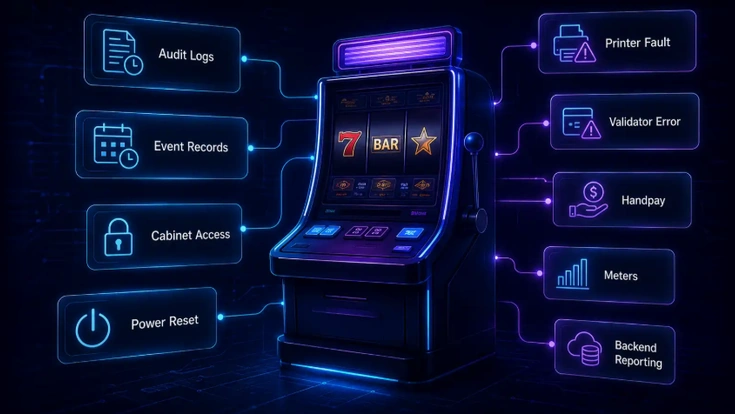
EGM audit logs and event records track important activity inside an electronic gaming machine. They record faults, tickets, handpays, door openings, and system changes. As a result, operators can understand what happened, when it happened, and why.
For casino operators, audit logs support dispute review, reconciliation, machine servicing, security monitoring, and audit workflows. These records are often discussed as slot machine audit logs because they help operators review physical machine activity, device faults, ticket events, and machine history.
Quick Summary of EGM Audit Logs and Event Records
| Area | What It Means |
|---|---|
| Main purpose | Record significant machine events with time and context |
| Used in | Slot machines, EGMs, VLTs, and gaming terminals |
| Common records | Door events, power events, faults, ticket events, configuration changes |
| Main users | Operators, technicians, auditors, compliance teams |
| Connected systems | Meters, TITO, cabinet hardware, backend monitoring |
| Operator value | Dispute review, reconciliation, security, audit trail |
What Are EGM Audit Logs?
EGM audit logs are records of significant machine events. They usually include a timestamp, event type, and supporting details. Common records include:
- Door open and close events
- Logic area access
- Cash box access
- Power loss and restart
- Machine faults
- Tilt conditions
- Printer events
- Bill validator events
- Ticket events
- Handpay events
- Configuration changes
- Game option changes
- Communication failures
- Operator or technician actions, where supported
These records create a machine-level history that operators and reviewers can check when something needs to be explained.
What Are EGM Event Records?
Event records are the individual entries inside the machine history. A single event record may include:
- Event type
- Date and time
- Machine state
- Related device
- Related value, if any
- Sequence or order
- Result or status
- Recovery information
The value of an event record comes from its context. For example, a door-open event is more useful when the operator can see what happened before and after it.
Why Audit Logs Matter
Audit logs matter because gaming machines handle value in a regulated environment. Singapore's Gambling Regulatory Authority states that EGMs deployed in Singapore must be secure, reliable, and auditable. Audit logs are one of the main ways a machine stays reviewable.
Without event records, operators may struggle to answer questions such as:
- Was the cabinet opened?
- When did the machine restart?
- Did a fault occur during play?
- Was a ticket printed correctly?
- Was a configuration changed?
- Was there a logged logic area access event?
- Did the machine recover correctly after power loss?
- What happened before a player dispute?
- Do machine events match backend records?
Audit Logs vs Accounting Meters
Although audit logs and accounting meters work together, they answer different questions. EGM accounting meters help operators review values such as credits in, credits out, wagers, wins, ticket-in, and ticket-out. Audit logs help operators review events such as door openings, faults, restarts, and configuration changes.
| Area | Accounting Meters | Audit Logs |
|---|---|---|
| Main question | What values moved? | What events happened? |
| Typical content | Credits, wagers, wins, tickets, handpays | Doors, power, faults, changes, device events |
| Format | Counters and totals | Timestamped event entries |
| Best for | Reconciliation and reporting | Investigation and review |
| Weakness alone | No event context | No value totals |
| Used together | A full machine history: values plus the events around them | |
A meter can show that a ticket-out value changed. The audit log can show whether a printer fault happened at the same time. Operators usually need both.
Common Types of EGM Audit Logs
Different machines and jurisdictions may use different log structures. However, most EGM audit trails include a few common event families.
Machine Significant Event Logs
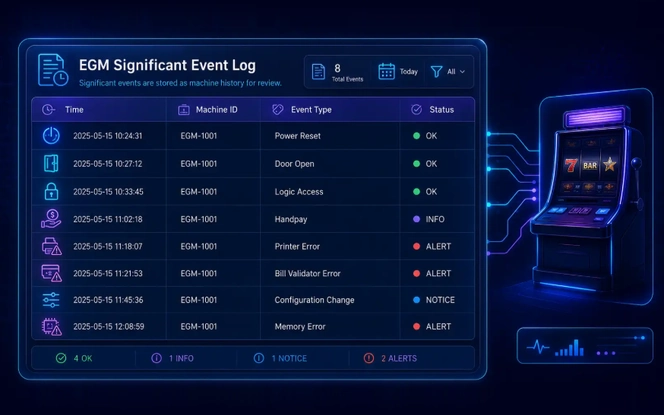
Significant event logs record the most important machine events in order. GLI-11 states that the last 100 significant events for gaming devices should be stored with an appropriate timestamp in secure machine logs that are not accessible to the player. These events can include configuration changes, power resets, handpay conditions, door events, logic area access, bill validator errors, and printer errors, where applicable.
The order of events matters. For this reason, reviewers need the full sequence rather than isolated entries.
Cabinet Access Events
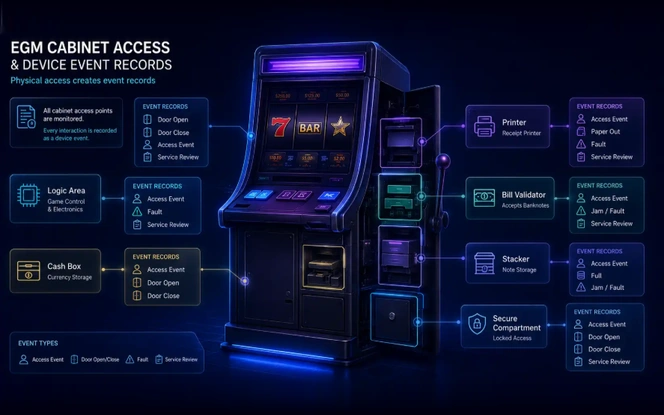
Cabinet access events record when machine compartments are opened or closed. An EGM may have several secure areas, including the main door, logic door, cash box door, and printer compartment.
Access records may include:
- Main door open and close
- Logic door open and close
- Cash box door open and close
- Belly door or service panel events
- Access during play or idle state
- Access linked to servicing or collection
Cabinet access records are easier to interpret alongside the full map of EGM cabinet components.
Logic Area Access Events
The logic area holds the game control hardware and protected components. Access to this area is usually treated with extra care because it is closely connected to game integrity and machine control. Logic access records help operators confirm when the area was opened, whether the access was expected, and what machine activity happened around the access event.
Power, Reset, and Recovery Events
Power events record interruptions, restarts, and recovery behavior. They may include:
- Power loss
- Power restore
- Machine restart
- Recovery status
- Game state restoration
- Credit restoration
- Pending payout recovery
- Memory check results
Recovery records matter because an interruption during a game, ticket print, or payout should not leave the machine state unclear.
Printer and Ticket Events
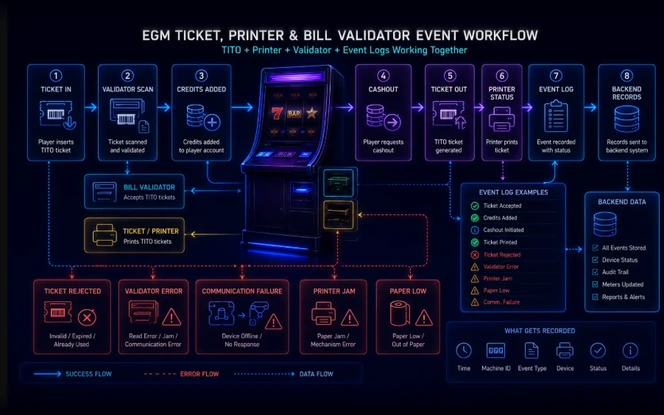
Printer and ticket events record cashout activity and printer health. These events connect closely with TITO in slot machines. Records may include:
- Ticket printed
- Ticket print failed
- Printer jam
- Printer paper low
- Ticket inserted
- Ticket accepted or rejected
- Ticket validation result
- Ticket value recorded
A failed ticket print during cashout shows why event records matter. The operator needs to know what the machine attempted, what failed, and what value was involved.
Bill Validator and Payment Events
Bill validator events record cash and voucher intake activity. These records may include:
- Bill accepted
- Bill rejected
- Validator fault
- Validator jam
- Cash box status
- Voucher accepted
- Intake value recorded
- Device reset
These events help operators connect physical value intake with meter updates and credit changes.
Handpay and Jackpot Events
Handpay and jackpot events record payout activity that may involve staff review. Records may include:
- Handpay triggered
- Handpay amount
- Handpay cleared
- Jackpot event
- Attendant action
- Cancelled credit record
- Related meter updates
- Related game result reference
High-value payout events usually need a clear record trail because they involve manual steps and larger amounts.
Configuration and Paytable Change Events
Configuration events record changes to machine setup. These may include:
- Denomination change
- Game option change
- Paytable or game version change
- RTP setting change, where supported
- Limit or threshold change
- Software verification event
- Operator login, where supported
- Change author or access record, where supported
Configuration records matter because the installed setup must match the reviewed and intended setup. EGM paytables and PAR sheets explain the game math side of that review.
Fault Events and Tilt Conditions
Fault and tilt events record abnormal machine conditions. These may include:
- Tilt condition
- Device fault
- Screen or touch fault
- Button panel fault
- Memory error
- Sensor error
- Communication loss
- Service required state
Fault records help technicians and operators find issues, review machine health, and confirm whether a fault affected play, payment, or records.
How Audit Logs Support Operations
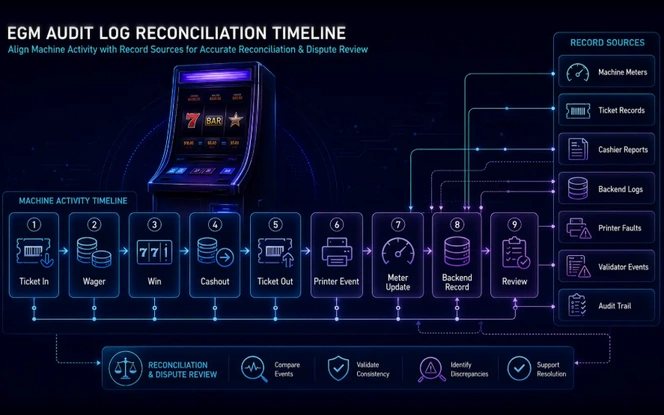
Audit logs earn their value in daily operations: disputes, reconciliation, recovery, and reporting all lean on the event history.
Player Dispute Review
When a player raises a dispute, the audit log helps reconstruct what happened. A dispute review may combine:
- Game history or game recall
- Credit meter changes
- Ticket events
- Printer events
- Handpay records
- Door and fault events
- Power and recovery events
- Backend records
The goal is to explain the sequence clearly. That means showing what the player did, what the machine did, and which records were created.
Reconciliation Support
Audit logs support reconciliation by adding context to meter values. If a meter value looks wrong, the event history may show a power reset, a printer fault, a communication failure, or a configuration change that explains the difference. Reconciliation works best when machine meters, event logs, ticket records, cashier records, and backend reports can be compared as one timeline.
Audit Logs and Critical Memory
Important machine records need to survive interruptions. Critical memory helps preserve machine state, meter values, and recent event information through power loss or restart. This matters for audit logs because a machine history with gaps is much harder to review. Recovery records should show that the machine restored its state correctly.
Game Recall and Machine History
Many machines support game recall, which helps review recent game activity such as the last games played, wagers, results, and payouts. Game recall and audit logs work together. The recall shows the game result. The audit log shows the machine condition around the result. The underlying game sequence is covered in how EGM slot machines work.
Backend Reporting and Monitoring
Modern EGMs often send event data to monitoring or casino management systems. Backend records help operators:
- Monitor machines across the floor
- Receive fault alerts
- Track access events
- Compare machine and backend records
- Review event history remotely
- Support audits
- Plan servicing
- Investigate incidents
The machine log and the backend record should tell the same story. Differences between them are themselves worth investigating.
EGM Audit Logs vs Online Casino Logs
EGM audit logs are machine-centered. Online casino logs are account-centered and platform-centered.
| Area | EGM Audit Logs | Online Casino Logs |
|---|---|---|
| Main object | Physical machine or terminal | Player account and session |
| Typical events | Doors, power, faults, tickets, handpays | Logins, sessions, payments, KYC, restrictions |
| Value records | Meters, tickets, cash intake | Wallet debits, credits, payment records |
| Security focus | Physical access and device health | Account security and platform integrity |
| Review style | Machine timeline review | Account and session review |
Both models need clear event records, but the objects being recorded are different.
Operator Review: Checks and Common Issues
Audit log review works best as a routine. Therefore, known failure points should be watched from the start.
What Operators Should Check
Useful questions include:
- Which events does the machine record?
- How many events are retained?
- Are events timestamped?
- Can events be exported or reviewed on screen?
- Which door events are recorded?
- How are power and recovery events shown?
- How are printer and ticket events recorded?
- How are handpays recorded?
- How are configuration changes recorded?
- Are operator or technician actions logged?
- Do machine events reach the backend system?
- How long are backend records kept?
- Who can view or clear logs?
- Can logs be cleared at all, and is clearing itself logged?
- How are logs used in dispute review?
- What jurisdiction-specific requirements apply?
Common Audit Log Issues
Common issues operators should watch for include:
- Events missing from the history
- Clock or timestamp drift
- Events out of sequence
- Log capacity too small for review needs
- Machine and backend records not matching
- Door events without service context
- Faults without recovery records
- Configuration changes without an author record
- Cleared logs without a clearing record
- Printer errors not linked to ticket records
- Handpays not linked to game results
- Communication gaps during key events
- Recovery status unclear after power loss
- Logs reviewed only after an incident
These issues should be handled through machine configuration review, backend monitoring, servicing procedures, and regular log checks.
Common Misunderstandings About EGM Audit Logs
Audit Logs Are Not Only for Compliance
Logs support compliance, but they also help floor operations, technicians, support teams, and dispute review every day.
Logs Do Not Replace Meters
Meters record values. Logs record events. A complete review usually needs both, compared as one timeline.
A Printer Error Is an Audit Event
A failed ticket print is not only a hardware issue. It is a value-related event that should appear in the machine history.
Door Events Are Not Noise
Access records protect the machine and the operator. A door event with no service context is a question worth asking.
Logs Only Help If Someone Reviews Them
A machine can record everything and still fail the operator if nobody checks the records until after an incident.
Checklist for Reviewing EGM Audit Logs
Before deployment or routine review, operators and product teams should check:
- Significant event log coverage
- Event retention count
- Timestamp accuracy
- Event sequence integrity
- Main door events
- Logic door events
- Cash box events
- Power loss events
- Recovery records
- Printer events
- Ticket events
- Bill validator events
- Handpay records
- Jackpot records
- Configuration change records
- Operator access records
- Fault and tilt records
- Backend event reporting
- Log clearing controls
- Dispute review procedure
- Jurisdiction-specific requirements
Overall, this checklist helps operators treat audit logs as an active operational tool rather than only a stored record.
Need Help Improving Your EGM Audit Logs?
Strengthen event tracking, dispute review, reconciliation, security monitoring, and backend reporting with a clearer audit-log setup.
Talk to Our EGM ExpertsFAQs About EGM Audit Logs and Event Records
EGM audit logs are machine-level records of significant events such as door openings, power resets, faults, ticket activity, handpays, and configuration changes. Each record normally includes a timestamp.
An event record is one entry in the machine history. It usually shows the event type, date and time, related device or value, and the machine status around the event.
No. Accounting meters record values such as credits, wagers, wins, and ticket amounts. Audit logs record events and context. Operators normally use both for a complete review.
Important audit records should remain protected in critical memory so the machine can restore its state and recent history after a power loss or restart.
Audit logs help rebuild the sequence around a dispute, including game activity, credit changes, ticket events, printer status, faults, door access, and recovery records.
Many modern EGMs send event data to casino management or monitoring systems. This helps operators receive alerts, review events remotely, and compare machine records with backend data.
Retention depends on the machine standard, operator policy, and local gaming rules. Operators should keep enough secure history to support investigations, reconciliation, servicing, and regulatory review.
Audit logs record important actions and system changes. They help your business improve security, investigate issues, and meet compliance requirements.
Your company needs audit log monitoring if it handles sensitive data, user accounts, payments, regulated systems, or important business operations.
Audit logs show who performed an action and what changed. Event logs record general system activity, errors, warnings, and performance events.
Final Thoughts
EGM audit logs and event records are the memory of the machine. Accounting meters show what values moved. Audit logs show what happened around those values: doors, power, faults, tickets, handpays, and configuration changes.
For casino operators and product teams, a strong audit trail supports dispute review, reconciliation, security monitoring, servicing, and compliance review. Audit logs should be planned together with the meters, the TITO flow, the cabinet hardware, and the backend reporting model, so the machine history stays complete, ordered, and reviewable.