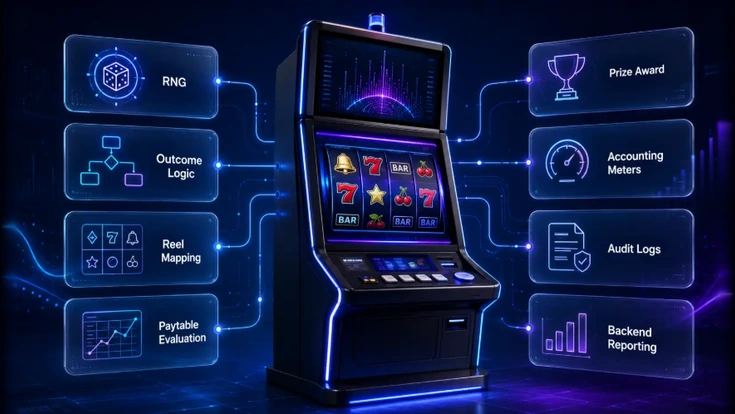
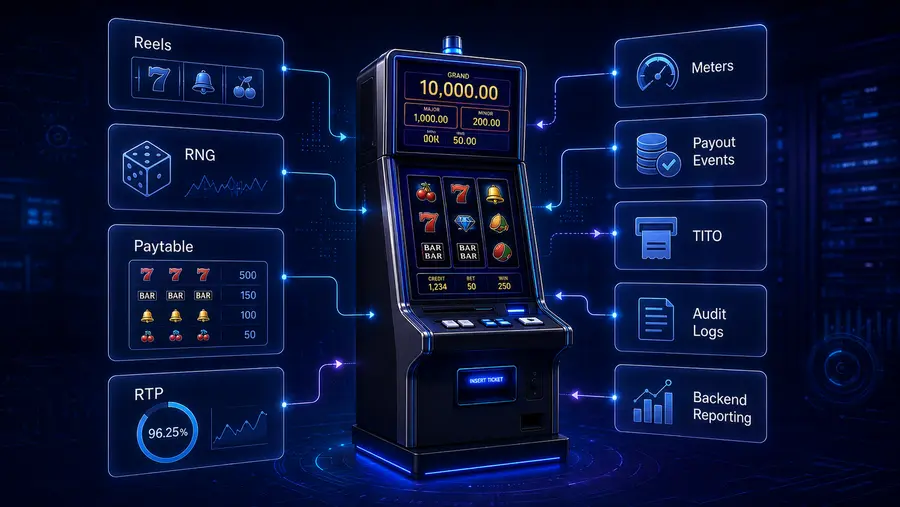
An EGM slot machine is a cabinet or terminal-based electronic gaming machine. It combines player input, reel behavior, random outcome logic, paytable rules, credit handling, meters, payout records, and audit logs.
To the player, the machine may look simple: insert credits, press spin, watch the reels, and collect any win. Behind that screen, the machine is managing several technical layers at the same time.
A modern EGM slot machine needs to track the game state, read player inputs, process the outcome, apply payout rules, update credits, record meters, store events, handle ticketing or cashout, and maintain security records.
- Reels and symbols
- RNG or outcome selection
- Paytable and RTP logic
- Credit, meter, and payout records
- Machine events, logs, and security controls
| Layer | What It Does |
|---|---|
| Reels | Show the visual result to the player. |
| RNG | Produces values used to determine the outcome. |
| Paytable | Defines winning combinations and payout rules. |
| Meters | Track credits, wagers, wins, tickets, and machine activity. |
| Event logs | Record payout events, cabinet events, faults, and changes. |
How an EGM Slot Machine Works in Simple Terms
An EGM slot machine works by taking the player's wager, generating or selecting an outcome, mapping that outcome to reel positions or symbols, applying the paytable, updating the credit balance, and recording the event.
A simplified spin flow looks like this:
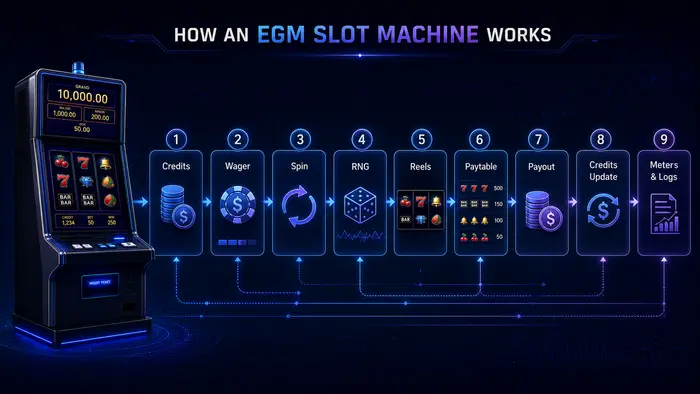
The player adds credits through cash, ticket, card, or another allowed method.
The player selects a bet amount, coin value (denomination), or game option.
The player presses the spin or play button.
The machine records the wager.
The RNG or outcome system determines the result.
The reel display shows the symbols or game result.
The paytable checks whether the result is a win.
The machine calculates the payout.
Credits, meters, and event records are updated.
The player can continue playing or cash out.
This process must be fast, secure, and easy to review and audit. The machine is not only showing a game result. It is also recording what happened before, during, and after each play.
Reels, RNG, Paytables, RTP, and Volatility
These layers decide what the player sees, how the result is selected, and what the game pays.
Reels and Symbols in an EGM Slot Machine
Reels are the visual part of a slot machine game. They show symbols, combinations, and outcomes to the player.
In older mechanical slot machines, reels were physical spinning drums. In modern EGM slot machines, reels are usually digital. The screen shows animated reels, but the result is controlled by software logic and the configured game math.
A reel setup usually includes:
- Number of reels
- Number of rows
- Symbol set
- Symbol frequency
- Paylines or ways-to-win
- Special symbols
- Bonus symbols
- Wilds and scatters
- Jackpot or feature triggers
The reel display is what the player sees, but the reel result must match the underlying game logic, paytable, and outcome process.
What Is RNG in an EGM Slot Machine?
RNG stands for random number generator. In many EGM slot machines, the RNG is used to produce values that determine the game outcome.
A gaming RNG may be hardware-based, software-based, or a combination of both, depending on the machine design and jurisdiction. Nevada's technical standards define an RNG as a hardware, software, or combined device used for generating number values.
In simple terms, the RNG helps decide the result of each play. The machine then maps that result to the reel positions, symbols, or game outcome.
The RNG does not "know" whether the player has won or lost in a human sense. It produces values, and the game logic interprets those values according to the game design.
How RNG Connects to Reels
The RNG and reels work together. A simplified example:
The player presses spin.
The RNG produces values.
The game maps those values to reel stops or symbol positions.
The screen shows the final reel result.
The paytable checks the symbol combination.
The machine pays the win, if any.
This is why the visible reel animation should not be confused with the actual result selection. The spin animation is part of the player experience. The outcome logic happens inside the machine software.
What Is a Paytable?
A paytable defines what each winning combination pays.
It tells the machine how to value symbols, lines, features, and bonus outcomes. Without a paytable, the machine would not know how much to award for a result.
A paytable can include:
- Symbol values
- Winning combinations
- Payline rules
- Ways-to-win rules
- Bet multipliers
- Bonus trigger conditions
- Free spin rules
- Jackpot rules
- Maximum win limits
- Feature payout rules
The paytable must match the game math. If the paytable, reel distribution, and game logic do not align, the expected payout behavior will not match the intended game model.
RTP and Volatility
RTP means return to player. It is the theoretical long-term return of the game based on its math model.
Volatility describes how the game pays over time. A low-volatility game may pay smaller wins more often. A high-volatility game may pay less often but with larger wins.
RTP and volatility are not controlled by one setting alone. They come from the relationship between:
- Reel strips
- Symbol frequency
- Paytable values
- Bet structure
- Bonus features
- Jackpot logic
- Hit frequency
- Maximum possible payout risk
- Game math model
A game can have the same RTP as another game but feel very different because the volatility is different.
Example: Same RTP, Different Player Experience
Two EGM slot machines can both have the same theoretical RTP but different gameplay behavior.
One machine may pay small wins often. Another may pay less often but offer bigger bonus rounds or jackpot-style outcomes.
From a technical view, this difference comes from the game math, symbol distribution, bonus frequency, paytable values, and win distribution.
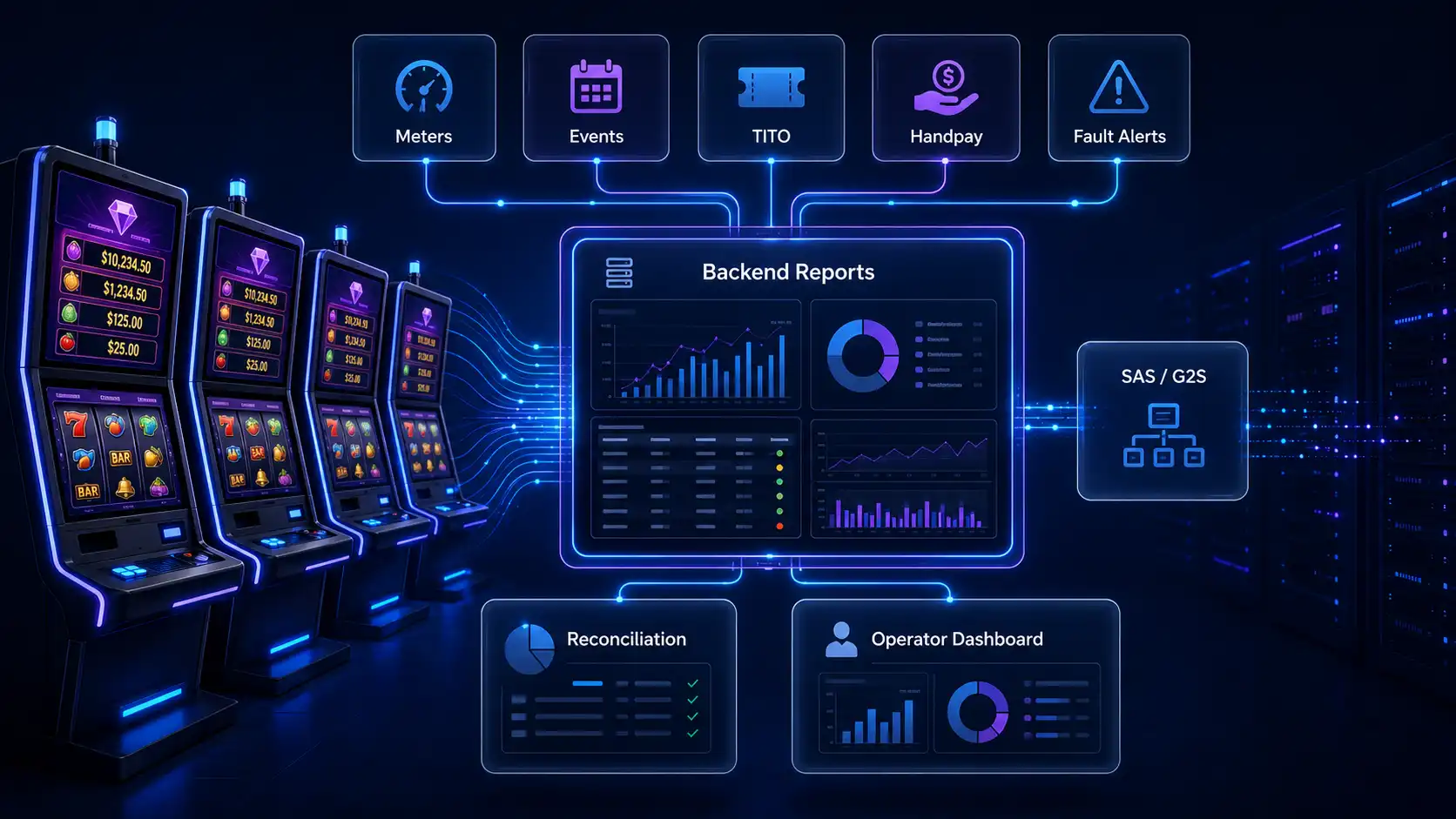
Accounting Meters, Payout Events, and TITO Records
What Are Accounting Meters?
Accounting meters are records that track important financial and machine activity.
In an EGM slot machine, meters help operators, auditors, and regulators understand what happened on the machine. GLI standards include requirements for gaming devices, including accounting, metering, and machine record controls.
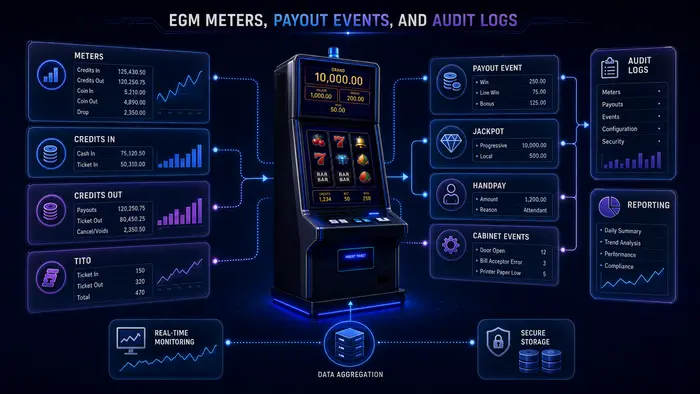
Common EGM meters may include:
- Credits in
- Credits out
- Games played
- Total wagers
- Total wins
- Handpay amounts
- Ticket-in values
- Ticket-out values
- Cancelled credits
- Jackpot values
- Door open events
- Bill validator activity
- Printer events
- Configuration changes
Meters are important because they create a machine-level record of play, payment, and operational activity.
Why Meters Matter
Meters help operators match play activity with credits, tickets, payouts, and machine events. They are also useful when reviewing printer errors, handpay events, configuration changes, or credit disputes.
What Are Payout Events?
A payout event is a machine event where credits, cashable value, or a prize amount is awarded or moved.
Payout events can happen in different ways depending on the machine setup and venue rules.
Common payout-related events include:
- Line win
- Bonus win
- Jackpot win
- Progressive win
- Free spin award
- Credit update
- Ticket-out
- Handpay
- Cancelled credit
- Cashout request
- Voucher redemption
- Printer error during cashout
- Failed ticket validation
- Payout limit event
Each event should be recorded clearly because payout activity affects player balance, accounting meters, and operator reporting.
How TITO Fits Into Payout Events
TITO stands for ticket-in ticket-out. It allows players to use barcoded tickets for credits and cashout instead of only coins or cash.
The Victorian Gambling and Casino Control Commission describes TITO as technology that lets patrons collect credits from a poker machine through a barcoded ticket that can be exchanged for cash or used in another compatible machine.
In an EGM slot machine, a TITO flow may look like this:
The player inserts a ticket.
The machine reads and validates the barcode.
Credits are added to the machine.
The player plays the game.
The player presses cashout.
The machine prints a new ticket.
The ticket value is recorded.
The ticket can be redeemed or used in another compatible machine.
TITO is not just a printer function. It connects to credit handling, validation, ticket records, accounting meters, and backend systems.
Event Logs, Cabinet Events, and Recovery Records
Beyond meters and payouts, the machine also keeps a technical history of events, faults, and recovery data.
Event Logs and Machine Records
Event logs record important machine activity.
These logs help create a technical history of what happened inside the EGM. Gaming standards often focus on secure, reliable, and auditable machine behavior. Singapore's Gambling Regulatory Authority, for example, states that EGMs deployed in Singapore must be secure, reliable, and auditable to ensure honest gaming.
Typical EGM event records may include:
- Game start
- Game end
- Wager accepted
- Win awarded
- Ticket inserted
- Ticket printed
- Door opened
- Cabinet fault
- Tilt event
- Printer error
- Bill validator event
- Power loss
- Machine restart
- Configuration change
- Operator login
- Software verification
- Communication error
These records support troubleshooting, audit review, operational control, and testing documentation.
Power Loss and Recovery Events
An EGM slot machine must be able to handle interruptions.
If the machine loses power during a game, ticket process, or payout event, it should preserve critical state and recover correctly. This is why critical memory, event recording, and recovery logic matter in EGM design.
GLI-11 refers to critical non-volatile memory, which is protected machine memory that keeps important data safe even when power is lost, for storing data elements that are vital to the continued operation of the gaming device, including electronic meters and current credits.
A recovery process may need to confirm:
- Current credits
- Last game state
- Last wager
- Last outcome
- Ticket status
- Meter values
- Pending payout
- Error condition
- Restart record
This helps prevent disputes, lost credits, duplicated tickets, or incorrect machine records.
How a Spin Is Recorded
A single EGM slot spin can create several records. A simplified record trail may include:
Player credit balance before spin.
Coin value (denomination) and bet amount.
Game selected.
Spin or play command.
Outcome selection.
Reel result.
Winning combination, if any.
Paytable reference.
Payout amount.
Credit balance after spin.
Meter updates.
Event log entry.
Not every system exposes these records in the same way, and requirements vary by jurisdiction. But the goal is the same: the machine should maintain a reliable technical history of important activity.
Cabinet Events and Peripheral Events
An EGM slot machine also records hardware-related events.
These events are separate from normal game outcomes but still important for security and operations. Examples include:
- Main door open
- Logic door open
- Cash box door open
- Bill validator fault
- Printer paper low
- Printer jam
- Touchscreen error
- Button panel error
- Card reader fault
- Communication loss
- Tilt condition
- Power interruption
- Cabinet restart
These events help operators understand machine health and identify issues that could affect play, cash handling, or reporting.
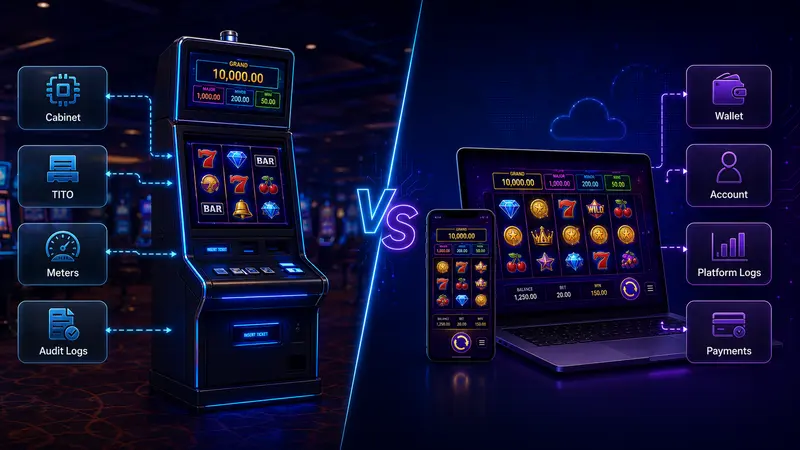
EGM Slot Machine vs Online Slot Game
An EGM slot machine is different from an online slot game even if the screen theme looks similar.
An EGM slot machine runs in a cabinet or terminal environment. It may use physical buttons, a bill validator, a ticket printer, TITO, cabinet doors, accounting meters, and local or casino-system reporting.
An online slot game runs through a web browser, mobile app, or online casino platform. It usually depends on user accounts, wallets, platform logs, payment gateways, and online gaming platform controls.
| Area | EGM Slot Machine | Online Slot Game |
|---|---|---|
| Environment | Physical cabinet or terminal | Browser or mobile app |
| Player input | Touchscreen, buttons, card, ticket | Screen tap, click, account input |
| Payment flow | Cash, ticket, card, TITO, venue system | Wallet, account balance, payment gateway |
| Records | Machine meters, event logs, ticket records | Platform logs, wallet records, user account logs |
| Hardware events | Door, printer, validator, tilt, power | Device or browser events |
| Compliance focus | Machine, cabinet, venue, jurisdiction | Platform, account, wallet, jurisdiction |
This distinction matters because EGM slot machines must manage physical machine behavior and cabinet events, not only game outcomes.
Common Misunderstandings About EGM Slot Machines
The Reels Do Not Decide Everything
The reels are the visual output of the game. The result comes from the outcome process and game logic. The reel display must match the selected result and paytable rules.
RTP Does Not Predict a Single Spin
RTP is a long-term theoretical value. It does not say what will happen on the next spin or during one short play session.
A Win Is More Than a Screen Animation
A win may trigger several machine actions: credit update, event log entry, meter update, sound and display feedback, and sometimes ticket or handpay logic.
TITO Is More Than Ticket Printing
TITO involves ticket validation, credit handling, ticket records, backend connection, and accounting updates.
Meters Are Not Only for Revenue
Meters also support matching records with payouts and credits, troubleshooting, compliance review, and machine history.
What to Check When Reviewing EGM Slot Machine Logic
When reviewing an EGM slot machine, product teams and operators should look beyond the screen design. Useful review questions include:
- How are reel strips or symbol positions defined?
- How does the RNG or outcome process map to reel results?
- Does the paytable match the game math?
- What is the intended RTP?
- What is the intended volatility profile?
- How are wins calculated?
- How are bonus triggers recorded?
- Which meters are updated after a spin?
- Which payout events are logged?
- How are TITO events handled?
- What happens if power is lost during play?
- What cabinet or peripheral events must be recorded?
- What data is needed for testing and review?
- What reports are needed by the operator?
These questions help connect game design, machine operation, payout behavior, and audit records.
FAQs About How EGM Slot Machines Work
EGM slot machines work by accepting credits, recording a wager, generating or selecting an outcome, showing reel results, applying paytable rules, updating credits, and recording meters and events.
The RNG produces number values that the game logic uses to determine outcomes. The result is then mapped to reel positions, symbols, or game states depending on the machine design.
No. In modern digital EGMs, the reels are mainly the visual representation of the outcome. The result is controlled by the RNG or configured outcome logic and the game math model.
A paytable defines winning combinations, symbol values, payout rules, bonus triggers, and prize structures. It tells the machine how much to award for each valid winning result.
Meters are machine records that track values such as credits in, credits out, wagers, wins, games played, handpays, ticket events, and other accounting or operational data.
A payout event is a machine record connected to a win, credit update, cashout, ticket-out, handpay, jackpot, or other transfer of value.
TITO means ticket-in ticket-out. It allows a player to use a barcoded ticket to add credits, cash out, redeem value, or continue play on another compatible machine.
Audit logs help record machine events, payout activity, configuration changes, errors, cabinet events, and operator actions. They support troubleshooting, reporting, and compliance review.
The machine should preserve critical state and recover correctly. Recovery may involve current credits, last game state, meter values, ticket status, pending payout, and error records.
Final Thoughts
EGM slot machines are more than digital reels on a screen. They combine game math, RNG or outcome logic, reel behavior, paytables, credit handling, payout events, accounting meters, TITO flows, cabinet events, audit logs, and recovery controls.
For operators and product teams, understanding these layers helps separate the visible player experience from the deeper machine logic. A reliable cabinet-ready EGM slot machine software setup must do more than show the right result. It must also record the right events, update the right meters, protect critical data, and support the review process required for its target market.