Businesses collect data through reports, dashboards, customer records, financial platforms, and operational systems. But having more data does not automatically make decisions easier.
Reports can explain performance, while fixed-rule workflows can handle predictable cases. Both may become limiting when decisions depend on changing context, competing goals, and information from several systems.
AI decision intelligence connects that information to action by helping businesses evaluate options, predict possible outcomes, and determine what should happen next.
AI Decision Intelligence Explained
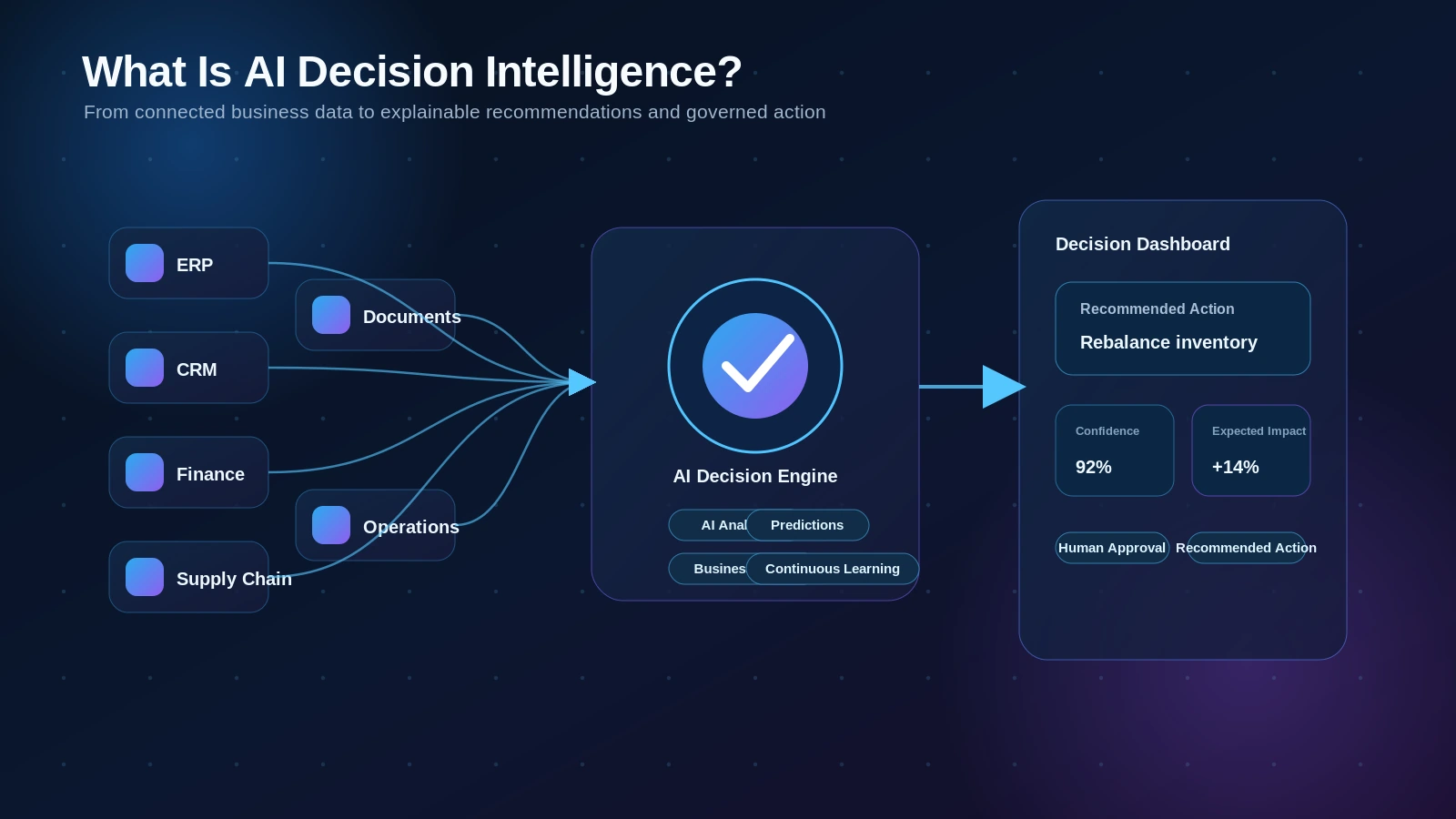
AI decision intelligence combines artificial intelligence, analytics, business rules, and structured decision criteria to help evaluate options, recommend actions, and support defined levels of automation. It evaluates context and possible outcomes before recommending an action, routing it for approval, or passing it to an operational workflow.
Decision intelligence is the broader discipline. AI decision intelligence specifically refers to decision processes that use artificial intelligence or machine learning as one of their inputs.
A decision intelligence system may help answer questions such as:
- Which customer needs immediate attention?
- Which process is likely to miss its target?
- Which supplier best fits the required cost, capacity, reliability, and risk criteria?
- Which transaction or customer case requires review?
- How should inventory be distributed?
- Which action is most likely to reduce cost or improve service?
Many business systems use fixed rules, such as routing a request for approval when it crosses a set threshold or creating an alert when a performance measure moves outside an accepted range. These rules are useful, but they apply the same predefined logic whenever a condition is met and may not account for context such as payment history, supplier reliability, or seasonal demand.
AI decision intelligence adds that context. Instead of only checking whether a condition is true, the system can examine several relevant factors, compare possible actions, and recommend an option for the current situation.
How AI Decision Intelligence Works
A typical AI decision intelligence process can be explained through six connected stages.
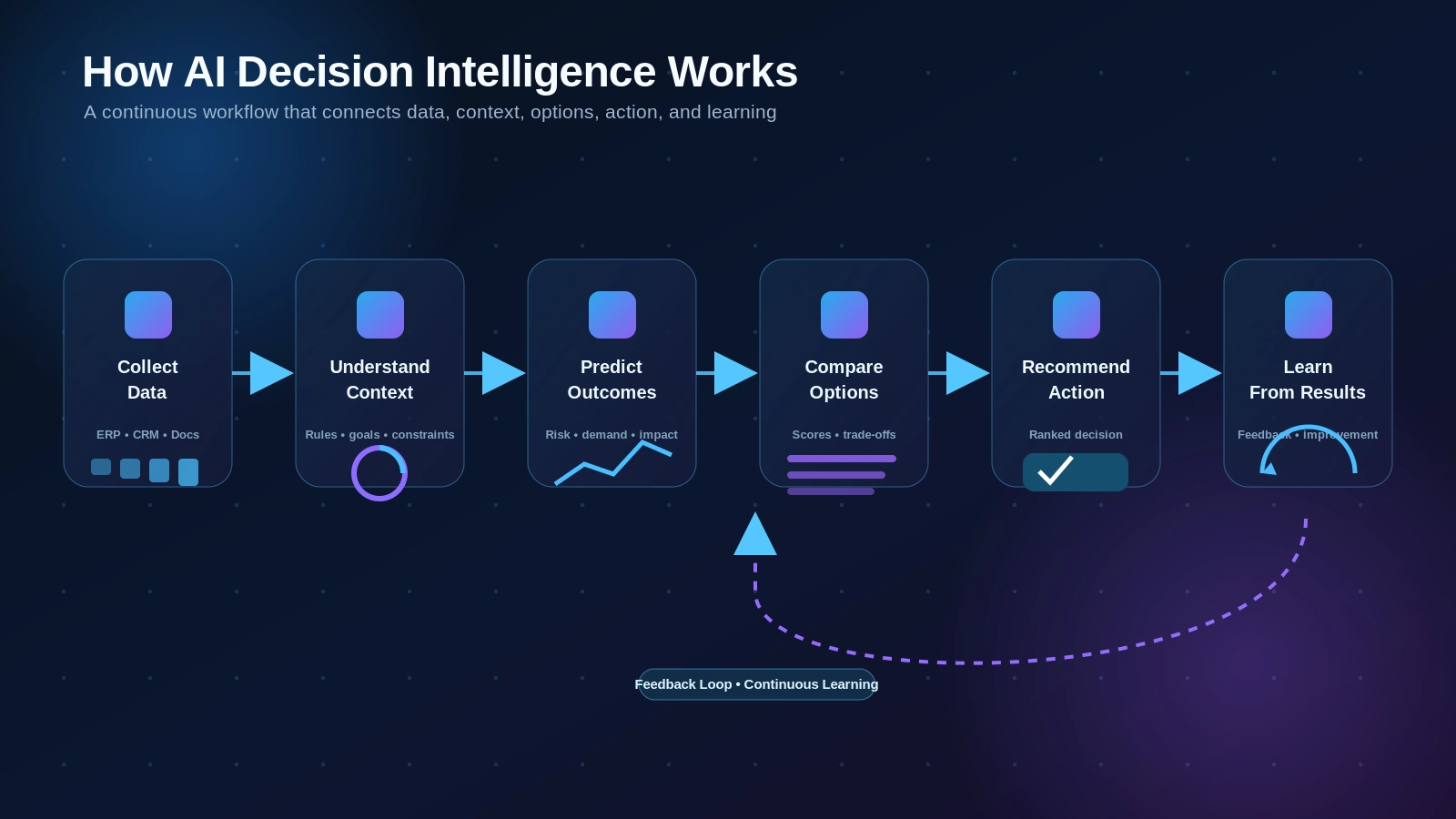
- Connect business data. The system gathers information from sources such as ERP platforms, CRM systems, financial software, supply chain systems, customer support platforms, IoT devices, and historical business records. The reliability of the recommendation depends heavily on the quality and relevance of the data.
- Understand the situation. The system combines relevant information to understand the current context rather than evaluating each data point separately. For example, it may consider customer history, demand, capacity, costs, and business priorities together.
- Predict possible outcomes. Machine learning models can estimate what may happen under different conditions, such as the probability of a delivery delay or the likelihood of customer churn, helping decision-makers prepare before a problem occurs.
- Compare available actions. A prediction does not determine the action on its own. The system may compare options such as reallocating resources, changing a service plan, adjusting inventory, escalating a case, or deferring a lower-priority issue. Each option can be evaluated against cost, risk, time, and business rules.
- Recommend, approve, or act. Depending on the process, the system may present a recommendation, rank available options, request human approval, or complete a clearly defined low-risk action.
- Review outcomes and improve. The system records what was recommended, what action was taken, and what result followed. Relevant outcomes and reviewer feedback can then be evaluated, tested, and used to improve future recommendations.
How It Compares With BI and Analytics
Decision intelligence is often confused with related concepts, including business intelligence and data analytics. Each has a different typical focus:
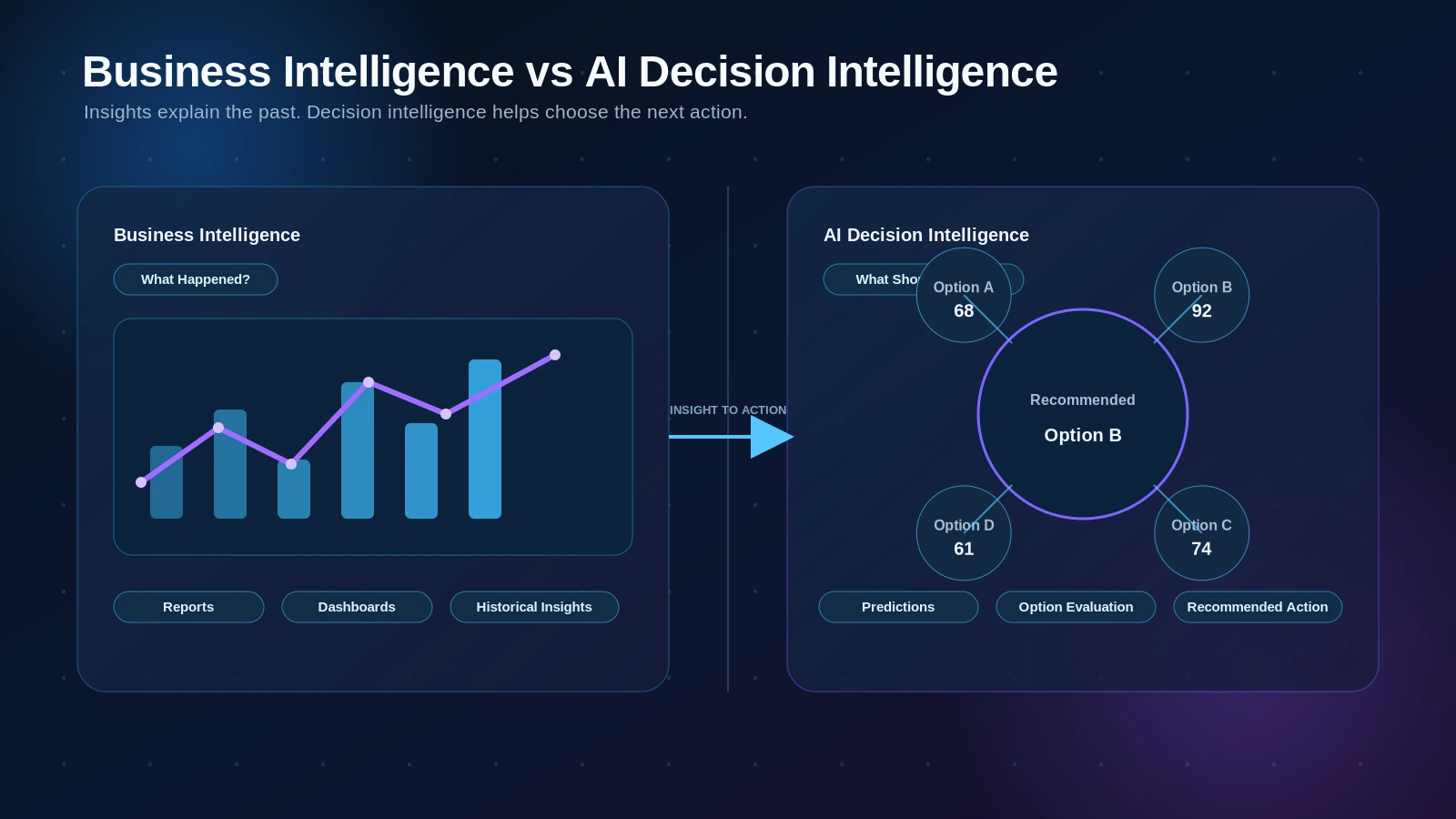
| Approach | Typical Focus |
|---|---|
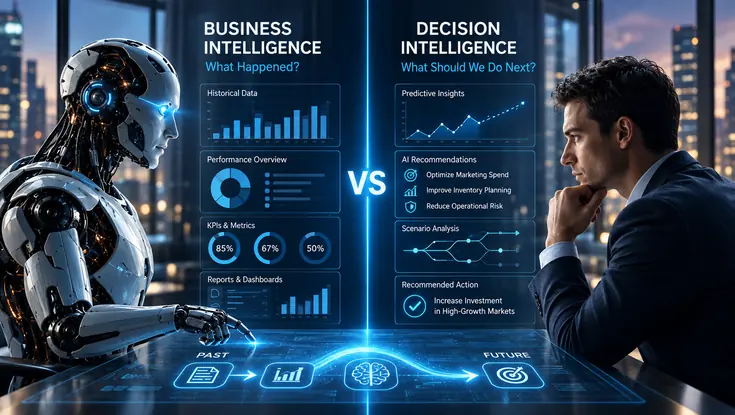
| Business intelligence | What is happening, and what happened? |
| Predictive analytics | What is likely to happen? |
| Prescriptive analytics | Which actions may improve the outcome? |
| Decision intelligence | How should the decision be made given goals, constraints, risks, ownership, and human controls? |
Business intelligence provides information. Predictive analytics estimates what may happen. Prescriptive analytics suggests possible actions. These areas can overlap. Decision intelligence goes beyond analysis or action recommendations by connecting business context, rules, risks, decision ownership, approval, execution, and outcome review.
AI Decision Intelligence Use Cases
The same decision-making approach can be used across many business functions. A few common examples:
Customer Management
Combines customer history, engagement, and value to determine which customers need support, which leads to prioritize, and which retention action is most appropriate.
Finance and Risk
Helps prioritize financial reviews, detect unusual transactions, assess payment or credit risk, reconcile records, and identify cases that require human attention.
Manufacturing
Compares the cost of planned maintenance against the possible cost of an unexpected shutdown to help schedule maintenance and manage production capacity.
Logistics and Supply Chain
Supports carrier selection, shipment prioritization, capacity planning, and disruption response by comparing cost, service commitments, and operational risk. In logistics software, these decisions may use shipment, carrier, capacity, and delivery data.
Retail and Inventory
Adjusts pricing, replenishment, and allocation recommendations based on store performance, local demand, stock availability, and seasonal patterns.
Workforce Planning
Supports staffing forecasts, workload planning, and skill-gap analysis. Decisions affecting individual employees should remain subject to human review, fairness checks, and company policy.
Human Oversight and Controlled Improvement
Some decision processes can include automated actions, but not every action should be completed without human oversight. One practical way to structure human involvement is through three levels:
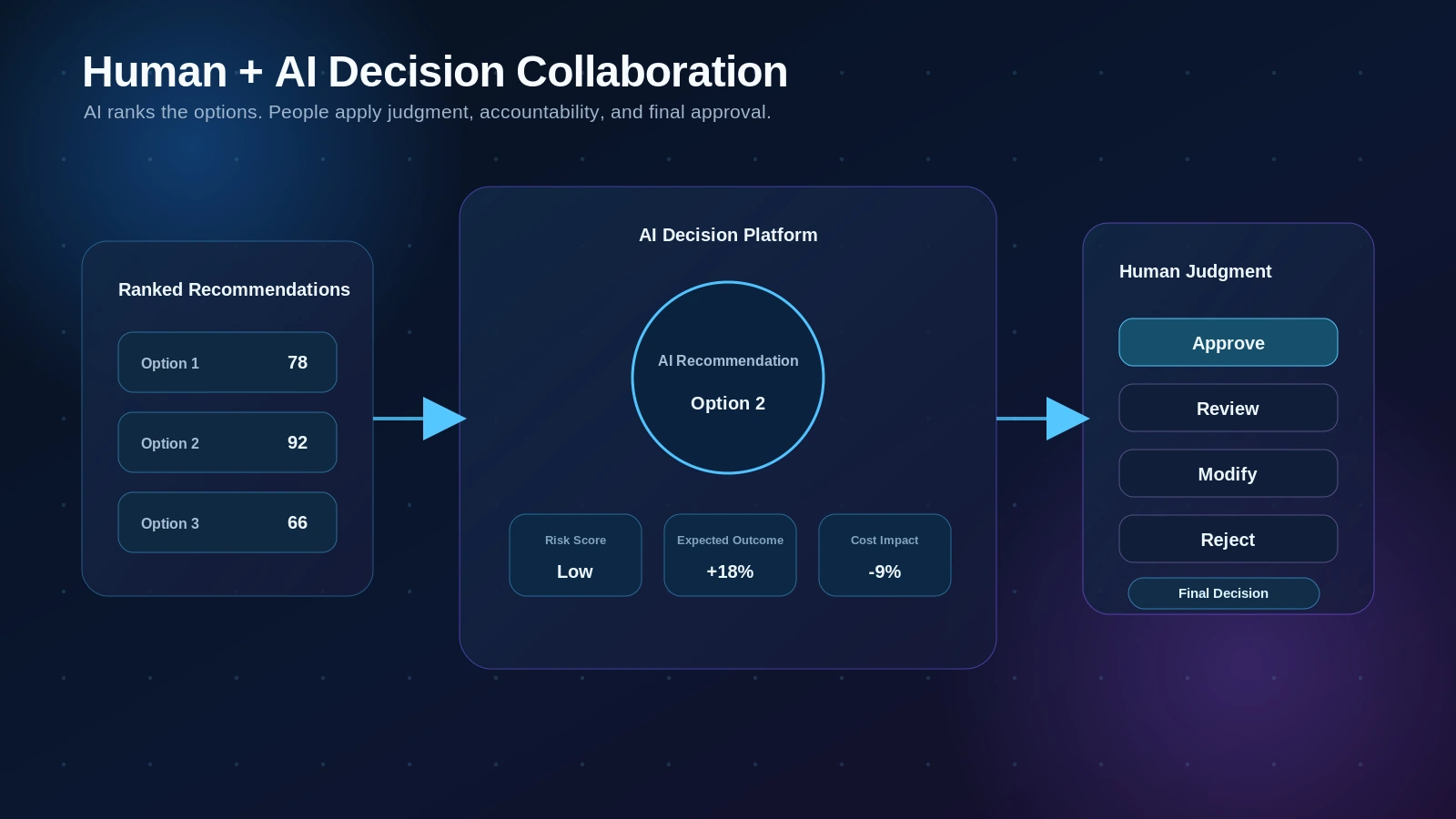
- Human-led decisions are made by people, with AI providing information or recommendations.
- Human-approved actions are recommended or prepared by the system but require approval before execution.
- Automated actions may be executed when risk is low, conditions are clearly defined, and the recommendation remains within established policy and confidence thresholds, with monitoring and fallback controls in place. These actions may form part of a wider AI workflow.
The correct level of automation depends on financial impact, legal requirements, operational risk, available data, and the need for human judgment. Explainability also matters here: a recommendation should be supported by relevant inputs, model outputs, business rules, and decision logs. The record should also show whether a person approved, modified, rejected, or overrode the recommendation.
A decision intelligence system can record its recommendation and compare it with the eventual result. This allows teams to evaluate whether the selected action worked, whether the predicted outcome was accurate, and whether a business rule should be adjusted.
When Decision Intelligence Is Useful
Not every business decision requires an AI-based system. A simple rule-based workflow may be enough when conditions are stable and the decision has few variables. Decision intelligence becomes more valuable when a decision is frequent, complex, data-dependent, and affected by changing conditions.
A potentially suitable use case usually has the following characteristics:
- The same decision type occurs frequently enough to justify a structured system.
- The decision requires information from several systems.
- Existing fixed rules do not handle every situation or exception well.
- The outcome of the decision can be recorded and measured.
- Delays or poor decisions create meaningful operational or financial cost.
- Business rules and approval ownership are reasonably clear.
- Historical data, expert criteria, or representative test cases are available for evaluation.
- A current baseline and success measure can be defined.
- Someone clearly owns exceptions, overrides, and failed actions.
A narrowly defined, measurable decision use case is usually a better starting point than a broad objective such as "improve operations." Prioritizing customer cases, identifying transactions that require review, or determining which equipment needs maintenance provides a clearer basis for evaluation than attempting to transform every process at once.
What Businesses Should Plan For
AI decision intelligence depends on more than selecting a model. Businesses should also plan for:
- Data quality and system integration
- Security, privacy, and access controls
- Explainability and decision ownership
- Bias, fairness, and unintended impact
- Regulatory and company-policy requirements
- Model and rule performance, versioning, monitoring, exception handling, and fallback procedures
- Human accountability for high-impact decisions
- User adoption, training, and change management
- Integration ownership and support responsibilities
A technically accurate recommendation may still be unsuitable if it ignores company policy, customer expectations, or operational limitations. For this reason, business rules and human oversight need to remain part of the system, not an afterthought.
Organizations can also use a structured AI risk-management framework to define ownership, monitoring, transparency, and risk controls.
The strongest starting point is one clearly defined decision with measurable outcomes, reliable data, and clear human ownership. Businesses can then establish a baseline, test recommendations in real operations, define fallback procedures, and expand only after the system performs reliably.
Frequently Asked Questions
Is decision intelligence a type of artificial intelligence?
Decision intelligence is a broader approach to improving decisions. It may use artificial intelligence, machine learning, business rules, data analysis, simulations, and human expertise.
Is AI decision intelligence the same as generative AI?
No. Generative AI mainly creates content such as text, images, code, or summaries. Decision intelligence evaluates information, possible outcomes, business rules, and available actions to support a specific decision. Generative AI may be used as one component of a broader decision intelligence system.
Does decision intelligence replace business intelligence?
No. Business intelligence provides reports and performance visibility. Decision intelligence can use those insights to support recommendations and actions.
What is the difference between prescriptive analytics and decision intelligence?
Prescriptive analytics suggests actions that may improve an outcome. Decision intelligence places those actions within a wider decision process that also considers business rules, risks, approval responsibilities, operational constraints, and recorded outcomes.
What data is required for decision intelligence?
The required data depends on the decision. It may include historical transactions, customer activity, operational records, business rules, documents, external conditions, and previous decision outcomes.
Does decision intelligence require real-time data?
Not always. Some decisions, such as fraud alerts or shipment rerouting, may benefit from real-time data. Others, including demand planning, supplier evaluation, or workforce forecasting, may use data updated daily, weekly, or at another suitable interval.
Explore AI Decision Intelligence Solutions
See how governed decision systems can combine business data, predictive models, rules, approvals, and operational workflows.