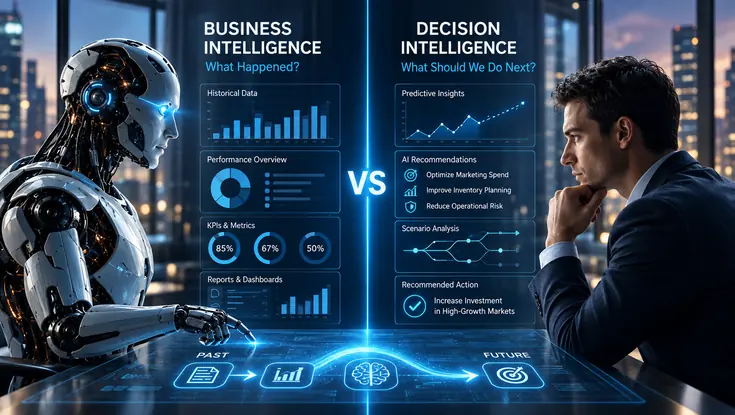
The decision intelligence vs business intelligence comparison shows how organizations move from understanding performance to improving actions. Business intelligence analyzes data through reports and dashboards, while decision intelligence turns those insights into recommendations, governed workflows, and measurable outcomes. In practice, decision intelligence usually builds on a strong business intelligence foundation rather than replacing it.
Quick answer: business intelligence collects, organizes, analyzes, and visualizes business data through reports, dashboards, KPIs, forecasts, charts, and alerts.
Decision intelligence combines trusted data, analytical models, artificial intelligence, business rules, operational constraints, human expertise, and workflows to recommend or execute an appropriate action.
What Is Business Intelligence?
Business intelligence, commonly called BI, refers to the technologies and processes used to collect, manage, analyze, and present organizational data.
IBM's overview of business intelligence defines BI as technological processes that collect, manage, and analyze organizational data to produce insights that support business strategies and operations.
Where business intelligence data comes from
A BI platform may combine information from:
It then converts this information into dashboards, reports, forecasts, scorecards, KPIs, and alerts. For example, a BI dashboard may show monthly revenue, sales performance, inventory levels, production downtime, marketing results, supplier performance, and budget variance.
How business intelligence works
A typical BI process includes five stages:
- Stage 01
Collect
First, data is collected from business applications and external sources.
- Stage 02
Prepare
Next, the information is cleaned, validated, and standardized.
- Stage 03
Store
Then, prepared data is stored in a warehouse, lake, or lakehouse.
- Stage 04
Analyze
Afterward, BI tools calculate metrics and analyze trends.
- Stage 05
Present
Finally, results are presented through reports, dashboards, and alerts.
Modern BI platforms may also include real-time reporting, self-service analytics, forecasting, anomaly detection, and natural-language queries. Their primary purpose, however, remains helping users understand data and business performance.
Organizations planning a reporting modernization initiative can explore SDLC Corp's business intelligence services and solutions for data integration, dashboards, analytics, and governed KPI delivery.
What Is Decision Intelligence?
Decision intelligence, or DI, is an applied discipline that improves how organizations design, evaluate, execute, govern, and monitor decisions.
Gartner's 2026 Magic Quadrant for Decision Intelligence Platforms describes these platforms as combining decision modeling, analytics, and artificial intelligence to augment or automate decisions and improve business outcomes.
Gartner's public decision intelligence definition frames DI as a practical discipline for understanding how decisions are made and improving how their outcomes are evaluated, managed, and refined through feedback.
Decision intelligence does not stop after presenting an insight. It connects analysis to a specific choice, action, and result.
Organizations moving from dashboards to governed recommendations can explore SDLC Corp's AI decision intelligence solutions for decision modeling, workflow integration, and controlled automation.
Example: from an inventory alert to an action
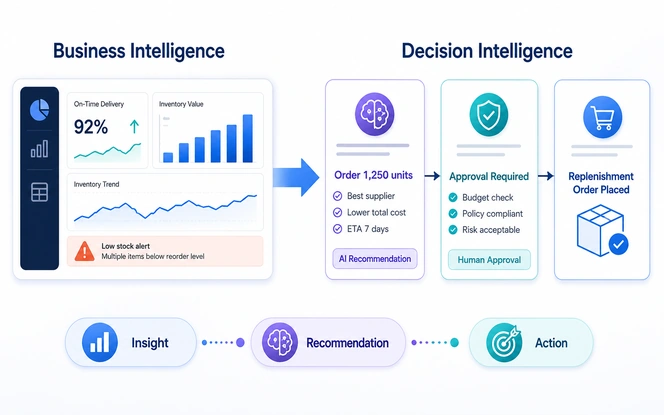
A BI dashboard may show that inventory is falling below normal levels. A decision intelligence system may then:
- First, predict when a stockout could occur.
- Next, estimate its effect on customer orders.
- Then, compare the available suppliers.
- Afterward, review prices and lead times.
- Moreover, recommend an appropriate order quantity.
- In addition, apply budget and approval rules.
- Subsequently, record the selected action.
- Finally, measure the result.
This reduces the gap between identifying a problem and responding to it.
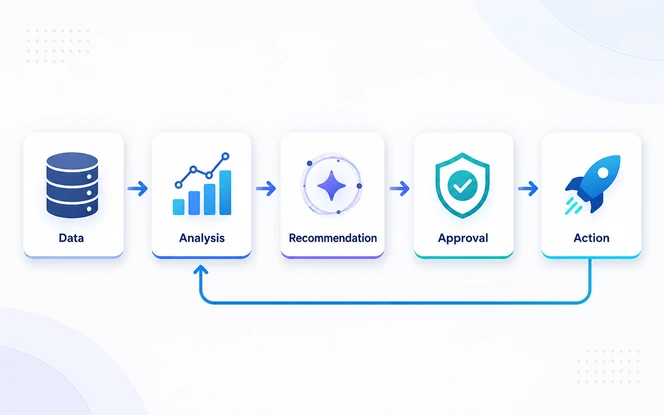
Decision intelligence connects trusted data and analytical models with governed recommendations, business actions, and measurable outcomes.
Core Components Of Decision Intelligence
A decision intelligence solution normally combines five elements:
- Element 01Trusted data
Reliable historical, operational, financial, customer, and real-time information.
- Element 02Analytical models
Predictive, prescriptive, optimization, or machine-learning models.
- Element 03Business rules
Budgets, risk limits, policies, permissions, and approval thresholds.
- Element 04Workflow integration
Connections to business applications, employees, and approval processes.
- Element 05Human oversight
The ability to approve, reject, investigate, or override recommendations.
- In shortHow the pieces fit
First, data makes prediction possible. Then, models make comparison possible.
These capabilities depend on a reliable enterprise data foundation. SDLC Corp's enterprise data modernization guide explains how architecture, governance, integration, and operating models support trusted analytics and decision workflows.
Decision Intelligence Vs Business Intelligence Comparison
| Comparison area | Business intelligence | Decision intelligence |
|---|---|---|
| Primary purpose | BI helps teams understand business performance. | DI improves decisions and business outcomes. |
| Main question | BI asks what happened and why. | DI asks what should happen next. |
| Design focus | BI focuses on data, metrics, and analysis. | DI focuses on decisions, actions, and results. |
| Common outputs | BI produces reports, dashboards, KPIs, and alerts. | DI produces recommendations, approvals, and actions. |
| Time orientation | BI examines historical, current, and predictive information. | DI uses predictive, prescriptive, and adaptive methods. |
| Human role | People interpret BI insights and select an action. | People approve or override DI recommendations. |
| AI role | AI improves BI analysis and forecasting. | AI supports DI prediction and optimization. |
| Business rules | In BI, rules often support filters and alerts. | DI rules directly influence available actions. |
| Workflow integration | Sometimes, BI ends after presenting an insight. | DI connects insights to operational workflows. |
| Automation | BI automates reporting and analysis. | DI may automate approved decisions. |
| Feedback | BI measures business performance. | DI measures decisions, actions, and outcomes. |
| Governance | BI governs data, access, and reporting. | DI also governs models and automation. |
| Best suited for | BI suits reporting, monitoring, and analysis. | DI suits repeatable or time-sensitive decisions. |
Key Differences Between Decision Intelligence And Business Intelligence
BI starts with data; DI starts with a decision
Business intelligence begins with data. In contrast, decision intelligence begins with a decision.
Therefore, the starting point shapes scope and success measures.
BI provides insights, while DI supports actions
A dashboard shows the problem. A decision intelligence system structures and executes the response.
As a result, insight creates value only through action.
BI measures performance, while DI measures decision outcomes
DI may use the same KPIs, but it also evaluates the decision.
You improve the decision process, not only the dashboard or model.
DI requires stronger governance
A misleading dashboard may contribute to a poor decision. Moreover, automation can repeat that decision quickly and at scale.
Automation scales good and bad decisions, so controls must come first.
Organizations must define which decisions can be automated, which require human approval, and which must remain fully under human control.
Does Decision Intelligence Replace Business Intelligence?
Decision intelligence does not replace business intelligence. BI remains essential for:
DI often depends on the same data pipelines, governed metrics, warehouses, and analytical systems used by BI. Organizations can extend an existing BI environment by adding predictive models, business rules, optimization, workflow integration, approval controls, and outcome monitoring.
Business intelligence
- Provides visibility and analysis.
- May forecast that demand will increase next month.
Decision intelligence
- Provides recommendations, decisions, and actions.
- Uses that forecast to recommend how much inventory to order, which supplier to select, and whether approval is required.
Modern BI can also predict future outcomes. However, the difference is how the prediction is used.
Decision Intelligence Vs Business Intelligence Example
Consider a manufacturer experiencing repeated production delays.
How business intelligence helps
- Downtime by production line
- Production cycle time
- Output against targets
- Defect rates
- Maintenance history
- Machine utilization
- Supplier delivery performance
How decision intelligence helps
- First, predict which machine is likely to fail.
- Next, estimate the effect on scheduled orders.
- Then, compare available maintenance windows.
- Afterward, check technician and spare-part availability.
- Moreover, calculate the cost of delaying maintenance.
- In addition, recommend the best service time.
- Subsequently, route the recommendation for approval.
- Finally, measure whether downtime was prevented.
These reports help managers identify where performance is declining. In this example, BI provides operational visibility. Consequently, DI turns that visibility into a structured and measurable maintenance decision.
How Decision Intelligence Applies Inside ERP Systems
ERP platforms contain finance, procurement, inventory, manufacturing, supply chain, sales, and workforce data. As a result, they provide a strong operational foundation for decision intelligence. For example:
- FunctionFinance
- BI shows cash flow and budget variance.
- DI can recommend payment priorities or flag unusual transactions.
- FunctionProcurement
- BI tracks supplier performance.
- DI can recommend suppliers and apply approval limits.
- FunctionInventory
- BI shows stock levels.
- DI can recommend replenishment quantities or stock transfers.
Common BI And Decision Intelligence Use Cases
| Business intelligence use cases | Decision intelligence use cases |
|---|---|
| BI supports executive KPI monitoring. | DI supports fraud and risk decisions. |
| BI supports financial reporting. | DI supports dynamic pricing. |
| BI supports sales analysis. | DI supports customer retention. |
| BI supports marketing analytics. | DI supports predictive maintenance. |
| BI improves supply chain visibility. | DI supports workforce scheduling. |
| BI supports customer service reporting. | DI supports supply chain response. |
| BI supports workforce analytics. | DI supports order routing. |
| BI supports budget analysis. | DI supports inventory replenishment. |
BI is most useful when teams need consistent visibility across organizational data.
DI is most useful when a decision is repeated, measurable, time-sensitive, or influenced by several variables.
When Should You Use BI Or DI?
Choose business intelligence when you need to
- Build a reliable view of business performance
- Replace manual spreadsheet reporting
- Standardize KPIs across departments
- Consolidate disconnected information
- Support financial or regulatory reporting
- Analyze trends and investigate problems
- Enable self-service reporting
Choose decision intelligence when a decision is
- Repeated frequently
- Time-sensitive
- Measurable
- Influenced by multiple variables
- Governed by clear rules
- Connected to operational systems
- Expensive to delay
- Suitable for recommendations or controlled automation
BI is also suitable when decisions are rare, highly strategic, or strongly dependent on human judgment.
Benefits And Limitations Of BI And DI
| Approach | Main benefits | Main limitations |
|---|---|---|
| Business intelligence | BI provides better visibility, faster reporting, consistent KPIs, easier analysis, and stronger planning. | Its limits include dashboard overload, conflicting metrics, manual interpretation, and delayed action. |
| Decision intelligence | DI provides faster decisions, scalable recommendations, greater consistency, controlled automation, and measurable outcomes. | Nevertheless, its limits include data-quality risks, integration complexity, model drift, weak explainability, and unclear accountability. |
Neither approach guarantees better results automatically.
Business intelligence requires
- Accurate data
- Shared metric definitions
- Useful dashboards
- User adoption
Decision intelligence requires
- Trusted data
- Clear decision logic
- Workflow integration
- Governance
- Human oversight
- Continuous monitoring
How To Implement Decision Intelligence
- Step 01
Identify a high-value decision
First, select a repeated decision that affects revenue, cost, risk, customer experience, or operational performance. Do not begin by asking where AI can be added. Instead, identify where a better decision can create measurable value.
- Step 02
Define the expected outcome
Next, choose clear success measures such as:
- Faster decision time
- Lower operating costs
- Fewer stockouts
- Reduced fraud losses
- Higher equipment availability
- Less manual work
Then, measure business outcomes rather than model accuracy alone.
- Step 03
Map the current decision process
Document:
- Who makes the decision
- Which information they use
- Which systems are involved
- What rules apply
- Where delays occur
- How outcomes are measured
As a result, this helps reveal gaps in data, ownership, workflows, and accountability.
- Step 04
Build a trusted data foundation
Next, connect the required data sources and standardize important business definitions. In addition, the data foundation should include controls for quality, security, privacy, access, lineage, and timeliness.
- Step 05
Design the decision model
Then, define the available actions, business objectives, constraints, risk limits, approval thresholds, and success measures. Depending on the use case, the model may use predictive analytics, prescriptive analytics, optimization, machine learning, simulation, or business rules. Custom predictive models are only as reliable as the pipelines feeding them, so the DataOps operating model sets out how those pipelines are tested, released, and monitored.
- Step 06
Add governance and human oversight
However, sensitive, high-value, unusual, or low-confidence recommendations should be routed to a human reviewer. Users should be able to understand, approve, reject, question, and override recommendations.
- Step 07
Integrate, test, and improve
Finally, deliver recommendations inside applications employees already use, such as ERP, CRM, service portals, and workflow platforms. Begin with a controlled pilot. Then, a structured ERP integration architecture guide can help teams coordinate APIs, data flows, system ownership, testing, and operational controls. Afterward, measure decision speed, user adoption, override rates, model performance, and business outcomes before expanding.
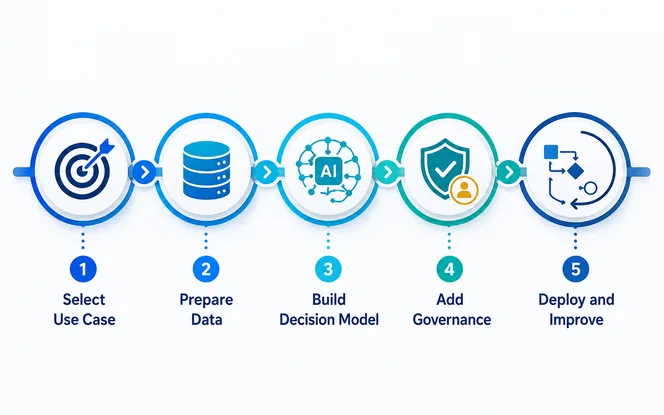
A practical decision intelligence roadmap moves from selecting a valuable decision and preparing trusted data to governance, workflow integration, testing, and continuous improvement.
How To Evaluate DI And BI Tools
Do not select a platform based only on an attractive dashboard or impressive AI demonstration. Instead, evaluate whether it can support your actual data, decisions, workflows, and governance requirements. Important questions include:
Build the shortlist with named products. For business intelligence, evaluate Microsoft Power BI, Tableau, and Qlik Sense. For decision intelligence, review platforms represented in Gartner's 2026 Magic Quadrant, including Aera Technology, FICO, IBM, Quantexa, SAS, Faculty, o9 Solutions, and RelationalAI. Compare each product against the same use case, integration, governance, explainability, workflow, and total-cost requirements.
Use free official vendor resources to verify the shortlist: the Microsoft Power BI overview, Tableau getting-started documentation, and Qlik Cloud Analytics documentation. Confirm connectors, governance, deployment, automation, and licensing details against current vendor documentation before making a final selection.
- Can the platform connect to critical data sources?
- How does it support governed business definitions?
- Can users trace the source of an insight?
- Which predictive and prescriptive analytics does it provide?
- How does it apply business rules and constraints?
- Can it explain recommendations?
- How can users approve or override decisions?
- Which operational applications does it integrate with?
- How does it record decisions and outcomes?
- What role-based access and audit trails does it provide?
- Can it monitor model performance and drift?
- What is the total implementation and maintenance cost?
Evaluate the tool based on what it enables in practice, not only on whether the vendor calls it BI, augmented analytics, automation, or decision intelligence.
How SDLC Corp Supports AI Decision Intelligence
Building an effective decision intelligence solution requires more than adding an AI assistant to a dashboard. SDLC Corp helps organizations combine trusted data, analytical models, business rules, governance, and operational workflows into practical AI-powered decision systems.
Our capabilities may include
- Decision discovery and use-case prioritization
- Data engineering and system integration
- BI modernization
- Predictive and prescriptive analytics
- ERP and CRM integration
- Human approval checkpoints
- Explainable AI
- Security and governance
- Performance monitoring
The goal is to help organizations make faster, more consistent, and more accountable decisions while maintaining appropriate human control.
Decision Intelligence: Definition and Implementation
To understand the underlying concept, see what AI decision intelligence is, including how data, models and decision workflows connect. If you are evaluating how to implement it, the decision intelligence build vs buy guide compares internal development with external platforms and implementation partners.
Conclusion
The decision intelligence vs business intelligence comparison should not be treated as a competition.
Business intelligence creates visibility by helping organizations monitor performance, investigate trends, and understand operations.
Decision intelligence builds on that foundation by connecting data and analytics to recommendations, actions, governance, and measurable outcomes.
Therefore, the better question is not simply whether an organization needs BI or DI. It is where the business needs better visibility and where it needs faster, more consistent, and better-governed decisions.
Frequently Asked Questions
What Is The Main Difference Between Decision Intelligence And Business Intelligence?
Business intelligence helps users understand data and performance. In contrast, decision intelligence connects data and analytics to recommendations, actions, and measurable outcomes.
Is Decision Intelligence Better Than Business Intelligence?
However, neither is always better. BI is suitable for reporting and monitoring, while DI is more useful for repeated decisions requiring prediction, recommendation, workflow integration, or automation.
Is Decision Intelligence Replacing Business Intelligence?
No. DI often builds on BI data, metrics, dashboards, and analytical foundations. BI provides visibility, while DI supports decisions and actions.
Can Business Intelligence Predict Future Outcomes?
Yes. For example, modern BI tools may include forecasting and predictive analytics. DI connects those predictions to actions, rules, approvals, and outcome tracking.
Is Decision Intelligence The Same As Artificial Intelligence?
No. In fact, AI is one component of decision intelligence. In addition, DI includes data, business rules, decision models, human expertise, governance, and workflows.
What Is A Decision Intelligence Example?
For example, a system that predicts equipment failure, compares maintenance options, recommends a service window, requests approval, and measures whether downtime was prevented is a decision intelligence example.
Does Decision Intelligence Always Automate Decisions?
No. DI may recommend an action, request human approval, or automatically execute a permitted decision. However, high-risk decisions should receive stronger human oversight.