First, choosing whether to build, buy, or use a hybrid decision intelligence platform affects implementation speed, cost, control, governance, and scalability. In contrast, building maximises ownership, buying speeds deployment, and a hybrid model combines proven platform capabilities with custom data, models, rules, workflows, and integrations. Overall, this guide compares all three options and provides a practical framework for choosing the right approach.
What Is a Decision Intelligence Platform?
Moreover, a decision intelligence platform combines data, analytics, artificial intelligence, business rules, decision models, and operational workflows to improve business decisions.
Accordingly, Gartner's decision intelligence platform research explains that these platforms combine decision modelling, analytics, and AI to augment or automate decisions and improve business outcomes.
Common use cases
- Approving loan applications
- Detecting suspicious transactions
- Selecting suppliers
- Prioritising sales opportunities
- Adjusting prices
- Identifying supply chain risks
- Forecasting inventory requirements
- Routing complex cases for human review
For example, agentic AI for finance shows how decision systems can combine automated actions with policy controls, escalation thresholds, audit trails, and human oversight.
What a production platform also requires
However, a production platform needs more than an AI model or rules engine. In addition, it requires:
As a result, these capabilities determine whether a system remains a prototype or becomes a dependable enterprise platform.
In short, here is the decision intelligence build vs buy verdict. First, build when decision intelligence creates a meaningful competitive advantage and your organisation has the technical resources to develop and operate it long term.
Next, buy when the use case is relatively standard, speed is important, and you need built-in security, governance, monitoring, and workflow capabilities.
Finally, choose hybrid when you want a proven platform foundation but still need proprietary models, rules, workflows, interfaces, or integrations.
Ultimately, the right choice depends on technical capability, regulation, business priorities, internal talent, risk, and the importance of owning the underlying intellectual property.
Decision Intelligence Build vs Buy and Hybrid Comparison
| Factor | Build | Buy | Hybrid |
|---|---|---|---|
| Deployment speed | Slow | Fast | Moderate to fast |
| Initial investment | High | Lower and predictable | Moderate |
| Customisation | Very high | Platform-dependent | High where required |
| Technical control | Full | Shared with vendor | High for selected components |
| IP ownership | High | Usually limited | High for proprietary components |
| Maintenance | Internal team | Mainly vendor | Shared |
| Governance | Must be developed | Usually included | Platform controls plus custom policies |
| Integration flexibility | High | Depends on APIs | High |
| Vendor dependency | Low | High | Moderate |
| Internal talent needed | Extensive | Limited to moderate | Moderate |
| Best for | Differentiated capabilities | Standard use cases | Complex enterprise requirements |
Decision Intelligence Build, Buy, and Hybrid Architecture
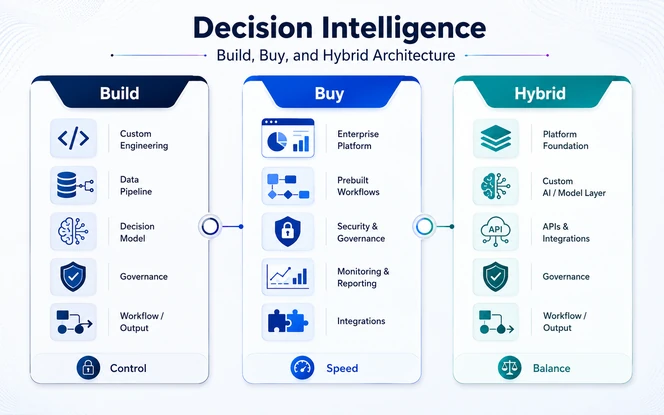
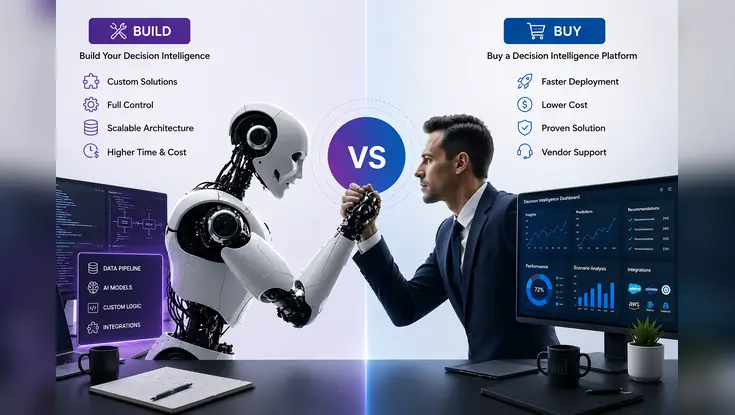
For example, a visual comparison can show how custom development, commercial platform capabilities, and hybrid integrations differ across control, speed, governance, and scalability.
When Should You Build?
In particular, building may be the right choice when decision intelligence directly differentiates your business and requires specialised AI development services.
For example, your organisation may rely on proprietary pricing algorithms, specialised risk models, unique operational data, or decision processes that competitors cannot easily reproduce.
Building is suitable when
- Existing platforms cannot support essential requirements
- Complete architectural control is required
- Sensitive data cannot be processed externally
- Performance requirements are highly specialised
- Dedicated engineering and operations teams are available
- The platform will support several long-term use cases
- Decision intelligence is part of your commercial product
However, development is only the beginning. In addition, your team must maintain infrastructure, integrations, security, testing, monitoring, documentation, versioning, support, and incident response.
Therefore, the real question is not whether your team can build a prototype. Instead, it is whether the organisation can operate and improve the platform reliably for years.
Build-to-Learn vs Build-to-Run
First, a proof of concept helps an organisation understand its data, workflows, risks, and requirements. In other words, it is a build-to-learn project. By contrast, a production platform is a build-to-run system.
- Clarify the business problem
- Understand available data
- Map decision workflows
- Identify risks and constraints
- Test model feasibility
- Validate integration needs
- Define success measures
- Confirm production requirements
- Security and access controls
- Decision traceability
- Continuous monitoring
- Change approval workflows
- Deployment and rollback controls
- Model and rule versioning
- Incident response procedures
- Long-term platform ownership
As a result, confusing these objectives can produce a system that performs well in a demonstration but becomes expensive or unreliable in production.
In addition, the NIST AI Risk Management Framework recommends managing AI risk throughout the design, development, use, and evaluation lifecycle rather than treating governance as a final step.
When Should You Buy?
By contrast, buying is generally the better choice when implementation speed, standardisation, and reliability matter more than complete ownership.
What an established platform may already provide
- Rule and workflow management
- Data connectors
- Model integration
- Decision tables
- Testing environments
- Data validation tools
- Role-based access
- Approval workflows
- Version control
- Audit trails
- Security features
- Policy enforcement
- Monitoring and reporting
- Deployment controls
- Rollback procedures
- Performance alerts
- Incident management
- Technical support
Therefore, these capabilities allow teams to focus on improving business decisions instead of developing every supporting platform component.
Moreover, buying is particularly suitable when business rules change frequently. For example, configurable platforms may allow authorised business, risk, or compliance teams to update decision logic without waiting for a full engineering release.
However, buying does not remove internal responsibility. Your organisation must still govern data, validate decisions, configure permissions, monitor performance, manage adoption, and review vendor performance.
In other words, a platform provides technical controls, but it cannot define your organisation's risk tolerance or business policies.
In addition, organisations operating in the European Union should consider the EU AI Act's risk-based framework during vendor evaluation, especially when decision systems affect regulated or high-impact activities.
When Is a Hybrid Approach Better?
On the other hand, a hybrid approach combines purchased platform capabilities with custom-built components.
For example, an organisation may purchase workflow execution, governance, monitoring, and access-control capabilities while developing proprietary models, decision rules, interfaces, and integrations.
Hybrid works well when
- Standard infrastructure is not a competitive advantage
- Decision logic must remain proprietary
- Some integrations are highly specialised
- Customisation is required
- Development time must be reduced
- Vendor dependency must be limited
- A gradual migration path is needed
Moreover, APIs, microservices, cloud platforms, and modular architectures have made hybrid approaches more practical.
Therefore, a useful principle is to build what differentiates your organisation, buy what every organisation needs, and integrate both carefully.
7 Key Factors in a Decision Intelligence Build vs Buy Evaluation
1. Strategic Differentiation
First, determine whether the decisioning capability creates a genuine competitive advantage.
Therefore, a custom build may be justified when unique decision logic directly affects revenue, risk, customer experience, operational performance, or product value. By contrast, standard approvals, routing, eligibility checks, and case prioritisation may not justify building an entire platform.
Ask
- Does the decision logic contain valuable intellectual property?
- Would ownership improve our market position?
- Could a configurable platform meet the requirement?
- Is custom development the best use of engineering resources?
2. Time to Value
In contrast, buying usually provides a faster implementation route because many technical capabilities already exist.
However, vendor selection, security reviews, data preparation, integration, configuration, testing, governance, and training still take time.
Therefore, compare realistic production timelines. In particular, do not compare a purchased production platform with a small internal prototype.
3. Internal Expertise
Moreover, building requires more than developers. Therefore, a sustainable platform may need:
Next, consider whether these people are available and whether platform development is the most valuable use of their time.
Moreover, staff continuity matters. Otherwise, a platform that depends on a few specialists may become difficult to maintain if they leave.
4. Customisation Requirements
First, identify which requirements are genuinely unique. However, some organisations assume they need a custom platform when they only require configurable rules, APIs, proprietary models, or tailored workflows.
Classify requirements as
For example, unique decision logic, protected data, or intellectual property may create a competitive advantage.
In addition, authorised teams may need to adjust rules, thresholds, approvals, or workflows without rebuilding.
By contrast, an established platform can provide common security, monitoring, deployment, and support capabilities.
As a result, this distinction often reveals whether build, buy, or hybrid is the most appropriate option.
5. Governance and Explainability
Because decision systems may affect customers, employees, finances, safety, and regulatory obligations, organisations must understand how decisions were produced and who approved them.
Evaluate whether the platform provides
- Decision histories
- Rule and model versions
- Approval records
- Data lineage
- Human-review steps
- Exception handling
- Outcome monitoring
- Rollback capabilities
- Manual overrides
In addition, the OECD AI Principles emphasise human rights, fairness, privacy, transparency, explainability, robustness, security, safety, and accountability as foundations for trustworthy AI.
Governance should therefore be treated as an architectural requirement, not an optional feature.
6. Integration and Scalability
In addition, a decision intelligence platform must connect with the systems where data is stored and actions occur. For example, well-planned software integration services help connect decision engines with enterprise applications, APIs, databases, and operational workflows. Specifically, these systems may include:
Therefore, review the depth of each integration rather than simply counting available connectors.
In addition, estimate transaction volume, peak demand, response-time requirements, data growth, user numbers, and future business expansion.
7. Vendor Lock-In
However, buying can create dependency on one provider. Before selecting a platform, determine whether you can export:
- Business rules
- Models
- Workflows
- Decision histories
- Audit logs
- Configuration data
In addition, the contract should explain data ownership, intellectual property rights, termination terms, price changes, migration support, and data-deletion procedures.
Compare the Total Cost of Ownership
Therefore, a fair decision intelligence build vs buy comparison should cover at least three to five years.
Therefore, it should include implementation, operation, maintenance, governance, growth, and migration rather than only the first development estimate or annual licence fee.
- Architecture and development
- Data engineering
- Cloud infrastructure
- System integrations
- Security and compliance
- Testing and validation
- Monitoring and observability
- Technical documentation
- Team training
- Ongoing maintenance
- Platform upgrades
- Incident response
- Software licences
- Usage and scaling fees
- Implementation services
- System integrations
- Data migration
- Platform configuration
- Team training
- Premium support
- Custom extensions
- Contract increases
- Security review
- Exit and migration costs
- Platform subscriptions
- Custom development
- Data engineering
- System integrations
- API management
- Security and governance
- Vendor management
- Internal ownership
- Shared testing
- Shared monitoring
- Ongoing maintenance
- Exit and migration planning
Hidden costs to plan for
For example, building: hidden costs may include refactoring, technical debt, urgent hiring, staff turnover, integration maintenance, and developers being moved away from customer-facing or revenue-generating work. In fact, the largest cost is often the long-term commitment of specialised employees rather than the initial software development.
Similarly, buying: commercial platforms may charge according to users, executions, models, environments, data volume, or API usage. Do not compare only the vendor subscription with the first development estimate. Instead, compare the complete operating cost under realistic growth scenarios.
Meanwhile, hybrid: hybrid can reduce development work. However, unclear architectural boundaries may create both vendor costs and internal maintenance costs. Consequently, each component, integration, upgrade, and control should have a clearly defined owner.
Decision Intelligence Total Cost and Ownership Model
For example, this visual compares development, licensing, integration, maintenance, governance, staffing, scaling, support, and migration costs over a three-to-five-year period.
Five-Step Decision Framework
Define the Business Outcome
First, define the decision you want to improve rather than starting with a platform or AI model. In addition, define the cost of a wrong decision. As a result, high-risk decisions require stronger monitoring, validation, explainability, and human oversight.
Separate Essential and Optional Requirements
Next, identify the capabilities required for the first production use case. As a result, this prevents unnecessary customisation and improves vendor comparisons.
Decide What You Must Own
Then, identify the components that contain strategic value or sensitive intellectual property. For example, these may include proprietary data, decision models, scoring methods, business policies, workflows, and strategic integrations. By contrast, standard infrastructure such as workflow execution, identity management, monitoring, and deployment tools may not require full internal ownership.
Run a Production-Focused Proof of Concept
After that, test one complete decision workflow rather than a simplified demonstration. In particular, the proof of concept should show whether the system can operate in production, not only whether an AI model can generate an output.
Use a Weighted Scorecard
Finally, score build, buy, and hybrid options against the criteria that matter most, then give more weight to the factors that matter most to your organisation.
Outcome targets for the first step
How to classify requirements
- Essential for launch
- Required for scaling
- Optional
- Unproven
What the proof of concept must include
- Realistic data
- One difficult integration
- User permissions
- Decision explanations
- Exception handling
- Human escalation
- Monitoring
- A measurable business outcome
Weighted scorecard criteria
- Strategic value
- Time to value
- Total cost
- Customisation
- Integration
- Scalability
- Governance
- Internal talent
- Vendor dependency
- Portability
- Operational risk
- Data control
For example, a regulated company may prioritise governance, security, explainability, and data control. By contrast, a growing digital business may prioritise speed, flexibility, and scalability.
Therefore, a documented scorecard produces a more defensible decision than relying on vendor demonstrations or internal preferences.
How SDLC Corp Supports Decision Intelligence
Ultimately, choosing the right approach is only the first step. Next, organisations must convert the decision into a practical architecture, implementation roadmap, governance model, and measurable business outcome.
Accordingly, SDLC Corp's AI decision intelligence solutions support build, buy, and hybrid strategies.
Decision Intelligence Build vs Buy Assessment
First, SDLC Corp evaluates decision processes, data readiness, integration requirements, governance needs, internal capabilities, and expected value. As a result, this helps determine:
- Which capabilities should be built
- Which capabilities can be purchased
- Where hybrid architecture is suitable
- Which use case should be implemented first
- Which risks must be resolved before production
Custom Development and Integration
In addition, SDLC Corp can develop and integrate:
- Predictive decision systems
- Recommendation engines
- Rule and policy engines
- Decision-support applications
- AI-assisted workflows
- ERP and CRM integrations
- Data pipelines and APIs
- Human approval processes
- Monitoring and audit controls
Similarly, for hybrid strategies, SDLC Corp can create clear boundaries between purchased infrastructure and proprietary components.
Governance and Proof of Value
Therefore, decision intelligence systems should be explainable, auditable, and controllable. For example, SDLC Corp can implement:
Finally, organisations can begin with one measurable workflow to test data, integration, governance, and business outcomes before wider implementation.
Frequently Asked Questions
Is it cheaper to build or buy a decision intelligence platform?
For example, buying is usually less expensive initially because the core infrastructure already exists. However, the answer depends on licence costs, integration, customisation, staffing, maintenance, usage, and contract terms. Therefore, a three-to-five-year decision intelligence build vs buy cost comparison provides a more accurate result.
How long does it take to build a decision intelligence platform?
However, the timeline depends on data readiness, integrations, security, governance, scope, and team size. For example, a prototype may be developed quickly, while a secure and scalable production platform requires more testing, monitoring, documentation, and operational preparation.
What is the biggest risk of building internally?
In particular, the biggest risk is underestimating long-term ownership. For example, teams may focus on models and decision logic while overlooking security, monitoring, governance, integrations, updates, support, and incident response.
Can a purchased platform support custom decision models?
In addition, many platforms support custom rules, machine-learning models, APIs, workflows, and interfaces. However, flexibility differs between vendors. Therefore, test customisation, deployment, ownership, and portability requirements during the proof of concept.
Is hybrid better than build or buy?
Hybrid is often suitable when an organisation needs both implementation speed and technical control. Therefore, standard capabilities can be purchased while proprietary decision logic and integrations remain internally controlled.
How can organisations avoid vendor lock-in?
First, evaluate data portability, model export, API access, contract termination terms, migration support, and documentation before selecting a platform. Then, keep proprietary data and decision logic in portable formats where possible.
Does decision intelligence replace business intelligence?
In short, decision intelligence does not replace business intelligence. Instead, business intelligence explains historical and current performance. By contrast, decision intelligence uses data, models, rules, and workflows to recommend or execute future actions. Therefore, decision intelligence and business intelligence often work together.