
Software Integration Services
Our software integration services connect CRM, ERP and SaaS applications to automate handoffs and keep records consistent. We provide API integration services and managed integration services, from implementation to ongoing operation. Software integration cost depends on your interfaces, workflows and data.
Featured work: Salesforce–ActiveCampaign workflows for BPMInstitute.org and Neto marketplace integration for Matchbox.
Business workflows
Software Integration
Workflows
Start with the handoffs that cause repeated entry, missing updates or reconciliation work. Define the business owner and exception path for each flow.
Lead to customer
Move qualified leads, account changes and deal stages between CRM, marketing and service tools. First, match records before creating new contacts.
Order to fulfilment
Pass orders, stock availability, shipment status and returns between storefronts, ERP and warehouse systems. Also, retain external order references for reconciliation.
Invoice to reconciliation
Send agreed invoice and payment data to accounting systems. If a transfer fails, route the rejected record to an owner for review.
Our Software Integration Services
Our application integration services connect business systems, replace fragile scripts and bring cross-team workflows under consistent controls.
API integration services
Our API integration services connect applications through documented REST, SOAP or GraphQL interfaces. Define authentication, field mapping, sync direction, rate limits and failure handling for each connection. New endpoint development is scoped separately.
Enterprise application integration services
Coordinate workflows across ERP, CRM, HR and operational applications. First, agree which system owns each business record and how conflicting updates are resolved.
Data integration services
Our data integration services build pipelines between databases, warehouses and reporting systems. Define validation, transformation, refresh frequency and reconciliation rules so downstream teams can trace the source of their data.
Cloud integration services
Connect hosted applications with cloud or on-premises systems. Before implementation, check network access, credentials, vendor limits and restrictions on where data can be processed.
Legacy software integration
Use supported interfaces, adapters or controlled file exchange to connect older software. First, assess access and stability to decide whether an interface can be extended or needs modernization.
B2B and EDI integration
Exchange orders, invoices and shipment messages with partners. Agree message formats, acknowledgements, duplicate checks, partner testing and ownership of rejected transactions.
Architecture
Software Integration
Architecture Choices
The best design depends on how quickly data must move, how many systems share it and who will maintain the connections.
In practice, architecture involves two decisions: how systems connect and when data moves. A direct API or middleware connection can use event-driven updates, scheduled batches or both.
Direct API integration services
API integration services suit a few systems with stable, documented interfaces. They avoid a separate integration platform, but each connection needs its own monitoring and change management. Budget for hosting where required and maintenance when either API changes.
Custom middleware or ESB
Use a shared layer when several systems need common routing, transformations or reusable business rules. It centralizes control, but adds a runtime that must be secured, monitored and recovered. Your team or support partner owns its operation; hosting and any platform licences are ongoing costs.
iPaaS integration
Use supported connectors for repeatable SaaS workflows when their triggers, objects and actions fit. Check execution limits, subscription or usage charges and export access. The vendor operates the platform, while your team or support partner maintains mappings, credentials and failed runs.
Update timing: events suit time-sensitive changes; scheduled batches suit bulk transfers or limited interfaces. Either approach needs retry limits, exception handling and reconciliation.
Portfolio
Software Integration
Case Studies
See the systems connected and the engineering choices behind the delivery.
BPMInstitute.org: Salesforce to ActiveCampaign
Salesforce remains the source of truth. Webhook-triggered logic maps and validates lead and opportunity data, matches existing records, updates stages and starts the appropriate automation.
As a result, the team can follow deal stages and launch follow-up automation without manual exports.

Matchbox: Neto marketplace integration
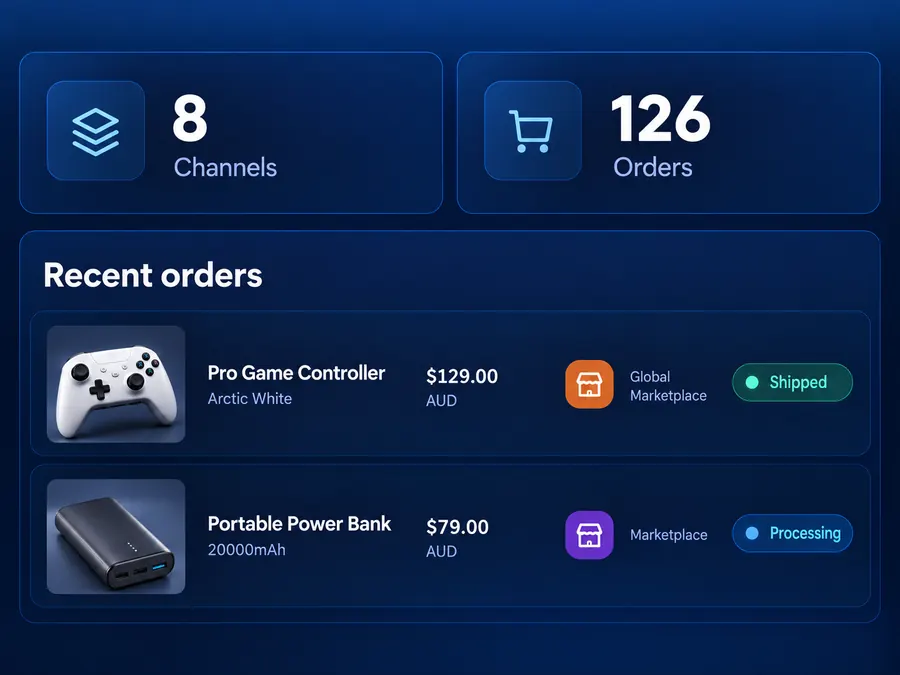
Marketplace-specific connectors handle channel mapping, product and stock updates, order imports and fulfilment. External order references and recorded sync activity support duplicate checks and exception tracing.
Client-reported result: 40 staff-hours saved per month through digitisation and automation after phased marketplace integration.
The published case study compares July–December 2020 with January–June 2025 and identifies ERP dashboards, sales reports and Google Analytics as supporting sources.
Integration products you can inspect
Explore connectors and API tooling alongside our custom delivery work. We check version compatibility, data ownership and workflow fit before recommending a product or a custom build.
Shopify–Odoo connector
Connect product, customer, order and inventory records between the storefront and ERP. Review the documented setup, mapping and webhook options against your store configuration.
Explore the Shopify connector →Magento 2–Odoo connector
Connect commerce records through Magento APIs, including products, customers and orders. Confirm the supported version, field mappings and sync directions for your installation.
Explore the Magento connector →Conflux API management
Review API publishing, access policies, traffic controls and monitoring in one platform. An API gateway supports the operating layer; business workflows and data mappings still need their own design.
Explore Conflux →Product licences, configuration, customization and support are quoted separately. A connector is suitable only when its supported objects and behaviours match the workflow.
Client feedback
Software Integration
Client Feedback
API integration feedback from Steve Graham.
“Complex data integrations requiring record ID matching, indexing and translation via the API.”
Project planning
Software Integration
Cost and Scope
Software integration cost is based on the agreed connections, datasets and workflow rules. These indicative prices cover defined work; complex orchestration is estimated after discovery.
Standard API connection
API integration services for one connection between two named systems using documented APIs.
- Indicative price
- $2,000 USD
- Workflow: One connection and its agreed sync behaviour.
- Integrations: Two named systems, objects, fields, directions and frequency.
- Migration: Historical records scoped separately.
- Includes: Authentication, error handling and acceptance tests.
- Excludes: New APIs, extra connections and additional business workflows.
Defined data migration
Transfer agreed datasets from one source to one destination.
- Indicative price
- $5,000 USD
- Workflow: One defined migration from source to destination.
- Integrations: Access or extraction method confirmed in discovery; no ongoing sync.
- Migration: Agreed datasets, volumes, mappings, transformations and reconciliation.
- Includes: Validation and the agreed migration test results.
- Excludes: Cleansing, extra sources and continuing synchronization unless specified.
Workflow automation
Automate one agreed business process with defined triggers and outcomes.
- Indicative price
- $10,000 USD
- Workflow: One agreed process with triggers, rules and exception paths.
- Integrations: System connections are itemized separately unless included.
- Migration: Historical transfer is scoped separately unless included.
- Includes: Testing, documentation and handover for the process.
- Excludes: Additional processes and third-party charges unless specified.
Prices are in USD and depend on the stated scope. Taxes, licences, hosting and third-party usage are excluded unless agreed. The connection schedule records the included endpoints, objects, directions, volumes and business rules. It also confirms acceptance criteria, milestones and the support period.
Your software integration cost estimate accounts for API access, vendor approvals, data quality, transaction volume, security requirements and testing. Implementation, platform subscriptions and ongoing support are separate cost components. For combined projects, the proposal itemizes connections, migration, automation and any shared setup; these prices are not an automatic bundle.
Engagement options
Integration Services
and Support
Choose a defined implementation or managed integration services for ongoing operation. Start with an assessment when interface readiness or scope is uncertain.
Software integration cost assessment
Choose this when you need to assess feasibility or stabilize unreliable connections. The assessment provides a system inventory, prioritized integration backlog, architecture recommendation and the dependencies behind an estimate.
Integration implementation
Choose this when the workflows and owners are ready for implementation. Delivery covers design, build, testing, cutover and handover against approved acceptance criteria. Your team supplies access, mapping decisions and user acceptance.
Managed integration services
Choose managed integration services when you need an operating owner after launch. The support plan specifies monitoring hours, incident severity, escalation, response targets and vendor API updates. Coverage and fees are confirmed separately from implementation.
Delivery process
Our Software
Integration Process
Each stage ends with a reviewable output, from the first system inventory to an accepted production workflow.
- 01
Software integration discovery
Your business owner identifies the workflows and priorities; your technical owner supplies API documentation, sandbox access and sample records. We produce the system inventory, dependency list and delivery scope.
- 02
Application integration design
We prepare the data contracts, field mappings, authentication and recovery design. Your system owners approve record ownership, update frequency, conflict rules and exception handling before the build.
- 03
Software integration build and testing
We build the flows and record results for valid, rejected and repeated transactions, outages and expected loads. Your reviewers validate the business outcomes against the acceptance checklist.
- 04
Release with a recovery plan
We agree a pilot, cutover window, parallel-running needs and rollback triggers with your operational owner. A reconciliation report and approval record support the decision to retire the old connection.
- 05
Hand over and support
We deliver the configuration or custom source code, mappings, test results and operating runbook. For managed integration services, the support plan names the incident owner, escalation path and API-change responsibilities.
Reliability and handover
Software Integration
Reliability and Recovery
A connection needs clear controls for incomplete data, unavailable systems and repeat events. The proposal defines which controls and tests apply.
Data integrity
Agree validation rules, source-of-truth ownership and stable record identifiers. Test repeated events and reconcile source and destination totals to detect missing or duplicate transactions.
Security and access
Use scoped service accounts, protected credentials and encrypted transport appropriate to the architecture. Define log redaction, audit access and retention around the data involved.
Monitoring and recovery
Managed integration services need alerts, retry limits and an exception queue. Specify who investigates failures, how records are replayed safely and when a failed transfer needs manual approval.
Your handover pack
Define the handover pack before development: architecture diagrams, field mappings, configuration or source code, test results and deployment instructions. Include recovery procedures and the access needed for your team to operate the connection.
Sample integration acceptance checklist
For API integration services connecting CRM and ERP, tests can cover a valid record, a repeated request, missing required fields, an expired credential and a destination outage. Each test records the input, expected destination state, actual result and reviewer approval.
A repeated request should not create a second customer. A rejected record should retain a traceable reason and recovery owner. Your project checklist defines the specific results before testing begins.
Technology
Integration Platforms
and Technologies
Software integration services are scoped to your platform editions, API permissions and operating constraints. Before we commit to delivery, we assess available connectors and vendor access.
CRM application integration
Lead, account, opportunity and campaign handoffs with agreed ownership and duplicate rules.
ERP and finance integration
Order, invoice, stock and payment workflows mapped to each platform’s supported interfaces.
Commerce system integration
Order and fulfilment updates, marketplace connections, service tickets and operational handoffs.
Interfaces and middleware
Custom connectors or platform-based orchestration selected for the workflow, licensing and operating requirements.
Software Integration
by Industry
Business rules, data sensitivity and operational dependencies shape the design.
01 / 03
Retail and ecommerce
Connect storefronts, marketplaces, POS, ERP and fulfilment. Prioritize stock consistency, external order references and recovery from failed order imports.
02 / 03
Manufacturing and logistics
Connect ERP, production, warehouse and transport workflows. Also define update intervals, site connectivity and ownership of delayed or rejected messages.
03 / 03
Financial services
Connect CRM, billing and accounting workflows. In particular, preserve transaction references, control access to financial records and reconcile rejected or incomplete transfers.
Scope Your
Integration Project
For implementation or managed integration services, share the systems, workflow and current failure. We review interface feasibility, outline the delivery approach and identify the inputs needed for a scoped estimate.
-
01
Architecture
-
02
Development
-
03
Integration
-
04
Deployment
FAQ
Software Integration
Services FAQs
Answers about scope, pricing, migration, reliability and ownership.
Software integration services connect applications so they can exchange data and trigger business workflows. In practice, the work includes architecture, data mapping, authentication, implementation, testing and deployment. Managed integration services provide maintenance and monitoring under a separately agreed support plan.
Software integration cost depends on interface readiness, data mapping and workflow complexity. Indicative prices are $2,000 for a standard API connection, $5,000 for defined data migration and $10,000 for automation of one agreed process. These are separate offers with defined scope. Your proposal confirms workflows, objects, record volumes, exclusions and support. Taxes, licences, hosting and third-party usage are excluded unless agreed.
We confirm the schedule after checking API readiness, sandbox access, data quality, transaction volumes and vendor dependencies. The delivery plan separates mapping approval, build, testing, user acceptance and cutover. Missing credentials, vendor approvals or unresolved record ownership can delay a milestone; these dependencies are recorded before a delivery commitment.
Yes, when a safe interface is available. We assess supported APIs, controlled file exchange, permitted database access and adapters before recommending a connection. If there is no reliable way to read or update the required records, we identify the changes needed or recommend keeping that workflow manual until the interface is ready.
Not always. A direct API connection may suit a small workflow. Middleware or iPaaS can help when several systems need shared routing, transformation and monitoring. We compare connector coverage, vendor limits, recurring licence costs and maintenance responsibilities before recommending an approach.
Only when it is explicitly included in the proposal. Ongoing synchronization and historical migration are different workstreams. Migration scope defines source and destination datasets, record volumes, transformations, cleansing responsibilities and reconciliation checks.
We define record identifiers, matching rules, validation and source-of-truth ownership. Depending on the flow, controls can include idempotent processing, bounded retries, exception queues and reconciliation. In addition, tests cover repeated events, rejected data and destination outages.
We map access controls, authentication, credential handling, encryption, logging and retention to the data and deployment environment. Any HIPAA, GDPR or other obligations are assessed for the specific engagement. Required audits, specialist assessments and evidence are defined separately in scope.
Ownership of custom integration source code, configuration and documentation is recorded in the agreement before implementation. The handover scope names the repository, deployment instructions and access your team receives. Third-party connectors, platforms and libraries retain their own licence terms, which are listed separately.
Managed integration services define responsibility for deprecation notices, regression tests, connector updates and incident response. A vendor API change or new business rule is assessed for effort, cost and release impact before approval. Fixing a defect against the original acceptance criteria is distinguished from adding or changing scope.
To estimate software integration cost, share the source and destination systems, editions, API documentation, required workflows, data objects, direction, expected volumes and update frequency. Sample records, access restrictions, current errors and the desired release date help identify dependencies. If needed, an NDA can be signed before detailed discovery.
Yes, after assessing the current code or configuration, credentials, documentation, known failures and ownership rights. We can prioritize stabilization, monitoring and documentation before adding new workflows. The assessment establishes which connections can be retained and which need replacement.
Application integration services coordinate actions and records across operational systems. By contrast, data integration services consolidate and transform data for reporting or other downstream use. A project can require both: an order workflow may update the ERP while a separate pipeline refreshes the reporting warehouse.
Before development, we define expected records, field mappings, update frequency, transaction volume and failure behaviour. Tests cover valid transfers, rejected data, repeated requests and recovery after an outage. We agree measurable success criteria such as reconciliation exceptions, processing time and manual effort, and identify the baseline and reporting source.
Contact us
Let’s Discuss Your
Integration Project
Include your source and destination systems, the workflow or records to connect, update frequency and the current problem. Add expected volume and API documentation if available.
- We review the workflow and interface dependencies.
- We discuss architecture, access and delivery scope.
- We confirm any discovery needed before preparing the scope, estimate and exclusions.