Master data management for AI gives analytics and AI systems a stable way to identify customers, products, suppliers, and other shared business entities. Without that discipline, the same business object appears under conflicting identifiers, attributes, and ownership rules. That breaks reports, retrieval, scoring, and operational automation.
- Use MDM to govern shared entities, not to create one giant database.
- Start with the domains that create the highest business or model risk when identity is inconsistent.
- Define matching, survivorship, stewardship, and publish rules before scaling tooling.
- Measure value through trusted-record use, lower duplicate rates, and fewer downstream incidents.
What Is Master Data Management (MDM)?
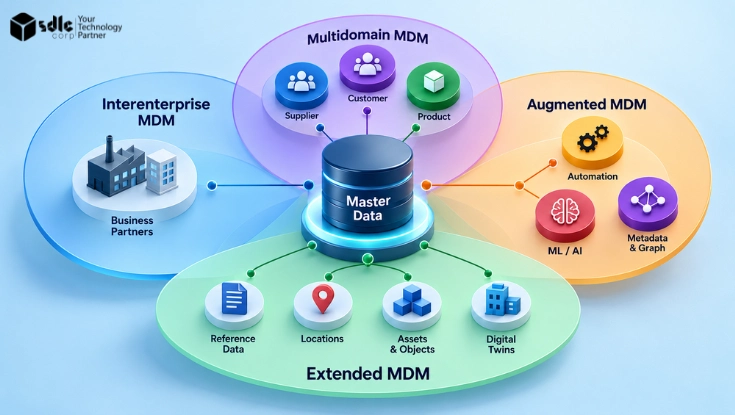
Master data management (MDM) is the set of processes, governance rules, technologies, and ownership practices used to create consistent records for shared business entities. Those entities include customers, products, suppliers, locations, and accounts.
In practice, the discipline covers domain scope, business definitions, identity resolution, attribute precedence, hierarchy handling, and stewardship. It also covers the rules that publish trusted records to consuming systems.
That matters for AI because models and retrieval systems inherit the identity quality of their inputs. If the same customer exists under five identifiers, feature engineering, reporting, document retrieval, and downstream workflow actions all become less reliable.
MDM does not require one physically centralized database for every enterprise. Some organizations publish a golden record hub, while others keep trusted entity services or synchronization patterns across operational and analytical platforms.
The requirement is governed identity and controlled distribution, not one universal storage topology, whichever data engineering services or platforms sit underneath.
Use MDM when a business entity must mean the same thing across systems, teams, and decisions.
Why Master Data Management Matters for AI
Analytics programs need stable business entities so that revenue, churn, margin, supplier exposure, or inventory metrics reconcile across reports. AI programs need the same stability so that features, retrieval documents, policies, and operational actions refer to the same real-world object every time. Inconsistent entities create silent errors: a model trains on one definition of a customer, serves against another, and gets measured against a third.
In retrieval and generative AI use cases, weak master data also harms context quality. The system may retrieve multiple versions of the same supplier, product, or contract record, each with different terms or ownership.
In predictive or rules-based systems, duplicate entities distort aggregates, labels, and historical behavior patterns. That is why MDM belongs beside data quality controls for AI and metadata management and data catalogs. It should not be treated as an isolated back-office task.
The practical outcome is better trust in shared inputs. When entity identity is governed, teams can attribute decisions correctly and trace lineage across source systems. They can also challenge model outputs against consistent business definitions instead of debating which source record was supposed to win.
How AI Is Changing Master Data Management
AI has moved into the mastering process itself. Machine learning now assists steps that once depended entirely on deterministic rules, from resolving entities to prioritizing the exceptions a steward sees first.
- Probabilistic matching: models score likely matches across name, address, and identifier variations that exact rules miss.
- Duplicate detection: pattern-based detection finds duplicate clusters instead of relying only on fixed thresholds.
- Anomaly detection: continuous checks flag out-of-pattern attribute values as they arrive rather than at the next audit.
- Classification and enrichment: category, segment, and reference attributes are proposed automatically from source and external context.
- Relationship discovery: likely parent-child links between legal entities, sites, or product families surface as candidates for review.
- Steward assistance: recommendations and confidence scores order the review queue by risk instead of arrival time.
AI should accelerate the work, not own the decision. High-impact merges, attribute overrides, hierarchy changes, and publish approvals still run through governed controls and human review. That matches the discipline expected by risk frameworks such as the NIST AI Risk Management Framework.
Traditional MDM vs AI-Driven MDM
| Area | Traditional MDM | AI-driven MDM |
|---|---|---|
| Matching | Deterministic rules and fixed logic | ML-assisted probabilistic matching |
| Duplicate detection | Threshold based | Pattern based across record clusters |
| Data quality | Periodic rule checks | Continuous anomaly detection |
| Enrichment | Manual or external batch updates | Automated contextual enrichment |
| Stewardship | Manual review queues | AI-assisted recommendations |
| Exception handling | First in, first out queue | Prioritized by risk and confidence |
| Rule maintenance | Manual rule updates | Suggested rule changes from exception patterns |
| Governance | Human controls | Human governance with AI assistance |
Select the First Master Data Domains
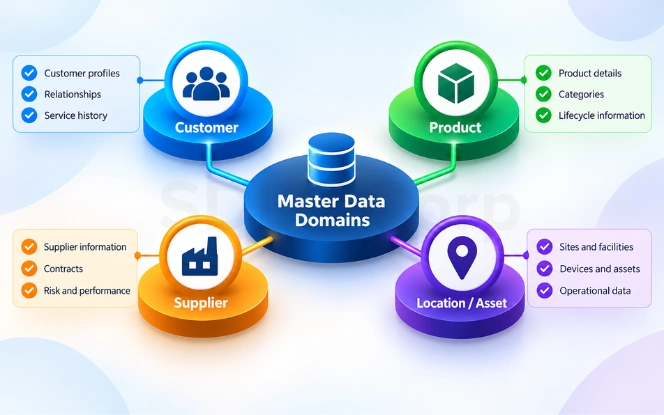
Do not start MDM by trying to master every entity at once. Start where identity failure already creates visible cost or decision risk. Typical first domains are customer, product, supplier, account, or location because they affect revenue attribution, regulatory reporting, procurement, service operations, and AI feature consistency.
| Domain | Start here when | AI and analytics impact |
|---|---|---|
| Customer | Duplicate accounts, channel conflict, or fragmented service history distort decisions. | Improves segmentation, churn, support retrieval, and customer-level automation. |
| Product | Descriptions, categories, or lifecycle states conflict across commerce, ERP, and content systems. | Stabilizes recommendation inputs, catalog search, margin reporting, and pricing logic. |
| Supplier | Vendor risk, contract ownership, or spend analysis uses inconsistent identifiers. | Improves supplier-risk scoring, procurement analytics, and contract retrieval. |
| Location or asset | Operational reporting depends on consistent site, device, or store identity. | Supports field-service AI, demand forecasting, and compliance traceability. |
Use a simple scorecard when choosing the first domain. Score business criticality, duplication rate, downstream system count, regulatory exposure, and the manual exception handling required today. The right first domain is rarely the cleanest one. It is the one where identity repair unlocks the largest operational gain and where the organization can actually assign stewardship.
Create Matching, Survivorship, and Hierarchy Rules
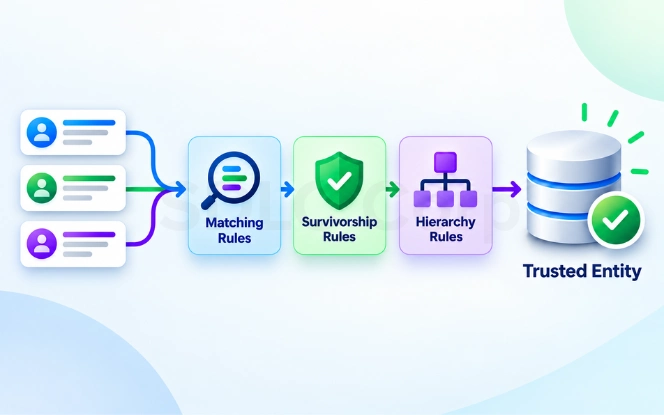
Matching rules decide when two records represent the same entity. Survivorship rules decide which values win when those records conflict. Hierarchy rules define how entities roll up into parents, regions, households, product families, or other structures that analytics and AI depend on.
For example, a customer domain might match on a combination of legal name, normalized address, tax identifier, and verified contact signals. Survivorship can prefer the CRM system for relationship owner, the billing system for payment status, and the service platform for current support tier. That is more reliable than asking one source to be correct for every attribute.
Design the rules to be explainable. Every match, non-match, merge, or split should be traceable to logic, evidence, or steward action.
Avoid opaque scoring that no business owner can challenge. If the organization cannot explain why a trusted record exists, it will not trust the output when a report or model result is disputed.
- Separate exact-match, likely-match, and steward-review cases.
- Define survivorship per attribute, not only per source system.
- Model hierarchies explicitly for products, accounts, geographies, or legal entities.
- Preserve the evidence used to merge, override, or publish a record.
Define Golden Records Without Hiding Source Context
A golden record is the governed representation of an entity that downstream users can rely on for shared decisions. It should not erase source history or imply that the enterprise has one perfect immutable truth.
A published mastered entity usually carries these elements:
- Canonical identifier: the stable enterprise ID every consuming system refers to.
- Approved attributes: the current governed values that survived the survivorship rules.
- Source provenance: which systems contributed each value and when.
- Match confidence: how certain the entity resolution was for this record.
- Hierarchy: parent, child, and rollup relationships for aggregation.
- Steward status: approved, under review, or held for escalation.
- Effective timestamp: when the current trusted state took effect.
- Publish status: which downstream systems already hold this version.
That distinction matters in AI. A model feature may need the trusted current customer segment, while an auditor needs the source records that fed it.
A retrieval experience may show the current approved supplier name, but an operations team may still need the original source record and its exception trail. Use metadata management and data catalogs to preserve business meaning, lineage, ownership, and publish status around the mastered entity.
| Design area | What to define |
|---|---|
| Trusted state | The attributes and hierarchy views the enterprise will publish for shared use. |
| Source provenance | Which records contributed, what rules applied, and when a steward intervened. |
| Publish logic | Which systems consume the record, on what cadence, and with which contract. |
| Exception handling | What happens when sources conflict, confidence drops, or a steward rejects the merge. |
Establish Stewardship and Exception Workflows
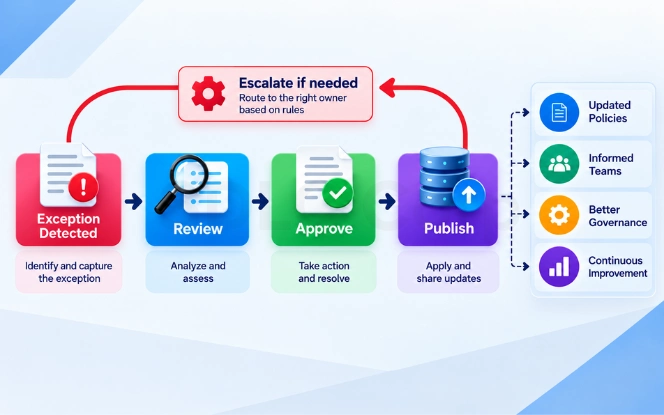
MDM fails when ownership is vague. Every mastered domain needs a business owner accountable for definitions and policy decisions. It also needs stewards who review exceptions and approve edge cases, plus platform or engineering teams that implement match, publish, and integration controls. Use the enterprise data governance framework to define the broader policy and decision-rights model behind those workflows.
The underlying roles and accountabilities follow the model set out in the DAMA-DMBOK data management body of knowledge.
Exception handling should be operational, not ceremonial. Route low-confidence matches, disputed merges, hierarchy conflicts, and publish failures into a visible work queue with service-level expectations. Record why the steward overrode the rule, what evidence they used, and whether the rule set should be updated to reduce future manual review.
- Name a domain owner for each mastered entity set.
- Define steward queues, approval paths, and escalation rules.
- Capture evidence for overrides, suppressions, and source challenges.
- Feed recurring exception patterns back into rule design and source remediation.
A workable escalation path runs owner, steward, engineering, and then business-owner approval for the highest-impact changes. For example, a low-risk attribute correction can clear the normal queue, while a medium-confidence match goes to steward review. A high-impact merge between two large accounts waits for business-owner sign-off.
Stewardship is not a side task. It is the operating mechanism that keeps trusted entities credible as the business changes.
Integrate MDM With Operational and Analytical Systems
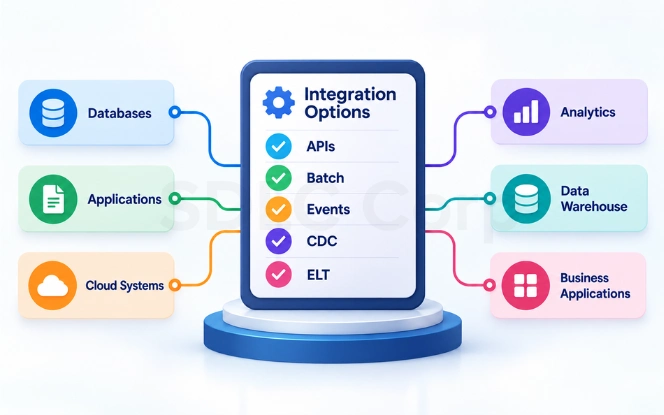
Trusted records must move back into the systems that use them. Publish mastered entities through governed APIs, events, or batch synchronization patterns that fit the estate. The publish contract should define identifiers, attribute sets, update cadence, and what downstream systems are allowed to override or enrich locally. Use enterprise data integration strategy when choosing the transport and failure-handling pattern.
Avoid turning the MDM platform into an isolated hub that analysts and AI teams still work around. Connect mastered entities to reporting models, feature pipelines, document stores, and workflow systems so downstream consumers use the same trusted identifiers. When local copies exist, publish change events and lineage signals so teams can reconcile updates, retries, and stale-state incidents.
Keep the system-of-record and system-of-reference distinction clear. An MDM platform does not have to replace CRM, ERP, or commerce systems, which remain the transaction systems of record. That stays true even as artificial intelligence transforms ERP software itself. MDM acts as the governed reference layer that masters identity and publishes trusted values back to them.
For AI systems in particular, align MDM outputs with feature definitions, retrieval metadata, and access controls. The same entity ID that powers the golden record should flow through retrieval filters, training labels, and operational decision logs.
Master Data Management for AI Agents and RAG
Agentic AI systems and retrieval pipelines consume master data differently from dashboards. They need a canonical entity ID to anchor context and approved attributes to answer from. They also need hierarchies to aggregate across, lifecycle status and permissions to filter by, and provenance to show where a value came from.
Those same mastered entities turn a document index or knowledge graph into something an agent can reason over. Without them, the agent invents its own version of a customer or supplier.
Publish entity IDs, hierarchy, status, and access permissions as retrieval metadata so filtering happens before generation, not as a correction afterwards.
Measure Data Quality and Business Adoption
Do not measure MDM only by the number of domains onboarded or records merged. Measure whether the trusted record is improving business and model outcomes. Useful operational metrics include duplicate rate, match precision and recall, steward queue age, and publish latency. Also track the share of critical entities with named owners and approved rule sets.
| Metric | What it tells you | Starting target |
|---|---|---|
| Duplicate rate | Whether entity quality is actually improving | Under 2% of active records in the domain |
| Match precision | How often records are merged incorrectly | At or above 98% on sampled merges |
| Match recall | How many true duplicates are still missed | At or above 95% on the known duplicate set |
| Steward backlog | Operational workload created by the rule set | Under 5 working days of open exceptions |
| Queue age | Review efficiency and escalation delays | 90% of items closed within 5 working days |
| Publish latency | How quickly trusted values reach consuming systems | Under 15 minutes for event-driven consumers |
| Trusted-record adoption | Whether the business is really using mastered data | At or above 80% of priority consuming systems |
| Downstream incidents | Operational impact of identity failures | Fewer than 1 identity-caused incident per month |
| AI use-case adoption | Value delivered to models, agents, and retrieval | Every new AI use case sourced from mastered entities |
Treat those targets as starting points and tune them to the domain, data volume, and risk profile.
Also track adoption signals. Which reports now consume the mastered customer or product record? Which workflows use the trusted entity ID? Which AI features, retrieval filters, or business rules are built on top of mastered data? If downstream teams are still bypassing the mastered record, the rollout is not complete even if the hub is technically live.
Use the results to decide when a domain is stable enough for broader AI use. If duplicate suppression is weak, exception queues are growing, or publish latency is unpredictable, route remediation before expanding the mastered entity into higher-risk use cases. Pair this with data readiness for AI when a use case needs a go or no-go decision.
Common MDM Implementation Mistakes
- Starting with tooling before defining domain scope, stewardship, and publish contracts.
- Assuming one source system must win every attribute instead of defining survivorship per field.
- Publishing a golden record without preserving source provenance and exception history.
- Trying to master every domain at once instead of proving value in the first high-impact domain.
- Treating stewardship as occasional cleanup rather than an operating workflow with service expectations.
Most MDM failures are operating-model failures before they are technology failures. The platform matters, but the durable value comes from explainable rules, accountable ownership, and controlled distribution into the systems that make decisions.
MDM for AI Implementation Roadmap
Run the first domain end to end before widening the scope. Each step below produces something the next step depends on.
- Prioritize a domainChoose customer, product, supplier, account, or location based on decision risk.
- Profile the sourcesQuantify duplicates, conflicts, and gaps across the contributing systems.
- Define identity rulesSet exact, probabilistic, and review thresholds for entity resolution.
- Define survivorshipDecide which source wins each attribute, not each record.
- Establish stewardshipAssign owners, review queues, approval paths, and escalation.
- Create mastered entitiesPublish governed IDs, approved values, hierarchy, and provenance.
- Integrate downstream systemsConnect analytics, applications, retrieval, and AI workflows.
- Measure adoption and qualityTrack duplicates, match quality, backlog, and trusted-record usage.
Treat Master Data as a Shared Business Capability
Master data management for AI works best as a sequence rather than a platform purchase. Choose one high-risk domain, profile its sources, define identity and survivorship rules, and stand up stewardship. Publish mastered entities, measure downstream adoption, and only then expand to the next domain.
The next step is implementing the domain model, stewardship workflow, and publish architecture in production.
Reference Standards for Shared Master Data
For an external standard perspective on shared master data, use the GS1 System Architecture Document. It covers standards for master data, business transaction data, and visibility event data. It is useful for grounding the point that master data is a repeat-use enterprise asset. Trusted identifiers and publishable records matter beyond one application.
It is worth keeping ISO 8000-1:2022 beside it. The ISO 8000 series defines the data quality and master data exchange requirements that make quality verifiable between systems and trading partners.
Frequently Asked Questions
Master data management defines the trusted business entities, matching rules, stewardship workflows, and publish patterns for shared records. Those rules keep customer, product, supplier, and similar records consistent across analytics and AI systems.
AI-driven MDM uses machine learning inside the mastering process for probabilistic matching, duplicate clustering, anomaly detection, classification, enrichment, and steward recommendations. Merges, overrides, and publish decisions stay under governed human control.
AI improves match coverage on messy records and detects quality anomalies continuously instead of periodically. It also proposes hierarchy relationships that no rule was written to catch. Steward queues are then ordered by risk and confidence, so high-impact exceptions are handled first.
Agents and RAG pipelines need a canonical entity ID, approved attributes, hierarchy, lifecycle status, permissions, and provenance to retrieve and act on the right record. Without mastered entities, agents mix duplicate profiles and obsolete records into a single answer.
No. MDM requires governed entity definitions, matching logic, survivorship rules, and publishable trusted records. The source systems can remain distributed as long as identity, ownership, and synchronization are controlled.
Start with the domains that drive the highest-value decisions and the highest-cost identity failures, such as customer, product, supplier, account, location, or contract. Prioritize where duplicate or conflicting records already affect reporting, automation, or model behavior.
Survivorship rules decide which source values win when records conflict. The golden record is the governed output produced by those rules, plus stewardship decisions, audit history, and publish logic.
Track duplicate rates, match precision and recall, steward queue age, publish latency, and downstream data-quality incidents. Add business adoption measures such as trusted-record usage in reports, workflows, or AI features.