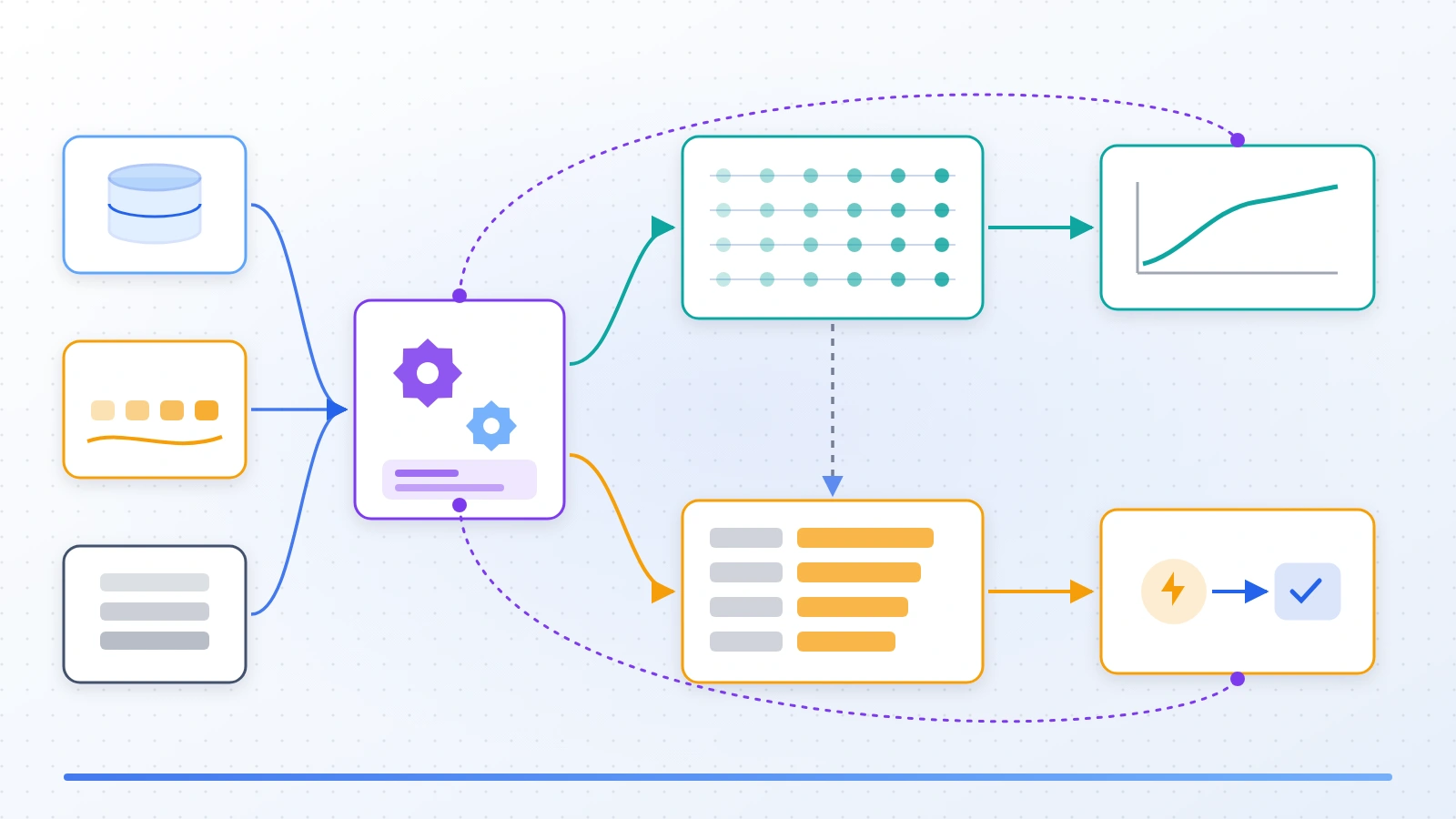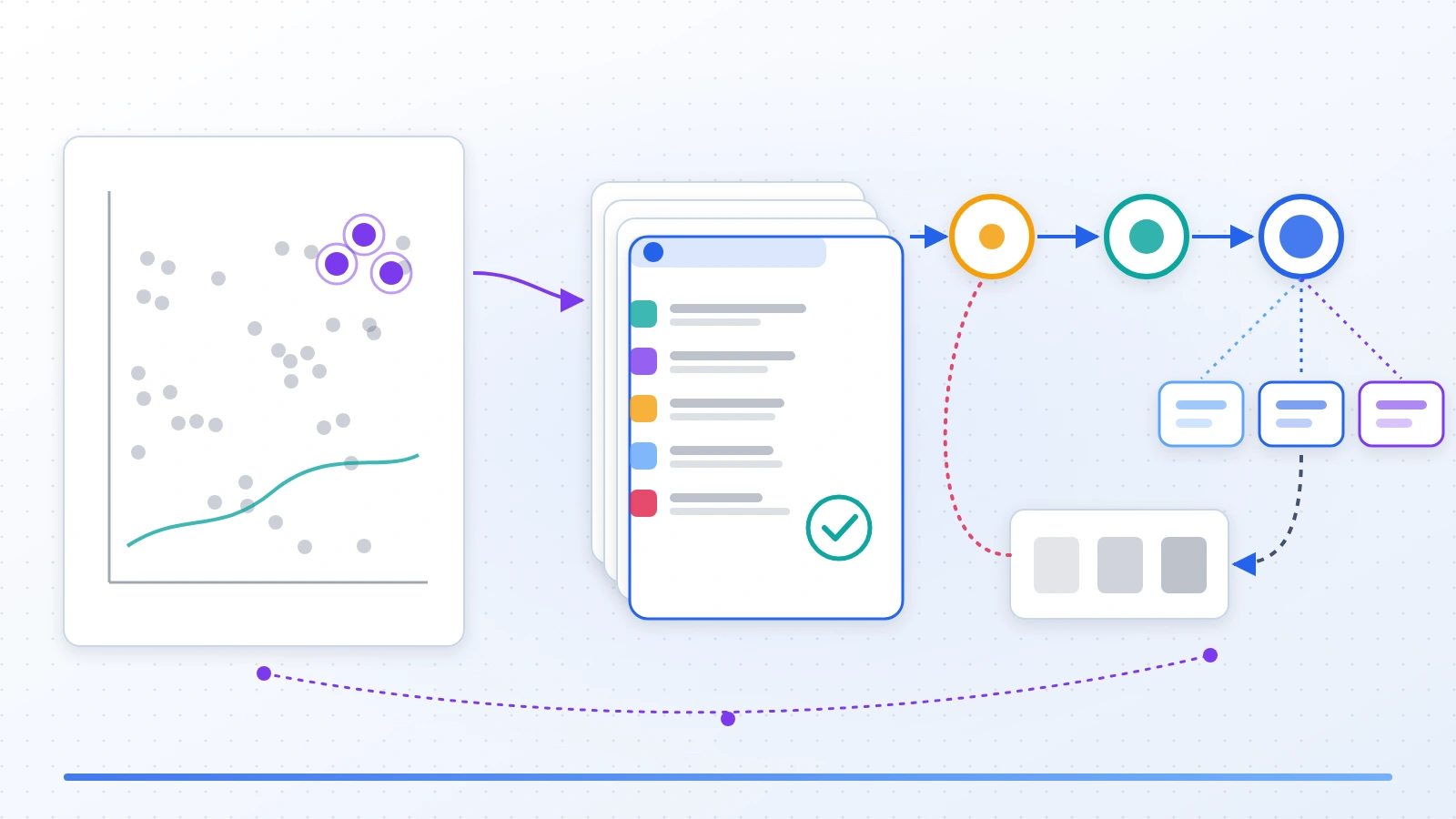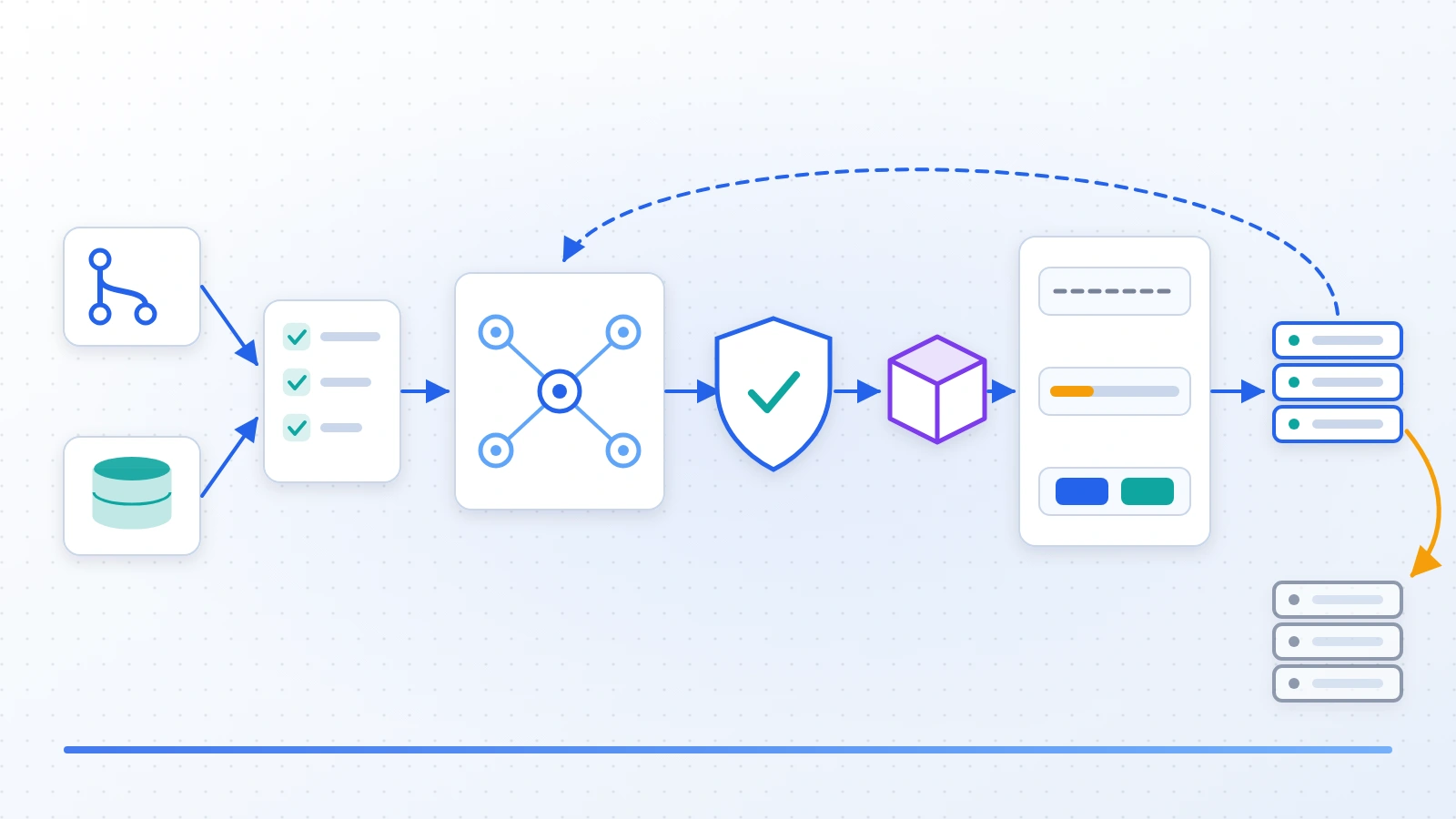
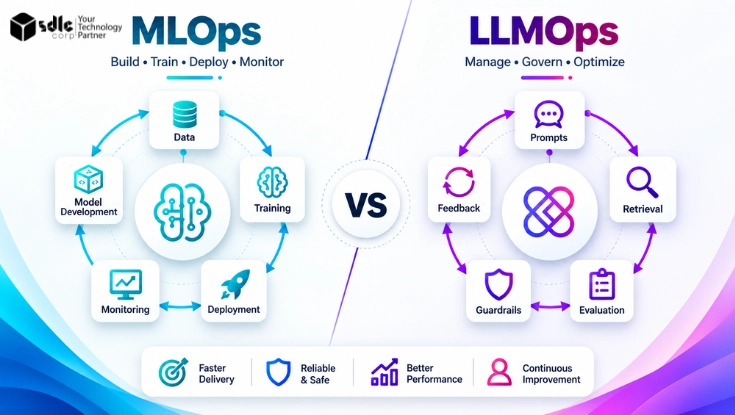
LLMOps extends the operational foundation of MLOps rather than replacing it. Both, in fact, run on the same spine: versioned artefacts, reproducible evaluation, controlled deployment, monitoring, incident response and accountable ownership.
What changes is everything an LLM application adds on top of that spine.
Use this comparison to decide which additional controls an AI system needs after the shared MLOps foundation is in place.
Key Takeaways
In short, MLOps manages training, deployment, monitoring, drift and retraining for predictive ML.
It also adds prompt, retrieval, evaluation, safety, provider, tool and token-cost controls.
LLMOps builds on the same deployment and governance foundations rather than replacing them.
Use MLOps for predictive models, and layer LLMOps controls onto generative AI, RAG and agentic applications.
What Is MLOps?
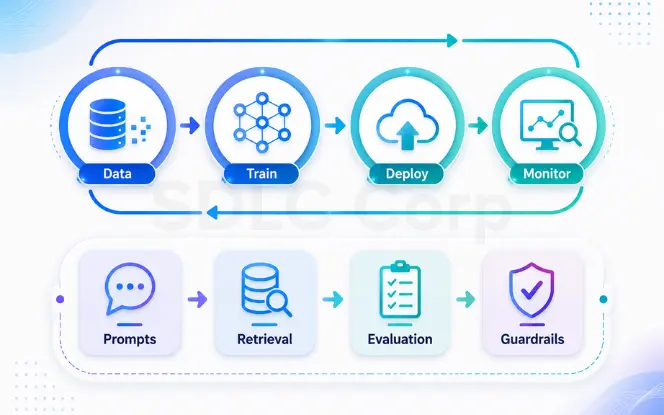
Operations boundary: This comparison explains the controls needed to operate predictive ML and LLM applications after they are live. It does not define pilot acceptance, user rollout, or production handover gates; those transition decisions belong in the production-readiness process.
In practice, MLOps manages the lifecycle for models that turn inputs into predictions. It also covers data checks, feature work, experiment tracking, training, holdout testing, and model registration. It also needs access control for data and artifacts.
Pipelines must be reproducible so a release can be rebuilt. Teams also need to trace a prediction back to its training data and code.
Deployment And Monitoring In MLOps
Operational MLOps emphasizes deployment patterns and prediction reliability. Teams select deployment types that match latency and throughput needs: batch scoring for offline analytics, online microservices for low-latency inference, or edge deployments for constrained devices.
The platform must support versioned rollouts, canary testing, and automated rollback when a model degrades or violates service-level targets tied to business metrics.
Finally, production MLOps needs monitoring and governance. In practice, track input drift, feature changes, prediction drift, latency, errors, and business KPIs. Link each signal to a runbook that states when to retrain, quarantine a model, or notify stakeholders.
Assign release ownership across data science, ML engineering, platform engineering, and the business.
Version datasets and features with lineage so models are reproducible.
Track experiments and register production-ready model artifacts.
Then use automated tests for data schema, feature ranges and model outputs.
Deploy with staged rollouts and rollback paths tied to metrics.
Monitor drift and tie alerts to runbooks and retraining workflows.
A practical baseline for the MLOps side of this comparison is Google Cloud's guidance on CI/CD/CT and production ML pipelines. Use it as a reference point when comparing what LLMOps adds rather than treating either term as pure branding.
What Is LLMOps?
First, a traditional model release is defined mainly by model weights and training data. An LLM release also includes prompt templates, retrieval documents or embeddings, provider endpoints, tool definitions and tokenization settings.
Any one of them can change what the application says to a user, so LLMOps treats each as a controlled production artifact with its own deployment, monitoring and incident path.
Teams building production AI systems should therefore assign an owner to every one of those artifacts.
Three consequences follow, each covered in its own section below. Generative output needs task-specific evaluation, grounding and safety checks rather than label-level correctness. Second, retrieval turns the content corpus into part of the release.
And because the model usually sits behind an external endpoint, provider behaviour and token spend become live operational signals.
Version prompt templates and parameter values as part of release records.
Similarly, treat retrieval indexes and content snapshots as deployable artifacts.
Test for hallucination, refusal consistency and safety across prompt variants.
Track provider version, latency and token usage as release-level signals.
Databricks and other platform vendors describe LLMOps in similar terms: the same delivery discipline, widened to cover prompts, retrieval and provider dependencies.
Because the prompt is now a release artifact, it helps to standardise on prompt engineering best practices before you start versioning them.
MLOps vs LLMOps: Key Differences
Compare the artifacts and controls that change by system type
The practical split is what each discipline actually ships. In short, MLOps ships trained weights. LLMOps mostly ships configuration and content, which is why testing, versioning and ownership all shift. So the table below sets the two side by side.
Where Governance Diverges
Governance is where the gap widens. LLMOps introduces risk vectors that predictive ML does not have: content leakage through retrieval, provider data-retention terms, and imperfect refusals on sensitive queries.
In addition, those sit alongside the access controls and audit trails both disciplines already need.
Side-By-Side Comparison Table
Dimension | MLOps | LLMOps |
|---|---|---|
Primary workload | Predictive ML: classification, regression, ranking. | Generative AI: assistants, copilots, RAG and agents. |
Main artifacts | Data, features and model weights. | Prompts, models, retrieval indexes and tool definitions. |
Versioning | Data, code and model binary. | Prompt, model, index, configuration and tools. |
Evaluation | Accuracy, F1, RMSE, AUC on labeled holdout sets. | Task quality, grounding, safety and structured human review. |
Monitoring | Drift, accuracy, latency and error rates. | Response quality, retrieval relevance, safety, latency and token cost. |
Optimization lever | Retraining on fresh or corrected data. | Prompt, retrieval, model or routing changes. |
Typical failure modes | Drift and gradual performance degradation. | Hallucination, poor retrieval, unsafe output and unexpected tool behaviour. |
Cost focus | Training compute and serving infrastructure. | Inference, token and provider API usage. |
Governance | Model and data lineage. | Prompt, output, retrieval and tool traceability. |
Best fit | Forecasting, fraud detection, scoring. | Copilots, RAG search, assistants and agentic workflows. |
Shared capabilities | Version control, CI/CD and release records, observability and production sampling, access control and approvals, rollback paths and incident runbooks. Cost allocation and ownership models apply to both. | |
MLOps owners: dataset versioning, feature pipelines, labeled evaluation sets and repeatable regression tests.
LLMOps owners: prompt and retrieval versioning, rubric/adversarial evaluation, and human review for valid output variation.
Enterprise responsibilities: identity, CI/CD, observability, incident management, plus content policies and contractual controls for external model providers.
What MLOps and LLMOps Have in Common
Both disciplines run on the same operating spine: versioned artifacts, automated tests, controlled deployment with rollback, observability, incident runbooks and named ownership.
That spine is what makes any change traceable, whether the system returns a prediction, generates language, retrieves a document or calls a tool.
The comparison gives architecture, procurement and risk teams a shared view of what must be operated centrally and what each product team owns.
Shared foundation | MLOps emphasis | LLMOps extension |
|---|---|---|
Versioned release artifacts | Training data, features, model binary, configuration. | Prompts, retrieval corpus and index, provider/model version, tool definitions. |
Automated evaluation | Performance, calibration, robustness, and drift checks. | Task evaluation, grounding, safety, prompt-injection, and tool-use checks. |
Production monitoring | Latency, errors, model performance, and data drift. | Latency, errors, quality, safety signals, retrieval quality, token cost, and provider behavior. |
Once the split is clear, the next task is designing release gates and rollback rules.
Both sides also need production evidence for whichever pattern the system follows.
What Actually Changes When You Move From MLOps to LLMOps?
The clearest way to see the difference is to put the two production lifecycles side by side. The stages rhyme, but the artifacts and the update lever are not the same.
MLOps lifecycle
Data
→Train
→Validate
→Register
→Deploy
→Monitor drift
→Retrain
LLMOps lifecycle
Prompt + model + retrieval + tools
→Evaluate
→Safety & grounding checks
→Deploy
→Monitor quality, retrieval & cost
→Update prompt / index / model / routing
→Roll back
In MLOps, the main lever is retraining, and it is slow, planned and tied to a dataset.
In LLMOps the lever is configuration. An edited prompt, a reindexed corpus, a different provider endpoint or a new routing rule can change behaviour in minutes, without a training run and often without a code deploy.
As a result, that speed is both the benefit and the risk of LLMOps.
In practice, it forces three practical changes. First, releases have to capture the whole runtime configuration, not just a model version. Evaluation has to run against open-ended output, so a regression suite and sampled human review replace a single accuracy number.
And rollback has to cover prompts and index snapshots, because reverting the model alone will not restore yesterday's behaviour.
Typical MLOps components
Data pipeline, feature store, experiment tracking, model registry, CI/CD, drift monitoring.
Typical LLMOps extensions
Prompt management, evaluation framework, vector database, RAG pipeline, model gateway, guardrails, token-cost monitoring, tool audit logs.
Why RAG Adds New LLMOps Requirements
Retrieval-augmented generation combines a retriever, an index of content, a reader or generator model, and optionally tool integrations.
Operational responsibilities include controlled ingestion pipelines, document chunking rules, metadata extraction, and index creation and refresh policies in whichever vector database backs the system.
Access controls and provenance metadata must travel with content so the system can surface why a source was returned and whether it is permissible for the request context.
Design retrieval evaluation metrics that go beyond recall. Relevance must be measured against business tasks: precision for factual answers, coverage for legal or compliance queries, and freshness for time-sensitive data.
Sampling production queries and calculating relevance using human judgments are necessary because automated metrics like cosine similarity do not capture semantic sufficiency for downstream tasks. Instrument the retriever to track source frequency, response confidence and unsupported-source indicators.
Index Rollback And Permissions
Meanwhile, two controls are specific to retrieval. Rollback has to reach the index: a chunking or ingestion change can shift behaviour while the model and prompts stay identical, so you need a prior snapshot to return to during an incident.
And permissions have to hold at query time, which means selective masking, redaction and tenant-aware indexing, including when outputs are sampled for evaluation.
Version content snapshots and index builds alongside model releases.
Instrument retrieval with source frequency, confidence and latency metrics.
Evaluate relevance with human-labeled samples tied to business tasks.
Apply provenance metadata and access controls to content chunks.
Enable index rollback to reproduce prior behavior during incidents.
For ingestion, chunking and index-refresh patterns, AWS's overview of retrieval-augmented generation is a useful reference alongside these operational controls.
Evaluation, Guardrails and Human Review
For that reason, evaluation for LLMs must be multi-layered. Automated checks can flag obvious failures: policy violations, unsafe content, hallucinations detected by classifiers, or divergence from expected formats. However, automated signals are imperfect.
For high-impact workflows, include structured human review with clear labeling schemas and escalation criteria. Human reviewers should annotate failure modes and feed those labels back into continuous evaluation and training data for corrective actions.
Guardrails limit inputs, outputs, and tool use. Add input cleaning, instruction filters, and clear refusal templates. Check tool calls against allowed capabilities and permissions.
Guardrails reduce risk, but they do not replace scope limits, user consent, or higher-assurance models for regulated work. Those decisions sit in a wider responsible AI development policy. Version guardrails and test for bypasses.
Evaluation is only useful if it feeds something. Instead, route the findings into a prioritised backlog: prompt edits, extra retrieval filtering, or labeled examples for fine-tuning.
Combine automated classifiers with structured human review for high-risk outputs.
Version guardrails and test them against adversarial prompt suites.
Require human approval gates for regulated or safety-critical tasks.
Feed reviewer labels into prioritised remediation and retraining backlogs.
Measure reviewer agreement and time-to-decision as operational KPIs.
Guardrails reduce operational risk, but they must be versioned, tested and paired with human review for high-impact tasks. The NIST AI Risk Management Framework is a practical reference for mapping these controls to documented risk and governance functions.
Monitoring Quality, Reliability and Cost
Tying Signals To Business Outcomes
Above all, monitoring in mixed MLOps/LLMOps environments must map technical signals to business outcomes. Track availability, latency, error rates and model confidence as basic SRE metrics.
Add LLM-specific signals such as token consumption per request, provider latency variance, refusal frequency, hallucination indicators and retrieval relevance scores. Correlate these metrics with business KPIs like customer satisfaction, throughput or compliance incidents to prioritize remediation.
Cost behaves differently here because pricing follows input and output tokens, provider rates and request volume rather than a fixed serving footprint.
Take a customer-support workflow: simple intent classification and short FAQ answers go to a smaller model, while escalations and multi-turn troubleshooting reserve the larger one.
LLMOps tracks the quality, latency and cost of each route, so the team can move traffic between them without losing control of the release. Track cost by route, tenant or workflow, and cache answers for repeat questions.
Design alarms and automation for common failure modes but include human-in-the-loop escalation for ambiguous cases.
Example automations: temporarily route to a fallback model when latency spikes, throttle requests when token spend exceeds a budget, or quarantine a model when hallucination rate exceeds a threshold.
Maintain playbooks that describe when to rollback prompts, reindex content, or switch provider endpoints to resolve incidents quickly.
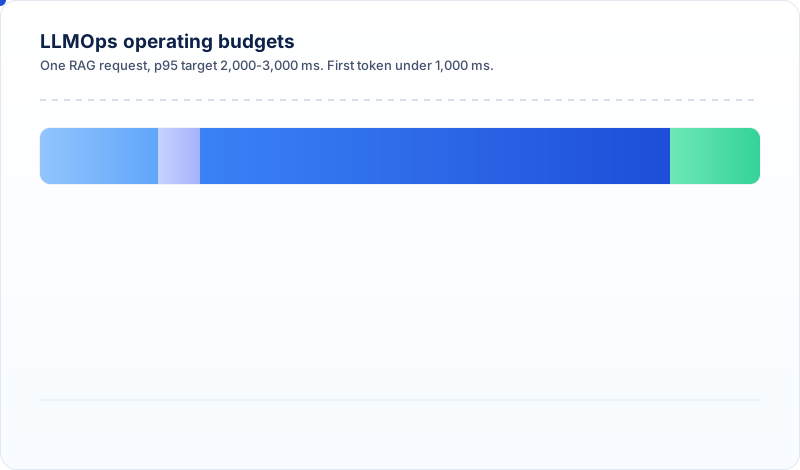
What To Watch In Production
Correlate technical signals with business KPIs to prioritize incidents.
Track token usage and cost per completed task for routing decisions.
Implement automated routing based on cost, latency and assurance needs.
Alarm on retrieval relevance drops, hallucination rate increases and provider SLA breaches.
Maintain playbooks for rolling back prompts, indices or provider endpoints.
When to Use MLOps, LLMOps, or Both
Start from what you are building, then add only the controls that system actually needs.
Forecasting, fraud or classification? MLOps is enough.
Chatbot, copilot or summarisation? MLOps foundation plus LLMOps controls.
RAG application? Add retrieval evaluation and index versioning.
Agentic AI using tools? Add tool permissions, action logging and approval gates.
System type | Primary operating pattern | Additional controls |
|---|---|---|
Predictive ML model | MLOps | Versioned training data, reproducible training, model registry, deployment pipeline, drift/performance monitoring, retraining triggers. |
LLM application without retrieval | MLOps foundation + LLMOps controls | Prompt/version management, evaluation sets, safety tests, provider/version tracking, token and latency monitoring. |
RAG application | MLOps foundation + LLMOps controls | Retrieval evaluation, corpus/index versioning, permission-aware retrieval, grounding tests, citation/attribution checks. |
Agentic workflow with tools | MLOps foundation + LLMOps controls | Tool allowlists, action permissions, state/audit logging, human approval for high-impact actions, rollback or compensating workflows. |
Add LLM-specific controls only where the application actually introduces prompts, retrieval, provider dependency, open-ended output or tool use. However, anything that stays purely predictive does not need them.
Conclusion
LLMOps vs MLOps is not a choice between two competing platforms. MLOps gives you the operating spine every production model needs: versioned artifacts, controlled deployment, monitoring and clear ownership.
LLMOps keeps that spine and widens it to cover the parts of a generative system that actually change behaviour in production, including prompts, retrieval indexes, provider endpoints, guardrails, tools and token cost.
In short, the practical test is simple. If the system returns a prediction, MLOps is enough. If it generates language, retrieves documents or calls tools, add the LLM-specific controls that match the risk, and no more than that.
Start by versioning prompts and index snapshots, add evaluation for open-ended output, and instrument quality, retrieval and cost together so route changes stay under release control.
If you are deciding where those controls belong in your own delivery process, the SDLC Corp AI engineering team can help you move models and LLM applications into controlled production operations.
Frequently Asked Questions
MLOps manages the lifecycle of conventional ML models: data pipelines, training, deployment and prediction monitoring. LLMOps extends that lifecycle to include prompt versioning, retrieval indexes, provider endpoints, tool integrations and response-level evaluation.
The key difference is that LLMOps treats configuration and content artifacts as first-class release components.
No. LLMOps extends many shared MLOps practices. Enterprises should keep a common operational foundation-CI/CD, registries, observability and governance-and layer LLM-specific controls such as prompt tracking, index versioning and token-cost telemetry where required.
Version models, prompt templates and parameter sets, retrieval index snapshots and ingestion pipelines, tool connectors and guardrail rule sets, plus evaluation datasets and release records. Treat the complete runtime configuration as the deployable artifact for reproducibility and incident investigation.
Monitor content freshness, retrieval relevance and source coverage, along with producer-side signals like index build durations and query latency. Track unsupported answers and provenance, and sample production outputs for human relevance judgments.
Correlate retrieval metrics with downstream business KPIs to prioritize remediation.
Yes. A single platform can supply identity, secrets, CI/CD, registries, logging and cost telemetry for both. Provide specialized evaluation paths and registries for LLM artifacts while keeping core primitives centralized.
Clear ownership and release records make a unified platform practical for most enterprises.
Adopt LLMOps controls once language-model components influence production behavior or carry business risk: repeated hallucinations, regulatory exposure, unpredictable provider changes, or material token cost. Start by versioning prompts and indices and adding human-in-the-loop evaluation for high-impact outputs.