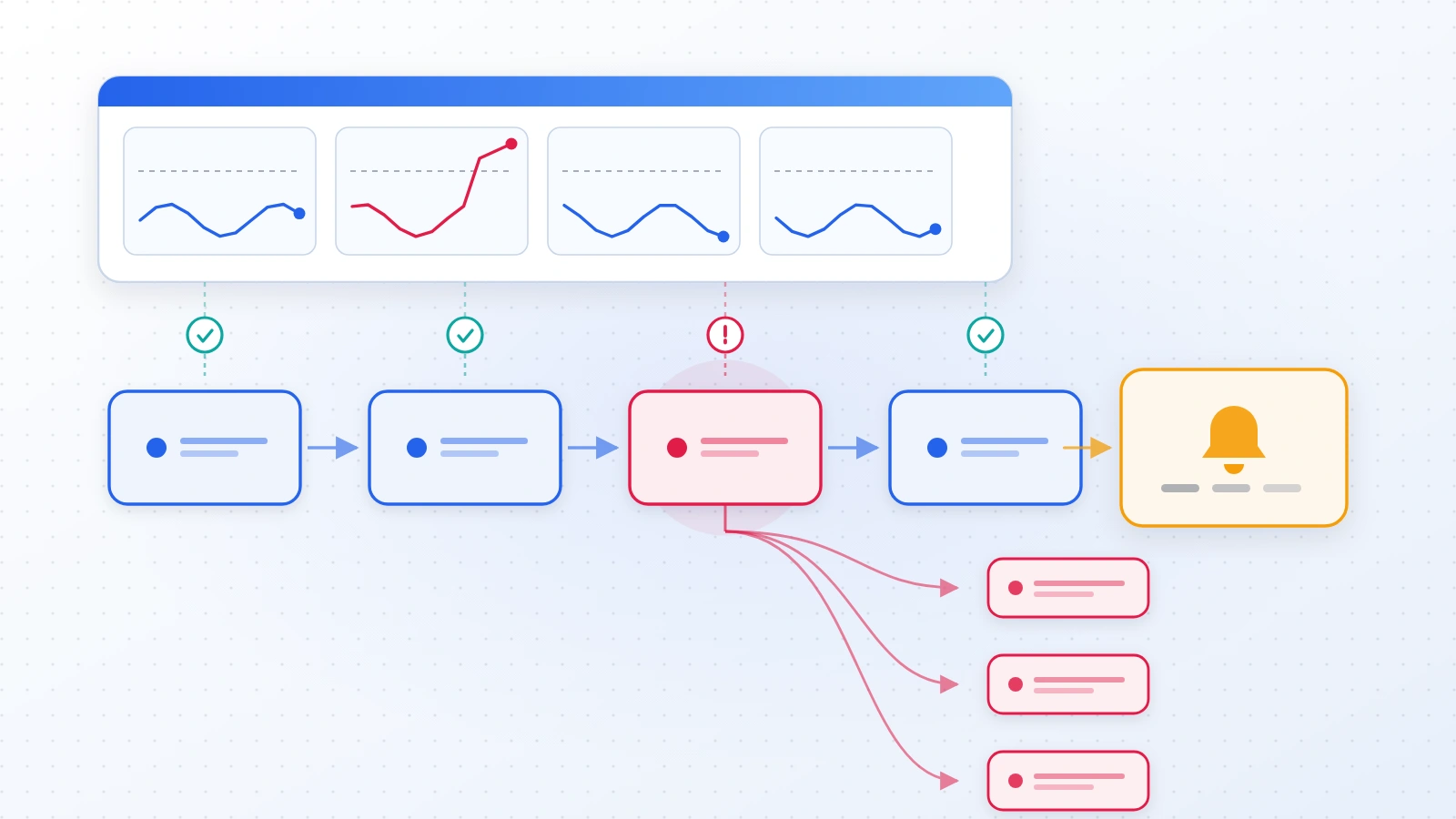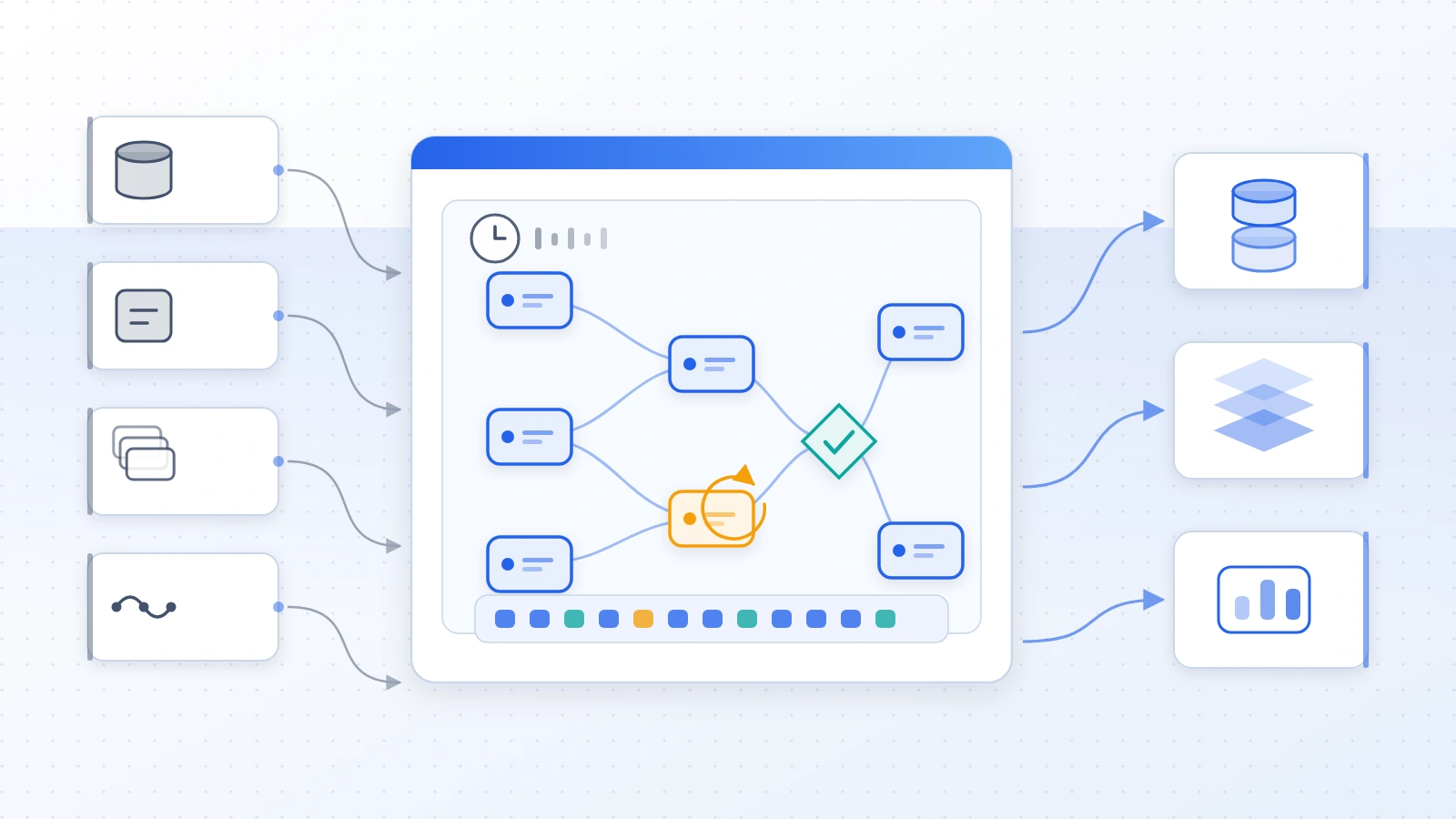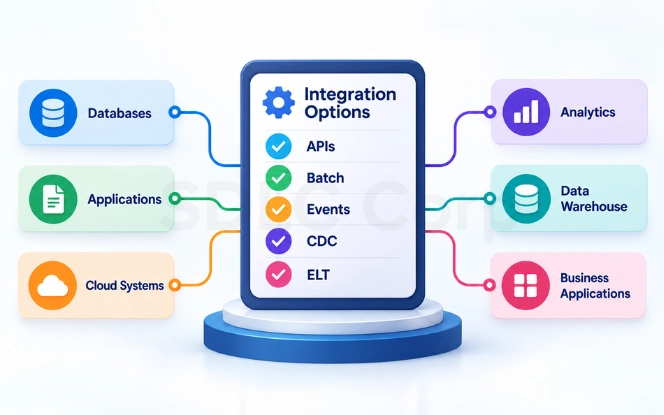

Enterprise data and AI projects fail to deliver when new models and pipelines are deployed but people keep making the same decisions the old way. Change management for data and AI transformation must center on the specific decisions, workflows and accountabilities that will change, not on activity metrics. This guidance frames adoption as a managed workstream that links technical delivery to daily operational choices.
Change management for data and AI transformation works when it is scoped as a list of decisions that will change hands, not as a communication campaign. Name the decision, the owner, the timing, the control rule and the behavioural signal that proves the workflow moved.
- What you will decide How to prepare people, processes and decision rights so data and AI capabilities are adopted in daily work.
- Why it matters An adoption-led approach focused on changed decisions and workflows rather than generic communication and training activities.
Start by defining the decision and workflow changes the program must cause. List the decisions that will use new data products or AI recommendations, the task handoffs that change, and who will own exceptions and controls.
This approach forces the team to design role changes, interfaces and measurements tied to adoption, rather than relying on broad communications or training completion as proof of value.
Structure the plan around four practical deliverables: a change definition that lists changed decisions and controls, a stakeholder map that separates sponsors and frontline users, a capability plan that redesigns roles and skills, and an adoption journey with measures that show behavioural change.
Integrate these deliverables into sprint plans and go live checklists so adoption activity is visible to sponsors and product teams.
Transformation Succeeds When Daily Decisions And Workflows Change
Define success in terms of changed decisions and outcomes, not system uptime or model performance alone. A sales forecasting model succeeds when regional planners change reorder thresholds according to new forecasts, not when the model hit rate is high.
The original Standish Group CHAOS report found that only 16.2% of surveyed software projects were completed on time and within budget. Meanwhile, 31.1% were cancelled, while 52.7% were challenged by cost, time or scope problems. The report ranked user involvement, executive management support and a clear requirements statement as the three leading success factors. Although the figures are historical, the lesson remains relevant: transformation outcomes depend on sponsorship, user adoption and clear operational requirements, not technology delivery alone.
Translate technical metrics into the concrete operational choices the model is intended to influence, and include those choice gates in acceptance criteria.
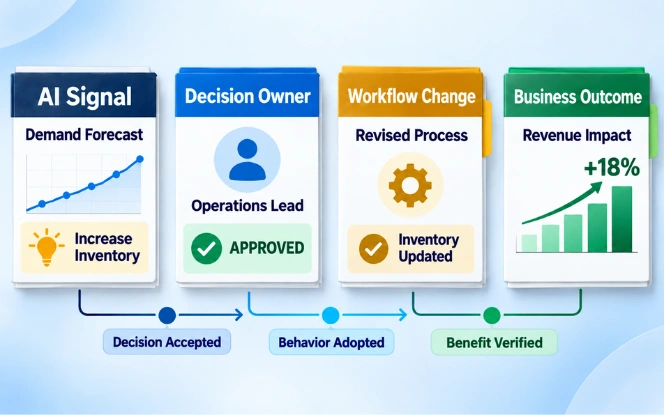
Embed adoption checkpoints into the delivery cadence. During design sprints, require a documented decision map that shows who will act on model outputs, when the decision happens, what control rules apply, and the expected operational impact.
Treat these maps as acceptance artifacts for each release so product teams and stakeholders validate that the feature enables a specific workflow change.
Make benefits realization a joint obligation of product owners and business sponsors. Create a short benefits statement per capability that identifies the changed decision, the expected behaviour, and the leading indicators to track in the first 90 days.
That alignment prevents teams from substituting generic change activities for the work needed to shift day to day operations.
- Define one or two target decisions per capability with clear owners and decision cadence.
- Convert engineering acceptance criteria into behaviour change checkpoints.
- Require a one line benefits statement that links output to an operational choice.
- Put adoption milestones on the program roadmap and sprint review agendas.
Measure deployments by whether they change how work gets done, not by deployment velocity alone.
For the team design and operating routines that make this approach sustainable, review enterprise AI operating model.
For the upstream explanation of why data constraints change AI outcomes in the first place, use how data modernization enables enterprise AI.
Define The Specific Changes People Must Make
Create a change definition for each capability that lists the existing task, the new task, the actor, the timing, the inputs and the outputs. Include handoffs and exception paths so teams can see where controls and approvals move.
Use the definition to scope integration needs, user interfaces and which SLAs change as a result of the new workflow.
Document control changes explicitly. For data and AI features, note where human review is required, what thresholds trigger escalation, and where overrides are allowed.
This reduces ambiguity about the role of automation in decision making and prevents teams from assuming full automation where governance or risk policies require human-in-loop checks.
Workflow Changes By Role And Acceptance Checkpoint
| Current state | New workflow | Owner | Frequency | Acceptance checkpoint |
|---|---|---|---|---|
| Manual reorder review | AI recommends reorder threshold; buyer approves | Procurement buyer | Daily | 90% of suggestions accepted or adjusted within SLA |
| Initial claims triage by junior adjuster | AI triage recommends severity and routing; adjuster reviews | Claims adjuster | Per claim on intake | Override rate 10% or lower after pilot, with every override documented and resolved inside 24 hours |
| Credit decision by analyst | Automated pre-score; analyst reviews marginal cases | Credit analyst | Real-time at application | False-positive rate below 5% in pilot |
| Invoice matching by AP clerk | AI auto-match with manual review for exceptions | AP clerk | Daily batch | Match rate above 85% before rollout |
| Customer outreach lists built manually | AI segments and suggests the campaign | Marketing ops | Weekly | A/B test lift at or above target |
| Data quality fixes by data steward | Automated alerts; steward approves fixes | Data steward | On anomaly detection | False-fix rate below 2% in pilot |
Workflow Data Inputs And Outputs
| Workflow | Inputs | Outputs |
|---|---|---|
| Manual reorder review | Stock levels, lead time, demand forecast | Suggested reorder qty |
| Initial claims triage by junior adjuster | Claim data, photos, policy rules | Severity label, recommended owner |
| Credit decision by analyst | Income, bureau score, AI score | Pre-approval, reject, or manual review flag |
| Invoice matching by AP clerk | PO, invoice PDF, GRN | Matched set or exception ticket |
| Customer outreach lists built manually | CRM data, engagement, AI model output | Segment list, expected uplift |
| Data quality fixes by data steward | Source records, anomaly report | Corrected record or rollback ticket |
Controls, exceptions and training per workflow
Exception Handling, Escalation And Training
| Workflow | Exception handling | Escalation | Training |
|---|---|---|---|
| Manual reorder review | If AI confidence is below 60%, route to the manual queue. | Category manager | Using the UI, interpreting confidence and adjusting quantity |
| Initial claims triage by junior adjuster | If the recommended owner is unavailable, route to manual routing. | Confidence below 50% or conflicting evidence goes to the triage team lead | Accepting or overriding with a documented reason, interpreting AI severity drivers, and using the UI to route exceptions |
| Credit decision by analyst | If signals conflict, route to the manual review queue. | Credit manager | Interpreting score drivers and documenting the decision |
| Invoice matching by AP clerk | If the match score falls below the threshold, raise an exception. | AP supervisor | Handling the exception workflow in the UI |
| Customer outreach lists built manually | If segments overlap, route to merge rules. | Campaign manager | Validating segments and setting guardrails |
| Data quality fixes by data steward | If a fix affects downstream systems, route to change freeze. | Data governance lead | Validating and approving automated fixes |
Use the change definition to size training and support. When a role gains a new task or new data inputs, specify the exact skills and process steps they must perform.
That creates a prioritized, role-based curriculum and clarifies which job descriptions and performance goals need adjustments before go live.
Define each workflow change by its current state, new workflow, owner, frequency, and expected outcome.
- Flag required human reviews, escalation thresholds and override rules.
- Map data inputs and outputs to the precise UI or API the user will interact with.
- Identify updates needed to job descriptions and performance objectives.
A precise change definition converts abstract benefits into actionable work changes.
For partner-evaluation criteria that match this scope, review choose a data and AI modernization partner.
Map Stakeholders By Impact And Influence
Build a stakeholder map that separates sponsors, owners, primary users, risk and compliance teams, and support functions. For each group record influence, impact, required decisions, and the daily tasks that will change.
This map should drive engagement cadence, from weekly sponsor reviews to hands-on workshops for frontline users, and determine who must sign operational readiness documents.
Prioritize mapping for stakeholders who control data, process exceptions, or customer-facing interactions. Include IT operations, security, legal, and data stewardship early, since their later involvement commonly causes release delays.
Use the map to negotiate cutover responsibilities and to allocate any post-deployment support windows.
Visualize the stakeholder map as a simple quadrant or swimlane diagram used at steering meetings. Keep it current and attach it to the capability plan so new team members quickly see who must be engaged for approvals.
That visualization should also show who will adopt the outputs and where escalation routes live.
- Classify stakeholders as sponsor, owner, user, risk reviewer or support function.
- Record influence and impact scores to focus engagement effort.
- Assign communication cadence per stakeholder group and decision authority.
- Include IT, security and data stewardship before final acceptance testing.
Stakeholder maps reduce late surprises by clarifying who must approve, act and support each change.
Build Visible Sponsorship And Decision Ownership
Sponsorship must be active and visible. Sponsors need to clear cross-functional tradeoffs, arbitrate prioritization when models surface conflicts, and signal that changed decisions are expected.
Kotter's change framework provides a useful structure for this sponsorship work. Build a guiding coalition across business, data, technology, risk and operations. Then communicate a clear change vision, remove workflow barriers, create short-term wins during pilots and anchor the new decision practices in management reviews. This approach turns executive support into observable actions instead of occasional messages.
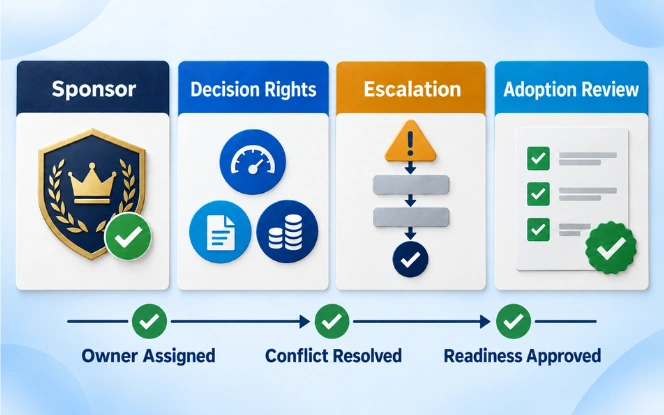
Define sponsor behaviours such as monthly operational reviews, escalation timelines for unresolved exceptions, and visible reinforcement when teams follow new workflows.
Tie sponsor commitments to decision rights and escalation paths. Document which sponsor can approve changes to thresholds, which executive handles conflicts between revenue and risk objectives, and how urgent fixes are funded.
This reduces informal bypasses that undermine controls and gives teams a clear route to resolve disputes quickly during early adoption.
Make sponsors accountable for adoption indicators, not only for project milestones. Require a sponsorship checklist before go live that covers readiness of decision owners, role redesign, support coverage, and a benefits baseline.
That keeps sponsors focused on whether the organization will actually use the capability rather than only whether it is delivered on time.
- Define sponsor behaviours: reviews, escalations and public reinforcement.
- Map decision rights for threshold changes, exceptions and funding.
- Require a sponsor sign off on operational readiness and adoption indicators.
- Schedule regular sponsor-led reviews of early usage and overrides.
Recommended Change Adoption Timeline
Use the following ranges to plan sponsorship, training, piloting and reinforcement. Increase the cadence for high-risk AI decisions, large user groups or workflows with frequent exceptions.
| Activity | Recommended timeline | Suggested cadence |
|---|---|---|
| Executive sponsorship | Entire program lifecycle | Biweekly during design and weekly during rollout |
| Sponsor steering review | Discovery through stabilization | Every two to four weeks |
| Stakeholder engagement | Start eight to twelve weeks before launch | Weekly or biweekly |
| Role-based training | Begin three to four weeks before launch | Two or three sessions per role |
| Guided practice | Two to three weeks before launch | Weekly scenario-based exercises |
| Adoption pilot | 60 to 90 days | Weekly adoption and exception review |
| Go-live hypercare | First two to four weeks | Daily triage during the first week |
| Benefits review | After sufficient operating data exists | At 30, 60 and 90 days |
A 60-to-90-day pilot usually provides enough time to measure usage, overrides, decision speed and operational outcomes before a wider rollout. Treat these figures as planning ranges rather than fixed rules.
Visible sponsors who own adoption reduce the chance of delivered features sitting unused.
Redesign Roles, Skills And Ways Of Working
Translate the change definition into role impact statements. For each role, list new responsibilities, removed tasks, and new interfaces to teammates or systems.
Use the Prosci ADKAR model to plan individual adoption. Build Awareness of why the workflow must change, create Desire by showing the role-level benefit, provide Knowledge through task-based learning, develop Ability through guided practice, and sustain Reinforcement with coaching and adoption measures. Track each stage by role because sponsors, managers, analysts and frontline users may face different barriers.
Worked example: claims adjuster
The adjuster is required to accept or override an AI triage recommendation within one business day, record a reason for every override, and hand appeals to the triage team lead. The role impact statement names that task, the one day window, and the appeal owner.
Design capability plans that bundle role changes, learning objectives and cross-team handoffs. Specify how many people per role require new onboarding, what practice sessions they need, and the on-the-job aids that will support them for the first 60 to 90 days.
This ensures training is targeted at real tasks rather than abstract concepts about models or data.
Adjust performance objectives and staffing plans to reflect changed workflows. Where automation reduces routine work, reassign capacity to higher value tasks and update KPIs to reflect decision quality and exception handling.
Ensure HR or line managers are part of the capability plan so promotions, job descriptions and resource allocations align with the new operating model.
- Produce role impact statements with concrete examples of new tasks.
- Create a capability plan that links training, practice and on-the-job aids.
- Update performance goals to emphasize decision quality and exception handling.
- Coordinate with HR and line managers for job redesign and staffing changes.
Redesigning roles before go live prevents workload gaps and preserves accountability.
Prepare Workflows, Controls And Support
Document how AI outputs and data products enter existing workflows. Create end to end flow diagrams showing touchpoints, data handoffs, timing constraints and failure modes.
For customer-facing changes, map the customer experience impact so teams can validate that the new workflow preserves service levels and legal or risk obligations.
Plan operational controls and monitoring that match the level of risk. Define quality gates, sampling rates for human review, and metrics for drift detection.
Specify who will receive alerts, how incidents are triaged, and the runbooks for reverting to manual processes. Clear controls make teams more comfortable adopting automated recommendations.
Stand up support models that cover the initial adoption window, including a hypercare period with dedicated SME rotations, a prioritization process for bug fixes or model retraining, and a feedback loop that captures frontline issues for the roadmap.
Ensure the support model is included in the release budget and staffed by people who understand the decision context, not just the code base.
- Map the end to end workflowRecord timing, handoffs and customer impacts for every touchpoint the new output passes through.
- Set the control pointsSpecify quality gates, sampling rules and who owns drift detection for each model in scope.
- Write the runbooksDocument incident triage and the manual fallback path so teams can revert without improvising.
- Staff the hypercare windowDefine an SME roster, escalation rules and the funding that covers the first adoption period.
Operational controls and staffed support lower the risk of adoption stalls and rollback.
For an external governance baseline on lifecycle controls, accountability, and operational review, use the NIST AI Risk Management Framework and its Govern-Map-Measure-Manage core.
Design Communication And Learning Around Real Tasks
Build communications and learning around the specific tasks people will perform with new data and AI outputs. Role-based quick guides, checklist templates, and scenario-based workshops are more effective than broad model overviews.
Train planners on how to interpret confidence bands in a forecast and how to adjust reorder decisions, not on the model architecture.
Use guided practice and real data in training. Create sandboxes or safe-mode workflows where people can practice decisions with historical examples and see the downstream effects.
Include decision support tools such as inline contextual help, example explanations, and easy override recording so users learn by doing while keeping audit trails for quality review.
Plan learning reinforcement with short, measurable practice goals. Replace completion certificates with behavioural milestones like proportion of decisions using the new input, time to first override, or documented use of new checklists.
Tie these milestones to coaching sessions and manager reviews so learning carries into daily performance conversations.
- Develop role-specific quick guides and checklist templates for real tasks.
- Use sandboxes with historical cases for guided practice and safe testing.
- Provide inline contextual help and explainable recommendations where needed.
- Measure learning by behavioural milestones, not course completion.
Design learning that mirrors the actual decisions and exceptions users will face.
Measure Adoption And Reinforce The Change
Select adoption metrics that reflect behaviour and outcomes. Leading indicators include usage of the data product at decision time, rate of manual overrides, time to decision, and process completion rates.
Tie these indicators to the specific decisions defined earlier so stakeholders can see whether workflows actually changed.
Instrument the product and workflow to capture these signals. Add lightweight telemetry that records when recommendations are shown, whether they were accepted, the override reason, and any downstream corrections.
Protect privacy and avoid invasive logging, but ensure enough context exists to analyze why users override and where model outputs cause confusion.
Use reinforcement tactics that link data to action. Publish short, focused adoption dashboards for sponsors and owners.
During early adoption, teams may use weekly exception reviews and targeted coaching for users with high override rates. Adjust the cadence to rollout risk, user volume, and exception rate, and reward good decision practices through manager recognition.
- Define adoption metrics tied to targeted decisions and outcomes.
- Instrument UI and APIs to capture acceptance, overrides and reasons.
- Use an exception-review cadence that fits rollout risk, user volume, and exception rate, then feed findings into the backlog.
- Share adoption dashboards with sponsors and line managers.
Adoption measures must be behavioural and actionable, not activity proxies.
Frequently Asked Questions
Start with a change definition that lists the specific decisions, tasks, handoffs, owners and controls that will change. This artifact converts abstract goals into operational work and drives role redesign, training scope and acceptance criteria.
Sponsors should own adoption indicators and participate in regular reviews that examine early usage, overrides and exceptions. They must clear cross-functional tradeoffs, fund hypercare, and publicly reinforce new decision behaviours so teams prioritize adoption.
Training completion shows exposure but not behaviour change. Valid adoption measures are behavioural signals such as percent of decisions using the new input, override rates, time to decision, and process completion rates tied to the defined decision change.
Build trust through paired decisioning, transparent performance reporting, explainable outputs, and clear failure cases. Use sandboxes and guided practice so users can validate recommendations with real examples before relying on them in production.
Run a 90 day pilot focused on one high-impact decision. Include the change definition, a stakeholder map, role-based training, hypercare support, and specific behavioural metrics. Use pilot results to adjust controls and scale with validated practices.