Introduction
Enterprise AI is moving from pilots to core operations, but many teams struggle to scale because initiatives are not tied to clear KPIs. When data stays fragmented or governance arrives late, delivery slows and risk increases. This guide outlines a practical roadmap that connects use cases, guardrails, and ROI measurement from day one. For teams operating in regulated environments, use Bias Mitigation in AI to strengthen evaluation and reduce rollout risk.
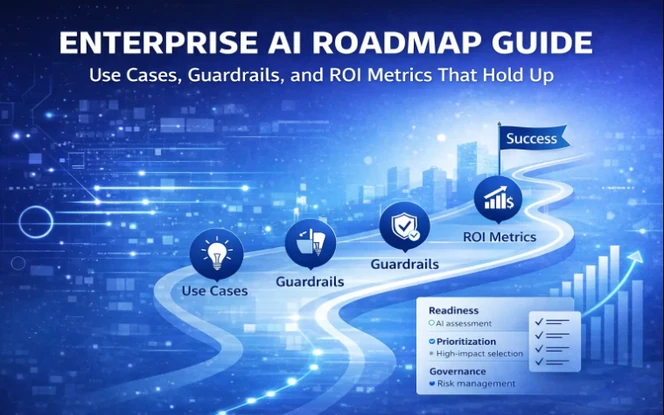
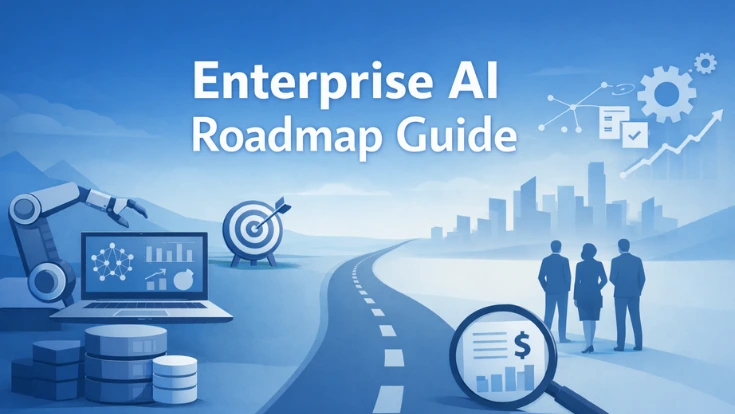
An enterprise AI roadmap is a structured plan for adopting, governing, and scaling AI across business functions. It explains what to build, why it matters, which foundations are required, and how success will be measured.
In simple terms, the roadmap turns scattered AI activity into an accountable business program.
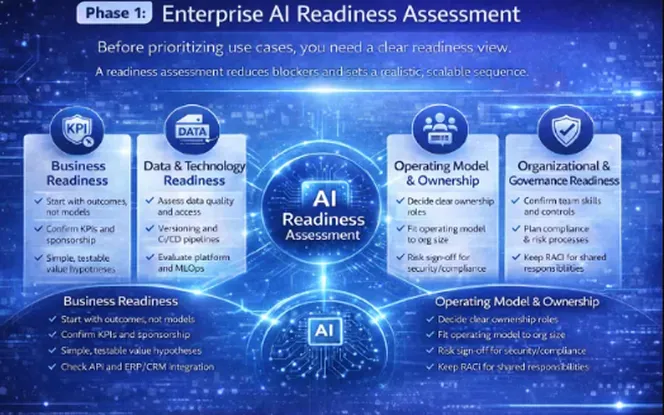
Phase 1: Enterprise AI Readiness Assessment
Before prioritizing use cases or selecting tools, build a clear view of enterprise readiness. Without this step, teams may commit to work that cannot move into production.
A readiness assessment reveals blockers before delivery begins. It also helps leaders choose the right sequence so early wins remain realistic and scalable.
Business readiness
Start with outcomes, not models. Confirm the business objectives AI should improve, then translate them into a small KPI set leaders will review (cycle time, cost per transaction, forecast accuracy, churn, fraud loss). Confirm sponsorship and decision flow. Define who owns the KPI, who funds the work, and who approves scope changes, then document simple, testable value hypotheses tied to cost reduction, revenue uplift, or risk reduction.
Data and technology readiness
AI performance depends on data. Assess data quality, access, governance, and lineage early. If key datasets stay incomplete or inconsistent, most use cases will fail in production.
Also review platform maturity and MLOps/LLMOps readiness:
Versioning
CI/CD
Evaluation pipelines
Monitoring
Incident response
Finally, check integration constraints. Validate APIs, identity and access, latency, and logging across ERP, CRM, and workflow tools.
Operating model and ownership
Enterprise AI needs clear ownership. Decide who owns:
Use case ownership (business or product team)
Data product ownership (data engineering team)
Model and prompt ownership (AI or ML team)
Risk sign-off (security and compliance teams)
Choose an operating model that fits your org. Centralized teams often move faster early, while federated models scale better later with shared standards and shared tooling.
Keep RACI simple:
Responsible: builds and runs the system
Accountable: owns the KPI and outcome
Consulted: risk, security, legal, finance
Informed: impacted teams and leaders
Organizational and governance readiness
Readiness includes people and controls. Confirm skills across data engineering, ML engineering, product, domain SMEs, and platform teams. If gaps exist, plan training, hiring, or partner support. Next, confirm how compliance and risk processes apply to AI (review gates, privacy checks, audit logging). Finally, plan safe operations after launch with monitoring, audits, incident response, and controlled updates as models drift and usage changes.
For a practical view of AI ownership and governance, read Shadow AI risks and solutions for businesses.
Enterprise AI readiness checklist
| Area | What “Ready” Looks Like |
|---|---|
| Business & KPIs | Clear goals with an accountable KPI owner |
| Leadership & funding | Executive sponsor and predictable approvals |
| Data readiness | Accessible, reliable data with clear ownership |
| Governance & access | Policies, permissions, and audit logs in place |
| Platform & MLOps | Scalable platform with deployment and monitoring |
| Integration | ERP/CRM/workflows connected via APIs |
| Ownership & skills | Defined RACI and teams to build and run |
| Monitoring & change | Runbooks for drift, incidents, and updates |
Know about: Generative AI for marketing
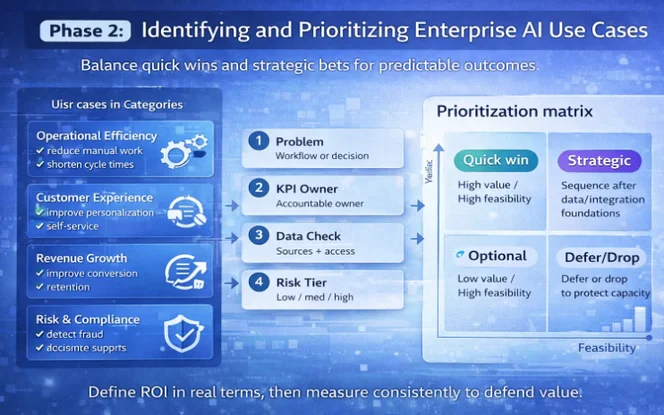
Phase 2: Identifying and Prioritizing Enterprise AI Use Cases
Use case categories
Most enterprise AI use cases fall into five buckets:- Operational efficiency: reduce manual work, shorten cycle times, improve throughput
- Customer experience: improve response quality, personalization, self-service resolution
- Revenue growth: improve conversion, pricing, cross-sell, retention, sales productivity
- Risk and compliance: detect fraud, reduce errors, automate controls, strengthen monitoring
- Decision intelligence: improve forecasting, planning, and decision support
Use case intake framework
A clean intake process keeps the portfolio grounded. Start with the problem and the KPI. Then validate data and risk early, before anyone estimates timelines. Use these rules:- Business problem first: define the workflow or decision that needs improvement
- KPI ownership: name the owner who will accept the target and track results
- Data availability early: confirm sources, freshness, and access
- Risk classification early: identify regulated decisions, sensitive data, or customer-facing outputs
Use case intake template
Use this template to lock scope before build starts. Begin with the business objective (what outcome should improve) and a short use case summary (what AI will do in plain language). Then define success: set one primary KPI, name the KPI owner (who signs off), and confirm the workflow location (CRM, ERP, support, ops, finance).
Next, capture delivery inputs:
AI type: GenAI, predictive ML, anomaly detection, optimization
Data sources: systems and datasets required
Data readiness: access, quality, lineage, latency (high / medium / low)
Integration needs: APIs, event streams, permissions, logging
Finally, document risk and planning so teams can ship safely:
Risk tier: low / medium / high (with reason)
Constraints: compliance, privacy, security, explainability
Expected impact: cost saved, revenue uplift, risk reduced (estimate)
Time-to-first-value: when a usable version can ship
Prioritization model
After intake, score each use case across value, feasibility, and risk. This keeps prioritization consistent and makes trade-offs easier to explain. Value measures the expected effect on KPIs and financial results. Feasibility covers data readiness, integration complexity, team capacity, and delivery time. Risk includes compliance exposure, customer harm, reputational impact, and audit requirements.
Use the scores to shape the portfolio. Prioritize quick wins when value and feasibility are high and risk is low or moderate. Fund strategic investments when value is high but delivery needs stronger foundations or governance. Defer ideas with low value, no KPI owner, poor data, or risks that cannot be controlled.
For a governance baseline that supports consistent scoring, read our Responsible AI Development guide.
| Use case | Value (1–5) | Feasibility (1–5) | Risk (1–5) | Priority | Notes |
|---|---|---|---|---|---|
| Support deflection | 4 | 4 | 2 | Quick win | Strong KPI + easier integration |
| Credit decisioning | 5 | 3 | 5 | Strategic | High governance and audit needs |
| Demand forecasting upgrade | 4 | 3 | 3 | Strategic | Needs data unification first |
When you run this process consistently, leadership can defend the portfolio. In addition, you avoid building models that demo well but fail at scale.
Read more: AI for manufacturing startups
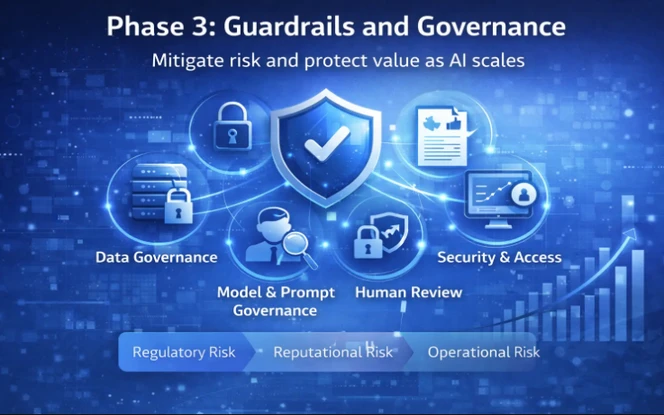
Phase 3: Guardrails and Governance
AI can create value fast. However, it can also create risk fast. When AI touches customer-facing content, regulated decisions, or sensitive data, mistakes become expensive. Therefore, build guardrails and governance into the roadmap from the start.
Why guardrails matter
Enterprises face three core risks as AI scales:
Regulatory risk: laws and sector rules may require traceability, controls, and audit evidence
Reputational risk: unsafe or biased outputs can damage trust quickly
Operational risk: drift and broken integrations degrade results over time
Retrofitting governance usually fails. It forces changes after systems are built, then triggers re-testing and re-approval under time pressure. A roadmap avoids this by defining controls and evidence early.
Core guardrail components
A practical approach covers the full lifecycle and assigns ownership:
Data governance: ownership, access, quality standards, lineage, allowed data use
Model and prompt governance: evaluation, release gates, documentation, version control
Human review: review, escalation, and override rules for higher-risk workflows
Security and access: least privilege, secrets management, vendor/model access control
Monitoring and incident handling: drift detection, alerting, rollback, escalation

Guardrails by lifecycle stage
| Lifecycle stage | Guardrail | What it prevents | Owner (typical) |
|---|---|---|---|
| Use-case intake | Risk tier + KPI owner | Ownerless or unsafe use cases | Product + Risk |
| Data sourcing | Access controls + lineage | Data leakage and unknown sources | Data + Security |
| Development | Evaluation standards | Weak, biased, or unstable outputs | AI/ML team |
| Pre-release | Approval gates + documentation | Unreviewed releases | Risk + IT |
| Deployment | Secure integration + logging | Untraceable decisions | IT + Security |
| Operations | Monitoring + drift detection | Silent performance degradation | MLOps/LLMOps |
| Incidents | Runbooks + rollback | Slow response and repeat failures | MLOps + Risk |
Guardrails differ by model type
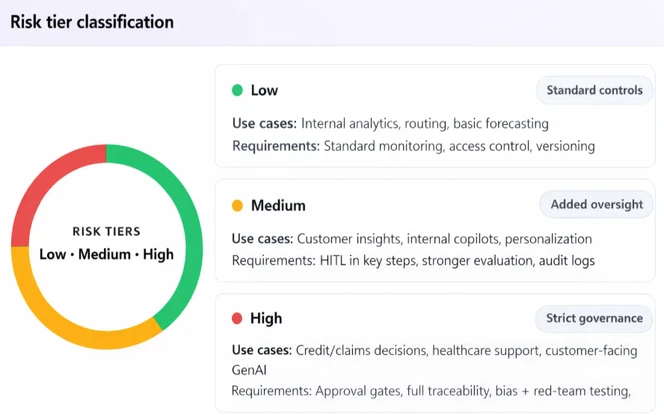
Guardrails should match risk and usage:
- Generative AI: prioritize output validation, content safety rules, and grounding with approved sources.
- Predictive models: focus on drift monitoring, bias testing, and explainability in regulated workflows.
- Automated decisions: require tighter review gates, audit logs, and clearly defined human override paths.
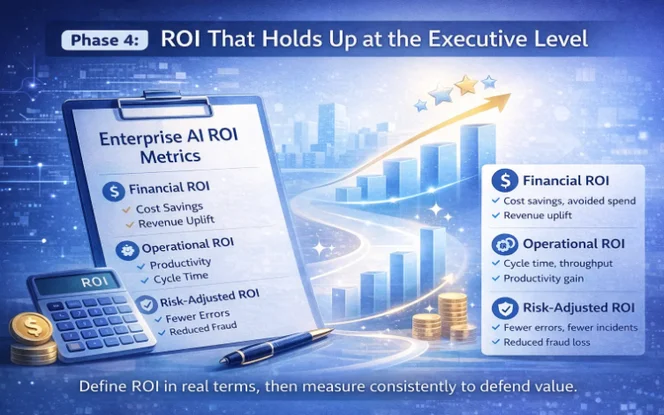
Phase 4: ROI That Holds Up at the Executive Level
Most AI programs lose support when leaders cannot see credible value. Demos help, but executives want a clear link to business outcomes. Therefore, define ROI early, measure it consistently, and defend it with evidence.
Why traditional ROI fails for AI
Attribution is hard: many changes ship together
Payback takes time: value depends on workflow adoption
Costs get missed: data, monitoring, governance, and change add run-rate spend
Value can be indirect: risk reduction needs clear measurement
Enterprise AI ROI metrics (3 layers)
Financial ROI: cost savings, avoided spend, margin improvement, revenue uplift
Operational ROI: cycle time, throughput, productivity, rework reduction
Risk-adjusted ROI: fewer errors, fewer incidents, reduced fraud loss, lower exposure
Make ROI defensible
Baselines: define “before” with consistent segments
Attribution: A/B tests or phased rollout comparisons
Time-to-value: time-to-first-value and time-to-full-value
Confidence ranges: best/base/worst-case expectations
Hidden and ongoing costs (run-rate)
Data work: integration, cleaning, labeling, contracts, lineage
Platform & tooling: MLOps/LLMOps, observability, eval tooling, storage
Monitoring & retraining: drift checks, re-evals, retraining, incident response
Governance & compliance: reviews, audits, docs, privacy/security checks
Change management: training, workflow redesign, adoption support
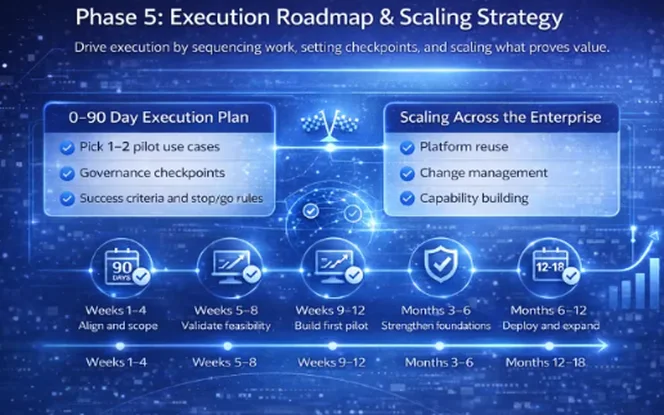
Phase 5: Execution Roadmap and Scaling Strategy
A roadmap only matters if it drives execution. Therefore, this phase focuses on sequencing work, setting checkpoints, and scaling what proves value. The goal is to ship quickly, measure against the KPI, and expand only when controls and adoption are working, which is easier to operationalize with AI consulting services that support delivery and governance from day one.
0–90 day execution plan
In the first 90 days, pick 1–2 pilot use cases with clear KPI impact and manageable risk. Assign a KPI owner, set governance checkpoints early (risk tier, approvals, logging, evaluation), and define success beyond accuracy (adoption, cycle time, error rate). Use simple stop/go rules so you either scale, iterate, or pause based on evidence.
Scaling across the enterprise
Scaling is not “more pilots.” Scaling means reusable patterns and consistent controls. Reuse the platform with shared data products, registries, monitoring, and evaluation templates, then support adoption with training, SOP updates, and tracking. Build capability by strengthening delivery, governance, and product ownership so teams can ship safely at speed.
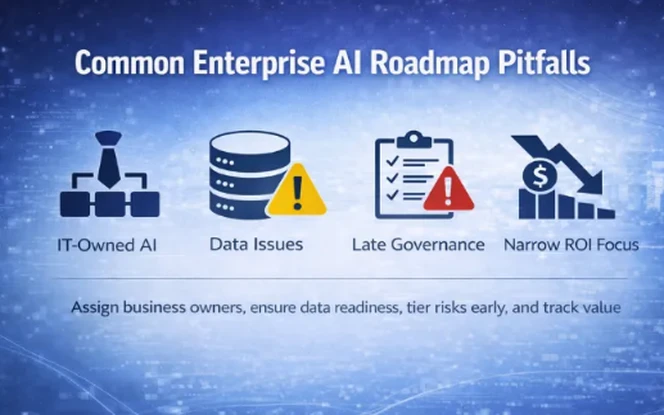
Common Enterprise AI Roadmap Pitfalls
Most AI programs fail for predictable reasons. Therefore, treat this as a pre-mortem and fix issues early. Watch for three fast signals: “great model, no users” (no KPI owner), reviews starting near go-live (late governance), and unstable results from assumed data readiness.
Keep mitigation simple and consistent: assign a business KPI owner and product lead, set risk tier and approval gates upfront, and lock inputs with a readiness scorecard and data contracts. Then protect trust with baselines, attribution, and time-to-value, and sustain impact with workflow redesign, adoption tracking, and monitoring/runbooks.
Know more: AI in finance
Conclusion: Building AI Programs That Last
Enterprise AI works best as a long-term capability rather than a one-time project. Models change, data evolves, and business priorities shift. The roadmap must therefore stay connected to measurable outcomes while keeping delivery under control.
A practical roadmap helps teams select the right use cases, build reliable foundations, and scale only what proves value. Governance should remain part of delivery because early controls speed approvals and reduce rework.
Begin with a readiness assessment and a focused prioritization workshop. Then align the next 12 to 18 months of execution with experienced AI development services.

FAQs
How long does it take to build an enterprise AI roadmap?
Most enterprises can define a roadmap in 4–8 weeks if stakeholders and data access are available. However, full execution typically takes 12–18 months because data foundations, governance, and workflow rollout take time.
How many AI use cases should an enterprise start with?
Start with 1–2 use cases that have clear KPIs, feasible data access, and manageable risk. Then expand to 3–5 production use cases once you have repeatable delivery and governance patterns.
What’s the difference between an AI roadmap and an AI strategy?
An AI strategy sets direction and investment priorities. In contrast, an AI roadmap defines sequencing, dependencies, ownership, and how outcomes and ROI will be measured.
How do guardrails differ across AI systems?
Guardrails should match risk. Customer-facing automation needs stronger review, logging, and safety controls, while internal analytics can move faster with standard monitoring and access control.
What KPIs best indicate enterprise AI success at scale?
Model accuracy alone is not enough. Strong KPIs include cycle time reduction, cost per transaction, adoption by intended users, error and escalation rates, and revenue uplift where relevant.
Who should own AI governance in an enterprise?
Ownership should be shared but clear. Business owners should own outcomes and KPIs. IT and security should own controls. Risk and compliance should own review gates. AI teams should own evaluation, deployment, and monitoring.
What’s the biggest reason enterprise AI programs fail to scale?
Most programs fail because pilots launch without production foundations. Common gaps include weak data readiness, unclear ownership, missing monitoring plans, and late governance, which creates delays and reduces trust.