










Retail
Retail and E-Commerce
Product photography variants, lifestyle scenes, seasonal recuts and localised campaign sets generated from one approved master per SKU.

Build systems that produce finished work - images, video, audio, 3D and long-form text - at the volume your business actually needs, not one prompt at a time.
Our generative AI development services cover model selection and fine-tuning, brand and style control, batch generation pipelines, human review, evaluation, rights and provenance, cost control and production deployment.
Proven Generative AI Delivery
Trusted by Fortune Global 500 leaders, governments & top universities across 30+ countries







Powered by leading cloud & AI platforms
Awards & industry recognition


End-to-end development of systems that generate production-ready assets and content under your brand, your rules and your review process.
Build
Build generation applications around your own catalogue, brand assets and approval workflow rather than wrapping a public tool in a form.
Adapt
Train LoRA adapters and fine-tunes on your products, styles and house voice so output is recognisably yours instead of generically on-trend.
Scale
Move from single prompts to queued, parallel jobs that produce thousands of assets per run with predictable throughput and cost per asset.
Control
Encode palettes, typography, product geometry, tone and prohibited treatments so generated work is on-brand before a human ever sees it.
Review
Route generated assets through scoring, shortlisting and named approvers, with a full record of what was accepted, rejected and regenerated.
Operate
Run generation in your environment with queue management, caching, spend limits and per-asset unit economics you can report on.
Planning the business case rather than the system? Start with our generative AI consulting services.
Generation is modality-specific. Each one has its own models, its own failure modes and its own review criteria, and we build for them separately.
Visual
Product photography, marketing creative, interior and architectural visuals, editorial imagery and variant sets built from a single approved concept.
Motion
Short-form social cuts, product motion, b-roll, storyboards and animatics, with shot consistency handled rather than left to chance between frames.
Audio
Narration, multilingual voiceover, character voice and sound beds, with consent and licensing handled for every voice the system can produce.
Spatial
Product meshes, textures, materials and staged scenes for catalogue, configurator, real-estate and game pipelines.
Written
Catalogue copy, localisation, campaign variants and document drafting at scale. Conversational and retrieval-grounded text belongs on our LLM development services page.
Technical
Synthetic datasets for training and testing, structured configuration and scaffolding generated against your own schemas and conventions.
Recognising and classifying existing images is a different discipline - see computer vision development services.
A production generation system is a pipeline, not a model call. Each stage exists because something goes wrong without it.
Stage 01
Generation starts from a campaign brief, a catalogue record, a CMS event or a scheduled batch - not from someone typing into a box.
Stage 02
Build the prompt programmatically from structured inputs so the same brief produces the same intent every time, and so prompts can be versioned and rolled back.
Stage 03
Apply style adapters, reference images, colour and layout constraints and negative prompts before generation, rather than correcting for them afterwards.
Stage 04
Route the job to the model best suited to the modality, quality bar and budget, with seeds recorded so any asset can be reproduced exactly.
Stage 05
Upscale, crop to required aspect ratios, colour-correct, composite logos and export the format each destination channel expects.
Stage 06
Score every candidate for brand adherence, prompt fidelity, safety and technical quality, so reviewers see a shortlist instead of a contact sheet.
Stage 07
Named approvers accept, reject or request regeneration, and the decision is stored with the asset as part of its record.
Stage 08
Deliver to DAM, CMS, PIM or ad platform with provenance metadata, licence terms and the full generation lineage attached.
Seeds, prompts, model versions and adapter versions are stored with every asset, so any output can be reproduced or explained months later.
No single model wins across modality, quality, licence terms and cost. We route per job and keep the routing layer replaceable as the field moves.
Fastest route to quality for marketing and concept work. Managed scaling, frequent capability jumps, per-call pricing and terms of service you have to read carefully where commercial use, training rights and likeness are concerned.
Run inside your own environment when volume is high, data cannot leave, or the style needs adapter training. More engineering to operate, but predictable unit cost and full control over weights, adapters and retention.
Modality
Image, video, audio, 3D and text each have different leaders.
Quality
A hero image and a thumbnail variant do not need the same model.
Rights
Commercial use, training rights and indemnity differ by provider.
Data
Where the prompt and the asset may be processed and stored.
Cost
Cost per accepted asset, not cost per generation call.
Routing sits behind an internal interface, so a better model becomes a configuration change rather than a rebuild of the pipeline.
The difference between a demo and a production system is whether the thousandth asset still looks like it came from you.
Adapters
Train lightweight adapters on your products, packaging, spaces or illustration style so the model reproduces them without a paragraph of prompt every time.
References
Condition on approved reference assets to hold product geometry, colourways and character identity steady across a whole campaign.
Structure
Constrain pose, framing, depth and safe areas so output drops into existing templates and ad formats without manual re-cropping.
Rules
Palettes, typography, tone and explicitly prohibited treatments become checks the pipeline enforces, not a PDF reviewers are expected to remember.
Variants
Generate sized, localised and channel-specific variants from one approved master, with the relationship between them recorded.
Drift
Run a fixed benchmark set after every model, adapter or prompt change to catch style drift before it reaches a campaign.
Brand control is the part most generative AI pilots skip, and the reason most of them never reach production.
Producing one good asset is a prompt. Producing fifty thousand on a deadline is an engineering problem.
Queue
Queue, prioritise and parallelise generation jobs so a catalogue refresh and an urgent campaign are not competing for the same capacity.
Reuse
Detect briefs that have already been generated and reuse the approved asset instead of paying to produce it twice.
Recover
A failed shot in a batch of four thousand should regenerate itself, not fail the run and lose the other three thousand nine hundred.
Capacity
Balance hosted API rate limits against self-hosted GPU capacity so throughput is planned rather than discovered during a launch.
Spend
Per-project budgets, spend alerts and a reported cost per accepted asset rather than a monthly bill nobody can attribute.
Deliver
Push finished assets into DAM, CMS, PIM, ad platforms and storefronts in the formats and metadata schemas each one expects.
Throughput targets are set against accepted assets, because generated-and-rejected costs money without producing anything.
Generated work reaches customers. Someone accountable signs it off, and the system should make that fast rather than ceremonial.
Shortlist
Reviewers open a ranked shortlist, not a folder of four hundred near-identical candidates to sift through by eye.
Compare
Compare candidates against the approved reference and against previously shipped assets, so consistency is judged rather than guessed.
Route
Route by asset class - brand, legal, product or regional - so the right reviewer sees the work that actually needs their sign-off.
Fix
Send back a specific correction rather than rerunning the whole brief, and keep the accepted parts of the set intact.
Record
Store who approved what, when, against which version of the prompt, model and adapter - for brand governance and for disputes.
Learn
Feed accept and reject decisions back into scoring and prompt defaults so the shortlist improves instead of staying static.
Review throughput is usually the real bottleneck in a generative programme, not model speed.
Generated assets carry legal and reputational exposure that classification systems do not. This is where generative programmes get stopped.
Origin
Attach C2PA-style content credentials and internal lineage so every asset can be traced to its prompt, model, adapter, seed and approver.
Marking
Apply visible or invisible marking where policy or regulation requires that AI-generated material be identifiable.
Licence
Select models and reference material on licence terms that survive legal review, and record which terms applied to which asset.
Likeness
Gate generation of real people's faces and voices behind recorded consent, with scope and expiry enforced by the system.
Safety
Block prohibited categories, protected marks and competitor material before generation, and screen output again before publication.
Regions
Apply different disclosure, data-residency and advertising rules per market instead of shipping one policy everywhere.
Provenance is cheap to build in at the start and expensive to retrofit once several million assets already exist.
Generative quality is subjective, which is exactly why it needs a measurement framework rather than an opinion in a review meeting.
Does the asset contain what the brief specified - the product, the setting, the count, the text, the aspect ratio.
Does the product, colourway, logo treatment and house style match the approved references, measured rather than eyeballed.
Resolution, artefacts, malformed detail, text rendering, colour profile and export correctness for the destination channel.
Structured reviewer ratings on a fixed benchmark set, tracked across model and prompt versions so regressions are visible.
Automated screening against prohibited content, trademarks, likeness rules and regional advertising restrictions.
The share of generated candidates a human accepts - the single number that best predicts whether the system pays for itself.
Elapsed time from brief to signed-off asset, including review, which is what the business actually feels.
Generation, storage, review time and rework, divided by assets that shipped.
Acceptance rate and cost per accepted asset are the two figures we hold ourselves to on every generative engagement.
The pipeline is the same shape everywhere. The brand rules, the review obligations and the asset economics are not.
Retail
Product photography variants, lifestyle scenes, seasonal recuts and localised campaign sets generated from one approved master per SKU.
Property
Virtual staging, renovation visualisation and listing imagery generated from empty-room photography at listing volume.
Media
Concept art, storyboards, animatics, promotional cutdowns and localisation for production pipelines under delivery deadlines.
Marketing
Creative variant generation for testing, channel resizing and market localisation without a proportional increase in studio hours.
Gaming
Asset, texture, environment and character variation for content pipelines, with art-direction constraints enforced by the system.
Training
Course imagery, narrated modules, multilingual voiceover and scenario content produced and refreshed without re-shooting.
Industry pages and product builds sit under our broader AI development services.
Chosen for the modality, the licence terms and the operating model - not for whichever tool trended most recently.
Generation systems we have built and run, with the figures each one is actually best evidence for.
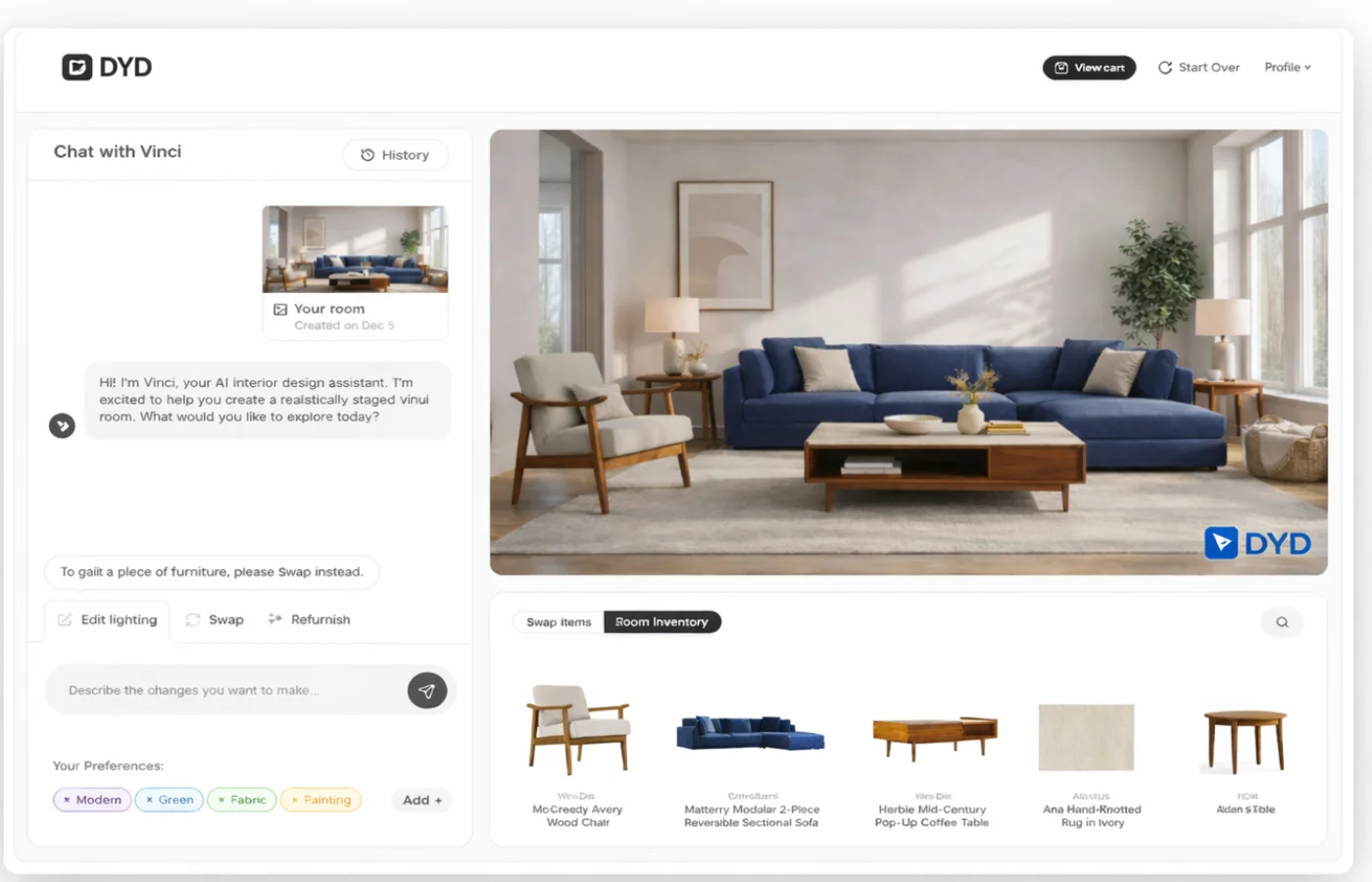
DYD turns photos of empty rooms into furnished, photo-real interiors, so a listing is staged in minutes instead of days. Style presets, perspective-consistent furniture placement and a review step keep every image ready for a public listing.

SDLC Corp unified Transworld Logistics' fleet, warehouse, accounting and order operations on one Odoo ERP, then added AI that extracts and validates shipment-document data before it reaches the workflow. Document turnaround dropped from about two days to a few hours.

SDLC Corp built an AI system that reads Transworld's freight invoices, matches them to the right shipment and vendor, validates every charge against operational data, and pushes approved shipment cost lines into Oracle OTM, with a human reviewer on every exception and a knowledge hub that learns from each approved decision.

Conversational and retrieval products are covered on our LLM development services and RAG development services pages.
Founders, CEOs, and operating leaders share what it's like to build with SDLC Corp.
Eric Leist
CEO, Edgerton Strategies

Doug Schmidt
CEO, Roofaid USA

Reyzal Razmi
All Star Influencers



They approached our Salesforce discovery with real technical depth, uncovered structural gaps others missed, and delivered a solution that worked exactly as promised.
SDLC CORP built a mobile application that met our strategic requirements with strong technical execution. The solution performs reliably and has become an important operational asset.
They saw inefficiencies in our Salesforce workflow and redesigned our entire quote-to-cash system. We now operate faster, cleaner, and with better accuracy.
From planning to post-launch, SDLC Corp guided us every step of the way. Their support makes them more than a vendor. They're a trusted partner.
The SDLC Corp team scaled our platform with impressive technical expertise, ensuring it's secure, robust, and ready for future growth.


The SDLC Corp team scaled our platform with impressive technical expertise, ensuring it's secure, robust, and ready for future growth.
From planning to post-launch, SDLC Corp guided us every step of the way. Their support makes them more than a vendor. They're a trusted partner.
They saw inefficiencies in our Salesforce workflow and redesigned our entire quote-to-cash system. We now operate faster, cleaner, and with better accuracy.
SDLC CORP built a mobile application that met our strategic requirements with strong technical execution. The solution performs reliably and has become an important operational asset.
They approached our Salesforce discovery with real technical depth, uncovered structural gaps others missed, and delivered a solution that worked exactly as promised.
10+ Years of
Experience.
Enterprise engineering experience behind generative systems that have to run every day, not demo well once.
Five stages, each ending in something you can judge rather than a status update.
Establish exactly what has to be produced, at what quality bar, for which channel, at what volume and against which brand rules - before any model is chosen.
Build a benchmark brief set and test candidate models, adapters and prompts against it until acceptance rate is high enough to justify the pipeline.
Implement prompt assembly, conditioning, generation, post-processing, scoring, review routing and delivery as one instrumented system.
Add provenance, licence records, consent gates, safety screening, spend limits and the audit trail the business will be asked for later.
Run at production volume, monitor acceptance rate and cost per accepted asset, and retrain adapters as the brand and catalogue move.
Most generative programmes we are called into already work in a demo. These are the reasons they stalled on the way to production.
We audit an existing pipeline end to end and prioritise the changes by what they do to acceptance rate, unit cost and governance exposure.
If the issue is strategy rather than engineering, our generative AI consulting services cover that first.
Generation is the easy part. We are engaged for everything that has to be true around it before the output can ship.
End to End
Pipelines, review, delivery and governance built as one system rather than a model call bolted onto a form.
Volume
Image and video pipelines behind millions of generated marketing and product assets.
Brand
Adapters, references and encoded guidelines, so the thousandth asset still looks like yours.
Governed
Licence terms, consent, disclosure and lineage recorded from the first asset, not retrofitted after legal review.
Certified
Delivery across three legal entities under certified information security and quality management systems.
Generation is one capability in a wider AI programme. These are the pages that cover the rest of it.
Consulting
Strategy, use-case selection, feasibility and roadmap before the build begins.
LLM
Build and integrate language models for reasoning, extraction and text work.
RAG
Ground model output in your own documents and data with citations.
Agents
Agents that plan, use tools and complete multi-step work across systems.
Vision
Recognise, classify and inspect existing images and video rather than create them.
Background reading on where generative AI is actually being put to work.
ExplainerHow generative models differ from predictive AI, and where the business value actually lands.
Read the explainer

IndustryConcept art, promotion and localisation workloads across entertainment production.
Read the article
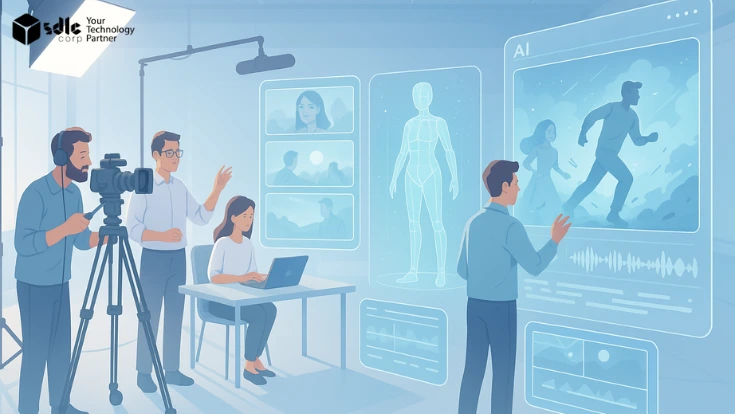
IndustryWhere generation fits into pre-visualisation, production and post pipelines.
Read the articleMove from generating impressive one-offs to producing approved, on-brand work at the volume your business runs at.
Tell us what has to be produced, at what quality bar and at what volume, and we will come back with an acceptance-rate target, a pipeline design and a cost per accepted asset.
Straight answers on scope, models, rights, cost and what separates this page from our other AI services.
Generative AI development services cover the design, development, integration and operation of systems that produce new content - images, video, audio, 3D assets and long-form text - rather than classify or predict from existing data.
A production engagement includes model selection and fine-tuning, brand and style control, batch generation pipelines, automated scoring, human review, rights and provenance, delivery into your existing systems, and ongoing cost and quality monitoring.
Generative AI consulting services answer whether and where to apply generation: use-case selection, feasibility, business case, roadmap and readiness.
This page covers building the system itself. Many clients take the consulting engagement first and the build second, but either can stand alone.
LLM development services and RAG development services are about understanding and reasoning over text - answering questions, extracting structure, grounding responses in your own documents.
Generative AI development, as covered here, is about producing finished assets at volume. The two overlap on text generation, and we route projects to whichever page matches the actual intent rather than duplicating the work.
Yes, and this is usually the core of the engagement. Consistency comes from training style and subject adapters on your own products and assets, conditioning on approved references, constraining layout and composition, and encoding brand rules as checks the pipeline enforces.
We also run a fixed benchmark set after every model, adapter or prompt change, so style drift is caught before it reaches a campaign rather than after.
We route per job rather than standardising on one provider. Hosted models tend to win on ceiling quality and time to value; open-weight models win when volume is high, data cannot leave your environment, or the style needs adapter training.
Routing sits behind an internal interface, so replacing a model as the field moves is a configuration change rather than a rebuild.
Yes. Open-weight image, video, audio and text models can run in your cloud account or data centre, which keeps prompts and generated assets inside your boundary and makes unit cost predictable at high volume.
The trade-off is that you own the GPU operations. We size that honestly against hosted pricing before recommending it.
Ownership and permitted use depend on the model and the licence under which it was used, and the terms differ significantly between providers - particularly on commercial use, training rights and indemnity.
We select models on terms that survive your legal review and record which terms applied to which asset, so the position is documented rather than assumed. This is information to take to your own counsel, not legal advice.
Generation of real people's faces and voices is gated behind recorded consent, with the scope and expiry of that consent enforced by the system rather than tracked in a spreadsheet.
Prohibited categories, protected marks and competitor material are blocked before generation and screened again before publication.
Yes. We attach content credentials and internal lineage to every asset, recording the prompt, model version, adapter version, seed, post-processing and approver.
That makes any asset reproducible and explainable months later, and satisfies disclosure requirements where regulation or platform policy demands them.
Against brief adherence, brand and subject consistency, technical quality, human preference scores on a fixed benchmark set, and policy compliance.
The two figures that matter commercially are acceptance rate - the share of generated candidates a human approves - and cost per accepted asset. Cost per generation call is misleading, because rejected work still costs money.
Throughput is set by queue capacity, model latency and, almost always, by human review rather than by generation itself.
We design review as part of the pipeline - scored shortlists, side-by-side comparison, role-based routing and targeted regeneration - because that is where the real ceiling sits.
Yes. We audit an existing pipeline end to end - prompts, conditioning, model choice, scoring, review flow, delivery and governance - and prioritise changes by their effect on acceptance rate, unit cost and governance exposure.
Remediation is often faster than a rebuild, because the difficult part is usually control and review rather than generation quality.
Both. Video work covers short-form cuts, product motion, b-roll, storyboards and animatics, with shot consistency handled explicitly rather than left to vary between frames.
Audio covers narration, multilingual voiceover, character voice and sound beds, with consent and licensing handled for every voice the system can produce.
Finished assets are pushed into DAM, CMS, PIM, ad platforms and storefronts in the formats and metadata schemas each destination expects, with provenance and licence terms travelling alongside.
Where delivery spans several business systems, we often combine this with workflow automation services.
Yes - by catalogue changes, CMS events, campaign schedules or an upstream system. Generation starting from a structured trigger is more reliable than generation starting from someone typing a prompt.
Where the trigger involves multi-step decision making, that belongs with agentic AI development.
No. Conversational products are covered by our AI chatbot development and LLM development services pages.
This page is specifically about producing assets and content at volume.
A benchmarked proof of quality typically takes weeks: build a representative brief set, test models and adapters against it, and establish whether acceptance rate justifies a pipeline.
A governed production pipeline with review, provenance and delivery is a longer engagement, and we stage it so the first workload is in production before the second is built.
Running cost is generation compute, storage, review time and rework. We report it as cost per accepted asset so it can be compared directly with the studio, agency or production cost it is replacing.
Budgets, spend alerts and caching are built into the pipeline, so spend is controlled by design rather than discovered on an invoice.
Ready to Innovate?

United States:
2457 Kane Lane, Batavia, Illinois
60510

United Kingdom:
30 Charter Avenue, Coventry
CV4 8GE Post code: CV4 8GF United Kingdom

United Arab Emirates:
Unit No: 729, DMCC Business Centre Level No 1, Jewellery & Gemplex 3 Dubai, United Arab Emirates

India:
715, Astralis, Supernova, Sector 94 Noida, Delhi NCR India. 201301

Qatar:
B-ring road zone 25, Bin Dirham Plaza building 113, Street 220, 5th floor office 510 Doha, Qatar

© 2026 SDLC Corp. All Rights Reserved.